
Microorganisms are the unseen pillars of mangrove biodiversity and ecosystem services
-
ABSTRACT
Mangrove ecosystems are widely acknowledged in international policy and scientific literature for their crucial ecosystem services, including carbon sequestration, greenhouse gas regulation, food provisioning, and cultural value. Effective mangrove conservation and restoration should account for the biodiversity that underpins ecosystem functioning and services. However, one fundamental layer of this biodiversity remains underrepresented in restoration assessments and monitoring: the microbial world. Microorganisms represent the most abundant and taxonomically diverse components of mangrove sediments and rhizospheres, serving as key mediators of biogeochemical processes and, under certain conditions (e.g., pathogen outbreaks), as potential disruptors of ecosystem services. We propose a roadmap that includes: (i) establishing baseline reference datasets across biogeographic regions, vegetation zones, and tidal elevations to enable distinction between natural variability and anthropogenic degradation, (ii) shifting research focus from descriptive diversity surveys toward establishing causal mechanisms and developing standardized microbial functional indicators that can be scaled from plot-level measurements to landscape-level ecosystem service outcomes, and (iii) integrating microbial monitoring into national and international policy frameworks, supported by capacity-building initiatives, sustained funding mechanisms, and biosecurity protocols for any microbiome-based interventions. -

-
REFERENCES
[1] Jin M., Guo X., Zhang R., et al. (2019). Diversities and potential biogeochemical impacts of mangrove soil viruses. Microbiome 7:58. DOI:10.1186/s40168-019-0675-9 [2] Qi Y. L., Zou D. Y., Hou J. J., et al. (2025). Temporal and spatial dynamics of microbial community composition and functional potential in mangrove wetlands over a seven-year period. Environ. Sci. Technol. 59:21540−21554. DOI:10.1021/acs.est.5c01564 [3] Junker R. R. and Farwig N. (2025). Microbial conservation is essential for sustaining ecosystem functions and services. Proc. Natl. Acad. Sci. USA 122:e2503013122. DOI:10.1073/pnas.2503013122 [4] Tabugo S. R. (2025). Mangrove microbiomes as hidden ecological gatekeepers. Trends Microbiol. 33:1254−1256. DOI:10.1016/j.tim.2025.10.009 [5] Qin G., Lu Z., Sanders C., et al. (2025). Mangrove sediment carbon burial offset by methane emissions from mangrove tree stems. Nat. Geosci. 18:1224−1231. DOI:10.1038/s41561-025-01848-4 [6] Lin Q. L., Su H. R. and He H. (2015). First report of Alternaria alternata causing leaf spot on Bruguiera gymnorrhiza in China. Plant dis. 99:286. DOI:10.1094/pdis-07-14-0755-pdn [7] Luo L., Wang H., Chen Z., et al. (2024). Biodiversity co-benefits of World Heritage protection. Innov. Life 2:100051. DOI:10.59717/j.xinn-life.2024.100051 [8] Gilbert J. A., Peixoto R. S., Scholz A. H., et al. (2025). Launching the IUCN Microbial Conservation Specialist Group as a global safeguard for microbial biodiversity. Nat. Microbiol. 10:2359−2360. DOI:10.1038/s41564-025-02113-5 [9] International Mangrove Center: Bridging Nations for Mangroves and Beyond. https://www.imc.int [10] Allard S. M., Costa M. T., Bulseco A. N., et al. (2020). Introducing the Mangrove Microbiome Initiative: Identifying microbial research priorities and approaches to better understand, protect, and rehabilitate mangrove ecosystems. mSystems 5. DOI:10.1128/mSystems.00658-20 -
ABOUT THIS ARTICLE
Cite this article:
Zhang C.-J., Zhang R. and Li M. (2027). Microorganisms are the unseen pillars of mangrove biodiversity and ecosystem services. The Innovation Life 5:100265. https://doi.org/10.59717/j.xinn-life.2026.100265
Welcome!
To request copyright permission to republish or share portions of our works, please visit Copyright Clearance Center's (CCC) Marketplace website at marketplace.copyright.com.
Export File
Citation
Zhang C.-J., Zhang R. and Li M. (2027). Microorganisms are the unseen pillars of mangrove biodiversity and ecosystem services. The Innovation Life 5:100265. https://doi.org/10.59717/j.xinn-life.2026.100265

Format
Content
 DownLoad:
-
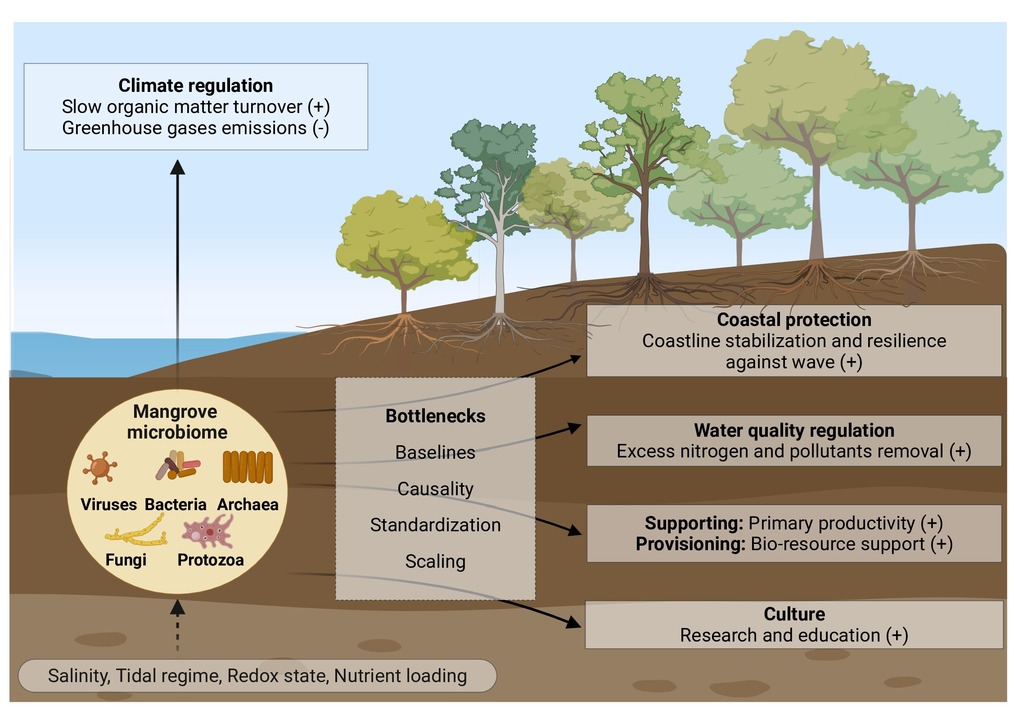
Figure 1.
Integrative framework linking microbial diversity to ecosystem services in mangroves
