
Neurexins, latrophilins, and teneurins: Trans-synaptic signalling modules for synapse specification and organisation
-
ABSTRACT
Synapse specification and organisation rely on coordinated trans-synaptic interactions that couple molecular recognition to the assembly of pre- and postsynaptic compartments. While neurexins and cerebellin-mediated pathways have long been recognised as core determinants of synaptic identity, recent studies have identified latrophilins (LPHNs) as important organisers of defined excitatory pathways. In particular, the formation of teneurin-latrophilin-FLRT complexes has emerged as a key mechanism contributing to synaptic specificity in selected hippocampal and cortical circuits. Accumulating evidence further indicates that alternative splicing of LPHN3 configures intracellular signalling logic rather than merely modulating extracellular adhesion, thereby biasing the maturation of trans-synaptic contacts toward functional synapses. Here, we review recent advances that redefine latrophilin-dependent complexes as dynamic, signal-transducing synaptic modules linking molecular recognition to nanoscale synaptic organisation.-
Keywords:
- synapse specification /
- neurexins /
- latrophilins /
- teneurins /
- FLRTs /
- alternative splicing /
- trans-synaptic signalling
-

-
REFERENCES
[1] Lin P.Y., Chen L.Y., Jiang M., et al. (2023). Neurexin-2: An inhibitory neurexin that restricts excitatory synapse formation in the hippocampus. Sci. Adv. 9:eadd8856. DOI:10.1126/sciadv.add8856 [2] Anderson G.R., Maxeiner S., Sando R., et al. (2017). Postsynaptic adhesion GPCR latrophilin-2 mediates target recognition in entorhinal-hippocampal synapse assembly. J. Cell Biol. 216:3831−3846. DOI:10.1083/jcb.201703042 [3] Wang C.Y., Trotter J.H., Liakath-Ali K., et al. (2021). Molecular self-avoidance in synaptic neurexin complexes. Sci. Adv. 7:eabk1924. DOI:10.1126/sciadv.abk1924 [4] Gogou C., Beugelink J.W., Frias C.P., et al. (2024). Alternative splicing controls teneurin-3 compact dimer formation for neuronal recognition. Nat. Commun. 15:3648. DOI:10.1038/s41467-024-47763-x [5] Wang S., DeLeon C., Sun W., et al. (2024). Alternative splicing of latrophilin-3 controls synapse formation. Nature 626:128−135. DOI:10.1038/s41586-023-06913-9 [6] Südhof T.C. (2025). Signaling by latrophilin adhesion-GPCRs in synapse assembly. Neuroscience 575:150−161. DOI:10.1016/j.neuroscience.2025.03.041 [7] Traunmüller L., Gomez A.M., Nguyen T.M., et al. (2016). Control of neuronal synapse specification by a highly dedicated alternative splicing program. Science 352:982−986. DOI:10.1126/science.aaf2397 [8] Zhang X., Chen X., Matúš D., et al. (2025). Reconstitution of synaptic junctions orchestrated by teneurin-latrophilin complexes. Science 387:322−329. DOI:10.1126/science.adq3586 [9] Sando R., Jiang X., and Südhof T.C. (2019). Latrophilin GPCRs direct synapse specificity by coincident binding of FLRTs and teneurins. Science 363:eaav7969. DOI:10.1126/science.aav7969 [10] Földy C., Darmanis S., Aoto J., et al. (2016). Single-cell RNAseq reveals cell adhesion molecule profiles in electrophysiologically defined neurons. Proc. Natl. Acad. Sci. USA 113:E5222−5231. DOI:10.1073/pnas.1610155113 -
ABOUT THIS ARTICLE
Cite this article:
Gao E. Y. and Lv X. (2027). Neurexins, latrophilins, and teneurins: Trans-synaptic signalling modules for synapse specification and organisation. The Innovation Life 5:100274. https://doi.org/10.59717/j.xinn-life.2026.100274
Welcome!
To request copyright permission to republish or share portions of our works, please visit Copyright Clearance Center's (CCC) Marketplace website at marketplace.copyright.com.
Export File
Citation
Gao E. Y. and Lv X. (2027). Neurexins, latrophilins, and teneurins: Trans-synaptic signalling modules for synapse specification and organisation. The Innovation Life 5:100274. https://doi.org/10.59717/j.xinn-life.2026.100274

Format
Content
 DownLoad:
-
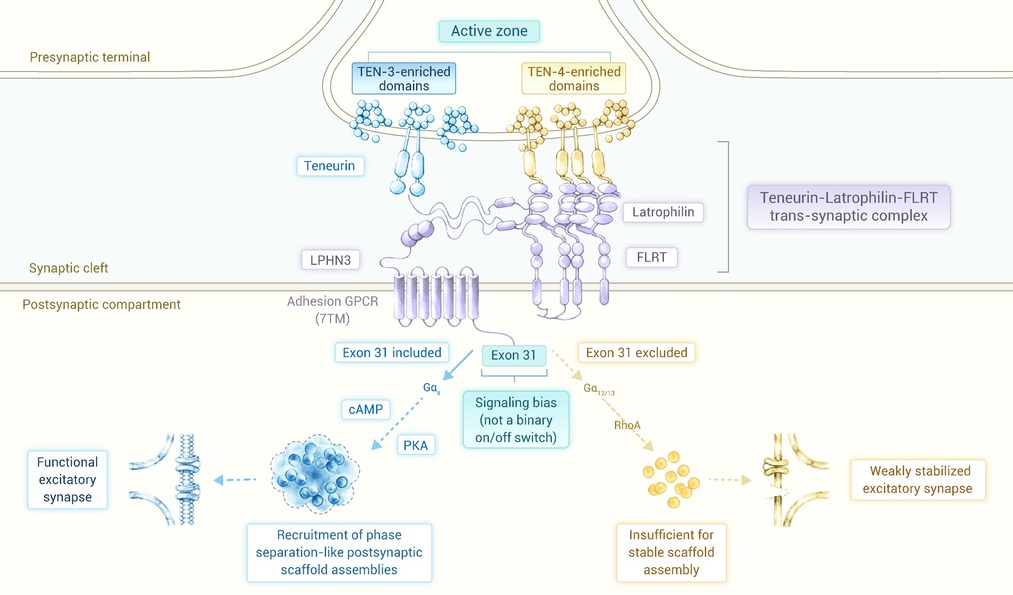
Figure 1.
Alternative splicing of latrophilin-3 biases trans-synaptic signalling logic to control excitatory synapse specification
