
-
GRAPHICAL ABSTRACT
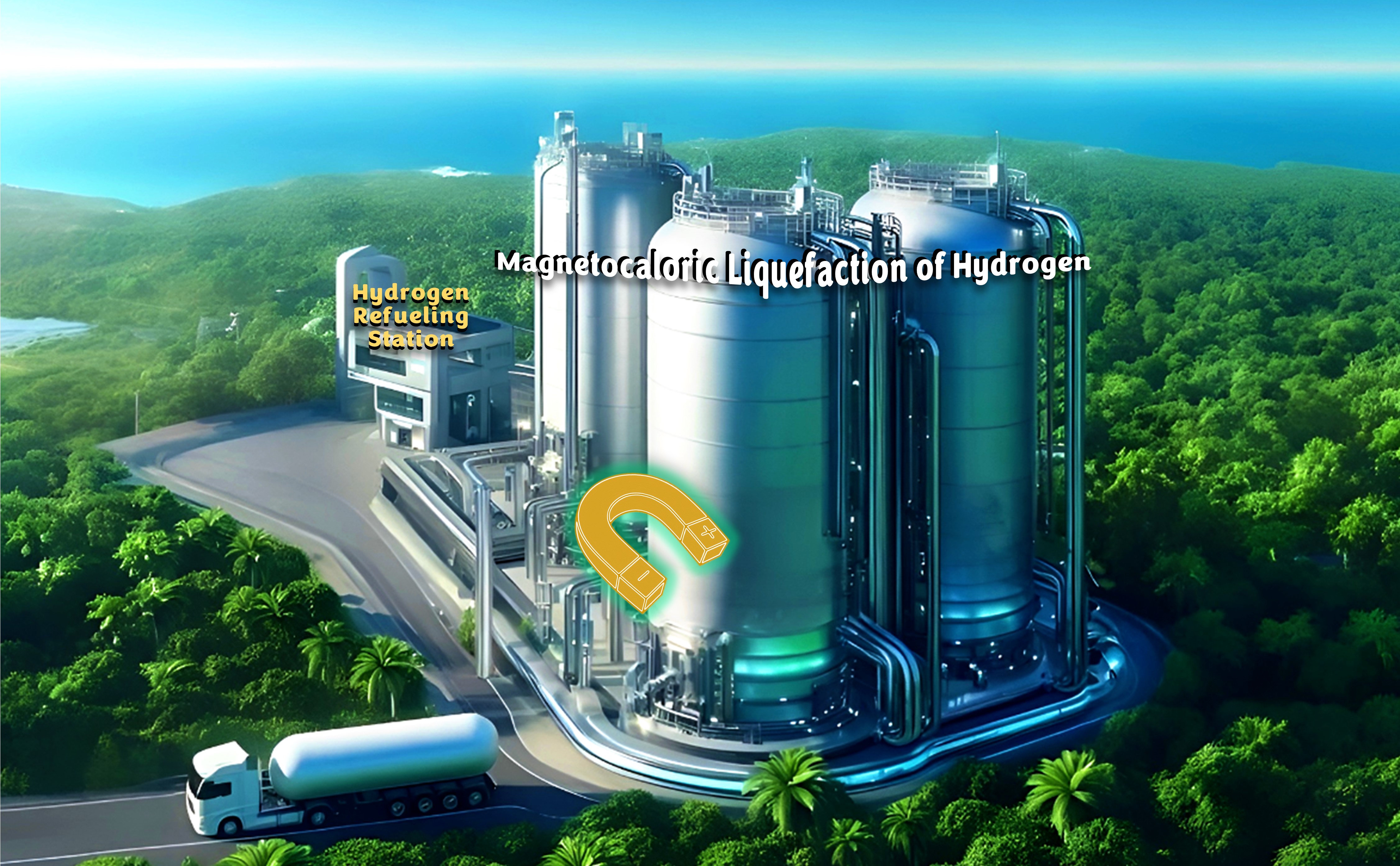
 DownLoad:
Full size image
DownLoad:
Full size image
-
PUBLIC SUMMARY
-
Magnetic refrigeration is a key enabling technology for hydrogen as an energy vector.
Adequate material selection is crucial for this application.
A critical review of over 400 magnetocaloric compounds is provided.
-
-
ABSTRACT
The expected energy transition to hydrogen gas as a greener energy vector has revived the interest in magnetic refrigeration at the cryogenic range, specifically between 20 and 80 K, with the vision to develop a new generation of hydrogen gas liquefiers. From the materials science point of view, the search for magnetocaloric materials containing mainly non-critical elements with a significant response in that temperature range, together with good cyclability and stability, is a challenging task. Given the increasing interest of the research community on this topic, we aim to establish a comprehensive catalog of the magnetocaloric compounds characterized so far, to be used as a starting point for further research. For this purpose, a systematic outlook of the state of the art is presented here, with the analysis and classification of more than 400 cryogenic magnetocaloric materials, divided into five large families according to their physicochemical properties. Moreover, we provide detailed information about their magnetocaloric properties, magnetic behavior, and transition characteristics together with criticality, which will facilitate the future search for optimal compounds. -

-
REFERENCES
[1] Al Ghafri, S.Z., Munro, S., Cardella, U., et al. (2022). Hydrogen liquefaction: a review of the fundamental physics, engineering practice and future opportunities. Energy Environ. Sci. 15: 2690−2731. DOI: 10.1039/D2EE00099G. [2] Aziz, M. (2021). Liquid hydrogen: A review on liquefaction, storage, transportation, and safety. Energies 14: 5917. DOI: 10.3390/en14185917. [3] Sari, O., and Balli, M. (2014). From conventional to magnetic refrigerator technology. Int. J. Refrig. 37: 8−15. DOI: 10.1016/j.ijrefrig.2013.09.027. [4] Franco, V., Blázquez, J., Ipus, J., et al. (2018). Magnetocaloric effect: From materials research to refrigeration devices. Prog. Mater. Sci. 93: 112−232. DOI: 10.1016/j.pmatsci.2017.10.005. [5] Tušek, J., and Kitanovski, A. (2015). Magnetocaloric energy conversion: From theory to applications. Heidelberg ua: Springer. [6] Weiss, P., and Piccard, A. (1917). Le phénomène magnétocalorique. J. Phys. Theor. Appl. 7: 103−109. DOI: 10.1051/jphystap:019170070010300. [7] Weiss, P. (1921). Le phénomène magnéto-calorique. J. Phys. Radium 2: 161−182. DOI: 10.1051/jphysrad:0192100206016100. [8] Giauque, W., and MacDougall, D. (1933). Attainment of temperatures below 1° absolute by demagnetization of Gd2(SO4)3·8H2O. Phys. Rev. 43: 768. DOI: 10.1103/PhysRev.43.768. [9] Brown, G. (1976). Magnetic heat pumping near room temperature. J. Appl. Phys. 47: 3673−3680. DOI: 10.1063/1.323176. [10] Pecharsky, V.K., and Gschneidner Jr, K.A. (1997). Giant magnetocaloric effect in Gd5(Si2Ge2). Phys. Rev. Lett. 78: 4494. DOI: 10.1103/PhysRevLett.78.4494. [11] Wada, H., and Tanabe, Y. (2001). Giant magnetocaloric effect of MnAs1−xSbx. Appl. Phys. Lett. 79: 3302−3304. DOI: 10.1063/1.1419048. [12] Tegus, O., Brück, E., Buschow, K., and De Boer, F. (2002). Transition-metal-based magnetic refrigerants for room-temperature applications. Nature 415: 150−152. DOI: 10.1038/415150a. [13] Liu, J., Gottschall, T., Skokov, K.P., et al. (2012). Giant magnetocaloric effect driven by structural transitions. Nat. Mater. 11: 620−626. DOI: 10.1038/nmat3334. [14] Fujieda, S., Fujita, A., and Fukamichi, K. (2002). Large magnetocaloric effect in La(FexSi1−x)13 itinerant-electron metamagnetic compounds. Appl. Phys. Lett. 81: 1276−1278. DOI: 10.1063/1.1498148. [15] Hu, F.-x., Shen, B.-g., Sun, J.-r., et al. (2001). Influence of negative lattice expansion and metamagnetic transition on magnetic entropy change in the compound LaFe11.4Si1.6. Appl. Phys. Lett. 78: 3675−3677. DOI: 10.1063/1.1375836. [16] Balli, M., Jandl, S., Fournier, P., and Kedous-Lebouc, A. (2017). Advanced materials for magnetic cooling: Fundamentals and practical aspects. Appl. Phys. Lett. 4: 021305. DOI: 10.1063/1.4983612. [17] Kitanovski, A. (2020). Energy applications of magnetocaloric materials. Adv. Energy Mater. 10: 1903741. DOI: 10.1002/aenm.201903741. [18] Smith, A., Bahl, C.R., Bjørk, R., et al. (2012). Materials challenges for high performance magnetocaloric refrigeration devices. Adv. Energy Mater. 2: 1288−1318. DOI: 10.1002/aenm.201200167. [19] Gschneidner, K.A., Pecharsky, V., and Tsokol, A. (2005). Recent developments in magnetocaloric materials. Rep. Prog. Phys. 68: 1479. DOI: 10.1088/0034-4885/68/6/R04. [20] Evangelisti, M., Luis, F., De Jongh, L., and Affronte, M. (2006). Magnetothermal properties of molecule-based materials. J. Mater. Chem. 16: 2534−2549. DOI: 10.1039/b603738k. [21] Al Ghafri, S.Z.S., Munro, S., Cardella, U., et al. (2022). Hydrogen liquefaction: a review of the fundamental physics, engineering practice and future opportunities. Energy Environ. Sci. 15 : 2690–2731. DOI: 10.1039/D2EE00099G. [22] Zimm, C., Jastrab, A., Sternberg, A., et al. (1998). Description and performance of a near-room temperature magnetic refrigerator. Adv. Cryog. Eng. 1759-1766. [23] Janda, D., DeGregoria, T., Johnson, J., et al. (1991). Design of an active magnetic regenerative hydrogen liquefier. Adv. Cryog. Eng. 891-898. [24] Thirumaleshwar, M., and Subramanyam, S. (1986). Cryogenic refrigeration methods for low and ultra-low temperatures—a review. Sadhana 9: 191−232. DOI: 10.1007/BF02811965. [25] Iwasaki, W. (2003). Magnetic refrigeration technology for an international clean energy network using hydrogen energy (WE-NET). Int. J. Hydrog. Energy 28: 559−567. DOI: 10.1016/S0360-3199(02)00076-9. [26] Kim, Y., Park, I., and Jeong, S. (2013). Experimental investigation of two-stage active magnetic regenerative refrigerator operating between 77 K and 20 K. Cryogenics 57: 113−121. DOI: 10.1016/j.cryogenics.2013.06.002. [27] Jeong, S. (2014). AMR (Active Magnetic Regenerative) refrigeration for low temperature. Cryogenics 62: 193−201. DOI: 10.1016/j.cryogenics.2014.03.015. [28] Kamiya, K., Numazawa, T., Matsumoto, K., et al. (2006). Design and build of magnetic refrigerator for hydrogen liquefaction. AIP Conf. Proc. 823: 591−597. DOI: 10.1063/1.2202464. [29] Numazawa, T., Kamiya, K., Utaki, T., and Matsumoto, K. (2014). Magnetic refrigerator for hydrogen liquefaction. Cryogenics 62: 185−192. DOI: 10.1016/j.cryogenics.2014.03.016. [30] Matsumoto, K., Kondo, T., Yoshioka, S., et al. (2009). Magnetic refrigerator for hydrogen liquefaction. J. Phys. Conf. Ser. 150: 012028. DOI: 10.1088/1742-6596/150/1/012028. [31] Kamiya, K., Matsumoto, K., Numazawa, T., et al. (2022). Active magnetic regenerative refrigeration using superconducting solenoid for hydrogen liquefaction. Appl. Phys. Express 15: 053001. DOI: 10.35848/1882-0786/ac5723. [32] Guillou, F., Yibole, H., Porcari, G., et al. (2014). Magnetocaloric effect, cyclability and coefficient of refrigerant performance in the MnFe (P, Si, B) system. J. Appl. Phys. 116: 063903. DOI: 10.1063/1.4892406. [33] Zhang, H., Gimaev, R., Kovalev, B., et al. (2019). Review on the materials and devices for magnetic refrigeration in the temperature range of nitrogen and hydrogen liquefaction. Physica B Condens. Matter 558: 65−73. DOI: 10.1016/j.physb.2019.01.035. [34] Li, L.-W. (2016). Review of magnetic properties and magnetocaloric effect in the intermetallic compounds of rare earth with low boiling point metals. Chin. Phys. B 25: 037502. DOI: 10.1088/1674-1056/25/3/037502. [35] Li, L., and Yan, M. (2020). Recent progresses in exploring the rare earth based intermetallic compounds for cryogenic magnetic refrigeration. J. Alloys Compd. 823: 153810. DOI: 10.1016/j.jallcom.2020.153810. [36] Li, L., and Yan, M. (2023). Recent progress in the development of RE2TMTM’O6 double perovskite oxides for cryogenic magnetic refrigeration. J. Mater. Sci. Technol. 136: 1−12. [37] Zhang, H., and Shen, B.-G. (2015). Magnetocaloric effects in RTX intermetallic compounds (R= Gd–Tm, T= Fe–Cu and Pd, X= Al and Si). Chin. Phys. B 24: 127504. DOI: 10.1088/1674-1056/24/12/127504. [38] Zhang, Y. (2019). Review of the structural, magnetic and magnetocaloric properties in ternary rare earth RE2T2X type intermetallic compounds. J. Alloys Compd. 787: 1173−1186. DOI: 10.1016/j.jallcom.2019.02.175. [39] H. Zhang, R. Gimaev, B. Kovalev, et al. (2019). Review on the materials and devices for magnetic refrigeration in the temperature range of nitrogen and hydrogen liquefaction. Physica B Condens. Matter. 558 : 65–73. DOI: 10.1016/j.physb.2019.01.035. [40] Zheng, X.-Q., and Shen, B.-G. (2017). The magnetic properties and magnetocaloric effects in binary R–T (R= Pr, Gd, Tb, Dy, Ho, Er, Tm; T= Ga, Ni, Co, Cu) intermetallic compounds. Chin. Phys. B 26: 027501. DOI: 10.1088/1674-1056/26/2/027501. [41] Law, J.Y., Moreno-Ramírez, L.M., Díaz-García, Á., and Franco, V. (2023). Current perspective in magnetocaloric materials research. J. Appl. Phys. 133: 040903. DOI: 10.1063/5.0130035. [42] Pecharsky, V., and Gschneidner Jr, K. (1999). Magnetocaloric effect from indirect measurements: Magnetization and heat capacity. J. Appl. Phys. 86: 565−575. DOI: 10.1063/1.370767. [43] Aznar, A., Gràcia-Condal, A., Planes, A., et al. (2019). Giant barocaloric effect in all-d-metal Heusler shape memory alloys. Phys. Rev. Mater. 3: 044406. DOI: 10.1103/PhysRevMaterials.3.044406. [44] Wood, M., and Potter, W. (1985). General analysis of magnetic refrigeration and its optimization using a new concept: maximization of refrigerant capacity. Cryogenics 25: 667−683. DOI: 10.1016/0011-2275(85)90187-0. [45] Xue, L., Shao, L., Li, Z., et al. (2022). Utilization of high entropy in rare earth-based magnetocaloric metallic glasses. J. Mater. Res. Technol. 18: 5301−5311. DOI: 10.1016/j.jmrt.2022.05.022. [46] Qian, S., Nasuta, D., Rhoads, A., et al. (2016). Not-in-kind cooling technologies: A quantitative comparison of refrigerants and system performance. Int. J. Refrig. 62: 177−192. DOI: 10.1016/j.ijrefrig.2015.10.019. [47] Franco, V. (2021). Magnetocaloric characterization of materials. Magnetic Measurement Techniques for Materials Characterization 697-726. [48] Buschow, K. (1980). Rare earth compounds. Handbook of Ferromagnetic Materials 1: 297−414. [49] Wang, X., Wang, L., Ma, Q., et al. (2017). Magnetic phase transitions and large magnetocaloric effects in equiatomic binary DyZn compound. J. Alloys Compd. 694: 613−616. DOI: 10.1016/j.jallcom.2016.09.161. [50] Li, L., Yuan, Y., Xu, C., et al. (2017). Observation of large magnetocaloric effect in equiatomic binary compound ErZn. AIP Adv. 7: 056401. DOI: 10.1063/1.4972796. [51] Li, L., Yuan, Y., Zhang, Y., et al. (2015). Magnetic phase transitions and large magnetic entropy change with a wide temperature span in HoZn. J. Alloys Compd. 643: 147−151. DOI: 10.1016/j.jallcom.2015.04.146. [52] Li, L., Yuan, Y., Zhang, Y., et al. (2015). Giant low field magnetocaloric effect and field-induced metamagnetic transition in TmZn. Appl. Phys. Lett. 107: 132401. DOI: 10.1063/1.4932058. [53] Walline, R., and Wallace, W. (1964). Magnetic and structural characteristics of Lanthanide—Nickel compounds. J. Chem. Phys. 41: 1587−1591. DOI: 10.1063/1.1726127. [54] Pecharsky, A.O., Mozharivskyj, Y., Dennis, K., et al. (2003). Preparation, crystal structure, heat capacity, magnetism, and the magnetocaloric effect of Pr5Ni1.9Si3 and PrNi. Phys. Rev. B 68 : 134452. DOI: 10.1103/PhysRevB.68.134452. [55] Drulis, H., Hackemer, A., Zaleski, A., et al. (2011). The magnetocaloric effect and low temperature specific heat of SmNi. Solid State Commun. 151: 1240−1243. DOI: 10.1016/j.ssc.2011.05.047. [56] Kumar, P., Suresh, K., Nigam, A., and Gutfleisch, O. (2008). Large reversible magnetocaloric effect in RNi compounds. J. Phys. D 41: 245006. DOI: 10.1088/0022-3727/41/24/245006. [57] Rajivgandhi, R., Arout Chelvane, J., Quezado, S., et al. (2017). Effect of rapid quenching on the magnetism and magnetocaloric effect of equiatomic rare earth intermetallic compounds RNi (R = Gd, Tb and Ho). J. Magn. Magn. Mater. 433: 169−177. DOI: 10.1016/j.jmmm.2017.03.011. [58] Tripathy, S., Suresh, K., Nirmala, R., et al. (2005). Magnetocaloric effect in the intermetallic compound DyNi. Solid State Commun. 134: 323−327. DOI: 10.1016/j.ssc.2005.01.047. [59] Zheng, X., Zhang, B., Wu, H., et al. (2016). Large magnetocaloric effect of HoxEr1-xNi (0≤ x≤ 1) compounds. J. Appl. Phys. 120: 163907. DOI: 10.1063/1.4966655. [60] Zheng, X., Chen, J., Xu, Z., et al. (2014). Nearly constant magnetic entropy change and adiabatic temperature change in PrGa compound. J. Appl. Phys. 115: 17A938. DOI: 10.1063/1.4868203. [61] Mo, Z.-J., Shen, J., Yan, L.-Q., et al. (2013). Low field induced giant magnetocaloric effect in TmGa compound. Appl. Phys. Lett. 103: 052409. DOI: 10.1063/1.4816729. [62] Yang, S., Zheng, X., Yang, W., et al. (2020). Tunable magnetic properties and magnetocaloric effect of TmGa by Ho substitution. Phys. Rev. B 102: 174441. DOI: 10.1103/PhysRevB.102.174441. [63] Zheng, X., Xu, J., Shao, S., et al. (2018). Large magnetocaloric effect of NdGa compound due to successive magnetic transitions. AIP Adv. 8: 056425. DOI: 10.1063/1.5006506. [64] Zheng, X.Q., Chen, J., Shen, J., et al. (2012). Large refrigerant capacity of RGa (R = Tb and Dy) compounds. J. Appl. Phys. 111 : 07A917. DOI: 10.1063/1.3672842. [65] Zhang, J., Luo, J., Li, J., et al. (2009). Magnetic properties and magnetocaloric effect of GdGa compound. J. Alloys Compd. 469: 15−19. DOI: 10.1016/j.jallcom.2008.01.115. [66] Chen, J., Shen, B., Dong, Q., and Sun, J. (2010). Giant magnetocaloric effect in HoGa compound over a large temperature span. Solid State Commun. 150: 157−159. DOI: 10.1016/j.ssc.2009.10.023. [67] Chen, J., Shen, B., Dong, Q., et al. (2009). Large reversible magnetocaloric effect caused by two successive magnetic transitions in ErGa compound. Appl. Phys. Lett. 95: 132504. DOI: 10.1063/1.3233925. [68] Zheng, X., Chen, J., Wang, L., et al. (2014). Magnetic properties and magnetocaloric effects of GdxEr1−xGa (0≤ x≤ 1) compounds. J. Appl. Phys. 115: 17A905. DOI: 10.1063/1.4854875. [69] Guillou, F., Pathak, A.K., Paudyal, D., et al. (2018). Non-hysteretic first-order phase transition with large latent heat and giant low-field magnetocaloric effect. Nat. Commun. 9: 2925. DOI: 10.1038/s41467-018-05268-4. [70] Tang, X., Sepehri-Amin, H., Terada, N., et al. (2022). Magnetic refrigeration material operating at a full temperature range required for hydrogen liquefaction. Nat. Commun. 13: 1817. DOI: 10.1038/s41467-022-29340-2. [71] Choe, W., Pecharsky, V.K., Pecharsky, A.O., et al. (2000). Making and breaking covalent bonds across the magnetic transition in the giant magnetocaloric material Gd5(Si2Ge2). Phys. Rev. Lett. 84: 4617. DOI: 10.1103/PhysRevLett.84.4617. [72] Rawat, R., and Das, I. (2001). The similar dependence of the magnetocaloric effect and magnetoresistance in TmCu and TmAg compounds and its implications. J. Phys. Condens. Matter 13: L379. DOI: 10.1088/0953-8984/13/19/104. [73] Li, L., Niehaus, O., Johnscher, M., and Pöttgen, R. (2015). Magnetic properties and tuneable magnetocaloric effect with large temperature span in GdCd1− xRux solid solutions. Intermetallics 60: 9−12. DOI: 10.1016/j.intermet.2015.01.005. [74] Wang, C., Zou, J., Liu, J., et al. (2013). Crystal structure, magnetic properties, and the magnetocaloric effect of Gd5Rh4 and GdRh. J. Appl. Phys. 113 : 17A904. DOI: 10.1063/1.4793775. [75] Zhang, Q., Gao, R., Cui, L., et al. (2015). Magnetic properties and magnetocaloric effect of the compound NdSi. Physica B Condens. Matter 456: 258−260. DOI: 10.1016/j.physb.2014.09.008. [76] Wang, Y., Wu, X., Du, Y., et al. (2020). Magnetic properties and magnetocaloric effect of binary compound NdPd. J. Low Temp. Phys. 198: 1−10. DOI: 10.1007/s10909-019-02236-0. [77] Yang, L., Zhang, H., Hu, F., et al. (2014). Magnetic and magnetocaloric properties of equiatomic alloys RAl (R= Ho and Er). J. Alloys Compd. 596: 58−62. DOI: 10.1016/j.jallcom.2014.01.202. [78] Zhang, Q., Cho, J., Li, B., et al. (2009). Magnetocaloric effect in Ho2In over a wide temperature range. Appl. Phys. Lett. 94: 182501. DOI: 10.1063/1.3130090. [79] Zhang, Q., Cho, J., Du, J., et al. (2009). Large reversible magnetocaloric effect in Tb2In. Solid State Commun. 149: 396−399. DOI: 10.1016/j.ssc.2008.12.009. [80] Zhang, Q., Liu, X., Yang, F., et al. (2009). Large reversible magnetocaloric effect in Dy2In. J. Phys. D 42: 055011. DOI: 10.1088/0022-3727/42/5/055011. [81] Zhang, H., Shen, B., Xu, Z., et al. (2011). Large reversible magnetocaloric effect in Er2In compound. J. Alloys Compd. 509: 2602−2605. DOI: 10.1016/j.jallcom.2010.11.108. [82] De Oliveira, N., Von Ranke, P., Costa, M.T., and Troper, A. (2002). Magnetocaloric effect in the intermetallic compounds RCo2 (R= Dy, Ho, Er). Phys. Rev. B 66: 094402. DOI: 10.1103/PhysRevB.66.094402. [83] Singh, N.K., Suresh, K., Nigam, A., et al. (2007). Itinerant electron metamagnetism and magnetocaloric effect in RCo2-based Laves phase compounds. J. Magn. Magn. Mater. 317: 68−79. DOI: 10.1016/j.jmmm.2007.04.009. [84] Tohei, T., and Wada, H. (2004). Change in the character of magnetocaloric effect with Ni substitution in Ho(Co1−xNix)2. J. Magn. Magn. Mater. 280: 101−107. DOI: 10.1016/j.jmmm.2004.02.026. [85] Giguere, A., Foldeaki, M., Schnelle, W., and Gmelin, E. (1999). Metamagnetic transition and magnetocaloric effect in ErCo2. J. Phys. Condens. Matter 11: 6969. DOI: 10.1088/0953-8984/11/36/313. [86] Wada, H., Tomekawa, S., and Shiga, M. (1999). Magnetocaloric properties of a first-order magnetic transition system ErCo2. Cryogenics 39: 915−919. DOI: 10.1016/S0011-2275(99)00121-6. [87] Zhu, Y., Asamoto, K., Nishimura, Y., et al. (2011). Magnetocaloric effect of (ErxR1−x)Co2 (R=Ho, Dy) for magnetic refrigeration between 20 and 80 K. Cryogenics 51: 494−498. DOI: 10.1016/j.cryogenics.2011.06.004. [88] Wada, H., Tanabe, Y., Shiga, M., et al. (2001). Magnetocaloric effects of Laves phase Er(Co1−xNix)2 compounds. J. Alloys Compd. 316: 245−249. DOI: 10.1016/S0925-8388(00)01305-0. [89] Hashimoto, T., Kuzuhara, T., Sahashi, M., et al. (1987). New application of complex magnetic materials to the magnetic refrigerant in an Ericsson magnetic refrigerator. J. Appl. Phys. 62: 3873−3878. DOI: 10.1063/1.339232. [90] Gschneidner, K., Takeya, H., Moorman, J., and Pecharsky, V. (1994). (Dy0.5Er0.5)Al2: A large magnetocaloric effect material for low‐temperature magnetic refrigeration. Appl. Phys. Lett. 64 : 253-255. DOI: 10.1063/1.111520. [91] Von Ranke, P., De Oliveira, N., Costa, M.T., et al. (2001). The influence of crystalline electric field on the magnetocaloric effect in the series RAl2 (R= Pr, Nd, Tb, Dy, Ho, Er, and Tm). J. Magn. Magn. Mater. 226: 970−972. [92] Von Ranke, P., Pecharsky, V., and Gschneidner, K. (1998). Influence of the crystalline electrical field on the magnetocaloric effect of DyAl2, ErAl2, and DyNi2. Phys. Rev. B 58: 12110. DOI: 10.1103/PhysRevB.58.12110. [93] Bykov, E., Liu, W., Skokov, K., et al. (2021). Magnetocaloric effect in the Laves-phase Ho1−xDyxAl2 family in high magnetic fields. Phys. Rev. Mater. 5: 095405. DOI: 10.1103/PhysRevMaterials.5.095405. [94] Liu, W., Gottschall, T., Scheibel, F., et al. (2023). Designing magnetocaloric materials for hydrogen liquefaction with light rare-earth Laves phases. J. Phys. Energy 5: 034001. DOI: 10.1088/2515-7655/accb0b. [95] Ćwik, J., Koshkid’ko, Y., de Oliveira, N., et al. (2017). Magnetocaloric effect in Laves-phase rare-earth compounds with the second-order magnetic phase transition: Estimation of the high-field properties. Acta Mater. 133: 230−239. DOI: 10.1016/j.actamat.2017.05.054. [96] Ćwik, J., Koshkid'ko, Y., Nenkov, K., et al. (2018). Structural, magnetic and magnetocaloric properties of HoNi2 and ErNi2 compounds ordered at low temperatures. J. Alloys Compd. 735: 1088−1095. DOI: 10.1016/j.jallcom.2017.11.194. [97] Ćwik, J., Koshkid'ko, Y., Kolchugina, N., et al. (2019). Thermal and magnetic effects in quasi-binary Tb1-xDyxNi2 (x= 0.25, 0.5, 0.75) intermetallics. Acta Mater. 173 : 27-33. [98] Lai, J., Tang, X., Sepehri-Amin, H., and Hono, K. (2020). Tuning magnetocaloric effect of Ho1-xGdxNi2 and HoNi2-yCoy alloys around hydrogen liquefaction temperature. Scripta Mater. 188: 302−306. DOI: 10.1016/j.scriptamat.2020.07.046. [99] Taskaev, S., Khovaylo, V., Skokov, K., et al. (2020). Magnetocaloric effect in GdNi2 for cryogenic gas liquefaction studied in magnetic fields up to 50 T. J. Appl. Phys. 127: 233906. DOI: 10.1063/5.0006281. [100] Ćwik, J., Koshkid'ko, Y., Nenkov, K., et al. (2021). Experimental and theoretical analysis of magnetocaloric behavior of Dy1−xErxNi2 intermetallics (x= 0.25, 0.5, 0.75) and their composites for low-temperature refrigerators performing an Ericsson cycle. Phys. Rev. B 103 : 214429. [101] Liu, W., Bykov, E., Taskaev, S., et al. (2022). A study on rare-earth Laves phases for magnetocaloric liquefaction of hydrogen. Appl. Mater. Today 29: 101624. DOI: 10.1016/j.apmt.2022.101624. [102] Zuo, W., Hu, F., Sun, J., and Shen, B. (2013). Large reversible magnetocaloric effect in RMn2 (R= Tb, Dy, Ho, Er) compounds. J. Alloys Compd. 575: 162−167. DOI: 10.1016/j.jallcom.2013.03.185. [103] Arora, P., Tiwari, P., Sathe, V., and Chattopadhyay, M. (2009). Magnetocaloric effect in DyCu2. J. Magn. Magn. Mater. 321: 3278−3284. DOI: 10.1016/j.jmmm.2009.05.062. [104] Karmakar, S., Giri, S., and Majumdar, S. (2015). Observation of large low temperature magnetocaloric effect in HoCu2. J. Appl. Phys. 117 : 193904. DOI: 10.1063/1.4921360. [105] Zheng, X., Xu, Z., Zhang, B., et al. (2017). The normal and inverse magnetocaloric effect in RCu2 (R= Tb, Dy, Ho, Er) compounds. J. Magn. Magn. Mater. 421: 448−452. DOI: 10.1016/j.jmmm.2016.08.048. [106] Mo, Z.-J., Shen, J., Yan, L.-Q., et al. (2013). Low-field induced large reversible magnetocaloric effect in Tm3Co compound. J. Alloys Compd. 572: 1−4. DOI: 10.1016/j.jallcom.2013.03.109. [107] Tripathy, S., Suresh, K., and Nigam, A. (2006). A comparative study of the magnetocaloric effect in Gd3Co and Gd3Ni. J. Magn. Magn. Mater. 306: 24−29. DOI: 10.1016/j.jmmm.2006.02.253. [108] Kumar, P., Singh, N.K., Nayak, A.K., et al. (2010). Large reversible magnetocaloric effect in Er3Co compound. J. Appl. Phys. 107: 09A932. DOI: 10.1063/1.3367887. [109] Jun, S., Jin-Liang, Z., Feng-Xia, H., et al. (2010). Order of magnetic transition and large magnetocaloric effect in Er3Co. Chin. Phys. B 19: 047502. DOI: 10.1088/1674-1056/19/4/047502. [110] Li, B., Du, J., Ren, W., et al. (2008). Large reversible magnetocaloric effect in Tb3Co compound. Appl. Phys. Lett. 92: 242504. DOI: 10.1063/1.2939220. [111] Shen, J., Zhao, J.-L., Hu, F.-X., et al. (2010). Magnetocaloric effect in antiferromagnetic Dy3Co compound. Appl. Phys. A 99: 853−858. DOI: 10.1007/s00339-010-5613-4. [112] Shen, J., and Wu, J.-F. (2011). Magnetocaloric effect and magnetic phase transition in Ho3Co. J. Appl. Phys. 109: 07A931. DOI: 10.1063/1.3561146. [113] Shang, Y., Cao, Y., Balfour, E.A., et al. (2018). The effect of Co substitution on the magnetic and magnetocaloric properties of Gd3Ru. J. Magn. Magn. Mater. 451: 368−372. DOI: 10.1016/j.jmmm.2017.09.052. [114] Monteiro, J., dos Reis, R., and Gandra, F. (2018). Role of electronic and structural characteristics on the magnetic properties of the Gd3Co1−xRux series. J. Alloys Compd. 768: 1−5. DOI: 10.1016/j.jallcom.2018.07.210. [115] Mo, Z.-J., Shen, J., Yan, L.-Q., et al. (2013). Magnetic properties and magnetocaloric effects in Er3−xGdxCo intermetallic compounds. J. Appl. Phys. 113: 033908. DOI: 10.1063/1.4776742. [116] Monteiro, J.C.B., Dos Reis, R., and Gandra, F. (2015). The physical properties of Gd3Ru: A real candidate for a practical cryogenic refrigerator. Appl. Phys. Lett. 106: 194106. DOI: 10.1063/1.4921143. [117] Monteiro, J., and Gandra, F. (2019). Magnetocaloric properties of (Gd1−xErx)3Ru alloys and their composites. J. Alloys Compd. 803: 1178−1183. DOI: 10.1016/j.jallcom.2019.06.265. [118] Talik, E., and Klimczak, M. (2009). Giant magnetocaloric effect in Tb3Rh. J. Alloys Compd. 486: L30−L33. DOI: 10.1016/j.jallcom.2009.07.159. [119] Kumar, P., Suresh, K., and Nigam, A. (2011). Magnetothermal effect in Gd3Rh. J. Appl. Phys. 109: 07A909. DOI: 10.1063/1.3540664. [120] Shang, Y., Yuan, Y., Cao, Y., et al. (2020). Structure, magnetic properties, and magnetocaloric effect of polycrystalline Ho3M (M= Rh, Ru) alloys. J. Magn. Magn. Mater. 497: 166055. DOI: 10.1016/j.jmmm.2019.166055. [121] Dong, Q., Chen, J., Shen, J., et al. (2011). Magnetic properties and magnetocaloric effects in R3Ni2 (R= Ho and Er) compounds. Appl. Phys. Lett. 99: 132504. DOI: 10.1063/1.3643142. [122] Herrero, A., Oleaga, A., Provino, A., et al. (2021). Crystallographic, magnetic and magnetocaloric properties in novel intermetallic materials R3CoNi (R= Tb, Dy, Ho, Er, Tm, Lu). J. Alloys Compd. 865: 158948. DOI: 10.1016/j.jallcom.2021.158948. [123] Wang, Y., Du, Y., Zhang, Y., et al. (2020). Low-temperature magnetic properties and large magnetocaloric effects in the RE3Rh2 (RE= Nd, Ho and Er) intermetallics. Intermetallics 127: 106989. DOI: 10.1016/j.intermet.2020.106989. [124] Zhang, H., Xu, Z., Zheng, X., et al. (2012). Giant magnetic refrigerant capacity in Ho3Al2 compound. Solid State Commun. 152: 1127−1130. DOI: 10.1016/j.ssc.2012.04.004. [125] Von Ranke, P., Mota, M., Grangeia, D., et al. (2004). Magnetocaloric effect in the RNi5 (R= Pr, Nd, Gd, Tb, Dy, Ho, Er) series. Phys. Rev. B 70: 134428. DOI: 10.1103/PhysRevB.70.134428. [126] Haldar, A., Dhiman, I., Das, A., et al. (2011). Magnetic, magnetocaloric and neutron diffraction studies on TbNi5−xMx (M= Co and Fe) compounds. J. Alloys Compd. 509: 3760−3765. DOI: 10.1016/j.jallcom.2011.01.012. [127] Toliński, T., Falkowski, M., Synoradzki, K., et al. (2012). Magnetocaloric effect in the ferromagnetic GdNi4M (M= Al, Si) and antiferromagnetic NdNiAl4 compounds. J. Alloys Compd. 523: 43−48. DOI: 10.1016/j.jallcom.2012.01.156. [128] Pecharsky, V.K., and Gschneidner Jr, K.A. (1997). Tunable magnetic regenerator alloys with a giant magnetocaloric effect for magnetic refrigeration from ~20 to ~290 K. Appl. Phys. Lett. 70: 3299−3301. DOI: 10.1063/1.119206. [129] Pecharsky, V.K., and Gschneidner Jr, K.A. (2001). Gd5(SixGe1–x)4: An extremum material. Adv. Mater. 13: 683−686. DOI: 3.0.CO;2-O">10.1002/1521-4095(200105)13:9<683::AID-ADMA683>3.0.CO;2-O. [130] Pecharsky, V.K., Samolyuk, G.D., Antropov, V.P., et al. (2003). The effect of varying the crystal structure on the magnetism, electronic structure and thermodynamics in the Gd5(SixGe1−x)4 system near x=0.5. J. Solid State Chem. 171 : 57-68. [131] Gschneidner Jr, K., Pecharsky, V., Pecharsky, A., et al. (2000). The nonpareil R5(SixGe1−x)4 phases. J. Alloys Compd. 303: 214−222. [132] Morellon, L., Magen, C., Algarabel, P.A., et al. (2001). Magnetocaloric effect in Tb5(SixGe1−x)4. Appl. Phys. Lett. 79: 1318−1320. DOI: 10.1063/1.1399007. [133] Ivtchenko, V., Pecharsky, V., and Gschneidner, K. (2000). Magnetothermal Properties of Dy5(SixGe1−x)4 Alloys. Adv. Cryog. Eng. Mater. 46: 405−412. [134] Pecharsky, A., Gschneidner Jr, K.A., Pecharsky, V.K., et al. (2004). Phase relationships and structural, magnetic, and thermodynamic properties of alloys in the pseudobinary Er5Si4−Er5Ge4 system. Phys. Rev. B 70: 144419. DOI: 10.1103/PhysRevB.70.144419. [135] Ryan, D., Elouneg-Jamróz, M., Van Lierop, J., et al. (2003). Field and temperature induced magnetic transition in Gd5Sn4: a giant magnetocaloric material. Phys. Rev. Lett. 90: 117202. DOI: 10.1103/PhysRevLett.90.117202. [136] Chen, X., and Zhuang, Y. (2008). Magnetocaloric effect of Gd12Co7. Solid State Commun. 148: 322−325. DOI: 10.1016/j.ssc.2008.08.036. [137] Deng, J., Zhuang, Y., Li, J., and Huang, J. (2007). Magnetic properties of Tb12Co7. Physica B Condens. Matter 391: 331−334. DOI: 10.1016/j.physb.2006.10.026. [138] Dong, Q., Chen, J., Zhang, X., et al. (2013). Magnetic phase transition and magnetocaloric effect in Dy12Co7 compound. J. Appl. Phys. 114: 173911. DOI: 10.1063/1.4829281. [139] Zheng, X., Shao, X., Chen, J., et al. (2013). Giant magnetocaloric effect in Ho12Co7 compound. Appl. Phys. Lett. 102: 022421. DOI: 10.1063/1.4788706. [140] Zheng, X., Zhang, B., Li, Y., et al. (2016). Large magnetocaloric effect in Er12Co7 compound and the enhancement of δTFWHM by Ho-substitution. J. Alloys Compd. 680: 617−622. DOI: 10.1016/j.jallcom.2016.04.216. [141] Zheng, Z., Zhong, X., Yu, H., et al. (2011). Magnetic phase transitions and magnetocaloric properties of (Gd12−xTbx)Co7 alloys. J. Appl. Phys. 109: 07A919. DOI: 10.1063/1.3551736. [142] Samanta, T., Das, I., and Banerjee, S. (2007). Magnetocaloric effect in Ho5Pd2: Evidence of large cooling power. Appl. Phys. Lett. 91: 082511. DOI: 10.1063/1.2775050. [143] Sharma, M.K., and Mukherjee, K. (2018). Evidence of large magnetic cooling power and double glass transition in Tb5Pd2. J. Magn. Magn. Mater. 466: 317−322. DOI: 10.1016/j.jmmm.2018.07.029. [144] Sharma, M.K., Kaur, G., and Mukherjee, K. (2019). Nature of glassy magnetic state in magnetocaloric materials Dy5Pd2−xNix (x= 0 and 1) and universal scaling analysis of R5Pd2 (R= Tb, Dy and Er). J. Alloys Compd. 782: 10−16. DOI: 10.1016/j.jallcom.2018.12.161. [145] Du, Y., Li, C., Cheng, G., et al. (2018). Investigation on the Magnetocaloric Effect of the Pr7Pd3 Compound. J. Supercond. Nov. Magn. 31: 2573−2577. DOI: 10.1007/s10948-017-4489-3. [146] Singh, N.K., Kumar, P., Mao, Z., et al. (2009). Magnetic, magnetocaloric and magnetoresistance properties of Nd7Pd3. J. Phys. Condens. Matter 21: 456004. DOI: 10.1088/0953-8984/21/45/456004. [147] Jensen, W.B. (2003). The place of zinc, cadmium, and mercury in the periodic table. J. Chem. Educ. 80: 952−961. DOI: 10.1021/ed080p952. [148] Gupta, S., and Suresh, K. (2015). Review on magnetic and related properties of RTX compounds. J. Alloys Compd. 618: 562−606. DOI: 10.1016/j.jallcom.2014.08.079. [149] Oboz, M., and Talik, E. (2011). Properties of the GdTX (T= Mn, Fe, Ni, Pd, X= Al, In) and GdFe6Al6 intermetallics. J. Alloys Compd. 509: 5441−5446. DOI: 10.1016/j.jallcom.2010.08.163. [150] Singh, N.K., Suresh, K., Nirmala, R., et al. (2007). Effect of magnetic polarons on the magnetic, magnetocaloric, and magnetoresistance properties of the intermetallic compound HoNiAl. J. Appl. Phys. 101: 093904. DOI: 10.1063/1.2724740. [151] Zhang, X., Wang, F., and Wen, G. (2001). Magnetic entropy change in RCoAl (R= Gd, Tb, Dy, and Ho) compounds: candidate materials for providing magnetic refrigeration in the temperature range 10 K to 100 K. J. Phys. Condens. Matter 13: L747. DOI: 10.1088/0953-8984/13/31/102. [152] Zhang, Y., Wilde, G., Li, X., et al. (2015). Magnetism and magnetocaloric effect in the ternary equiatomic REFeAl (RE= Er and Ho) compounds. Intermetallics 65: 61−65. DOI: 10.1016/j.intermet.2015.06.003. [153] Dong, Q., Shen, B., Chen, J., et al. (2009). Large reversible magnetocaloric effect in DyCuAl compound. J. Appl. Phys. 105: 113902. DOI: 10.1063/1.3122598. [154] Dong, Q., Shen, B., Chen, J., et al. (2009). Magnetic properties and magnetocaloric effects in amorphous and crystalline GdCuAl ribbons. Solid State Commun. 149: 417−420. DOI: 10.1016/j.ssc.2008.12.006. [155] Dong, Q., Chen, J., Shen, J., et al. (2012). Large magnetic entropy change and refrigerant capacity in rare-earth intermetallic RCuAl (R= Ho and Er) compounds. J. Magn. Magn. Mater. 324: 2676−2678. DOI: 10.1016/j.jmmm.2012.03.052. [156] Wang, L., Dong, Q., Mo, Z., et al. (2013). Low-temperature reversible giant magnetocaloric effect in the HoCuAl compound. J. Appl. Phys. 114: 163915. DOI: 10.1063/1.4826270. [157] Mo, Z.-J., Shen, J., Yan, L.-Q., et al. (2013). Low-field induced giant magnetocaloric effect in TmCuAl compound. Appl. Phys. Lett. 102: 192407. DOI: 10.1063/1.4804576. [158] Singh, N.K., Kumar, P., Suresh, K., and Nigam, A. (2009). Investigations on magnetic and magnetocaloric properties of the intermetallic compound TbAgAl. J. Appl. Phys. 105: 023901. DOI: 10.1063/1.3065528. [159] Zhang, Y., Yang, B., and Wilde, G. (2015). Magnetic properties and magnetocaloric effect in ternary REAgAl (RE= Er and Ho) intermetallic compounds. J. Alloys Compd. 619: 12−15. DOI: 10.1016/j.jallcom.2014.08.235. [160] Xu, J., Zheng, X., Yang, S., et al. (2019). Low working temperature near liquid helium boiling point of RNiAl2 (R= Tm, Tb and Gd) compounds with large magnetocaloric effect. J. Appl. Phys. 125: 225102. DOI: 10.1063/1.5090388. [161] Zhang, Y., Guo, D., Geng, S., et al. (2018). Structure, magnetic and cryogenic magneto-caloric properties in intermetallic gallium compounds RE2Co2Ga (RE= Dy, Ho, Er, and Tm). J. Appl. Phys. 124: 043903. DOI: 10.1063/1.5044578. [162] Zhang, H., Xu, Z., Zheng, X., et al. (2011). Magnetocaloric effects in RNiIn (R= Gd-Er) intermetallic compounds. J. Appl. Phys. 109: 123926. DOI: 10.1063/1.3603044. [163] Zhang, H., Shen, B., Xu, Z., et al. (2013). Large reversible magnetocaloric effects in ErFeSi compound under low magnetic field change around liquid hydrogen temperature. Appl. Phys. Lett. 102: 092401. DOI: 10.1063/1.4794415. [164] Morozkin, A., Genchel, V., Garshev, A., et al. (2017). Magnetic ordering of Mo2NiB2-type {Gd, Tb, Dy)2Co2Al compounds by magnetization and neutron diffraction study. J. Magn. Magn. Mater. 442: 36−44. DOI: 10.1016/j.jmmm.2017.06.090. [165] Dong, X., Feng, J., Yi, Y., and Li, L. (2018). Investigation of the crystal structure and cryogenic magnetic properties of RE2T2Al (RE= Dy, Ho, Er, and Tm; T= Co and Ni) compounds. J. Appl. Phys. 124: 093901. DOI: 10.1063/1.5048696. [166] Li, D., Nimori, S., and Aoki, D. (2013). Magnetic entropy change and relative cooling power of Gd3Ni6Al2 and Tb3Ni6Al2 compounds. Solid State Commun. 156: 54−58. DOI: 10.1016/j.ssc.2012.12.002. [167] Xu, J., Zheng, X., Yang, S., et al. (2021). Large reversible magnetic entropy change of R3Ni6Al2 (R= Dy, Ho and Er) compounds. J. Alloys Compd. 879: 160468. DOI: 10.1016/j.jallcom.2021.160468. [168] Meng, L., Jia, Y., Qi, Y., et al. (2017). Investigation of the magnetism and magnetocaloric effect in the R2CoAl3 (R= Gd, Tb, Dy, and Ho) compounds. J. Alloys Compd. 715: 242−246. DOI: 10.1016/j.jallcom.2017.04.321. [169] Zhang, Y., Yang, Y., Hou, C., et al. (2018). Metamagnetic transition and magnetocaloric properties in antiferromagnetic Ho2Ni2Ga and Tm2Ni2Ga compounds. Intermetallics 94: 17−21. DOI: 10.1016/j.intermet.2017.12.013. [170] Guo, D., Li, H., and Zhang, Y. (2018). Magnetic phase transition and magnetocaloric effect in ternary Er2Ni2Ga compound. IEEE T. Magn. 55: 1−4. [171] Guo, D., Moreno-Ramírez, L.M., Law, J.-Y., et al. (2023). Excellent cryogenic magnetocaloric properties in heavy rare-earth based HRENiGa2 (HRE= Dy, Ho, or Er) compounds. Sci. China Mater. 66: 249−256. DOI: 10.1007/s40843-022-2095-6. [172] Da Silva, L., Dos Santos, A., Coelho, A., and Cardoso, L. (2013). Magnetic properties and magnetocaloric effect of the HoAgGa compound. Appl. Phys. Lett. 103: 162413. DOI: 10.1063/1.4826440. [173] Wang, L., Cui, L., Dong, Q., et al. (2014). Large magnetocaloric effect with a wide working temperature span in the R2CoGa3 (R= Gd, Dy, and Ho) compounds. J. Appl. Phys. 115: 233913. DOI: 10.1063/1.4884233. [174] Guo, D., Moreno-Ramírez, L.M., Romero-Muñiz, C., et al. (2021). First-and second-order phase transitions in RE6Co2Ga (RE= Ho, Dy or Gd) cryogenic magnetocaloric materials. Sci. China Mater. 64: 2846−2857. DOI: 10.1007/s40843-021-1711-5. [175] Zhang, Z., Dong, X., Wang, Q., and Li, L. (2018). Investigation of the crystal structure, magnetic phase transition and magnetocaloric effect in RE5Ni2In4 (RE= Dy, Ho and Er) compounds. Intermetallics 100: 136−141. DOI: 10.1016/j.intermet.2018.06.012. [176] Zhang, Y., Xu, X., Yang, Y., et al. (2016). Study of the magnetic phase transitions and magnetocaloric effect in Dy2Cu2In compound. J. Alloys Compd. 667: 130−133. DOI: 10.1016/j.jallcom.2016.01.157. [177] Zhang, Y., Yang, Y., Xu, X., et al. (2016). Large reversible magnetocaloric effect in RE2Cu2In (RE= Er and Tm) and enhanced refrigerant capacity in its composite materials. J. Phys. D 49: 145002. DOI: 10.1088/0022-3727/49/14/145002. [178] Li, L., Yi, Y., Su, K., et al. (2016). Magnetic properties and large magnetocaloric effect in Ho2Cu2In and Ho2Au2In compounds. J. Mater. Sci. 51: 5421−5426. DOI: 10.1007/s10853-016-9845-3. [179] Bigun, I., Steinberg, S., Smetana, V., et al. (2017). Magnetocaloric behavior in ternary europium indides EuT5In: probing the design capability of first-principles-based methods on the multifaceted magnetic materials. Chem. Mater. 29: 2599−2614. DOI: 10.1021/acs.chemmater.6b04782. [180] Zhang, Z., Wang, P., Rong, H., and Li, L. (2019). Structural and cryogenic magnetic properties of RE2Ni2In (RE= Pr, Nd, Dy and Ho) compounds. Dalton Trans. 48: 17792−17799. DOI: 10.1039/C9DT03245B. [181] Zhang, Z., Stein, S., Li, L., and Poettgen, R. (2019). Magnetocaloric effect and critical behavior in ternary equiatomic magnesium compounds REPtMg (RE= Tb, Dy and Ho). Intermetallics 109: 24−29. DOI: 10.1016/j.intermet.2019.03.003. [182] Li, L., Niehaus, O., Kersting, M., and Pöttgen, R. (2014). Reversible table-like magnetocaloric effect in Eu4PdMg over a very large temperature span. Appl. Phys. Lett. 104: 092416. DOI: 10.1063/1.4867882. [183] Li, L., Niehaus, O., Kersting, M., and Pöttgen, R. (2015). Magnetic properties and magnetocaloric effect in the rare earth-rich phases RE4PtMg (RE= Ho and Er). Intermetallics 62: 17−21. DOI: 10.1016/j.intermet.2015.03.004. [184] Li, L., Niehaus, O., Kersting, M., and Pöttgen, R. (2015). Large reversible magnetocaloric effect around liquid hydrogen temperature in Er4PdMg compound. IEEE T. Magn. 51: 1−4. [185] Li, L., Huo, D., Su, K., and Pöttgen, R. (2018). Magnetic properties and large magnetic entropy change in rare earth-rich cadmium compounds of RE4CoCd (RE = Tm and Ho). Intermetallics 93: 343−346. DOI: 10.1016/j.intermet.2017.10.016. [186] Guo, D., Wang, Y., Li, H., et al. (2019). Observation of large magnetocaloric effect in ternary Er-based Er4CoCd compound. J. Magn. Magn. Mater. 489: 165462. DOI: 10.1016/j.jmmm.2019.165462. [187] Yang, Y., Zhang, Y., Xu, X., et al. (2017). Magnetic and magnetocaloric properties of the ternary cadmium based intermetallic compounds of Gd2Cu2Cd and Er2Cu2Cd. J. Alloys Compd. 692: 665−669. DOI: 10.1016/j.jallcom.2016.09.104. [188] Zhang, Y., Yang, Y., Xu, X., et al. (2016). Excellent magnetocaloric properties in RE2Cu2Cd (RE= Dy and Tm) compounds and its composite materials. Sci. Rep. 6: 34192. DOI: 10.1038/srep34192. [189] Yi, Y., Li, L., Su, K., et al. (2017). Large magnetocaloric effect in a wide temperature range induced by two successive magnetic phase transitions in Ho2Cu2Cd compound. Intermetallics 80: 22−25. DOI: 10.1016/j.intermet.2016.10.005. [190] Gupta, S., and Suresh, K. (2013). Observation of giant magnetocaloric effect in HoCoSi. Mater. Lett. 113: 195−197. DOI: 10.1016/j.matlet.2013.09.076. [191] Gupta, S.B., and Suresh, K. (2013). Giant low field magnetocaloric effect in soft ferromagnetic ErRuSi. Appl. Phys. Lett. 102: 022408. DOI: 10.1063/1.4775690. [192] Li, L., Hutchison, W.D., Huo, D., et al. (2012). Low-field giant reversible magnetocaloric effect in intermetallic compound ErCr2Si2. Scripta Mater. 67: 237−240. DOI: 10.1016/j.scriptamat.2012.04.028. [193] Rawat, R., and Das, I. (2001). Magnetocaloric and magnetoresistance studies of GdPd2Si. J. Phys. Condens. Matter 13: L57. DOI: 10.1088/0953-8984/13/3/102. [194] Rawat, R., and Das, I. (2006). Heat capacity and magnetocaloric studies of RPd2Si (R= Gd, Tb and Dy). J. Phys. Condens. Matter 18: 1051. DOI: 10.1088/0953-8984/18/3/020. [195] Majumdar, S., Sampathkumaran, E., Paulose, P., et al. (2000). Anisotropic giant magnetoresistance, magnetocaloric effect, and magnetic anomalies in single crystalline Tb2PdSi3. Phys. Rev. B 62: 14207. DOI: 10.1103/PhysRevB.62.14207. [196] Sampathkumaran, E., Das, I., Rawat, R., and Majumdar, S. (2000). Magnetocaloric effect in Gd2PdSi3. Appl. Phys. Lett. 77: 418−420. DOI: 10.1063/1.126995. [197] Pakhira, S., Mazumdar, C., Ranganathan, R., et al. (2016). Large magnetic cooling power involving frustrated antiferromagnetic spin-glass state in R2NiSi3 (R= Gd, Er). Phys. Rev. B 94: 104414. DOI: 10.1103/PhysRevB.94.104414. [198] Kumar, P., Singh, N.K., Suresh, K., and Nigam, A. (2008). Magnetocaloric and magnetotransport properties of R2Ni2Sn compounds (R= Ce, Nd, Sm, Gd, and Tb). Phys. Rev. B 77: 184411. DOI: 10.1103/PhysRevB.77.184411. [199] Li, L., Niehaus, O., Gerke, B., and Poettgen, R. (2014). Magnetism and magnetocaloric effect in EuAuZn. IEEE T. Magn. 50: 1−4. [200] Klenner, S., Zhang, Z., Poettgen, R., and Li, L. (2020). Magnetic and magnetocaloric properties of the equiatomic europium intermetallics EuAgZn, EuAgCd, EuPtZn and EuAuCd. Intermetallics 120: 106765. DOI: 10.1016/j.intermet.2020.106765. [201] Zhang, Y., and Wilde, G. (2016). Reversible table-like magnetocaloric effect in EuAuGe compound. J. Supercond. Nov. Magn. 29: 2159−2163. DOI: 10.1007/s10948-016-3519-x. [202] Zeng, R., Dou, S., Wang, J. et al. (2011). Large magnetocaloric effect in re-entrant ferromagnet PrMn1.4Fe0.6Ge2. J. Alloys Compd. 509 : L119-L123. [203] Kim, M., Sung, N., Son, Y., et al. (2011). Giant reversible anisotropic magnetocaloric effect in an antiferromagnetic EuFe2As2 single crystal. Appl. Phys. Lett. 98: 172509. DOI: 10.1063/1.3579254. [204] Castro, P.B.d., Terashima, K., Yamamoto, T.D., et al. (2020). Machine-learning-guided discovery of the gigantic magnetocaloric effect in HoB2 near the hydrogen liquefaction temperature. NPG Asia Mater. 12: 35. DOI: 10.1038/s41427-020-0214-y. [205] Li, J., Liu, Y., Lu, X., et al. (2021). Enhanced refrigeration capacity in Ho1−xDyxB2 compounds around liquid hydrogen temperature. J. Alloys Compd. 864: 158757. DOI: 10.1016/j.jallcom.2021.158757. [206] Meng, H., Li, B., Han, Z., et al. (2012). Reversible magnetocaloric effect and refrigeration capacity enhanced by two successive magnetic transitions in DyB2. Sci. China Technol. Sci. 55: 501−504. DOI: 10.1007/s11431-011-4684-6. [207] Castro, P.B.d., Terashima, K., Yamamoto, T.D., et al. (2020). Effect of Dy substitution in the giant magnetocaloric properties of HoB2. Sci. Technol. Adv. Mater. 21: 849−855. DOI: 10.1080/14686996.2020.1856629. [208] Iwasaki, S., Yamamoto, T.D., de Castro, P.B., et al. (2022). Al substitution effect on magnetic properties of magnetocaloric material HoB2. Solid State Commun. 342: 114616. DOI: 10.1016/j.ssc.2021.114616. [209] Han, Z., Li, D., Meng, H., et al. (2010). Magnetocaloric effect in terbium diboride. J. Alloys Compd. 498: 118−120. DOI: 10.1016/j.jallcom.2010.03.154. [210] Meng, L., Xu, C., Yuan, Y., et al. (2016). Magnetic properties and giant reversible magnetocaloric effect in GdCoC2. Rsc Adv. 6: 74765−74768. DOI: 10.1039/C6RA16486B. [211] Li, D., Yamamura, T., Nimori, S., et al. (2013). Giant and isotropic low temperature magnetocaloric effect in magnetic semiconductor EuSe. Appl. Phys. Lett. 102: 152409. DOI: 10.1063/1.4802260. [212] Li, D., Yamamura, T., Nimori, S., et al. (2014). Large reversible magnetocaloric effect in ferromagnetic semiconductor EuS. Solid State Commun. 193: 6−10. DOI: 10.1016/j.ssc.2014.05.024. [213] Hirayama, Y., Nakagawa, T., Kusunose, T., and Yamamoto, T.A. (2008). Magnetocaloric effect of rare earth nitrides. IEEE T. Magn. 44: 2997−3000. DOI: 10.1109/TMAG.2008.2002586. [214] Yamamoto, T.A., Nakagawa, T., Sako, K., et al. (2004). Magnetocaloric effect of rare earth mono-nitrides, TbN and HoN. J. Alloys Compd. 376: 17−22. DOI: 10.1016/j.jallcom.2003.12.012. [215] Nakagawa, T., Sako, K., Arakawa, T., and Yamamoto, T.A. (2004). Magnetocaloric effect of mononitride containing gadolinium and dysprosium GdxDy1−xN. J. Alloys Compd. 364: 53−58. DOI: 10.1016/S0925-8388(03)00546-2. [216] Nakagawa, T., Sako, K., Arakawa, T., et al. (2006). Magnetocaloric effects of binary rare earth mononitrides, GdxTb1–xN and TbxJ. alloys and compounds. J. Alloys Compd. 408: 187−190. [217] Li, L., Nishimura, K., and Yamane, H. (2009). Giant reversible magnetocaloric effect in antiferromagnetic GdCo2B2 compound. Appl. Phys. Lett. 94: 102509. DOI: 10.1063/1.3095660. [218] Li, L., Nishimura, K., Usui, G., et al. (2012). Study of the magnetic properties and magnetocaloric effect in RCo2B2 (Rá= áTb, Dy and Ho) compounds. Intermetallics 23: 101−105. DOI: 10.1016/j.intermet.2011.12.002. [219] Li, L., and Nishimura, K. (2009). Magnetic properties and large reversible magnetocaloric effect in PrCo2B2 compound. J. Appl. Phys. 106: 023903. DOI: 10.1063/1.3173565. [220] Li, L., and Nishimura, K. (2009). Magnetic properties and magnetocaloric effect in NdCo2B2 compound. J. Phys. D 42: 145003. DOI: 10.1088/0022-3727/42/14/145003. [221] Li, L., Igawa, H., Nishimura, K., and Huo, D. (2011). Study of the magnetic transition and large magnetocaloric effect in DyCo3B2 compound. J. Appl. Phys. 109: 083901. DOI: 10.1063/1.3572060. [222] Li, L., Nishimura, K., Igawa, H., and Huo, D. (2011). Magnetic properties and magnetocaloric effect in GdCo3B2 compound. J. Alloys Compd. 509: 4198−4200. DOI: 10.1016/j.jallcom.2011.01.049. [223] Li, L., Huo, D., Igawa, H., and Nishimura, K. (2011). Large magnetocaloric effect in TbCo3B2 compound. J. Alloys Compd. 509: 1796−1799. DOI: 10.1016/j.jallcom.2010.10.043. [224] Zheng, X., Xu, J., Zhang, H., et al. (2018). Magnetic properties and magnetocaloric effect of HoCo3B2 compound. AIP Adv. 8: 056432. DOI: 10.1063/1.5006505. [225] Meng, L., Jia, Y., and Li, L. (2018). Study of the magnetic and magnetocaloric properties in RECoC (RE= Tb and Er) compounds. Intermetallics 97: 67−70. DOI: 10.1016/j.intermet.2018.03.010. [226] Shi, C., Hu, W., Li, J., et al. (2022). Large magnetocaloric effect in antiferromagnetic ternary carbide Dy2Cr2C3 around liquid hydrogen temperature. J. Magn. Magn. Mater. 555: 169339. DOI: 10.1016/j.jmmm.2022.169339. [227] Zhang, Y., Li, S., Hu, L., et al. (2022). Excellent magnetocaloric performance in the carbide compounds RE2Cr2C3 (RE= Er, Ho, and Dy) and their composites. Mater. Today Phys. 27: 100786. DOI: 10.1016/j.mtphys.2022.100786. [228] Meng, L., Jia, Y., and Li, L. (2017). Large reversible magnetocaloric effect in the RECoC2 (RE= Ho and Er) compounds. Intermetallics 85: 69−73. DOI: 10.1016/j.intermet.2017.02.006. [229] Li, B., Hu, W., Liu, X., et al. (2008). Large reversible magnetocaloric effect in TbCoC2 in low magnetic field. Appl. Phys. Lett. 92: 242508. DOI: 10.1063/1.2948900. [230] Zhang, Y., Guo, D., Wu, B., et al. (2020). Magnetic properties and magneto-caloric performances in RECo2B2C (RE= Gd, Tb and Dy) compounds. J. Alloys Compd. 817: 152780. DOI: 10.1016/j.jallcom.2019.152780. [231] Li, L., Nishimura, K., Kadonaga, M., et al. (2011). Giant magnetocaloric effect in antiferromagnetic borocarbide superconductor RNi2B2C (R= Dy, Ho, and Er) compounds. J. Appl. Phys. 110: 043912. DOI: 10.1063/1.3625250. [232] Zhang, Y., Geng, S., and Wilde, G. (2016). Magnetocaloric properties in TbNi2B2C compound. J. Supercond. Nov. Magn. 29: 2681−2684. DOI: 10.1007/s10948-016-3602-3. [233] Li, L., Kadonaga, M., Huo, D., et al. (2012). Low field giant magnetocaloric effect in RNiBC (R= Er and Gd) and enhanced refrigerant capacity in its composite materials. Appl. Phys. Lett. 101: 122401. DOI: 10.1063/1.4752738. [234] Li, L., Hirai, S., Nakamura, E., and Yuan, H. (2016). Influences of Eu2O3 characters and sulfurization conditions on the preparation of EuS and its large magnetocaloric effect. J. Alloys Compd. 687: 413−420. DOI: 10.1016/j.jallcom.2016.06.053. [235] Matsumoto, K., Li, L., Hirai, S., et al. (2016). Large magnetocaloric effect in sintered ferromagnetic EuS. Cryogenics 79: 45−48. DOI: 10.1016/j.cryogenics.2016.08.001. [236] Delacotte, C., Pomelova, T.A., Stephant, T., et al. (2022). NaGdS2: a promising sulfide for cryogenic magnetic cooling. Chem. Mater. 34: 1829−1837. DOI: 10.1021/acs.chemmater.1c04105. [237] Yan, L., Shen, J., Li, Y., et al. (2007). Large magnetocaloric effect in spinel CdCr2S4. Appl. Phys. Lett. 90: 262502. DOI: 10.1063/1.2751576. [238] Dey, K., Indra, A., Karmakar, A., and Giri, S. (2020). Multicaloric effect in multiferroic sulpho spinel MCr2S4 (M= Fe & Co). J. Magn. Magn. Mater. 498: 166090. DOI: 10.1016/j.jmmm.2019.166090. [239] Bouhbou, M., Moubah, R., Belayachi, W., et al. (2017). Magnetic and magnetocaloric properties in sulfospinel Cd1−xZnxCr2S4 (x= 0, 0.3, 0.5) powders. Chem. Phys. Lett. 688 : 84-88. [240] Tsurkan, V., Von Nidda, H.-A.K., Deisenhofer, J., et al. (2021). On the complexity of spinels: Magnetic, electronic, and polar ground states. Phys. Rep. 926: 1−86. DOI: 10.1016/j.physrep.2021.04.002. [241] Nakagawa, T., Arakawa, T., Sako, K., et al. (2006). Magnetocaloric effects of ferromagnetic erbium mononitride. J. Alloys Compd. 408: 191−195. [242] Hirayama, Y., Tomioka, N., Nishio, S., et al. (2008). Magnetocaloric effect, specific heat and adiabatic temperature change of HoxEr1−xN (x= 0.25, 0.5, 0.75). J. Alloys Compd. 462 : L12-L15. [243] Hirayama, Y., Nakagawa, T., Kusunose, T., and Yamamoto, T.A. (2007). Magnetocaloric effects of binary rare earth nitrides. MRS Online Proceedings Library (OPL) 1040: 1040−Q1009-1005. [244] Nishio, S., Nakagawa, T., Arakawa, T., et al. (2006). Specific heat and thermal conductivity of HoN and ErN at cryogenic temperatures. J. Appl. Phys. 99: 08K901. DOI: 10.1063/1.2158689. [245] Kim, D., Ahn, J., Sinha, B., et al. (2015). Novel route to prepare HoN nanoparticles for magnetic refrigerant in cryogenic temperature. Int. J. Hydrog. Energy 40: 11465−11469. DOI: 10.1016/j.ijhydene.2015.03.052. [246] Shinde, K., Jang, S., Kim, J., et al. (2015). Magnetocaloric properties of TbN, DyN and HoN nanopowders prepared by the plasma arc discharge method. Dalton Trans. 44: 20386−20391. DOI: 10.1039/C5DT03528G. [247] Ahn, K., Pecharsky, A., Gschneidner, K., and Pecharsky, V. (2005). Preparation, heat capacity, magnetic properties, and the magnetocaloric effect of EuO. J. Appl. Phys. 97: 063901. DOI: 10.1063/1.1841463. [248] Yin, S., Sharma, V., McDannald, A., et al. (2016). Magnetic and magnetocaloric properties of iron substituted holmium chromite and dysprosium chromite. RSC Adv. 6: 9475−9483. DOI: 10.1039/C5RA24323H. [249] Oliveira, G., Pires, A., Machado, P., et al. (2019). Effect of chemical pressure on the magnetocaloric effect of perovskite-like RCrO3 (R-Yb, Er, Sm and Y). J. Alloys Compd. 797: 269−276. DOI: 10.1016/j.jallcom.2019.05.011. [250] McDannald, A., Kuna, L., and Jain, M. (2013). Magnetic and magnetocaloric properties of bulk dysprosium chromite. J. Appl. Phys. 114: 113904. DOI: 10.1063/1.4821016. [251] Huang, R., Cao, S., Ren, W., et al. (2013). Large rotating field entropy change in ErFeO3 single crystal with angular distribution contribution. Appl. Phys. Lett. 103: 162412. DOI: 10.1063/1.4825274. [252] Ke, Y.-J., Zhang, X.-Q., Ma, Y., and Cheng, Z.-H. (2016). Anisotropic magnetic entropy change in RFeO3 single crystals (R= Tb, Tm, or Y). Sci. Rep. 6: 19775. DOI: 10.1038/srep19775. [253] Das, M., Roy, S., and Mandal, P. (2017). Giant reversible magnetocaloric effect in a multiferroic GdFeO3 single crystal. Phys. Rev. B 96: 174405. DOI: 10.1103/PhysRevB.96.174405. [254] Ke, Y.-J., Zhang, X.-Q., Wang, J.-F., and Cheng, Z.-H. (2018). Giant magnetic entropy change in gadolinium orthoferrite near liquid hydrogen temperature. J. Alloys Compd. 739: 897−900. DOI: 10.1016/j.jallcom.2017.12.358. [255] Midya, A., Khan, N., Bhoi, D., and Mandal, P. (2014). 3d-4f spin interaction and field-induced metamagnetism in RCrO4 (R= Ho, Gd, Lu) compounds. J. Appl. Phys. 115: 17E114. DOI: 10.1063/1.4861680. [256] Palacios, E., Evangelisti, M., Sáez-Puche, R., et al. (2018). Magnetic structures and magnetocaloric effect in RVO4 (R= Gd, Nd). Phys. Rev. B 97: 214401. DOI: 10.1103/PhysRevB.97.214401. [257] Balli, M., Mansouri, S., Dimitrov, D., et al. (2020). Strong conventional and rotating magnetocaloric effects in TbVO4 crystals over a wide cryogenic temperature range. Phys. Rev. Mater. 4: 114411. DOI: 10.1103/PhysRevMaterials.4.114411. [258] Moon, J., Kim, M., Oh, D., et al. (2018). Anisotropic magnetic properties and giant rotating magnetocaloric effect in double-perovskite Tb2CoMnO6. Phys. Rev. B 98: 174424. DOI: 10.1103/PhysRevB.98.174424. [259] Tkáč, V., Orendáčová, A., Čižmár, E., et al. (2015). Giant reversible rotating cryomagnetocaloric effect in KEr(MoO4)2 induced by a crystal-field anisotropy. Phys. Rev. B 92: 024406. DOI: 10.1103/PhysRevB.92.024406. [260] Phan, M.-H., and Yu, S.-C. (2007). Review of the magnetocaloric effect in manganite materials. J. Magn. Magn. Mater. 308: 325−340. DOI: 10.1016/j.jmmm.2006.07.025. [261] Chandra, S., Biswas, A., Phan, M.-H., and Srikanth, H. (2015). Impacts of nanostructuring and magnetic ordering of Nd3+ on the magnetic and magnetocaloric response in NdMnO3. J. Magn. Magn. Mater. 384: 138−143. DOI: 10.1016/j.jmmm.2015.02.032. [262] Balli, M., Mansouri, S., Jandl, S., et al. (2016). Large rotating magnetocaloric effect in the orthorhombic DyMnO3 single crystal. Solid State Commun. 239: 9−13. DOI: 10.1016/j.ssc.2016.04.002. [263] Jin, J.-L., Zhang, X.-Q., Li, G.-K., et al. (2011). Giant anisotropy of magnetocaloric effect in TbMnO3 single crystals. Physi. Rev. B 83: 184431. DOI: 10.1103/PhysRevB.83.184431. [264] Midya, A., Mandal, P., Das, S., et al. (2010). Magnetocaloric effect in HoMnO3 crystal. Appl. Phys. Lett. 96: 142514. DOI: 10.1063/1.3386541. [265] Jin, J.-L., Zhang, X.-Q., Ge, H., and Cheng, Z.-H. (2012). Rotating field entropy change in hexagonal TmMnO3 single crystal with anisotropic paramagnetic response. Phys. Rev. B 85: 214426. DOI: 10.1103/PhysRevB.85.214426. [266] Bohigas, X., Tejada, J., Del Barco, E., et al. (1998). Tunable magnetocaloric effect in ceramic perovskites. Appl. Phys. Lett. 73: 390−392. DOI: 10.1063/1.121844. [267] Su, Y., Sui, Y., Cheng, J.-G., et al. (2013). Critical behavior of the ferromagnetic perovskites RTiO3 (R= Dy, Ho, Er, Tm, Yb) by magnetocaloric measurements. Phys. Rev. B 87: 195102. DOI: 10.1103/PhysRevB.87.195102. [268] Omote, H., Watanabe, S., Matsumoto, K., et al. (2019). Magnetocaloric effect in single crystal GdTiO3. Cryogenics 101: 58−62. DOI: 10.1016/j.cryogenics.2019.05.008. [269] Mo, Z.-J., Shen, J., Li, L., et al. (2015). Observation of giant magnetocaloric effect in EuTiO3. Mater. Lett. 158: 282−284. DOI: 10.1016/j.matlet.2015.06.040. [270] Midya, A., Mandal, P., Rubi, K., et al. (2016). Large adiabatic temperature and magnetic entropy changes in EuTiO3. Phys. Rev. B 93: 094422. DOI: 10.1103/PhysRevB.93.094422. [271] Balli, M., Roberge, B., Jandl, S., et al. (2015). Observation of large refrigerant capacity in the HoVO3 vanadate single crystal. J. Appl. Phys. 118: 073903. DOI: 10.1063/1.4929370. [272] Dong, Q., Ma, Y., Ke, Y., et al. (2015). Ericsson-like giant magnetocaloric effect in GdCrO4–ErCrO4 composite oxides near liquid hydrogen temperature. Mater. Lett. 161: 669−673. DOI: 10.1016/j.matlet.2015.09.070. [273] Palacios, E., Tomasi, C., Sáez-Puche, R., et al. (2016). Effect of Gd polarization on the large magnetocaloric effect of GdCrO4 in a broad temperature range. Phys. Rev. B 93: 064420. DOI: 10.1103/PhysRevB.93.064420. [274] Midya, A., Khan, N., Bhoi, D., and Mandal, P. (2013). 3d-4f spin interaction induced giant magnetocaloric effect in zircon-type DyCrO4 and HoCrO4 compounds. Appl. Phys. Lett. 103: 092402. DOI: 10.1063/1.4819768. [275] Jiménez, E., Isasi, J., and Sáez-Puche, R. (2002). Field-induced magnetic properties in RCrO4 oxides (R= Pr, Gd, Tb, Tm, and Yb). J. Solid State Chem. 164: 313−319. DOI: 10.1006/jssc.2001.9476. [276] Sáez-Puche, R., Jiménez, E., Isasi, J., et al. (2003). Structural and magnetic characterization of RCrO4 oxides (R= Nd, Er and Tm). J. Solid State Chem. 171: 161−169. DOI: 10.1016/S0022-4596(02)00203-7. [277] Dey, K., Indra, A., Majumdar, S., and Giri, S. (2017). Cryogenic magnetocaloric effect in zircon-type RVO4 (R= Gd, Ho, Er, and Yb). J. Mater. Chem. C 5: 1646−1650. DOI: 10.1039/C6TC05182K. [278] Midya, A., Khan, N., Bhoi, D., and Mandal, P. (2014). Giant magnetocaloric effect in antiferromagnetic DyVO4 compound. Physica B Condens. Matter 448: 43−45. DOI: 10.1016/j.physb.2014.03.019. [279] Balli, M., Jandl, S., Fournier, P., and Gospodinov, M.M. (2014). Anisotropy-enhanced giant reversible rotating magnetocaloric effect in HoMn2O5 single crystals. Appl. Phys. Lett. 104: 232402. DOI: 10.1063/1.4880818. [280] Balli, M., Jandl, S., Fournier, P., and Dimitrov, D. (2016). Giant rotating magnetocaloric effect at low magnetic fields in multiferroic TbMn2O5 single crystals. Appl. Phys. Lett. 108: 102401. DOI: 10.1063/1.4943109. [281] Li, L., Wang, J., Su, K., et al. (2016). Magnetic properties and magnetocaloric effect in metamagnetic RE2Cu2O5 (RE= Dy and Ho) cuprates. J. Alloys Compd. 658: 500−504. DOI: 10.1016/j.jallcom.2015.10.289. [282] Li, L., Su, K., and Huo, D. (2018). Large reversible normal and inverse magneto-caloric effects in the RE2BaCuO5 (RE= Dy and Er) compounds. J. Alloys Compd. 735: 773−776. DOI: 10.1016/j.jallcom.2017.11.146. [283] Zhang, Y., Li, H., Wang, J., et al. (2018). Structure and cryogenic magnetic properties in Ho2BaCuO5 cuprate. Ceram. Int. 44: 1991−1994. DOI: 10.1016/j.ceramint.2017.10.143. [284] Xu, P., Hu, L., Zhang, Z., et al. (2022). Electronic structure, magnetic properties and magnetocaloric performance in rare earths (RE) based RE2BaZnO5 (RE= Gd, Dy, Ho, and Er) compounds. Acta Mater. 236: 118114. DOI: 10.1016/j.actamat.2022.118114. [285] Tian, Y., Ouyang, J., Xiao, H., and Zhang, Y. (2021). Structural and magnetocaloric properties in the aeschynite type GdCrWO6 and ErCrWO6 oxides. Ceram. Int. 47: 29197−29204. DOI: 10.1016/j.ceramint.2021.07.084. [286] Ghara, S., Fauth, F., Suard, E., et al. (2018). Synthesis, structure, and physical properties of the polar magnet DyCrWO6. Inorg. Chem. 57: 12827−12835. DOI: 10.1021/acs.inorgchem.8b02023. [287] Dhital, C., Pham, D., Lawal, T., et al. (2020). Crystal and magnetic structure of polar oxide HoCrWO6. J. Magn. Magn. Mater. 514: 167219. DOI: 10.1016/j.jmmm.2020.167219. [288] Panda, D.P., Yanda, P., Behera, S.S., and Sundaresan, A. (2022). Magnetic, magnetodielectric, and magnetocaloric properties of new polar oxides RCrWO6 (R= Sm, Eu, Gd, and Tb). Solid State Commun. 353: 114843. DOI: 10.1016/j.ssc.2022.114843. [289] Jia, Y., Wang, Q., Wang, P., and Li, L. (2017). Structural, magnetic and magnetocaloric properties in R2CoMnO6 (R= Dy, Ho, and Er). Ceram. Int. 43: 15856−15861. DOI: 10.1016/j.ceramint.2017.08.158. [290] Sahoo, R., Das, S., and Nath, T. (2018). Role of Gd spin ordering on magnetocaloric effect and ferromagnetism in Sr substituted Gd2CoMnO6 double perovskite. J. Appl. Phys. 124: 103901. DOI: 10.1063/1.5039806. [291] Jia, Y., Wang, Q., Qi, Y., and Li, L. (2017). Multiple magnetic phase transitions and magnetocaloric effect in double perovskites R2NiMnO6 (R= Dy, Ho, and Er). J. Alloys Compd. 726: 1132−1137. DOI: 10.1016/j.jallcom.2017.08.073. [292] Dong, Z., Wang, Z., and Yin, S. (2020). Structural, magnetic and cryogenic magneto-caloric properties in RE2FeCrO6 (RE= Er and Tm) compounds. Ceram. Int. 46: 26632−26636. DOI: 10.1016/j.ceramint.2020.07.132. [293] Gardner, J.S., Gingras, M.J., and Greedan, J.E. (2010). Magnetic pyrochlore oxides. Rev. Mod. Phys. 82: 53. DOI: 10.1103/RevModPhys.82.53. [294] Zhang, Y., Li, H., Guo, D., et al. (2018). Cryogenic magnetic properties in the pyrochlore RE2TiMnO7 (RE= Dy and Ho) compounds. Ceram. Int. 44: 15681−15685. DOI: 10.1016/j.ceramint.2018.05.239. [295] Cai, Y., Jiao, Y., Cui, Q., et al. (2017). Giant reversible magnetocaloric effect in the pyrochlore Er2Mn2O7 due to a cooperative two-sublattice ferromagnetic order. Phys. Rev. Mater. 1: 064408. DOI: 10.1103/PhysRevMaterials.1.064408. [296] Luo, X., Sun, Y., Hu, L., et al. (2009). Observation of the large magnetocaloric effect in an orbital–spin-coupled system MnV2O4. J. Phys. Condens. Matter 21: 436010. DOI: 10.1088/0953-8984/21/43/436010. [297] Luo, X., Lu, W., Huang, Z., et al. (2012). Large reversible magnetocaloric effect in spinel MnV2O4 with minimal Al substitution. J. Magn. Magn. Mater. 324: 766−769. DOI: 10.1016/j.jmmm.2011.09.013. [298] Huang, Z., Luo, X., Hu, L., et al. (2014). Observation of the large magnetocaloric effect and suppression of orbital entropy change in Fe-doped MnV2O4. J. Appl. Phys. 115: 034903. DOI: 10.1063/1.4861630. [299] Shahi, P., Singh, H., Kumar, A., et al. (2014). Effect of Zn doping on the magneto-caloric effect and critical constants of Mott insulator MnV2O4. AIP Adv. 4: 097137. DOI: 10.1063/1.4896955. [300] Li, R., Li, G., and Greaves, C. (2018). Gaudefroyite: a mineral with excellent magnetocaloric effect suitable for liquefying hydrogen. J. Mater. Chem. A 6: 5260−5264. DOI: 10.1039/C7TA06883B. [301] Head, J., Manuel, P., Orlandi, F., et al. (2020). Structural, magnetic, magnetocaloric, and magnetostrictive properties of Pb1−xSrx MnBO4 (x= 0, 0.5, and 1.0). Chem. Mater. 32 : 10184-10199. [302] Li, R. (2019). Enhancing the magnetocaloric effect of a paramagnet to above liquid hydrogen temperature. Energy Technol. 7: 1801070. DOI: 10.1002/ente.201801070. [303] Tishin, A.M., and Spichkin, Y.I. (2016). The magnetocaloric effect and its applications. CRC Press. https://doi.org/10.1201/9781420033373. [304] McMichael, R.D., Ritter, J., and Shull, R. (1993). Enhanced magnetocaloric effect in Gd3Ga5−xFexO12. J. Appl. Phys. 73: 6946−6948. DOI: 10.1063/1.352443. [305] Neupane, D., Hulsebosch, L., Ali, K.S., et al. (2022). Enhanced magnetocaloric effect in aluminum doped Gd3Fe5-xAlxO12 garnet: Structural, magnetic, and Mössbauer study. Materialia 21: 101301. DOI: 10.1016/j.mtla.2021.101301. [306] Sultana, J., Mohapatra, J., Liu, J.P., and Mishra, S.R. (2023). Structural, magnetic, and magnetocaloric properties of chromium doped Gd3Fe5-xCrxO12 garnet compound. AIP Adv. 13: 025252. DOI: 10.1063/9.0000519. [307] Franco, V., Blázquez, J., Conde, C., and Conde, A. (2006). A Finemet-type alloy as a low-cost candidate for high-temperature magnetic refrigeration. Appl. Phys. Lett. 88: 042505. DOI: 10.1063/1.2167803. [308] Franco, V., Blázquez, J., and Conde, A. (2006). Field dependence of the magnetocaloric effect in materials with a second order phase transition: A master curve for the magnetic entropy change. Appl. Phys. Lett. 89: 222512. DOI: 10.1063/1.2399361. [309] Zhang, Y., Zuo, T.T., Tang, Z., et al. (2014). Microstructures and properties of high-entropy alloys. Prog. Mater. Sci. 61: 1−93. DOI: 10.1016/j.pmatsci.2013.10.001. [310] Law, J.Y., and Franco, V. (2023). Review on magnetocaloric high-entropy alloys: Design and analysis methods. J. Mater. Res. 38: 37−51. DOI: 10.1557/s43578-022-00712-0. [311] Law, J.Y., and Franco, V. (2021). Pushing the limits of magnetocaloric high-entropy alloys. APL Mater. 9: 080702. DOI: 10.1063/5.0058388. [312] Baker, M. (2021). Defining pathways for realizing the revolutionary potential of high entropy alloys: A TMS accelerator study. The Minerals, Metals & Materials Society. [313] Sheng, G., and Liu, C.T. (2011). Phase stability in high entropy alloys: Formation of solid-solution phase or amorphous phase. Prog. Nat. Sci. 21: 433−446. DOI: 10.1016/S1002-0071(12)60080-X. [314] Dong, Z., Wang, Z., and Yin, S. (2020). Magnetic properties and large cryogenic magneto-caloric effect of Er0.2Tm0.2Ho0.2Cu0.2Co0.2 amorphous ribbon. Intermetallics 124 : 106879. [315] Huo, J., Zhao, D., Bai, H., et al. (2013). Giant magnetocaloric effect in Tm-based bulk metallic glasses. J. Non. Cryst. Solids 359: 1−4. DOI: 10.1016/j.jnoncrysol.2012.09.020. [316] Huo, J., Huo, L., Men, H., et al. (2015). The magnetocaloric effect of Gd-Tb-Dy-Al-M (M= Fe, Co and Ni) high-entropy bulk metallic glasses. Intermetallics 58: 31−35. DOI: 10.1016/j.intermet.2014.11.004. [317] Yao, K., and Xu, Y. (2022). Magnetic properties, magnetic transition and large magneto-caloric effect in the Ho0.2Er0.2Tm0.2Ni0.2Cu0.2 amorphous ribbon. Solid State Commun. 345 : 114702. [318] Wang, Y., Guo, D., Wu, B., et al. (2020). Magnetocaloric effect and refrigeration performance in RE60Co20Ni20 (RE= Ho and Er) amorphous ribbons. J. Magn. Magn. Mater. 498: 166179. DOI: 10.1016/j.jmmm.2019.166179. [319] Zhang, Y., Zhu, J., Li, S., et al. (2022). Achievement of giant cryogenic refrigerant capacity in quinary rare-earths based high-entropy amorphous alloy. J. Mater. Sci. Technol. 102: 66−71. [320] Lucas, M., Belyea, D., Bauer, C., et al. (2013). Thermomagnetic analysis of FeCoCrxNi alloys: Magnetic entropy of high-entropy alloys. J. Appl. Phys. 113: 17A923. DOI: 10.1063/1.4798340. [321] Law, J.Y., Moreno-Ramírez, L.M., Díaz-García, Á., et al. (2021). MnFeNiGeSi high-entropy alloy with large magnetocaloric effect. J. Alloys Compd. 855: 157424. DOI: 10.1016/j.jallcom.2020.157424. [322] Law, J.Y., Díaz-García, Á., Moreno-Ramírez, L.M., and Franco, V. (2021). Increased magnetocaloric response of FeMnNiGeSi high-entropy alloys. Acta Mater. 212: 116931. DOI: 10.1016/j.actamat.2021.116931. [323] Graedel, T.E., Barr, R., Chandler, C., et al. (2012). Methodology of metal criticality determination. Environ. Sci. Technol. 46: 1063−1070. DOI: 10.1021/es203534z. [324] Wang, F., Harindintwali, J.D., Yuan, Z., et al. (2021). Technologies and perspectives for achieving carbon neutrality. The Innovation 2: 100180. DOI: 10.1016/j.xinn.2021.100180. [325] Law, J.Y., and Franco, V. (2021). Magnetocaloric Composite Materials. In Encyclopedia of Materials. Composites, pp. 461-472. [326] Li, L., Yuan, Y., Qi, Y., et al. (2018). Achievement of a table-like magnetocaloric effect in the dual-phase ErZn2/ErZn composite. Mater. Res. Lett. 6: 67−71. DOI: 10.1080/21663831.2017.1393778. [327] Chaturvedi, A., Stefanoski, S., Phan, M.-H., et al. (2011). Table-like magnetocaloric effect and enhanced refrigerant capacity in Eu8Ga16Ge30-EuO composite materials. Appl. Phys. Lett. 99: 162513. DOI: 10.1063/1.3654157. -
ABOUT THIS ARTICLE
Cite this article:
Romero-Muñiz C., Law J.Y., Revuelta-Losada J., et al., (2023). Magnetocaloric materials for hydrogen liquefaction. The Innovation Materials 1(3), 100045. https://doi.org/10.59717/j.xinn-mater.2023.100045
Welcome!
To request copyright permission to republish or share portions of our works, please visit Copyright Clearance Center's (CCC) Marketplace website at marketplace.copyright.com.
Article Metrics
Relative Articles
Cited by
Export File
Citation
Romero-Muñiz C., Law J.Y., Revuelta-Losada J., et al., (2023). Magnetocaloric materials for hydrogen liquefaction. The Innovation Materials 1(3), 100045. https://doi.org/10.59717/j.xinn-mater.2023.100045

Format
Content



-
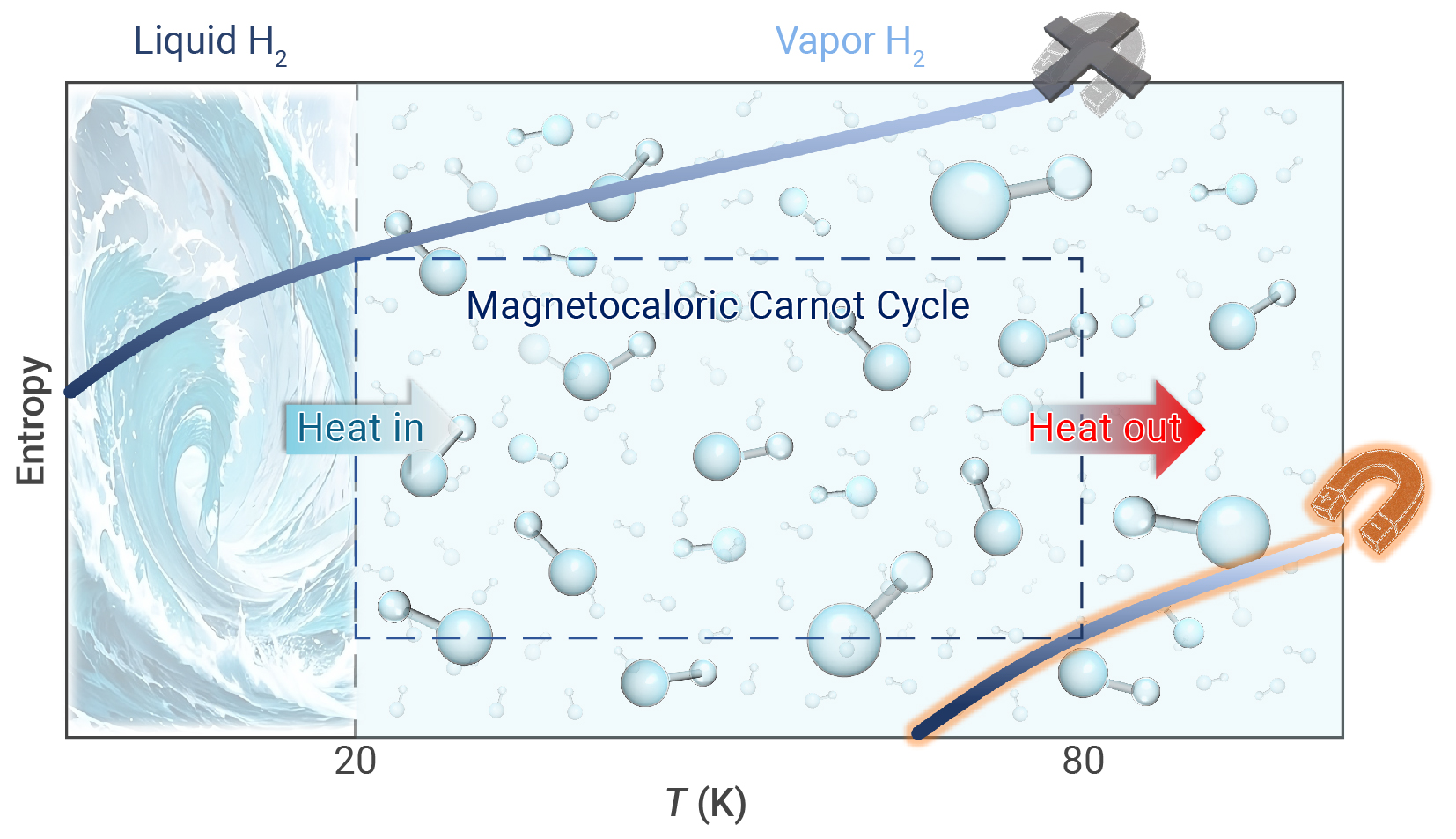
Figure 1.
An ideal magnetocaloric Carnot cycle operating between the temperatures of liquid nitrogen (hot reservoir) and liquid hydrogen (cold reservoir)
-
Figure 2.
Classification of the cryogenic magnetocaloric materials analyzed in this review
-
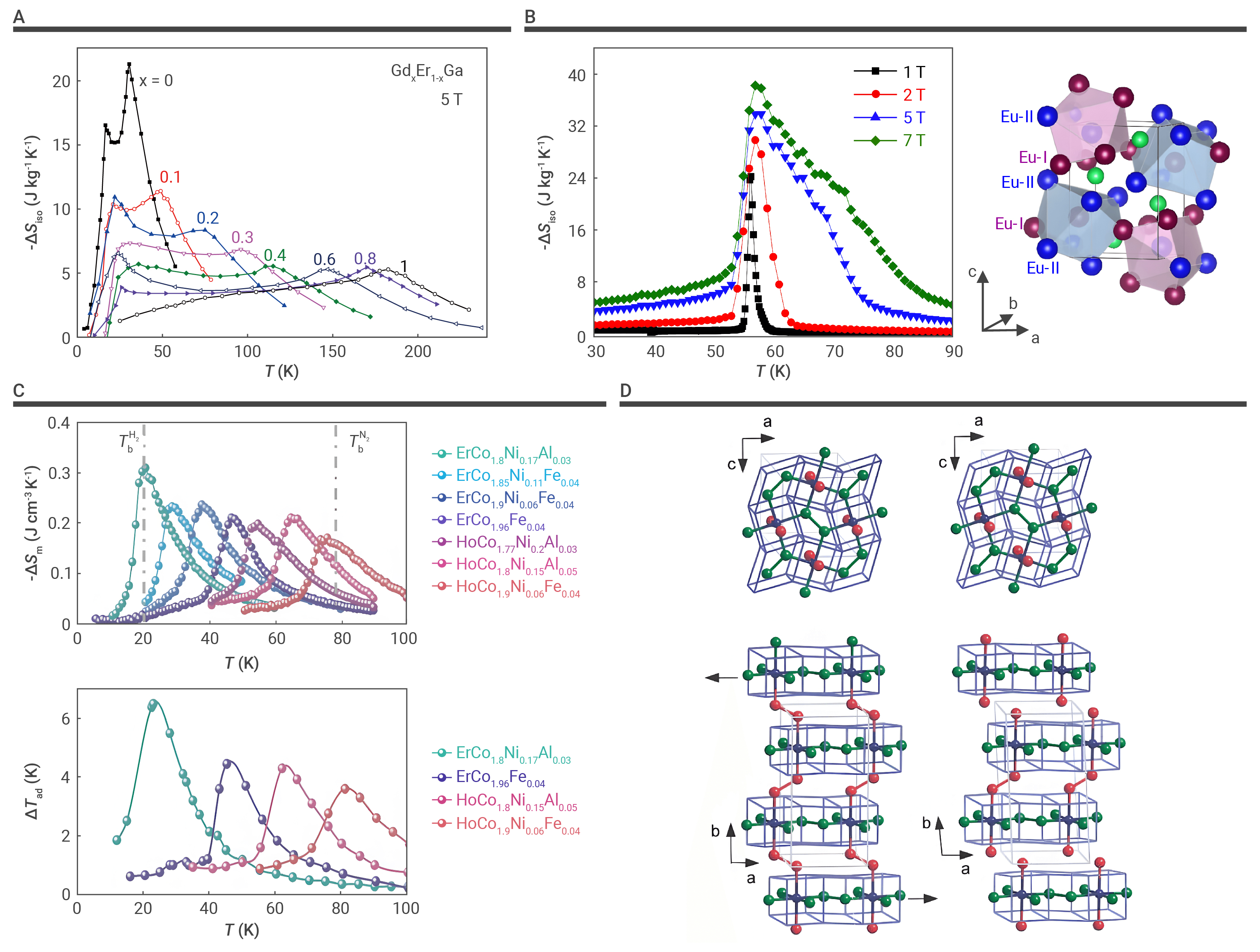
Figure 3.
Magnetocaloric response for some promising binary intermetallic materials as well as some examples of representative crystal structures
-
Figure 4.
$ \Delta {\mathit{S}}_{\mathbf{i}\mathbf{s}\mathbf{o}} $ -
Figure 5.
Magnetocaloric response for some promising non-metallic materials
-
Figure 6.
Conventional and rotary magnetocaloric response for some promising oxides
-
Figure 7.
Magnetocaloric amorphous materials
-
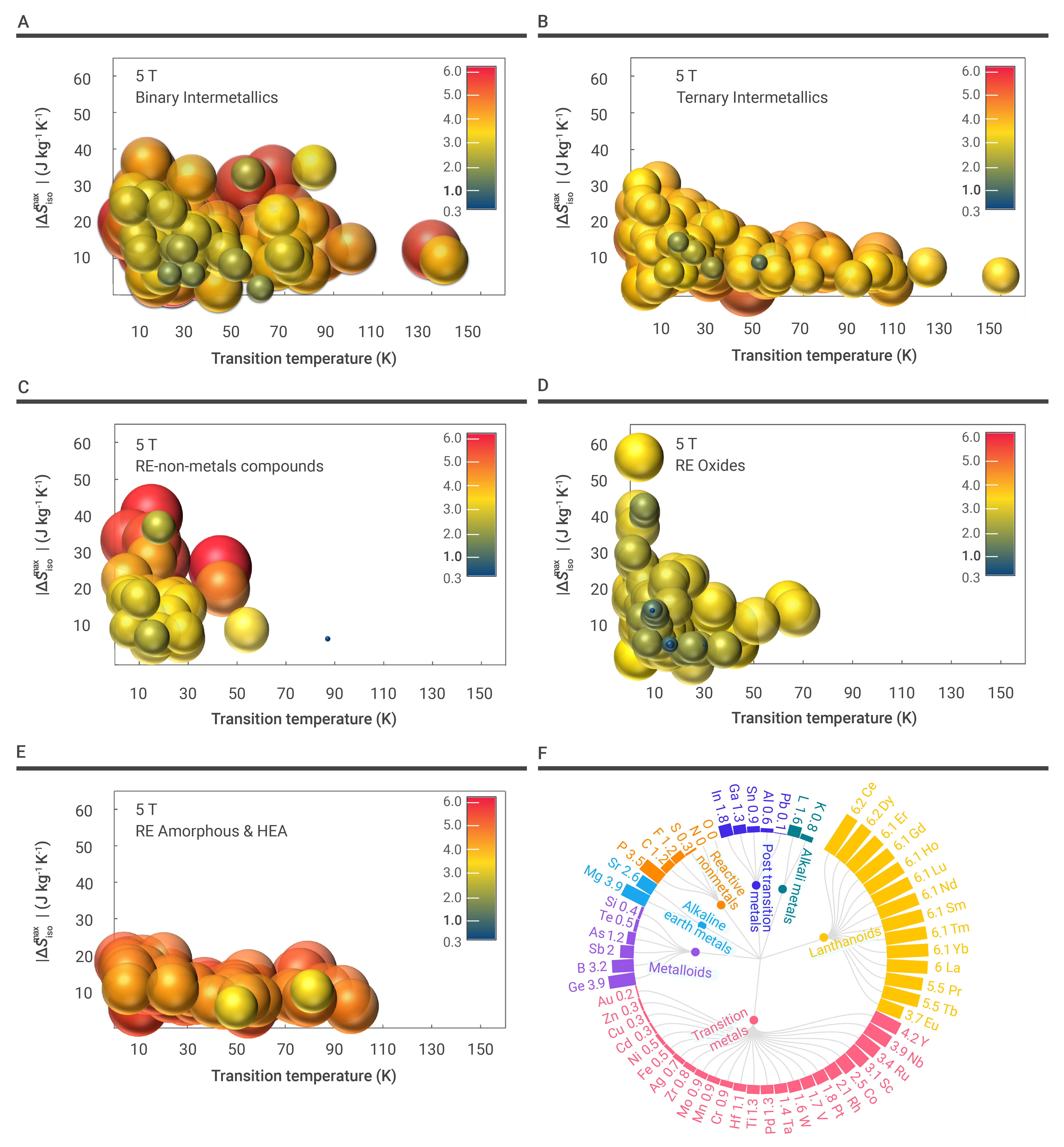
Figure 8.
Performance comparison for 5 T considering the weighed criticality supply risk index
