
-
-
Keywords:
- Energy storage /
- relaxor ferroelectric films /
- isolated polar slush
-

-
REFERENCES
[1] Shu, L., Shi, X., Zhang, X., et al. (2024). Partitioning polar-slush strategy in relaxors leads to large energy-storage capability. Science 385: 204−209. DOI: 10.1126/science.adn8721. [2] Pan, H., Lan, S., Xu, S., et al. (2021). Ultrahigh energy storage in superparaelectric relaxor ferroelectrics. Science 374: 100−104. DOI: 10.1126/science.abi7687. [3] Yang, B., Zhang, Q., Huang, H., et al. (2023). Engineering relaxors by entropy for high energy storage performance. Nat. Energy 8: 956−964. DOI: 10.1038/s41560-023-01300-0. [4] Cheema, S.S., Shanker, N., Hsu, S.-L., et al. (2024). Giant energy storage and power density negative capacitance superlattices. Nature 629: 803. DOI: 10.1038/s41586-024-07365-5. [5] Kim, J., Saremi, S., Acharya, M., et al. (2020). Ultrahigh capacitive energy density in ion-bombarded relaxor ferroelectric films. Science 369: 91−94. DOI: 10.1126/science.abb0631. -
ABOUT THIS ARTICLE
Cite this article:
Liu L., Zhang J., and Wang Y. (2024). Addressing a novel paradigm toward high energy storage. The Innovation Materials 2(4): 100103. https://doi.org/10.59717/j.xinn-mater.2024.100103
Welcome!
To request copyright permission to republish or share portions of our works, please visit Copyright Clearance Center's (CCC) Marketplace website at marketplace.copyright.com.
Export File
Citation
Liu L., Zhang J., and Wang Y. (2024). Addressing a novel paradigm toward high energy storage. The Innovation Materials 2(4): 100103. https://doi.org/10.59717/j.xinn-mater.2024.100103

Format
Content
 DownLoad:
-
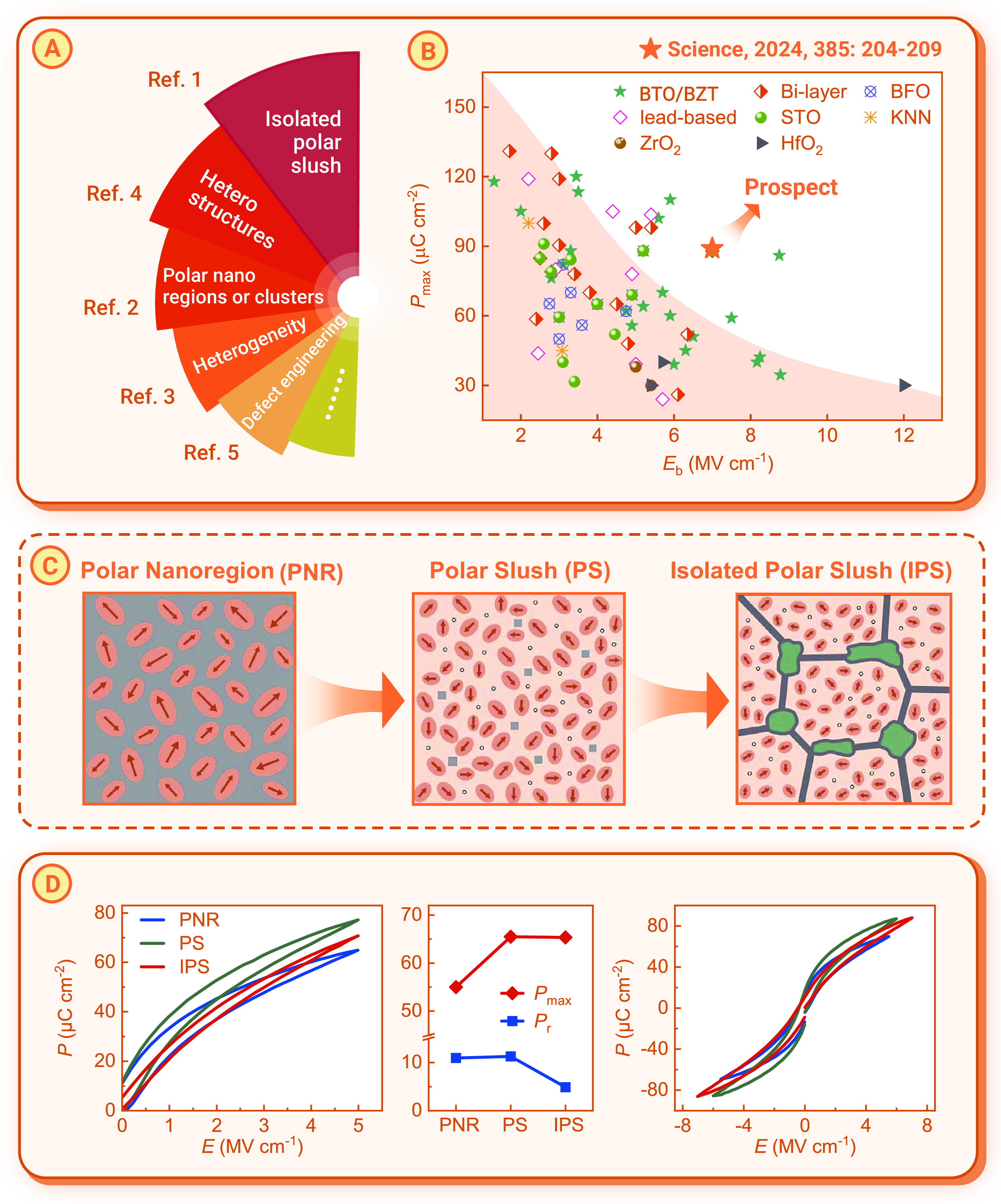
Figure 1.
Design route of achieving high energy storage density
