
Observation of the Josephson effect in superhydrides: DC SQUID based on (La,Ce)H10+x with operating temperature of 179 K
-
GRAPHICAL ABSTRACT
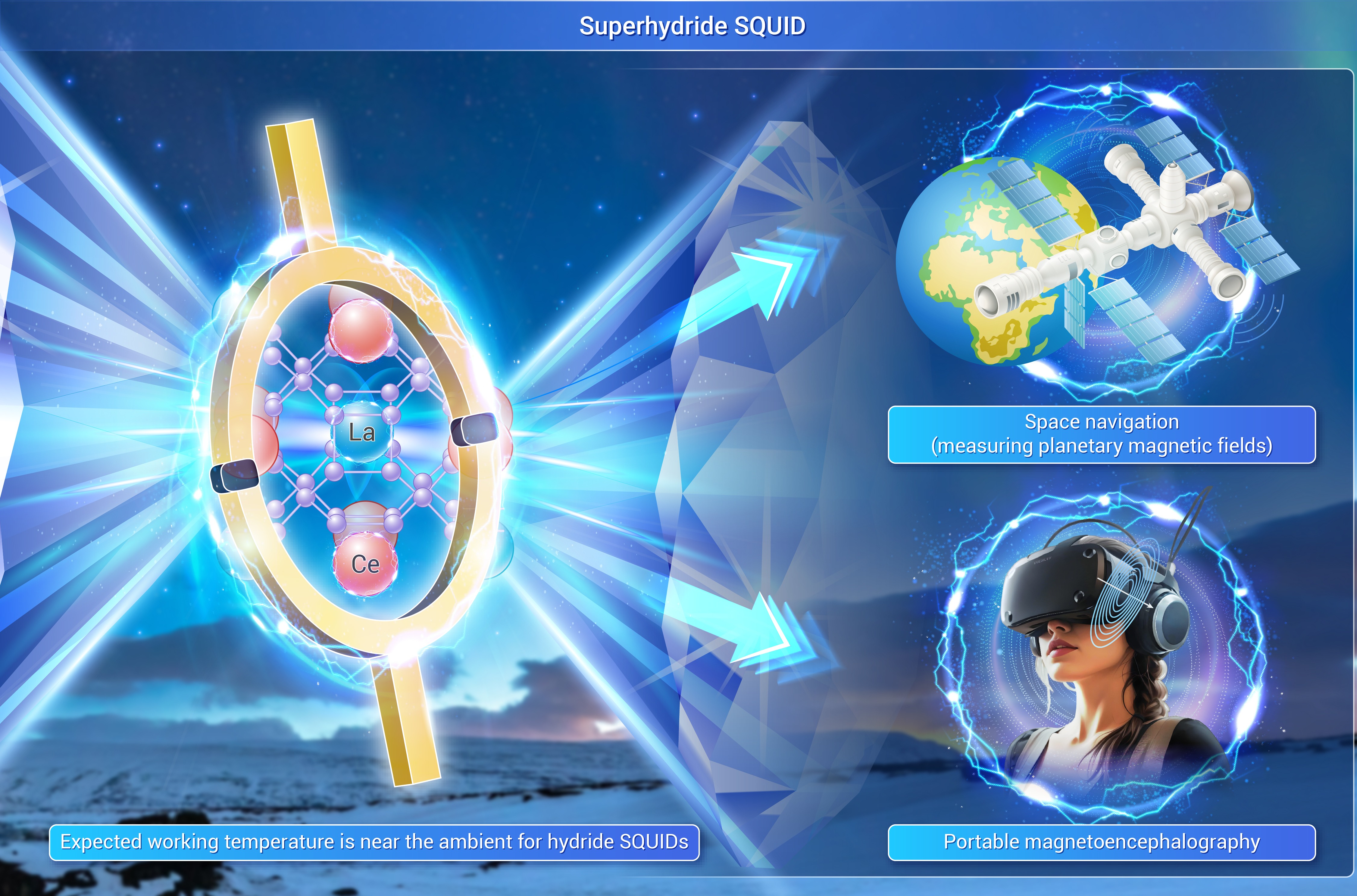
 DownLoad:
Full size image
DownLoad:
Full size image
-
PUBLIC SUMMARY
-
We created SQUID (superconducting quantum interference device) with a record operating temperature of 179 K.
Sensitivity of superhydride SQUIDs can be improved to 0.01 G, and the operating temperature can reach 240 K.
More advanced applications of hydride SQUIDs can be envisioned by taking advantage of microfabrication tools.
-
-
ABSTRACT
Among known materials, hydride superconductors have the highest critical temperatures and are very promising as a basis for electronic sensors. Superconducting quantum interference device (SQUID), due to its unique sensitivity to magnetic fields, is the most important application of superconductors in microelectronics. In this work, we describe a direct current SQUID made of lanthanum-cerium superhydride (La, Ce)H10+x (x is between ‒1 and +2) at pressure of 148 GPa, with operating temperature of 179 K and bias current of about 2 mA. When placing (La, Ce)H10+x in a modulated magnetic field (frequency: 0.1-0.005 Hz, 5 Gauss), we observed generation of higher harmonics up to 18ν0 and a periodic dependence of the sample resistance on the magnetic flux density R∝ |sin(πФ/Ф0)|. We demonstrate that the (La, Ce)H10+x SQUID with a size of ~ 4-6 μm, operates in the mode of low thermal fluctuations and can be used to detect magnetic fields below 0.1 G. Our findings pave the road to more advanced applications of the Josephson effect and SQUIDs made of hydride superconductors.-
Keywords:
- SQUID /
- superhydrides /
- quantum interference /
- magnetometer /
- superconductivity /
- Josephson effect /
- Andreev reflection
-

-
REFERENCES
[1] Jaklevic R. C., Lambe J., Silver A. H., et al. (1964). Quantum interference effects in Josephson tunneling. Phys. Rev. Lett. 12:159−160. DOI:10.1103/PhysRevLett.12.159 [2] Anderson P. W. and Rowell J. M. (1963). Probable observation of the Josephson superconducting tunneling effect. Phys. Rev. Lett. 10:230−232. DOI:10.1103/PhysRevLett.10.230 [3] Aprili M. (2006). The nanoSQUID makes its debut. Nat. Nanotechnol. 1:15−16. DOI:10.1038/nnano.2006.78 [4] Ran S. K. d. (2004). Gravity probe B: exploring Einstein's universe with gyroscopes. NASA:26. URL:https://einstein.stanford.edu/content/education/GP-B_T-Guide4-2008-HQ.pdf. [5] Clarke J. (1994). SQUIDs. Sci. Am. 271:46−53. DOI:10.1038/scientificamerican0894-46 [6] Cleuziou J. P., Wernsdorfer W., Bouchiat V., et al. (2006). Carbon nanotube superconducting quantum interference device. Nat. Nanotechnol. 1:53−59. DOI:10.1038/nnano.2006.54 [7] Colclough M. S., Gough C. E., Keene M., et al. (1987). Radio-frequency SQUID operation using a ceramic high-temperature superconductor. Nature 328:47−48. DOI:10.1038/328047a0 [8] Lee L. P., Char K., Colclough M. S., et al. (1991). Monolithic 77 K dc SQUID magnetometer. Appl. Phys. Lett. 59:3051−3053. DOI:10.1063/1.105790 [9] Cohen D. (1968). Magnetoencephalography: evidence of magnetic fields produced by alpha-rhythm currents. Science 161:784−786. DOI:10.1126/science.161.3843.784 [10] Weitschies W., Kosch O., Mönnikes H., et al. (2005). Magnetic marker monitoring: an application of biomagnetic measurement instrumentation and principles for the determination of the gastrointestinal behavior of magnetically marked solid dosage forms. Adv. Drug Deliver. Rev. 57:1210−1222. DOI:10.1016/j.addr.2005.01.025 [11] Clarke J., Lee A. T., Mück M., et al. (2006). The SQUID handbook Vol. II Applications of SQUIDs and SQUID systems (Wiley-VCH). ISBN:3-527-40408-2 DOI:10.1002/9783527609956. [12] Kjaergaard M., Schwartz M. E., Braumüller J., et al. (2020). Superconducting qubits: current state of play. Annu. Rev. Condens. Matter Phys. 11:369−395. DOI:10.1146/annurev-conmatphys-031119-050605 [13] Black R. C., Mathai A., Wellstood F. C., et al. (1993). Magnetic microscopy using a liquid nitrogen cooled YBa2Cu3O7 superconducting quantum interference device. Appl. Phys. Lett. 62:2128−2130. DOI:10.1063/1.109448 [14] Vasil'Ev B. and Kolycheva E. (1978). Measurement of the electric dipole moment of the electron with a quantum interferometer. Sov. Phys. JETP 47:243−246. [15] Irwin K. D. and Hilton G. C. (2005). Transition-Edge sensors. In cryogenic particle detection, C. Enss, ed. (Springer), pp. 63-150. DOI:10.1007/10933596_3. [16] Drozdov A. P., Eremets M. I., Troyan I. A., et al. (2015). Conventional superconductivity at 203 kelvin at high pressures in the sulfur hydride system. Nature 525:73−76. DOI:10.1038/nature14964 [17] Drozdov A. P., Kong P. P., Minkov V. S., et al. (2019). Superconductivity at 250 K in lanthanum hydride under high pressures. Nature 569:528−531. DOI:10.1038/s41586-019-1201-8 [18] Somayazulu M., Ahart M., Mishra A. K., et al. (2019). Evidence for superconductivity above 260 K in lanthanum superhydride at Megabar Pressures. Phys. Rev. Lett. 122:027001. DOI:10.1103/PhysRevLett.122.027001 [19] Troyan I. A., Semenok D. V., Kvashnin A. G., et al. (2021). Anomalous high‐temperature superconductivity in YH6. Adv. Mater. 33:2006832. DOI:10.1002/adma.202006832 [20] Kong P., Minkov V. S., Kuzovnikov M. A., et al. (2021). Superconductivity up to 243 K in the yttrium-hydrogen system under high pressure. Nat. Commun. 12:5075. DOI:10.1038/s41467-021-25372-2 [21] Semenok D. V., Kvashnin A. G., Ivanova A. G., et al. (2020). Superconductivity at 161 K in thorium hydride ThH10: synthesis and properties. Mater. Today 33:36−44. DOI:10.1016/j.mattod.2019.10.005 [22] Chen W., Semenok D. V., Huang X., et al. (2021). High-temperature superconducting phases in cerium superhydride with a Tc up to 115 K below a aressure of 1 megabar. Phys. Rev. Lett. 127:117001. DOI:10.1103/PhysRevLett.127.117001 [23] Troyan I. A., Semenok D. V., Ivanova A. G., et al. (2023). Non-Fermi-Liquid behavior of superconducting SnH4. Adv. Sci. 2303622:1−10. DOI:10.1002/advs.202303622 [24] Chen W., Huang X., Semenok D. V., et al. (2023). Enhancement of superconducting critical temperature realized in La-Ce-H system at moderate pressures. Nat. Commun. 14:2660. DOI:10.1038/s41467-023-38254-6 [25] Bi J., Nakamoto Y., Zhang P., et al. (2022). Giant enhancement of superconducting critical temperature in substitutional alloy (La,Ce)H9. Nat. Commun. 13:5952. DOI:10.1038/s41467-022-33743-6 [26] Laniel D., Trybel F., Winkler B., et al. (2022). High-pressure synthesis of seven lanthanum hydrides with a significant variability of hydrogen content. Nat. Commun. 13:6987. DOI:10.1038/s41467-022-34755-y [27] Kawamura Y. A. H. (2006). Pressure calibration of diamond anvil Raman gauge to 310 GPa. J. Appl. Phys. 100:043516. DOI:10.1063/1.2335683 [28] Semenok D. V., Troyan I. A., Sadakov A. V., et al. (2022). Effect of magnetic impurities on superconductivity in LaH10. Adv. Mater. 34:2204038. DOI:10.1002/adma.202204038 [29] Model 2182 and 2182A Nanovoltmeter user's manual (2017). (Keithley Instruments). [30] Moll P. J. W. and Geshkenbein V. B. (2023). Evolution of superconducting diodes. Nat. Phys. 19:1379−1380. DOI:10.1038/s41567-023-02229-7 [31] Cohen D. (1972). Magnetoencephalography: Detection of the brain's electrical activity with a superconducting magnetometer. Science 175:664−666. DOI:10.1126/science.175.4022.664 [32] Gross R. and Marx A. (2005). Applied superconductivity: Josephson effect and superconducting electronics (Walther-Meißner-Institut). ISBN:9783110417067. [33] Tafuri F. (2019). Fundamentals and frontiers of the Josephson effect (Springer Nature). ISBN:978-3-030-20726-7. [34] Golubov A. A., Kupriyanov M. Y. and Il'Ichev E. (2004). The current-phase relation in Josephson junctions. Rev. Mod. Phys. 76:411−469. DOI:10.1103/RevModPhys.76.411 [35] Chesca B., Kleiner R. and Koelle D. (2004). SQUID theory. Clarke J. and Braginski A.I. (eds). SQUID handbook, pp:29-92. DOI:10.1002/3527603646.ch2 [36] Tanaka Y., Yamamori H. and Arisawa S. (2021). Effective method of forming and detecting a fractional magnetic flux quantum. Phys. C (Amsterdam, Neth.) 589:1353932. DOI:10.1016/j.physc.2021.1353932 [37] Ishizu H., Yamamori H., Arisawa S., et al. (2022). Observation of multiple fractional quanta in a superconducting bilayer disk with a pinhole. Phys. C (Amsterdam, Neth.) 600:1354103. DOI:10.1016/j.physc.2022.1354103 [38] Little W. and Parks R. (1962). Observation of quantum periodicity in the transition temperature of a superconducting cylinder. Phys. Rev. Lett. 9:9. DOI:10.1103/PhysRevLett.9.9 [39] Tinkham M. (1996). Introduction to superconductivity (McGraw-Hill Book Co. 2nd edition). ISBN:0486435032. [40] Sun D., Minkov V. S., Mozaffari S., et al. (2021). High-temperature superconductivity on the verge of a structural instability in lanthanum superhydride. Nat. Commun. 12:6863. DOI:10.1038/s41467-021-26706-w [41] van der Pauw L. J. (1958). A method of measuring the resistivity and Hall coefficient on lamellae of arbitrary shape. Philips Tech. Rev. 20:220−224. [42] Trabaldo E., Pfeiffer C., Andersson E., et al. (2019). Grooved Dayem nanobridges as building blocks of high-performance YBa2Cu3O7−δ SQUID magnetometers. Nano Letters 19:1902−1907. DOI:10.1021/acs.nanolett.8b04991 [43] Gough C., Colclough M., Forgan E., et al. (1987). Flux quantization in a high-T c superconductor. Nature 326:855−855. DOI:10.1038/326855a0 [44] Semenok D. V., Troyan I. A., Zhou D., et al. (2024). Ternary superhydrides under pressure of Anderson's theorem: Near-record superconductivity in (La, Sc) H12. arXiv:2408.07477. DOI:10.48550/arXiv.2408.07477 [45] Guo J., Semenok D., Shutov G., et al. (2024). Unusual metallic state in superconducting A15-type La4H23. Natl. Sci. Rev. 11:nwae149. DOI:10.1093/nsr/nwae149 [46] Gurtovoi V. L., Ermolaev A. B., Chernykh A. V., et al. (1993). Weak-link investigation of a YBaCuO thin film DC SQUID by SEM. Supercond. Sci. Technol. 6:809. DOI:10.1088/0953-2048/6/12/001 [47] Semenok D. V., Troyan I. A., Kvashnin А. G., et al. (2021). Superconductivity at 253 K in lanthanum-yttrium ternary hydrides. Mater. Today 48:18−28. DOI:10.1016/j.mattod.2021.03.025 -
ABOUT THIS ARTICLE
Cite this article:
Semenok D., Troyan I., Zhou D., et al. (2025). Observation of the Josephson effect in superhydrides: DC SQUID based on (La,Ce)H10+x with operating temperature of 179 K. The Innovation Materials 3:100115. https://doi.org/10.59717/j.xinn-mater.2024.100115
Welcome!
To request copyright permission to republish or share portions of our works, please visit Copyright Clearance Center's (CCC) Marketplace website at marketplace.copyright.com.
Article Metrics
Relative Articles
Cited by
Export File
Citation
Semenok D., Troyan I., Zhou D., et al. (2025). Observation of the Josephson effect in superhydrides: DC SQUID based on (La,Ce)H10+x with operating temperature of 179 K. The Innovation Materials 3:100115. https://doi.org/10.59717/j.xinn-mater.2024.100115

Format
Content
-
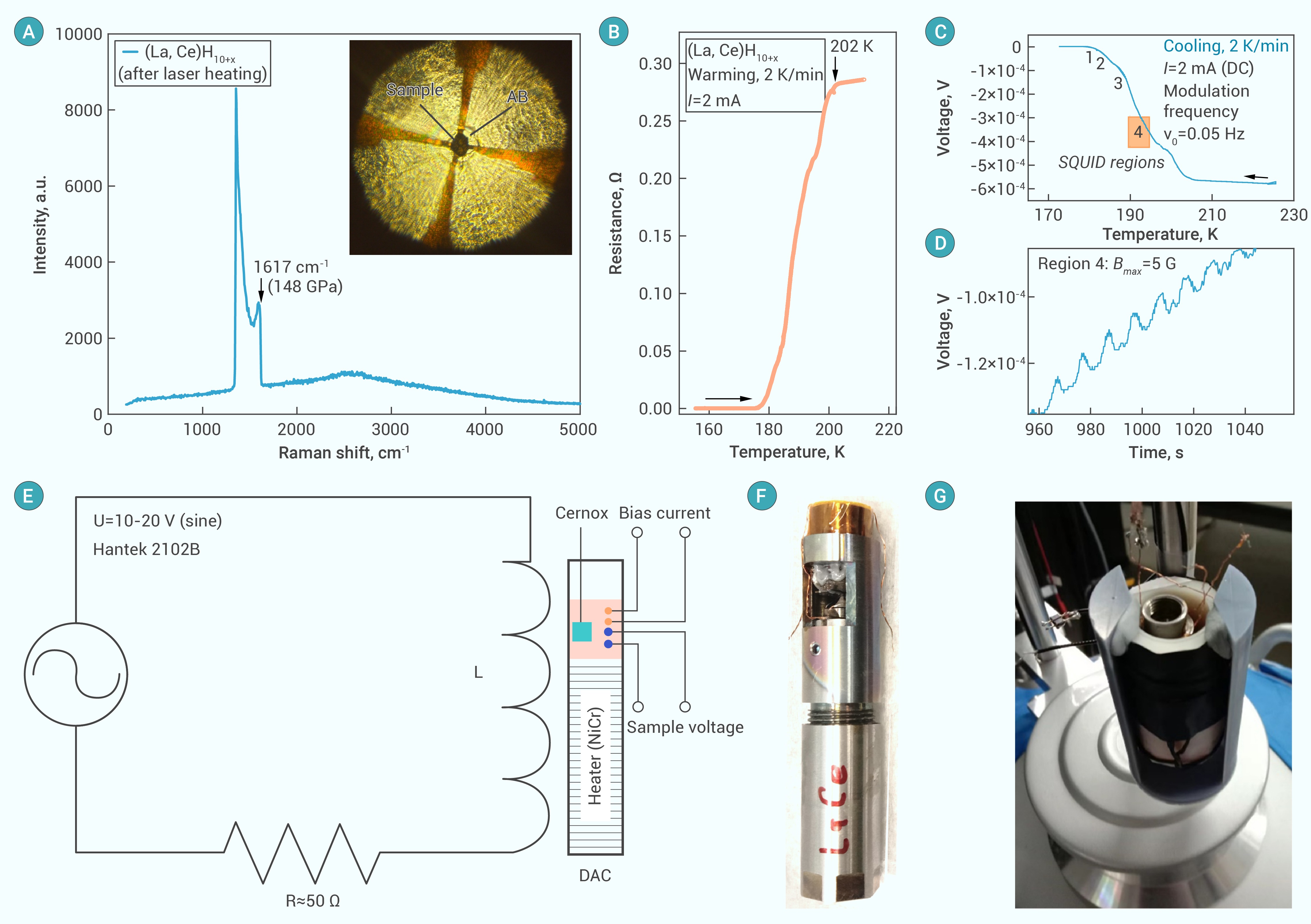
Figure 1.
Properties of the (La, Ce)H10+x sample in the DAC H and the scheme of measurements.
-
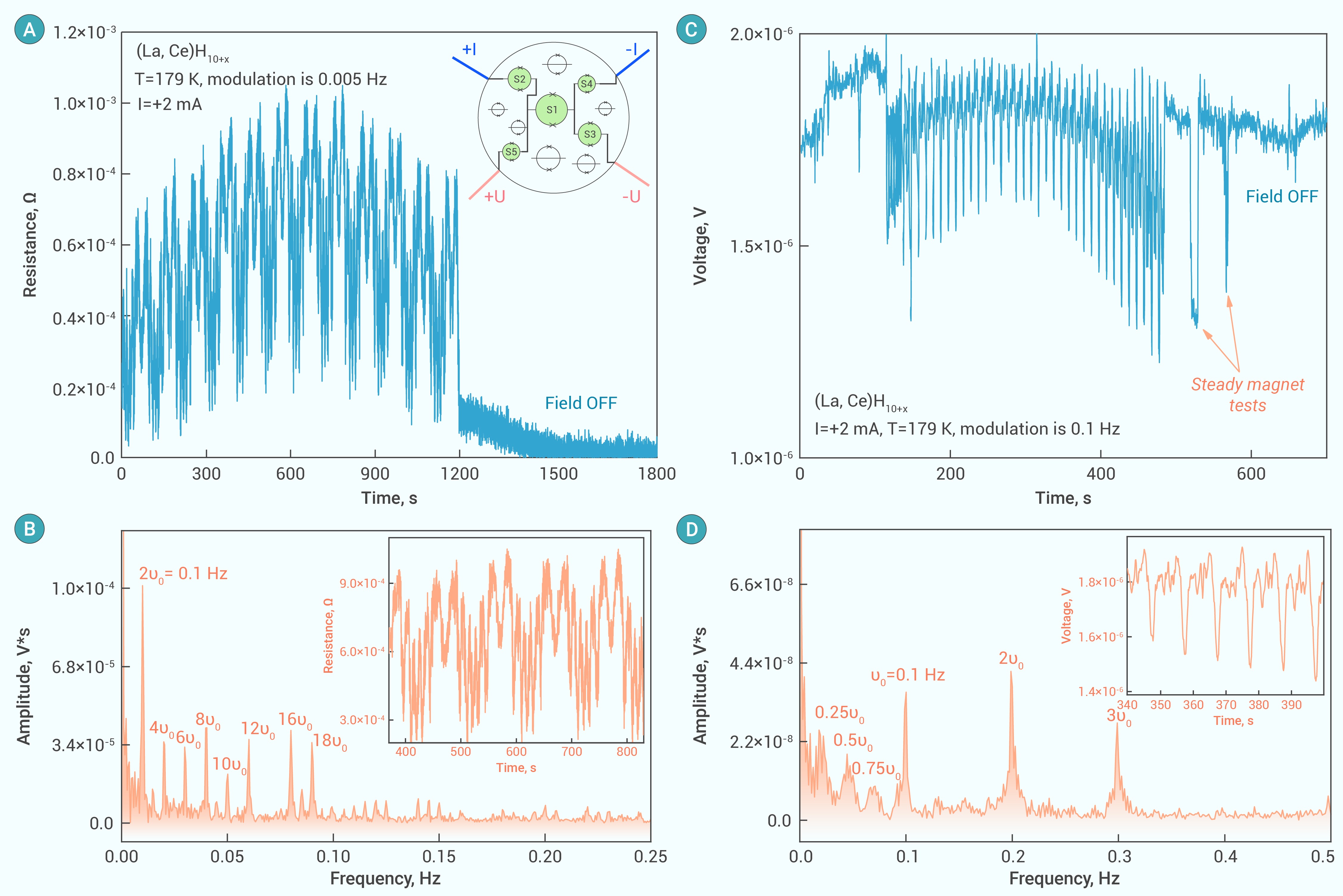
Figure 3.
The AC transport study of the (La, Ce)H10+x sample in DAC H at 148 GPa in a modulated low-frequency magnetic field. A four-electrode van der Pauw41 circuit was used
-
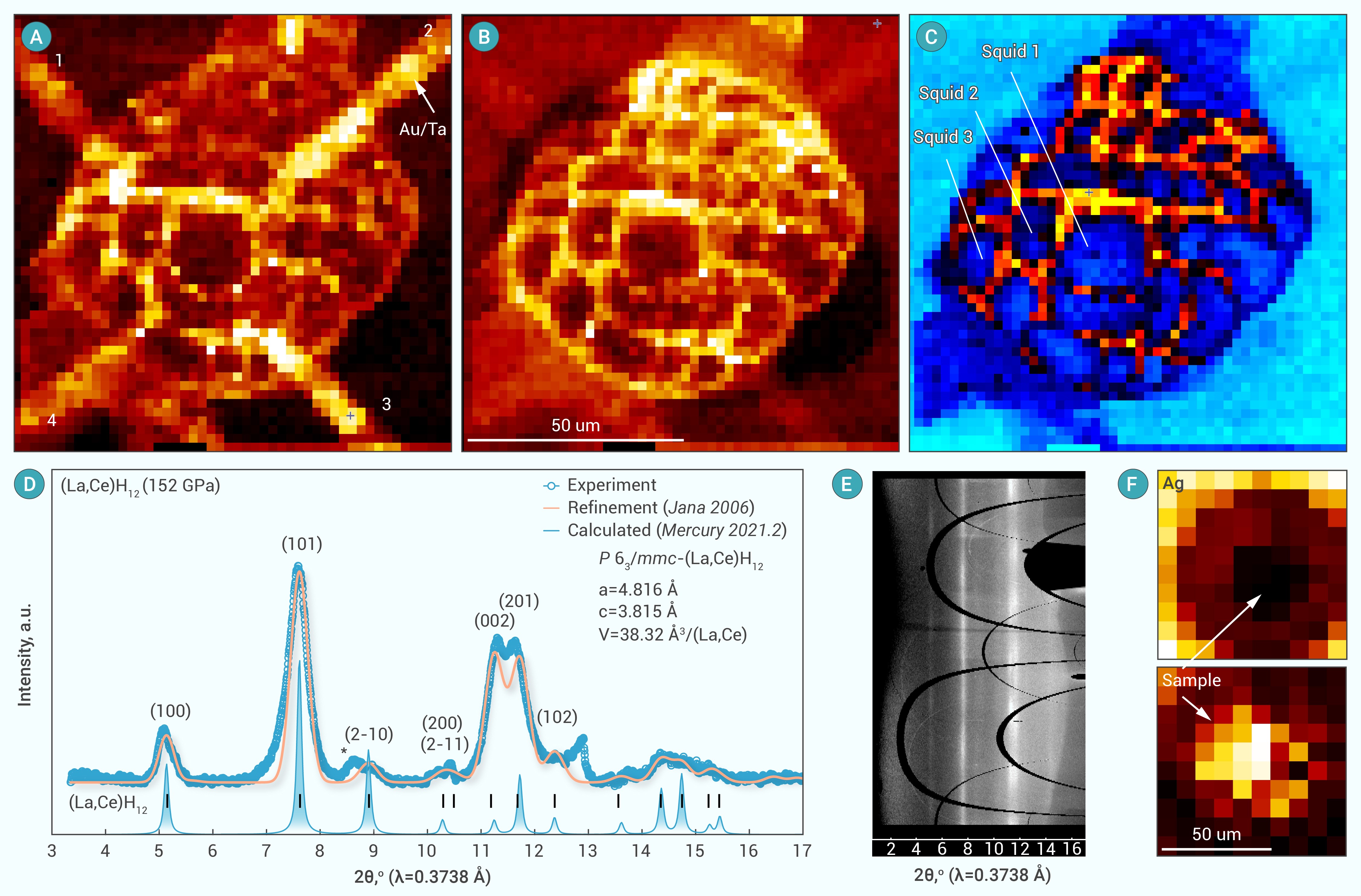
Figure 4.
X-ray diffraction studies of polyhydrides in special DACs with a wide opening angle, synthesized via laser heating of metals and alloys with ammonia borane
-
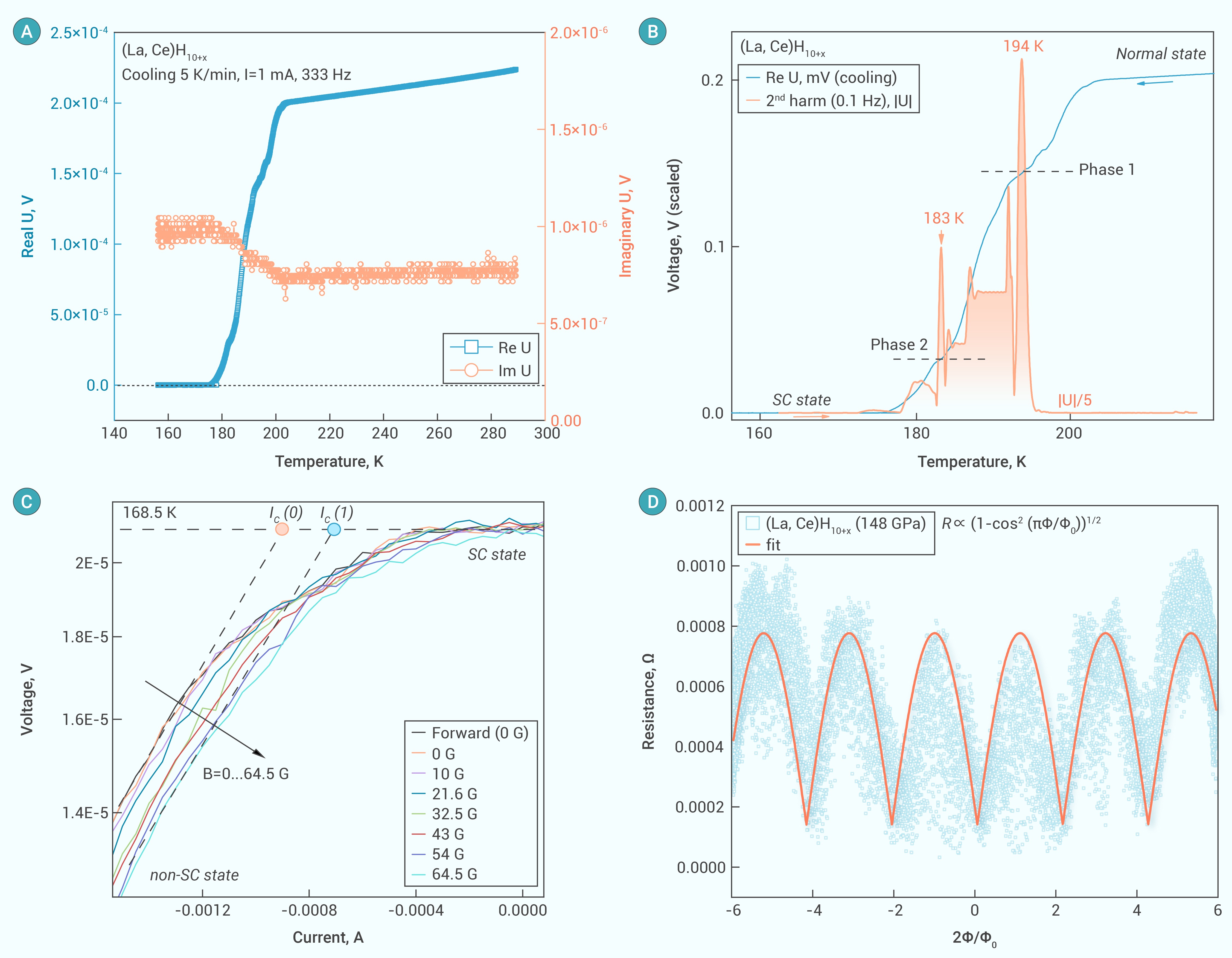
Figure 2.
The DC SQUID effect and generation of higher harmonics in the (La, Ce)H10+x sample at the pressure of 148 GPa and the temperature of 179 ± 0.5 K. The external magnetic field was generated by a sinusoidal current passing through a solenoid with a frequency of
