
Degradation breakthrough of stabilized compounds with C-F bonds
-

-
REFERENCES
[1] Evich M. G., Davis M. J. B., McCord J. P., et al. (2022). Per- and polyfluoroalkyl substances in the environment. Science 375:eabg9065. DOI:10.1126/science.abg9065 [2] Arima Y., Okayasu Y., Yoshioka D., et al. (2024). Multiphoton‐driven photocatalytic defluorination of persistent perfluoroalkyl substances and polymers by visible light. Angew. Chem. Int. Ed. 63:e202408687. DOI:10.1002/anie.202408687 [3] Zhang H., Chen J.-X., Qu J.-P., et al. (2024). Photocatalytic low-temperature defluorination of PFASs. Nature 635:610−617. DOI:10.1038/s41586-024-08179-1 [4] Liao M., Zhao S., Zhan G., et al. (2025). Silicate-confined hydrogen on nanoscale zerovalent iron for efficient defluorination reactions. J. Am. Chem. Soc. 147:3402−3411. DOI:10.1021/jacs.4c14261 [5] Liu X., Sau A., Green A. R., et al. (2024). Photocatalytic C–F bond activation in small molecules and polyfluoroalkyl substances. Nature 637:601−607. DOI:10.1038/s41586-024-08327-7 -
ABOUT THIS ARTICLE
Cite this article:
Yang W. and Dong F. (2025). Degradation breakthrough of stabilized compounds with C-F bonds. The Innovation Materials 3:100142. https://doi.org/10.59717/j.xinn-mater.2025.100142
Welcome!
To request copyright permission to republish or share portions of our works, please visit Copyright Clearance Center's (CCC) Marketplace website at marketplace.copyright.com.
Export File
Citation
Yang W. and Dong F. (2025). Degradation breakthrough of stabilized compounds with C-F bonds. The Innovation Materials 3:100142. https://doi.org/10.59717/j.xinn-mater.2025.100142

Format
Content
 DownLoad:
-
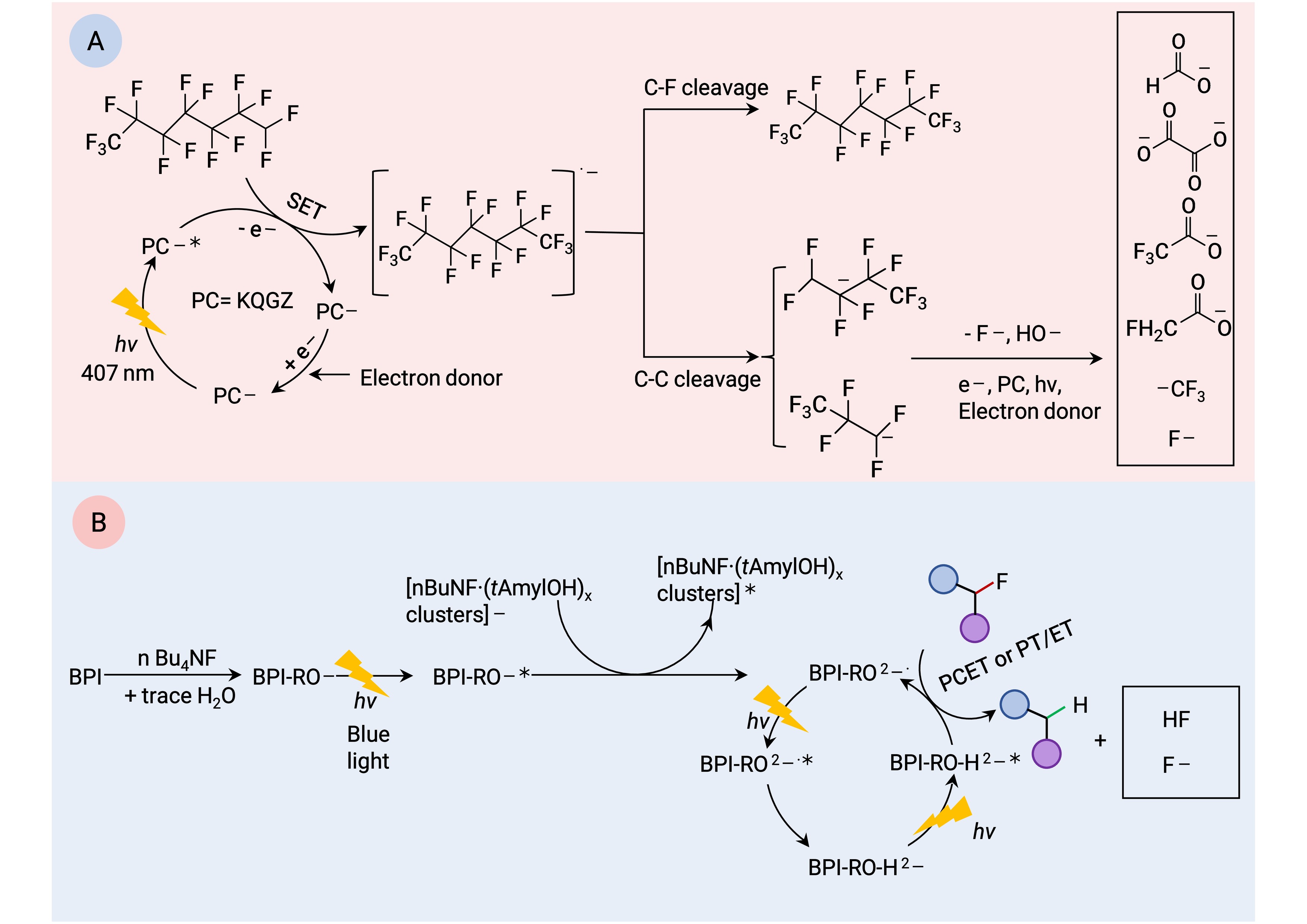
Figure 1.
Mechanism diagram of photocatalytic degradation of C-F bonds
