
Towards energy-autonomous wearables: Multimodal harvesting technologies and sustainable applications
-
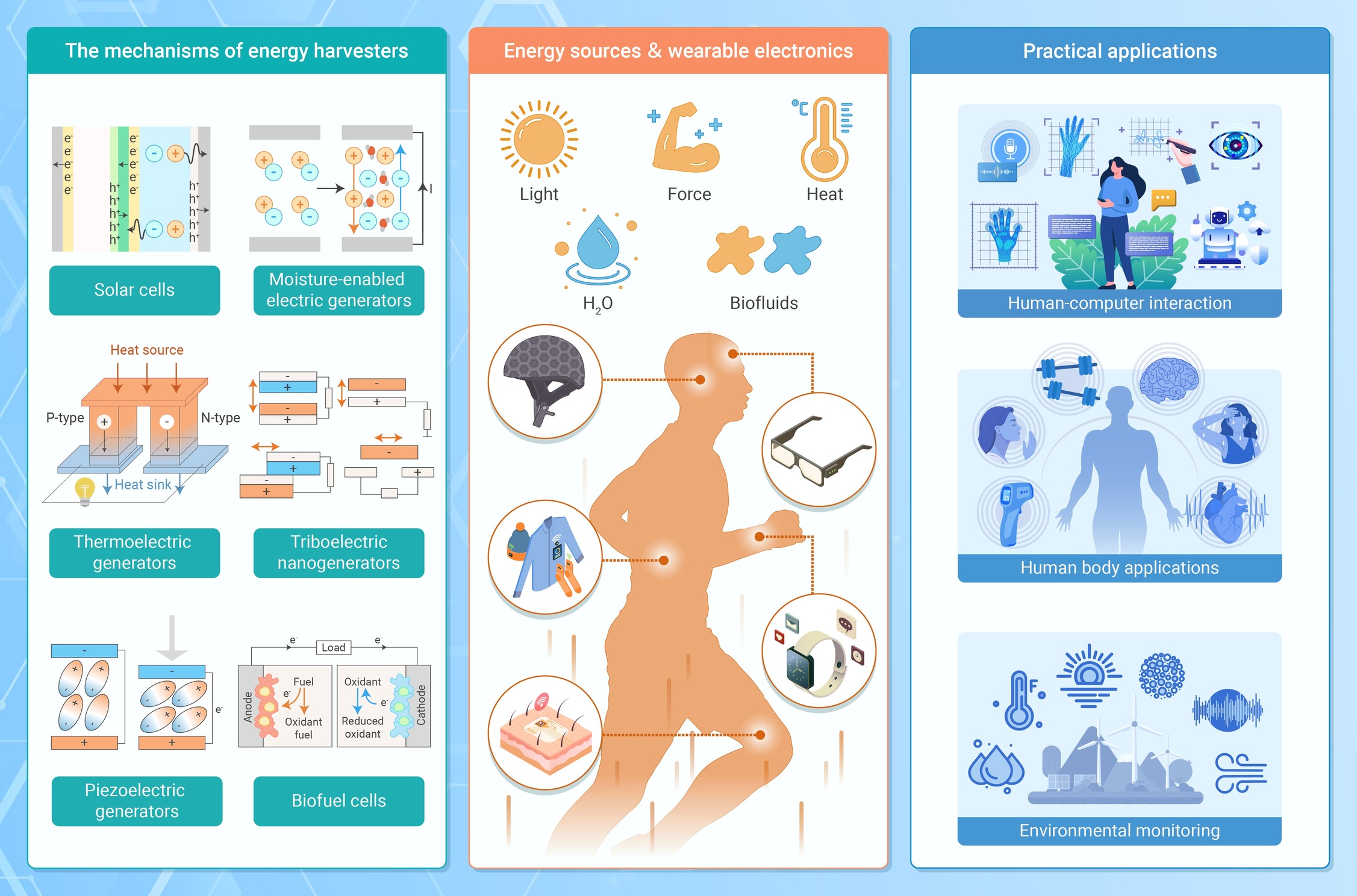
GRAPHICAL ABSTRACT
 DownLoad:
Full size image
DownLoad:
Full size image
-
PUBLIC SUMMARY
-
This review summarizes the principles of self-powered technologies.
The challenges and solutions faced by self-powered wearable electronics are introduced.
The latest applications of self-powered wearable electronics are showcased in the fields.
The development prospects of self-powered wearable devices are discussed.
-
-
ABSTRACT
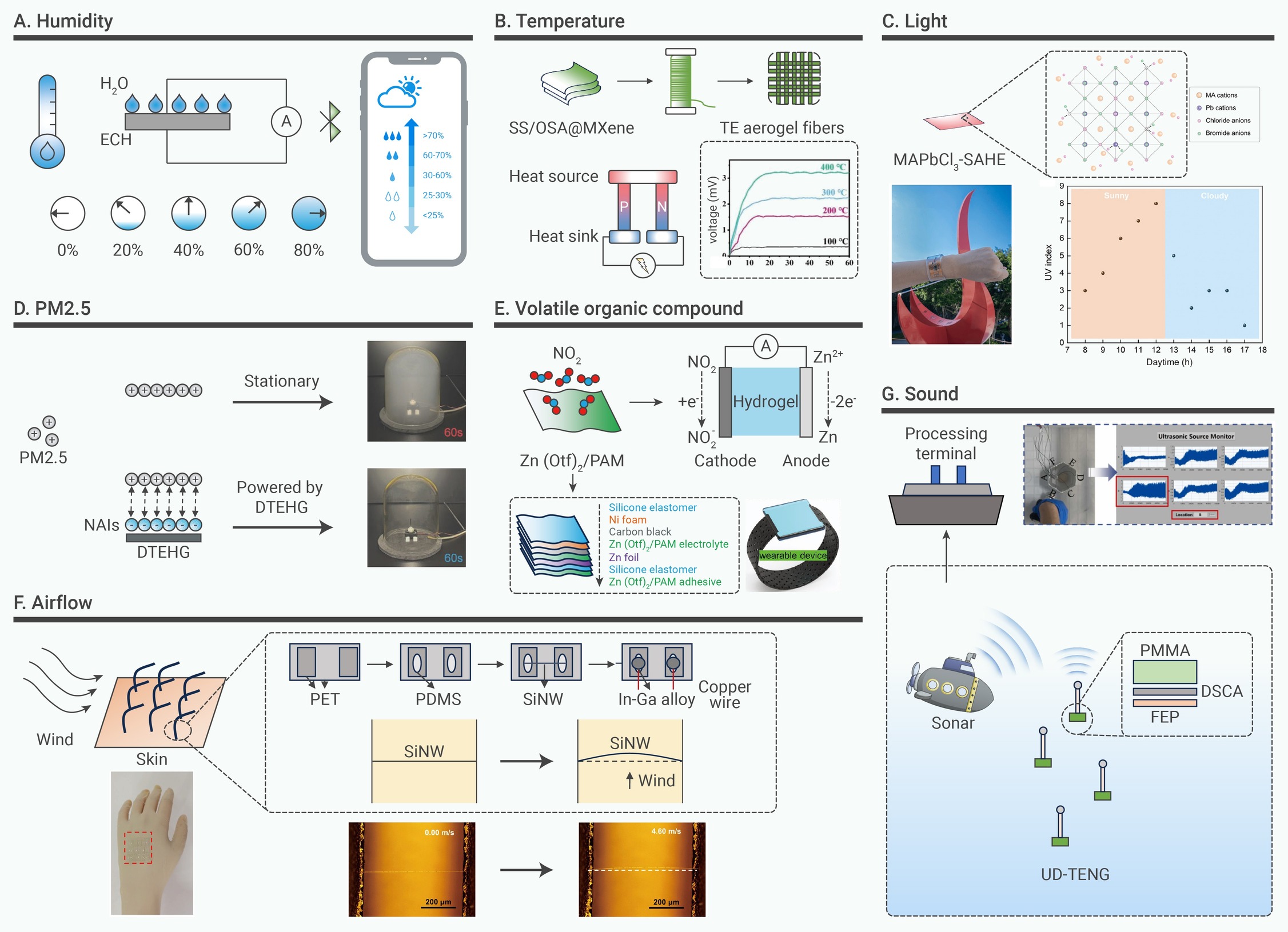
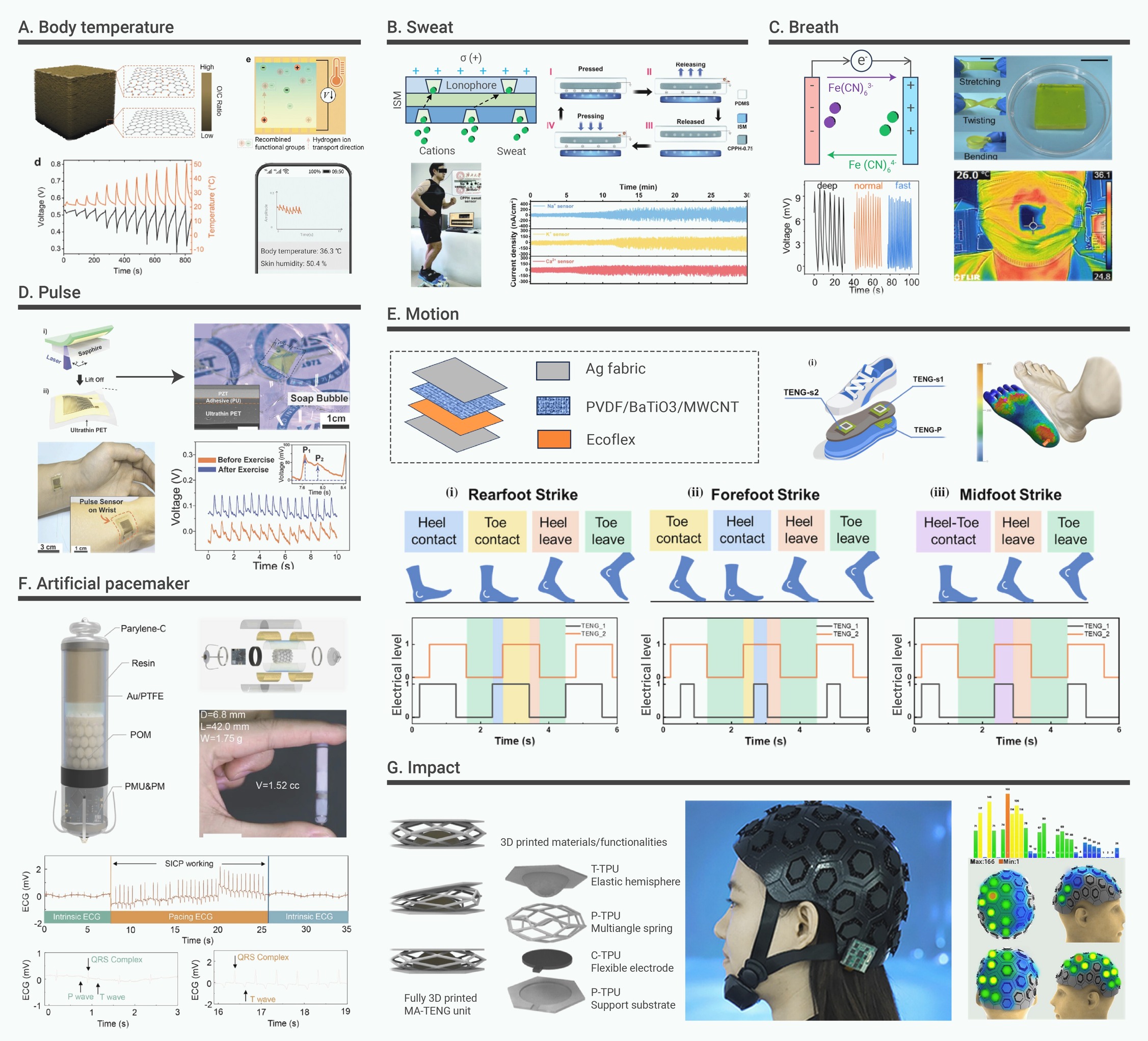
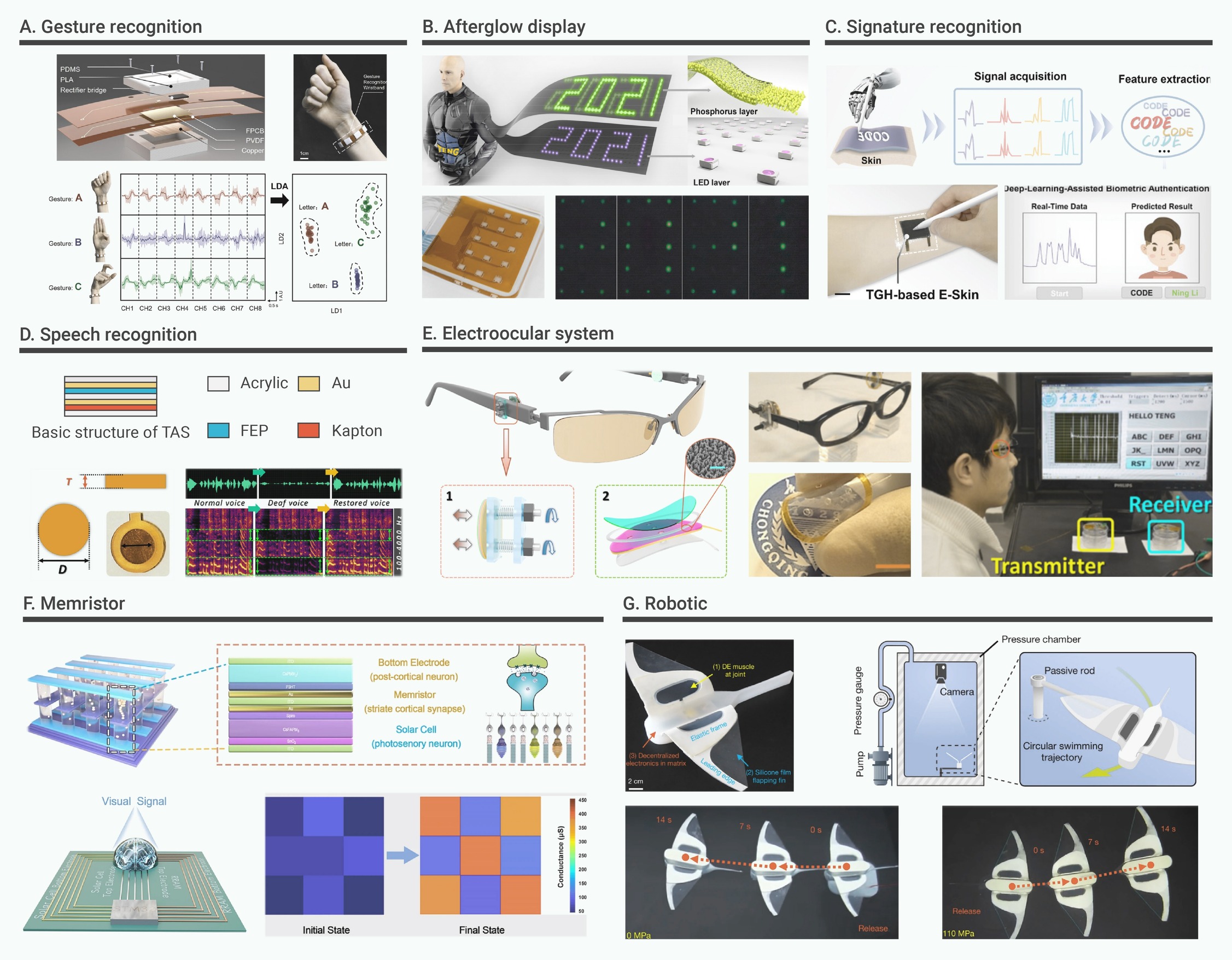
The integration of wearable electronics into daily life is revolutionizing personalized healthcare, environmental sensing, and human-machine interfaces. The global market for wearable electronics was valued at approximately $70–80 billion in 2023. By 2029, the scale will reach $138.5 billion. However, the reliance on rigid and short-lifespan batteries severely limit their adaptability and sustainability. Self-powered systems capable of harvesting ambient energy from both environmental sources (light and moisture) and human biomechanics (thermal gradients, motion, and biofluids) represent a paradigm shift toward autonomous and eco-friendly wearable devices. This review systematically classifies and compares six key energy harvesting technologies, i.e., solar cells, moisture-enabled/thermoelectric/triboelectric/piezoelectric generators, and biofuel cells, summarizing their working principles and analyze the issues they face when used in wearable devices, such as improving energy output, flexible manufacturing, and mechanical stability. In addition, we focus on three application scenarios: environmental monitoring, human applications, and human-computer interaction, introducing emerging applications spanning such as real-time PM2.5 detection, self-powered cardiac pacemakers, and deep-sea exploration robots, etc., demonstrating how energy autonomy intersects with global sustainability goals. This review provides a roadmap for transforming laboratory innovation into market ready solutions. Ultimately, the convergence of Adv. Mater., Al-driven design, and circular economy principles outlined here will accelerate the development of next-generation wearable electronics that seamlessly adapt to both human and environmental dynamics. -

-
REFERENCES
[1] Min J. H., Demchyshyn S., Sempionatto J. R., et al. (2023). An autonomous wearable biosensor powered by a perovskite solar cell. Nat. Electron. 6:630−641. DOI:10.1038/s41928-023-00996-y [2] Gong S., Zhang X., Nguyen X. A., et al. (2023). Hierarchically resistive skins as specific and multimetric on-throat wearable biosensors. Nat. Nanotech. 18:889−897. DOI:10.1038/s41565-023-01383-6 [3] Lin M. Y., Zhang Z. Y., Gao X. X., et al. (2024). A fully integrated wearable ultrasound system to monitor deep tissues in moving subjects. Nat. Biotechnol. 42:448−457. DOI:10.1038/s41587-023-01800-0 [4] Rafique A., Ferreira I., Abbas G., et al. (2023). Recent advances and challenges toward application of fibers and textiles in integrated photovoltaic energy storage devices. Nano-Micro Lett. 15:40. DOI:10.1007/s40820-022-01008-y [5] Xu R. D., She M. H., Liu J. X., et al. (2023). Skin-friendly and wearable iontronic touch panel for virtual-real handwriting interaction. ACS Nano 17:8293−8302. DOI:10.1021/acsnano.2c12612 [6] Hui Z. Y., Zhang L. R., Ren G. Z., et al. (2023). Green flexible electronics: natural materials, fabrication, and applications. Adv. Mater. 35:2211202. DOI:10.1002/adma.202211202 [7] Dong J. C., Tang X. W., Peng Y. D., et al. (2023). Highly permeable and ultrastretchable E-textiles with EGaIn-superlyophilicity for on-skin health monitoring, joule heating, and electromagnetic shielding. Nano Energy. 108:108194. DOI:10.1016/j.nanoen.2023.108194 [8] Fang H., Wang L., Fu Z. Z., et al. (2023). Anatomically designed triboelectric wristbands with adaptive accelerated learning for human-machine interfaces. Adv. Sci. 10:2205960. DOI:10.1002/advs.202205960 [9] Li S., Zhang Y., Liang X. P., et al. (2022). Humidity-sensitive chemoelectric flexible sensors based on metal-air redox reaction for health management. Nat. Commun. 13:5416. DOI:10.1038/s41467-022-33133-y [10] Lai Z. H., Xu J. C., Bowen C. R., et al. (2022). Self-powered and self-sensing devices based on human motion. Joule. 6:1501−1565. DOI:10.1016/j.joule.2022.06.013 [11] Xiao X., Zheng Z. Y., Zhong X. W., et al. (2023). Rational design of flexible Zn-based batteries for wearable electronic devices. ACS Nano. 17:1764−1802. DOI:10.1021/acsnano.2c09509 [12] Liu R. Y., Wang Z. L., Fukuda K., et al. (2022). Flexible self-charging power sources. Nat. Rev. Mater. 7:870−886. DOI:10.1038/s41578-022-00441-0 [13] Jia Y. H., Jiang Q. L., Sun H. D., et al. (2021). Wearable thermoelectric materials and devices for self-powered electronic systems. Adv. Mater. 33:2102990. DOI:10.1002/adma.202102990 [14] Liu C., Feng Z. H., Yin T., et al. (2024). Multi-interface engineering of mxenes for self-powered wearable devices. Adv. Mater. 36:2403791. DOI:10.1002/adma.202403791 [15] Qi L. F., Kong L. J., Wang Y., et al. (2023). Recent progress in application-oriented self-powered microelectronics. Adv. Energy Mater. 13:2302699. DOI:10.1002/aenm.202302699 [16] Song Z. Q., Li W. Y., Bao Y., et al. (2023). Research progress of wearable self-powered electrochemical sensors. CJAC. 51:769−776. DOI:10.19756/j.issn.0253-3820.221632 [17] Xu C., Song Y., Han M. D., et al. (2021). Portable and wearable self-powered systems based on emerging energy harvesting technology. Microsyst. Nanoeng. 7:25. DOI:10.1038/s41378-021-00248-z [18] Sun Z. Y., Wen X., Wang L. M., et al. (2022). Emerging design principles, materials, and applications for moisture-enabled electric generation. Escience 2:32−46. DOI:10.1016/j.esci.2021.12.009 [19] Gao H., Xiao K., Lin R., et al. (2024). Homogeneous crystallization and buried interface passivation for perovskite tandem solar modules. Science (New York, N.Y.) 383:855−859. DOI:10.1126/science.adj6088 [20] Li L. D., Wang Y. R., Wang X. Y., et al. (2022). Flexible all-perovskite tandem solar cells approaching 25% efficiency with molecule-bridged hole-selective contact. Nat. Energy 7:708−717. DOI:10.1038/s41560-022-01045-2 [21] Xie L. S., Du S. Y., Li J., et al. (2023). Molecular dipole engineering-assisted strain release for mechanically robust flexible perovskite solar cells. Energ. Environ. Sci. 16:5423−5433. DOI:10.1039/d3ee02569a [22] Zhao Y. P., Li Z. Q., Deger C., et al. (2023). Achieving sustainability of greenhouses by integrating stable semi-transparent organic photovoltaics. Nat. Sustain. 6:539−548. DOI:10.1038/s41893-023-01071-2 [23] Aydin E., Ugur E., Yildirim B. K., et al. (2023). Enhanced optoelectronic coupling for perovskite/silicon tandem solar cells. Nature 623:732−738. DOI:10.1038/s41586-023-06667-4 [24] Shrivastav N., Kashyap S., Madan J., et al. (2023). Perovskite-cigs monolithic tandem solar cells with 29.7% efficiency: a numerical study. Energy & Fuels 37:3083-3090. DOI:10.1021/acs.energyfuels.2c03973. [25] Chen P., Xiao Y., Hu J. T., et al. (2024). Multifunctional ytterbium oxide buffer for perovskite solar cells. Nature 625:516−522. DOI:10.1038/s41586-023-06892-x [26] Chen H., Liu C., Xu J., et al. (2024). Improved charge extraction in inverted perovskite solar cells with dual-site-binding ligands. Science (New York, N.Y.) 384:189−193. DOI:10.1126/science.adm9474 [27] Liu W. Z., Liu Y. J., Yang Z. Q., et al. (2023). Flexible solar cells based on foldable silicon wafers with blunted edges. Nature 617:717−723. DOI:10.1038/s41586-023-05921-z [28] Zeng R., Zhu L., Zhang M., et al. (2023). All-polymer organic solar cells with nano-to-micron hierarchical morphology and large light receiving angle. Nat. Commun. 14:4148. DOI:10.1038/s41467-023-39832-4 [29] De Bastiani M., Mirabelli A. J., Hou Y., et al. (2021). Efficient bifacial monolithic perovskite/silicon tandem solar cells via bandgap engineering. Nat. Energy 6:167−175. DOI:10.1038/s41560-020-00756-8 [30] Li Z. G., Chen Y. D., Guo R. Q., et al. (2024). Doubling power conversion efficiency of si solar cells. Adv. Mater. 36:2405724. DOI:10.1002/adma.202405724 [31] Yoshikawa K., Kawasaki H., Yoshida W., et al. (2017). Silicon heterojunction solar cell with interdigitated back contacts for a photoconversion efficiency over 26%. Nat. Energy 2:17032. DOI:10.1038/nenergy.2017.32 [32] Wang Y. R., Lin R. X., Liu C. S. Y., et al. (2024). Homogenized contact in all-perovskite tandems using tailored 2D perovskite. Nature 635:867−873. DOI:10.1038/s41586-024-08158-6 [33] Wu J., Torresi L., Hu M., et al. (2024). Inverse design workflow discovers hole-transport materials tailored for perovskite solar cells. Science (New York, N.Y.) 386:1256−1264. DOI:10.1126/science.ads0901 [34] Fan X., Chen J., Wang J., et al. (2025). Efficient rigid and flexible perovskite solar cells using strongly adsorbed molecules for lattice repair and grain boundary mitigation. Energ. Environ. Sci. 18:2905−2917. DOI:10.1039/D4EE05232C [35] Chen H. Y., Huang Y. T., Zhang R., et al. (2025). Organic solar cells with 20.82% efficiency and high tolerance of active layer thickness through crystallization sequence manipulation. Nat. Mater. 24: 444–453. DOI:10.1038/s41563-024-02062-0. [36] Wang J. Q., Wang Y. F., Bi P. Q., et al. (2023). Binary organic solar cells with 19.2% efficiency enabled by solid additive. Adv. Mater. 35:2301583. DOI:10.1002/adma.202301583. [37] Kakiage K., Aoyama Y., Yano T., et al. (2015). Highly-efficient dye-sensitized solar cells with collaborative sensitization by silyl-anchor and carboxy-anchor dyes. Chem. Comm. 51:15894−15897. DOI:10.1039/c5cc06759f [38] Mathew S., Yella A., Gao P., et al. (2014). Dye-sensitized solar cells with 13% efficiency achieved through the molecular engineering of porphyrin sensitizers. Nat. Chem. 6:242−247. DOI:10.1038/nchem.1861 [39] Li M., Zhou J., Tan L., et al. (2022). Multifunctional succinate additive for flexible perovskite solar cells with more than 23% power-conversion efficiency. The Innovation 3:100310. DOI:10.1016/j.xinn.2022.100310 [40] Shao B. B., Song Y. H., Song Z. H., et al. (2023). Electricity generation from phase transitions between liquid and gaseous water. Adv. Energy Mater. 13:2204091. DOI:10.1002/aenm.202204091 [41] Yao H. Z., Zhang P. P., Yang C., et al. (2021). Janus-interface engineering boosting solar steam towards high-efficiency water collection. Energ. Environ. Sci. 14:10. DOI:10.1039/d1ee01381e [42] Huang Y. X., Cheng H. H., Yang C., et al. (2019). All-region-applicable, continuous power supply of graphene oxide composite. Energ. Environ. Sci. 12:1848−1856. DOI:10.1039/c9ee00838a [43] Zhao F., Cheng H. H., Zhang Z. P., et al. (2015). Direct power generation from a graphene oxide film under moisture. Adv. Mater. 27:4351−4357. DOI:10.1002/adma.201501867 [44] Xu T., Ding X. T., Huang Y. X., et al. (2019). An efficient polymer moist-electric generator. Energ. Environ. Sci. 12:972−978. DOI:10.1039/c9ee00252a [45] Zhang H. T., He N., Wang B. S., et al. (2023). High-performance, highly stretchable, flexible moist-electric generators via molecular engineering of hydrogels. Adv. Mater. 35:2300398. DOI:10.1002/adma.202300398 [46] Shao C. X., Ji B. X., Xu T., et al. (2019). Large-scale production of flexible, high-voltage hydroelectric films based on solid oxides. Acs Appl. Mater. Interfaces 11:30927−30935. DOI:10.1021/acsami.9b09582 [47] Zhang X., Liang J., Ahmad K., et al. (2024). Moisture-driven fabric-based generator for powering wearable electronics. Device 2:100316. DOI:10.1016/j.device.2024.100316 [48] He T. C., Wang H. Y., Lu B., et al. (2023). Fully printed planar moisture-enabled electric generator arrays for scalable function integration. Joule 7:935−951. DOI:10.1016/j.joule.2023.04.007 [49] Tian J. L., Zang Y. H., Sun J. C., et al. (2020). Surface charge density-dependent performance of Ni-Al layered double hydroxide-based flexible self-powered generators driven by natural water evaporation. Nano Energy 70:104502. DOI:10.1016/j.nanoen.2020.104502 [50] Zhao F., Liang Y., Cheng H. H., et al. (2016). Highly efficient moisture-enabled electricity generation from graphene oxide frameworks. Energ. Environ. Sci. 9:912−916. DOI:10.1039/c5ee03701h [51] Bae J., Yun T. G., Suh B. L., et al. (2020). Self-operating transpiration-driven electrokinetic power generator with an artificial hydrological cycle. Energ. Environ. Sci. 13:527−534. DOI:10.1039/c9ee02616a [52] Zhang Y. X., Guo S., Yu Z. G., et al. (2022). An asymmetric hygroscopic structure for moisture-driven hygro-ionic electricity generation and storage. Adv. Mater. 34. 2201228. DOI:10.1002/adma.202201228. [53] Huang Y. X., Cheng H. H., Yang C., et al. (2018). Interface-mediated hygroelectric generator with an output voltage approaching 1.5 volts. Nat. Commun. 9:4166. DOI:10.1038/s41467-018-06633-z. [54] Wang H. Y., He T. C., Hao X. Z., et al. (2022). Moisture adsorption-desorption full cycle power generation. Nat. Commun. 13:2524. DOI:10.1038/s41467-022-30156-3 [55] Wei X. Y., He D. Y., Yang Y. N., et al. (2025). Enhancing the performance of fluorinated graphdiyne moisture cells via hard acid-base coordination of aluminum ions. Adv. Mater. 37:2419706. DOI:10.1002/adma.202419706 [56] Duan P., Wang C. X., Huang Y. P., et al. (2025). Moisture-based green energy harvesting over 600 hours via photocatalysis-enhanced hydrovoltaic effect. Nat. Commun. 16:239. DOI:10.1038/s41467-024-55516-z [57] Gao W. H., Liu F., Zheng Y. L., et al. (2025). Long-lasting and high-power-density yarn-based moisture-enabled electric generator for self-powered electronic textiles. Small 21:2409438. DOI:10.1002/smll.202409438 [58] Huang Z., Li C., Ying W., et al. (2024). A hydrogel-based moist-electric generator with superior energy output and environmental adaptability. Nano Energy 126:109673. DOI:10.1016/j.nanoen.2024.109673 [59] Guchait A., Pramanik S., Goswami D. K., et al. (2024). Elastomeric ionic hydrogel-based flexible moisture-electric generator for next-generation wearable electronics. Acs Appl. Mater. Interfaces 16:46844−46857. DOI:10.1021/acsami.4c11907 [60] Lin Y., Kang Q., Liu Y. J., et al. (2023). Flexible, highly thermally conductive and electrically insulating phase change materials for advanced thermal management of 5g base stations and thermoelectric generators. Nano-Micro Lett. 15:31. DOI:10.1007/s40820-022-01003-3 [61] Li L., Liu W. D., Liu Q. F., et al. (2022). Multifunctional wearable thermoelectrics for personal thermal management. Adv. Funct. Mater. 32:2200548. DOI:10.1002/adfm.202200548 [62] Yuan D. D., Jiang W., Sha A. M., et al. (2023). Technology method and functional characteristics of road thermoelectric generator system based on Seebeck effect. Appl. Energy 331:120459. DOI:10.1016/j.apenergy.2022.120459 [63] Zhang S., Liu Z. K., Zhang X. T., et al. (2024). Sustainable thermal energy harvest for generating electricity. The Innovation 5:100591. DOI:10.1016/j.xinn.2024.100591 [64] Zhang Q. H., Deng K. F., Wilkens L., et al. (2022). Micro-thermoelectric devices. Nat. Electron. 5:333−347. DOI:10.1038/s41928-022-00776-0 [65] Zhao X. P., Li T. Y., Xie H., et al. (2023). A solution-processed radiative cooling glass. Science 382:684−691. DOI:10.1126/science.adi2224 [66] Zhang S., Liu Z. K., Zhang W. B., et al. (2024). Multi-bioinspired flexible thermal emitters for all-day radiative cooling and wearable self-powered thermoelectric generation. Nano Energy 123:109393. DOI:10.1016/j.nanoen.2024.109393 [67] Zhang S., Wu Z. H., Liu Z. K., et al. (2022). Power generation on chips: harvesting energy from the sun and cold space. Adv. Mater. Technol. 7:2200478. DOI:10.1002/admt.202200478 [68] Deng T., Gao Z., Li Z., et al. (2024). Room-temperature exceptional plasticity in defective Bi2Te3-based bulk thermoelectric crystals. Science (New York, N.Y.) 386:1112−1117. DOI:10.1126/science.adr8450 [69] Zheng Z. H., Shi X. L., Ao D. W., et al. (2023). Harvesting waste heat with flexible Bi2Te3 thermoelectric thin film. Nat. Sustain. 6:180−191. DOI:10.1038/s41893-022-01003-6 [70] Sun T. T., Zhou B. Y., Zheng Q., et al. (2020). Stretchable fabric generates electric power from woven thermoelectric fibers. Nat. Commun. 11:572. DOI:10.1038/s41467-020-14399-6 [71] Yang M. C., Hu Y., Wang X. L., et al. (2024). Chaotropic effect-boosted thermogalvanic ionogel thermocells for all-weather power generation. Adv. Mater. 36:2312249. DOI:10.1002/adma.202312249 [72] Wei J. T., Yang L. L., Ma Z., et al. (2020). Review of current high-ZT thermoelectric materials. J. Mater. Sci. 55:12642−12704. DOI:10.1007/s10853-020-04949-0 [73] Wang S. H., Zuo G. Z., Kim J., et al. (2022). Progress of conjugated polymers as emerging thermoelectric materials. Prog. Polym. Sci. 129:101548. DOI:10.1016/j.progpolymsci.2022.101548 [74] Wu Z. H., Zhang S., Liu Z. K., et al. (2022). Thermoelectric converter: Strategies from materials to device application. Nano Energy 91:106692. DOI:10.1016/j.nanoen.2021.106692 [75] Luo Z. Z., Cai S. T., Hao S. Q., et al. (2022). Extraordinary role of Zn in enhancing thermoelectric performance of Ga-doped n-type PbTe. Energ. Environ. Sci. 15:368−375. DOI:10.1039/d1ee02986j [76] Xing T., Song Q. F., Qiu P. F., et al. (2021). High efficiency GeTe-based materials and modules for thermoelectric power generation. Energ. Environ. Sci. 14:995−1003. DOI:10.1039/d0ee02791j [77] Fadaly E. M. T., Dijkstra A., Suckert J. R., et al. (2020). Direct-bandgap emission from hexagonal Ge and SiGe alloys. Nature 580:205−209. DOI:10.1038/s41586-020-2150-y [78] Zheng Y., Slade T. J., Hu L., et al. (2021). Defect engineering in thermoelectric materials: what have we learned. Chem. Soc. Rev. 50:9022−9054. DOI:10.1039/d1cs00347j [79] Zhang L., Shi X. L., Yang Y. L., et al. (2021). Flexible thermoelectric materials and devices: From materials to applications. Mater. Today 46:62−108. DOI:10.1016/j.mattod.2021.02.016 [80] Hu H. H., Ju Y. W., Yu J. C., et al. (2024). Highly stabilized and efficient thermoelectric copper selenide. Nat. Mater. 23:527−534. DOI:10.1038/s41563-024-01815-1 [81] Qin B. C., Wang D. Y., Liu X. X., et al. (2021). Power generation and thermoelectric cooling enabled by momentum and energy multiband alignments. Science 373:556-561. DOI:10.1126/science.abi8668 [82] Ahmad A., Zhu B., Wang Z. B., et al. (2024). Largely enhanced thermoelectric performance in p-type Bi2Te3-based materials through entropy engineering. Energ. Environ. Sci. 17:695−703. DOI:10.1039/d3ee03720g [83] Fu T., Yue X., Wu H., et al. (2016). Enhanced thermoelectric performance of PbTe bulk materials with figure of merit zT >2 by multi-functional alloying. J. Materiomics 2:141-149. DOI:10.1016/j.jmat.2016.05.005 [84] Zhou C. J., Lee Y. K., Yu Y., et al. (2021). Polycrystalline SnSe with a thermoelectric figure of merit greater than the single crystal. Nat. Mater. 20:1378−1384. DOI:10.1038/s41563-021-01064-6 [85] Hao F., Qiu P. F., Tang Y. S., et al. (2016). High efficiency Bi2Te3-based materials and devices for thermoelectric power generation between 100 and 300 °C. Energ. Environ. Sci. 9:3120−3127. DOI:10.1039/c6ee02017h [86] Wang Y., Shi Y. G., Mei D. Q., et al. (2018). Wearable thermoelectric generator to harvest body heat for powering a miniaturized accelerometer. Appl. Energy 215:690−698. DOI:10.1016/j.apenergy.2018.02.062 [87] Kim S. J., We J. H. and Cho B. J. (2014). A wearable thermoelectric generator fabricated on a glass fabric. Energ. Environ. Sci. 7:1959−1965. DOI:10.1039/c4ee00242c [88] Li A. R., Wang Y. C., Li Y. Z., et al. (2024). High performance magnesium-based plastic semiconductors for flexible thermoelectrics. Nat. Commun. 15:5108. DOI:10.1038/s41467-024-49440-5 [89] Wu B., Guo Y., Hou C. Y., et al. (2019). High-performance flexible thermoelectric devices based on all-inorganic hybrid films for harvesting low-grade heat. Adv. Funct. Mater. 29:1900304. DOI:10.1002/adfm.201900304 [90] Zhou Q., Zhu K., Li J., et al. (2021). Leaf-inspired flexible thermoelectric generators with high temperature difference utilization ratio and output power in ambient air. Adv. Sci. 8:2004947. DOI:10.1002/advs.202004947 [91] Shi X. L., Chen W. Y., Zhang T., et al. (2021). Fiber-based thermoelectrics for solid, portable, and wearable electronics. Energ. Environ. Sci. 14:729−764. DOI:10.1039/d0ee03520c [92] Huang L., Lin S. Z., Xu Z. S., et al. (2020). Fiber-based energy conversion devices for human-body energy harvesting. Adv. Mater. 32:1902034. DOI:10.1002/adma.201902034 [93] Hong M., Sun S., Lyu W. Y., et al. (2023). Advances in printing techniques for thermoelectric materials and devices. Soft Sci. 3:29. DOI:10.20517/ss.2023.20 [94] Chen W. Y., Shi X. L., Li M., et al. (2024). Nanobinders advance screen-printed flexible thermoelectrics. Science 386:1265−1271. DOI:10.1126/science.ads5868 [95] Yang Q. Y., Yang S. Q., Qiu P. F., et al. (2022). Flexible thermoelectrics based on ductile semiconductors. Science 377:854−858. DOI:10.1126/science.abq0682 [96] Cao T. Y., Shi X. L. and Chen Z. G. (2023). Advances in the design and assembly of flexible thermoelectric device. Prog. Mater. Sci. 131:101003. DOI:10.1016/j.pmatsci.2022.101003 [97] Zhang Y. H., Wang Y. S., Gao C., et al. (2023). Recent advances in n-type and ambipolar organic semiconductors and their multi-functional applications. Chem. Soc. Rev. 52:1331−1381. DOI:10.1039/d2cs00720g [98] Han Y., Li X. H., Jin Y. F., et al. (2024). Synergistic dual doping of sulfur and copper for improved thermoelectric properties of silver selenide nanomaterials. Small 20:2309863. DOI:10.1002/smll.202309863 [99] Mahan G. D., Sofo J. O. and Bartkowiak M. (1998). Multilayer thermionic refrigerator and generator. J. Appl. Physics 83:4683−4689. DOI:10.1063/1.367255 [100] Park N.-W., Lee W.-Y., Kim G.-S., et al. (2021). High in-plane seebeck coefficients of bi–sb–te alloy thin films with growth texture and their field-controlled seebeck coefficients. JPCC 125:2373−2381. DOI:10.1021/acs.jpcc.0c10926 [101] Wang G. X., Meng F. Z., Chen Y. Q., et al. (2024). Boosting thermoelectric performance of bi2te3 material by microstructure engineering. Adv. Sci. 11:2308056. DOI:10.1002/advs.202308056 [102] Wang Z. L. (2013). Triboelectric nanogenerators as new energy technology for self-powered systems and as active mechanical and chemical sensors. Acs Nano 7:9533−9557. DOI:10.1021/nn404614z [103] Triboelectric nanogenerators. (2023). Nat. Rev. Method. Prime. 3:38. DOI:10.1038/s43586-023-00230-1 [104] Niu S. M., Wang S. H., Lin L., et al. (2013). Theoretical study of contact-mode triboelectric nanogenerators as an effective power source. Energ. Environ. Sci. 6:3576−3583. DOI:10.1039/c3ee42571a [105] Niu S. M., Liu Y., Wang S. H., et al. (2014). Theoretical investigation and structural optimization of single-electrode triboelectric nanogenerators. Adv. Funct. Mater. 24:3332−3340. DOI:10.1002/adfm.201303799 [106] Niu S. M., Liu Y., Wang S. H., et al. (2013). Theory of sliding-mode triboelectric nanogenerators. Adv. Mater. 25:6184−6193. DOI:10.1002/adma.201302808 [107] Niu S. M., Liu Y., Chen X. Y., et al. (2015). Theory of freestanding triboelectric-layer-based nanogenerators. Nano Energy 12:760−774. DOI:10.1016/j.nanoen.2015.01.013 [108] Wang S. H., Xie Y. N., Niu S. M., et al. (2014). Maximum surface charge density for triboelectric nanogenerators achieved by ionized-air injection: methodology and theoretical understanding. Adv. Mater. 26:6720−6728. DOI:10.1002/adma.201402491 [109] He L. X., Zhang C. G., Zhang B. F., et al. (2023). A high-output silk-based triboelectric nanogenerator with durability and humidity resistance. Nano Energy 108:108244. DOI:10.1016/j.nanoen.2023.108244 [110] Qian C. C., Li L. H., Gao M., et al. (2019). All-printed 3D hierarchically structured cellulose aerogel based triboelectric nanogenerator for multi-functional sensors. Nano Energy 63:103885. DOI:10.1016/j.nanoen.2019.103885 [111] Jeong C. K., Baek K. M., Niu S. M., et al. (2014). Topographically-designed triboelectric nanogenerator via block copolymer self-assembly. Nano Lett. 14:7031−7038. DOI:10.1021/nl503402c [112] Zhu G., Pan C. F., Guo W. X., et al. (2012). Triboelectric-generator-driven pulse electrodeposition for micropatterning. Nano Lett. 12:4960−4965. DOI:10.1021/nl302560k [113] Lin Z. H., Xie Y. N., Yang Y., et al. (2013). Enhanced triboelectric nanogenerators and triboelectric nanosensor using chemically modified tio2 nanomaterials. Acs Nano 7:4554−4560. DOI:10.1021/nn401256w [114] Seol M. L., Woo J. H., Lee D. I., et al. (2014). Nature-replicated nano-in-micro structures for triboelectric energy harvesting. Small 10:3887−3894. DOI:10.1002/smll.201400863 [115] Yang W. X., Wang X. L., Li H. Q., et al. (2019). Fundamental research on the effective contact area of micro-/nano-textured surface in triboelectric nanogenerator. Nano Energy 57:41−47. DOI:10.1016/j.nanoen.2018.12.029 [116] Liu J. M., Xu J. Y., Wang Y. X., et al. (2024). A human-skin inspired self-healing, anti-bacterial and high performance triboelectric nanogenerator for self-powered multifunctional electronic skin. Chem. Eng. J. 495:153601. DOI:10.1016/j.cej.2024.153601 [117] Yun B. K., Kim J. W., Kim H. S., et al. (2015). Base-treated polydimethylsiloxane surfaces as enhanced triboelectric nanogenerators. Nano Energy 15:523−529. DOI:10.1016/j.nanoen.2015.05.018 [118] Zhang X. S., Han M. D., Wang R. X., et al. (2014). High-performance triboelectric nanogenerator with enhanced energy density based on single-step fluorocarbon plasma treatment. Nano Energy 4:123−131. DOI:10.1016/j.nanoen.2013.12.016 [119] Li H. Y., Su L., Kuang S. Y., et al. (2015). Significant enhancement of triboelectric charge density by fluorinated surface modification in nanoscale for converting mechanical energy. Adv. Funct. Mater. 25:5691−5697. DOI:10.1002/adfm.201502318 [120] Zhang D. Z., Wang D. Y., Xu Z. Y., et al. (2021). Diversiform sensors and sensing systems driven by triboelectric and piezoelectric nanogenerators. CCR 427:213597. DOI:10.1016/j.ccr.2020.213597 [121] Fan F. R., Tang W. and Wang Z. L. (2016). Flexible nanogenerators for energy harvesting and self-powered electronics. Adv. Mater. 28:4283−4305. DOI:10.1002/adma.201504299 [122] Wu C. S., Wang A. C., Ding W. B., et al. (2019). Triboelectric nanogenerator: a foundation of the energy for the new era. Adv. Energy Mater. 9:1802906. DOI:10.1002/aenm.201802906 [123] Zhang R. Y. and Olin H. (2020). Material choices for triboelectric nanogenerators: A critical review. Ecomat 2:e12062. DOI:10.1002/eom2.12062 [124] Sun W. H., Chen J. L., Yuan T. Y., et al. (2024). A novel tiny triboelectric acoustic sensor design based on nanocomposite enhancement for highly-sensitive, broadband, and self-powered multi-functional applications. Nano Energy 128:109913. DOI:10.1016/j.nanoen.2024.109913 [125] Liu Z. Q., Huang Y. Z., Shi Y. X., et al. (2022). Fabrication of triboelectric polymer films via repeated rheological forging for ultrahigh surface charge density. Nat. Commun. 13:4083. DOI:10.1038/s41467-022-31822-2 [126] Tao X. L., Chen X. Y. and Wang Z. L. (2023). Design and synthesis of triboelectric polymers for high performance triboelectric nanogenerators. Energ. Environ. Sci. 16:3654−3678. DOI:10.1039/d3ee01325a [127] Li S. Y., Fan Y., Chen H. Q., et al. (2020). Manipulating the triboelectric surface charge density of polymers by low-energy helium ion irradiation/implantation. Energ. Environ. Sci. 13:896−907. DOI:10.1039/c9ee03307f [128] Cui X., Nie J. H. and Zhang Y. (2024). Recent advances in high charge density triboelectric nanogenerators. Int. J. Extreme Manuf. 6:042001. DOI:10.1088/2631-7990/ad39ba [129] Gao M., Kim S. B., Li Y. H., et al. (2023). Triboelectric nanogenerator with enhanced output and durability based on Si-DLC films. Nano Energy 105:107997. DOI:10.1016/j.nanoen.2022.107997 [130] Ramaswamy S. H., Shimizu J., Chen W. H., et al. (2019). Investigation of diamond-like carbon films as a promising dielectric material for triboelectric nanogenerator. Nano Energy 60:875−885. DOI:10.1016/j.nanoen.2019.03.095 [131] Lin L., Xie Y. N., Niu S. M., et al. (2015). Robust triboelectric nanogenerator based on rolling electrification and electrostatic induction at an instantaneous energy conversion efficiency of ∼55%. Acs Nano 9:922−930. DOI:10.1021/nn506673x [132] Liu Y. H., Zhu M. K., Nan D. H., et al. (2023). Enhanced durability and robustness of triboelectric nanogenerators with blade-enclosed structure for breeze energy harvesting. Adv. Sustain. Syst. 7:2200367. DOI:10.1002/adsu.202200367 [133] Yang W. X., Wang Y. Q., Li Y. K., et al. (2019). Integrated flywheel and spiral spring triboelectric nanogenerator for improving energy harvesting of intermittent excitations/triggering. Nano Energy 66:104104. DOI:10.1016/j.nanoen.2019.104104 [134] Lin Z. M., Zhang B. B., Guo H. Y., et al. (2019). Super-robust and frequency-multiplied triboelectric nanogenerator for efficient harvesting water and wind energy. Nano Energy 64:103908. DOI:10.1016/j.nanoen.2019.103908 [135] Fu S. K. and Hu C. G. (2024). Achieving ultra-durability and high output performance of triboelectric nanogenerators. Adv. Funct. Mater. 34:2308138. DOI:10.1002/adfm.202308138 [136] Chen C. Y., Chen L. J., Wu Z. Y., et al. (2020). 3D double-faced interlock fabric triboelectric nanogenerator for bio-motion energy harvesting and as self-powered stretching and 3D tactile sensors. Mater. Today 32:84−93. DOI:10.1016/j.mattod.2019.10.025 [137] Taborda M. I. R., Elissalde C., Chung U. C., et al. (2020). Key features in the development of unimorph stainless steel cantilever with screen-printed PZT dedicated to energy harvesting applications. Int. J. Appl. Ceram. 17:2533−2544. DOI:10.1111/ijac.13588 [138] Shin S. H., Kim Y. H., Lee M. H., et al. (2014). Hemispherically aggregated BaTiO3 nanoparticle composite thin film for high-performance flexible piezoelectric nanogenerator. Acs Nano 8:2766−2773. DOI:10.1021/nn406481k [139] Baek S. H. and Park I. K. (2017). Flexible piezoelectric nanogenerators based on a transferred ZnO nanorod/Si micro-pillar array. Nanotechnology 28:095401. DOI:10.1088/1361-6528/aa58ee [140] Habib M., Lantgios I. and Hornbostel K. (2022). A review of ceramic, polymer and composite piezoelectric materials. J Phys. D. Appl. Phys. 55:423002. DOI:10.1088/1361-6463/ac8687 [141] Xiong J. P., Wang L., Liang F. H., et al. (2024). Flexible piezoelectric sensor based on two-dimensional topological network of pvdf/da composite nanofiber membrane. Adv. Fiber Mater. 6:1212−1228. DOI:10.1007/s42765-024-00415-7 [142] Wang D. Y., Zhang D. Z., Li P., et al. (2021). Electrospinning of flexible poly(vinyl alcohol)/mxene nanofiber-based humidity sensor self-powered by monolayer molybdenum diselenide piezoelectric nanogenerator. Nano-Micro Lett. 13:57. DOI:10.1007/s40820-020-00580-5 [143] Peng R. B., Zhang B. T., Dong G. H., et al. (2024). Enhanced piezoelectric energy harvester by employing freestanding single-crystal BaTiO3 films in pvdf-trfe based composites. Adv. Funct. Mater. 34:2316519. DOI:10.1002/adfm.202316519 [144] Yang Z. Y., Wang Q. Z., Yu H. X., et al. (2024). Self-powered biomimetic pressure sensor based on mn-ag electrochemical reaction for monitoring rehabilitation training of athletes. Adv. Sci. 11:2401515. DOI:10.1002/advs.202401515 [145] Yan D. Z., Wang J. X., Xiang J. W., et al. (2023). A flexoelectricity-enabled ultrahigh piezoelectric effect of a polymeric composite foam as a strain-gradient electric generator. Sci. Adv. 9:eadc8845. DOI:10.1126/sciadv.adc8845 [146] Xue Y., Yang T., Zheng Y. P., et al. (2023). Heterojunction engineering enhanced self-polarization of PVDF/CsPbBr3/Ti3C2Tx composite fiber for ultra-high voltage piezoelectric nanogenerator. Adv. Sci. 10:2300650. DOI:10.1002/advs.202300650 [147] Tian G., Deng W. L., Gao Y. Y., et al. (2019). Rich lamellar crystal baklava-structured PZT/PVDF piezoelectric sensor toward individual table tennis training. Nano Energy 59:574−581. DOI:10.1016/j.nanoen.2019.03.013 [148] Yang Y., Pan H., Xie G. Z., et al. (2020). Flexible piezoelectric pressure sensor based on polydopamine-modified BaTiO3/PVDF composite film for human motion monitoring. SENSOR ACTUAT A-PHYS 301:111789. DOI:10.1016/j.sna.2019.111789 [149] Li J. J., Chen S., Liu W. T., et al. (2019). High performance piezoelectric nanogenerators based on electrospun ZnO nanorods/poly(vinylidene fluoride) composite membranes. J. Phys. Chem. C 123:11378−11387. DOI:10.1021/acs.jpcc.8b12410 [150] Park K. I., Xu S., Liu Y., et al. (2010). Piezoelectric BaTiO3 thin film nanogenerator on plastic substrates. Nano Lett. 10:4939−4943. DOI:10.1021/nl102959k [151] Petritz A., Karner-Petritz E., Uemura T., et al. (2021). Imperceptible energy harvesting device and biomedical sensor based on ultraflexible ferroelectric transducers and organic diodes. Nat. Commun. 12:2399. DOI:10.1038/s41467-021-22663-6 [152] Jeong C. K., Baek C., Kingon A. I., et al. (2018). Lead-free perovskite nanowire-employed piezopolymer for highly efficient flexible nanocomposite energy harvester. Small 14:1704022. DOI:10.1002/smll.201704022 [153] Gao M., Li L. H., Li W. B., et al. (2016). Direct writing of patterned, lead-free nanowire aligned flexible piezoelectric device. Adv. Sci. 3:1600120. DOI:10.1002/advs.201600120 [154] Zhang J. L., Yang T., Tian G., et al. (2024). Spatially confined MXene/PVDF nanofiber piezoelectric electronics. Adv. Fiber Mater. 6:133−144. DOI:10.1007/s42765-023-00337-w [155] Sharma B., Gupta R., Sharma A., et al. (2025). Power in motion: KNN-PDMS self-biased flexible piezoelectric nanogenerators. Mater. Today Commun. 44:112140. DOI:10.1016/j.mtcomm.2025.112140. [156] Chakraborty S., Pal S. and Ray S. K. (2025). Flexible piezoelectric nanogenerators based on sono-chemically exfoliated MoSe2-PVDF nanocomposites for efficient energy harvesting. Acs Appl. Energy Mater. 8:2620−2629. DOI:10.1021/acsaem.4c03290 [157] Wang D., Liu W., Gu L., et al. (2025). Instantaneous piezoelectric nanogenerator for pacemaker applications. Nano Energy 138:110828. DOI:10.1016/j.nanoen.2025.110828. [158] Sobianin I., Psoma S. D. and Tourlidakis A. (2022). Recent advances in energy harvesting from the human body for biomedical applications. Energies 15:7959. DOI:10.3390/en15217959 [159] Yu Y., Nassar J., Xu C. H., et al. (2020). Biofuel-powered soft electronic skin with multiplexed and wireless sensing for human-machine interfaces. Sci. Robot. 5:eaaz7946. DOI:10.1126/scirobotics.aaz7946 [160] Guan S. J., Li J. X., Wang Y. Y., et al. (2023). Multifunctional MOF-derived Au, Co-doped porous carbon electrode for a wearable sweat energy harvesting-storage hybrid system. Adv. Mater. 35:2304465. DOI:10.1002/adma.202304465 [161] Wang J. J., Sun M. M., Pei X. Y., et al. (2022). Flexible biofuel cell-in-a-tube (ieztube): An entirely self-contained biofuel cell for wearable green bio-energy harvesting. Adv. Funct. Mater . 32:2209697. DOI:10.1002/adfm.202209697 [162] Ding S. C., Saha T., Yin L., et al. (2024). A fingertip-wearable microgrid system for autonomous energy management and metabolic monitoring. Nat. Electron. 7:788−799. DOI:10.1038/s41928-024-01236-7 [163] Sharma A., Singh G. and Arya S. K. (2021). Biofuel cell nanodevices. IJHE 46:3270−3288. DOI:10.1016/j.ijhydene.2020.02.164 [164] Wu H. Q., Zhang Y., Kjoniksen A. L., et al. (2021). Wearable biofuel cells: advances from fabrication to application. Adv. Funct. Mater. 31:2103976. DOI:10.1002/adfm.202103976 [165] Kong X. K., Gai P. P., Ge L., et al. (2020). Laser-scribed N-doped graphene for integrated flexible enzymatic biofuel cells. ACS Sustain. Chem. Eng. 8:12437−12442. DOI:10.1021/acssuschemeng.0c03051 [166] Khumngern S. and Jeerapan I. (2024). Synergistic convergence of materials and enzymes for biosensing and self-sustaining energy devices towards on-body health monitoring. Commun. Mater. 5:135. DOI:10.1038/s43246-024-00557-6 [167] Wen Y. T., Xu W. Q., Hu L. Y., et al. (2023). Tuning atomic-scale sites in metal-organic framework-based nanozymes for sensitive biosensing. Sens. diagn 2:1376−1389. DOI:10.1039/d3sd00177f [168] Veenuttranon K., Kaewpradub K. and Jeerapan I. (2023). Screen-printable functional nanomaterials for flexible and wearable single-enzyme-based energy-harvesting and self-powered biosensing devices. Nano-Micro Lett. 15:85. DOI:10.1007/s40820-023-01045-1 [169] Guan S. J., Yang Y., Wang Y. Y., et al. (2024). A dual-functional MXene-Based bioanode for wearable self-charging biosupercapacitors. Adv. Mater. 36:2305854. DOI:10.1002/adma.202305854 [170] Huo Z. Y., Kim Y. J., Chen Y. Y., et al. (2023). Hybrid energy harvesting systems for self-powered sustainable water purification by harnessing ambient energy. FESE 17:118. DOI:10.1007/s11783-023-1718-9 [171] Xu C., Wang X. D. and Wang Z. L. (2009). Nanowire structured hybrid cell for concurrently scavenging solar and mechanical energies. J. Am. Chem. Soc. 131:5866−5872. DOI:10.1021/ja810158x [172] Yin L., Kim K. N., Lv J., et al. (2021). A self-sustainable wearable multi-modular E-textile bioenergy microgrid system. Nat. Commun. 12:1542. DOI:10.1038/s41467-021-21701-7 [173] Chen J., Huang Y., Zhang N. N., et al. (2016). Micro-cable structured textile for simultaneously harvesting solar and mechanical energy. Nat. Energy 1:16138. DOI:10.1038/nenergy.2016.138 [174] Seo B., Cha Y., Kim S., et al. (2019). Rational design for optimizing hybrid thermo-triboelectric generators targeting human activities. Acs Energy Lett. 4:2069−2074. DOI:10.1021/acsenergylett.9b01426 [175] Qiu C. K., Wu F., Lee C., et al. (2020). Self-powered control interface based on Gray code with hybrid triboelectric and photovoltaics energy harvesting for IoT smart home and access control applications. Nano Energy 70:104456. DOI:10.1016/j.nanoen.2020.104456 [176] Zhao Y. D., Jiang W. K., Zhuo S., et al. (2023). Stretchable photothermal membrane of NIR-II charge-transfer cocrystal for wearable solar thermoelectric power generation. Sci. Adv. 9:eadh8917. DOI:10.1126/sciadv.adh8917 [177] Zhang M. Y., Bao C. M., Hu C. S., et al. (2022). A droplet-based triboelectric-piezoelectric hybridized nanogenerator for scavenging mechanical energy. Nano Energy 104:107992. DOI:10.1016/j.nanoen.2022.107992 [178] Barman S. R., Chan S. W., Kao F. C., et al. (2023). A self-powered multifunctional dressing for active infection prevention and accelerated wound healing. Sci. Adv. 9:adc8758. DOI:10.1126/sciadv.adc8758 [179] Nie J. H., Zhang Y., Li L. J., et al. (2020). Piezo-phototronic effect enhanced photodetectors based on MAPbI3 perovskite. J. Mater. Chem. C 8:2709−2718. DOI:10.1039/c9tc05721h [180] Pan Z. J., Peng W. B., Li F. P., et al. (2018). Piezo-phototronic effect on performance enhancement of anisotype and isotype heterojunction photodiodes. Adv. Funct. Mater. 28:1706897. DOI:10.1002/adfm.201706897 [181] Wang Z. L. (2010). Piezopotential gated nanowire devices: piezotronics and piezo-phototronics. Nano Today 5:540−552. DOI:10.1016/j.nantod.2010.10.008 [182] Pan C. F., Zhai J. Y. and Wang Z. L. (2019). Piezotronics and piezo-phototronics of third generation semiconductor nanowires. Chem. Rev. 119:9303−9359. DOI:10.1021/acs.chemrev.8b00599 [183] Wang X. D., Peng D. F., Huang B. L., et al. (2019). Piezophotonic effect based on mechanoluminescent materials for advanced flexible optoelectronic applications. Nano Energy 55:389−400. DOI:10.1016/j.nanoen.2018.11.014 [184] Peng Y. Y., Lu J. F., Wang X. D., et al. (2022). Self-powered high-performance flexible GaN/ZnO heterostructure UV photodetectors with piezo-phototronic effect enhanced photoresponse. Nano Energy 94:106945. DOI:10.1016/j.nanoen.2022.106945 [185] Yang M. C., Hu Y., Zheng S. J., et al. (2023). Integrated moist-thermoelectric generator for efficient waste steam energy utilization. Adv. Sci. 10:2206071. DOI:10.1002/advs.202206071 [186] Hoffmann R., Muttarak R., Peisker J., et al. (2022). Climate change experiences raise environmental concerns and promote green voting. Nat. Clim. Change 12:148−155. DOI:10.1038/s41558-021-01263-8 [187] Jones M. W., Peters G. P., Gasser T., et al. (2023). National contributions to climate change due to historical emissions of carbon dioxide, methane, and nitrous oxide since 1850. Sci. Data 10:155. DOI:10.1038/s41597-023-02041-1 [188] Robinson A., Lehmann J., Barriopedro D., et al. (2021). Increasing heat and rainfall extremes now far outside the historical climate. Npj Clim. Atmos. Sci 4:45. DOI:10.1038/s41612-021-00202-w [189] Chang A., Uy C., Xiao X., et al. (2022). Self-powered environmental monitoring via a triboelectric nanogenerator. Nano Energy 98:107282. DOI:10.1016/j.nanoen.2022.107282 [190] Cui X., Zhou Y., Liu R., et al. (2024). Self-powered wireless temperature monitor system based on triboelectric nanogenerator with machine learning. Adv. Energ. Sust. Res. 5:2300233. DOI:10.1002/aesr.202300233 [191] Li X., Xiao X., Bai C., et al. (2022). Thermogalvanic hydrogels for self-powered temperature monitoring in extreme environments. J. Mater. Chem. C 10:13789−13796. DOI:10.1039/D2TC00889K [192] Wang J., Chen X., Sun Y., et al. (2024). A natural-light-enabled self-powered system simultaneously monitoring wind speed, humidity, and irradiance in multiple channels. Nano Energy 123:109364. DOI:10.1016/j.nanoen.2024.109364 [193] Shooshtari L., Rafiefard N., Barzegar M., et al. (2022). Self-Powered Humidity Sensors Based on SnS2 Nanosheets. ACS Appl. Nano Mater. 5:17123−17132. DOI:10.1021/acsanm.2c04050 [194] Wu W., Xiao Y., Li M., et al. (2024). A flexible bimodal self-powered optoelectronic skin for comprehensive perception of multiplexed sensoring signals. Nano Energy 125:109593. DOI:10.1016/j.nanoen.2024.109593 [195] Sahare S., Ghoderao P., Sharma M. K., et al. (2023). Pyro-phototronic effect: An effective route toward self-powered photodetection. Nano Energy 107:108172. DOI:10.1016/j.nanoen.2023.108172 [196] Zhong T., Guan H., Dai Y., et al. (2019). A self-powered flexibly-arranged gas monitoring system with evaporating rainwater as fuel for building atmosphere big data. Nano Energy 60:52-60. DOI:10.1016/j.nanoen.2019.03.041 [197] Chen J., Gong S., Gong T., et al. (2023). Stackable direct current triboelectric-electromagnetic hybrid nanogenerator for self-powered air purification and quality monitoring. Adv. Energy Mater. 13:2203689. DOI:10.1002/aenm.202203689 [198] Zhang M., Duan Z., Zhang B., et al. (2023). Electrochemical humidity sensor enabled self-powered wireless humidity detection system. Nano Energy 115:108745. DOI:10.1016/j.nanoen.2023.108745 [199] Jiang Q., Wan Y., Qin Y., et al. (2024). Durable and wearable self-powered temperature sensor based on self-healing thermoelectric fiber by coaxial wet spinning strategy for fire safety of firefighting clothing. Adv. Fiber Mater. 6:1387−1401. DOI:10.1007/s42765-024-00416-6 [200] Niknejad N., Ismail W. B., Mardani A., et al. (2020). A comprehensive overview of smart wearables: the state of the art literature, recent advances, and future challenges. Eng. Appl. Artif. Intell. 90:103529. DOI:10.1016/j.engappai.2020.103529. [201] Zhou Y., Qiu X., Wan Z. a., et al. (2022). Halide-exchanged perovskite photodetectors for wearable visible-blind ultraviolet monitoring. Nano Energy 100:107516. DOI:10.1016/j.nanoen.2022.107516. [202] Wu Z., Wang H., Ding Q., et al. (2023). A self-powered, rechargeable, and wearable hydrogel patch for wireless gas detection with extraordinary performance. Adv. Funct. Mater. 33:2300046. DOI:10.1002/adfm.202300046. [203] Huang S., Zhang B., Lin Y., et al. (2021). Compact biomimetic hair sensors based on single silicon nanowires for ultrafast and highly-sensitive airflow detection. Nano Lett. 21:4684−4691. DOI:10.1021/acs.nanolett.1c00852 [204] Guo J., He J., Yuan Z., et al. (2023). Self-powered angle-resolved triboelectric nanogenerator for underwater vibration localization. Nano Energy 110:108392. DOI:10.1016/j.nanoen.2023.108392. [205] Kim J., Campbell A. S., de Ávila B. E.-F., et al. (2019). Wearable biosensors for healthcare monitoring. Nat. Biotechnol. 37:389−406. DOI:10.1038/s41587-019-0045-y [206] Zhang L., Xing S., Yin H., et al. (2024). Skin-inspired, sensory robots for electronic implants. Nat. Commun. 15:4777. DOI:10.1038/s41467-024-48903-z [207] Guo Y., Wang Y., Tong Q., et al. (2024). Active electronic skin: an interface towards ambient haptic feedback on physical surfaces. npj Flex. Electron. 8:25. DOI:10.1038/s41528-024-00311-5 [208] Zhao C., Park J., Root S. E., et al. (2024). Skin-inspired soft bioelectronic materials, devices and systems. Nat. Rev. Bioeng. 2:671−690. DOI:10.1038/s44222-024-00194-1 [209] Bayoumy K., Gaber M., Elshafeey A., et al. (2021). Smart wearable devices in cardiovascular care: where we are and how to move forward. Nat. Rev. Cardiol. 18:581−599. DOI:10.1038/s41569-021-00522-7 [210] Smuck M., Odonkor C. A., Wilt J. K., et al. (2021). The emerging clinical role of wearables: factors for successful implementation in healthcare. npj Digital Med. 4:45. DOI:10.1038/s41746-021-00418-3 [211] Tang W., Sun Q. and Wang Z. L. (2023). Self-powered sensing in wearable electronics─a paradigm shift technology. Chem. Rev. 123:12105−12134. DOI:10.1021/acs.chemrev.3c00305 [212] Yan W., Ma C., Cai X., et al. (2023). Self-powered and wireless physiological monitoring system with integrated power supply and sensors. Nano Energy 108:108203. DOI:10.1016/j.nanoen.2023.108203. [213] Zhang L., Fang R., Li X., et al. (2023). Self-powered physiological monitoring strategy enabled by adaptive dual-network thermogalvanic hydrogels. Sensor Actuat A-Phys 361:114604. DOI:10.1016/j.sna.2023.114604. [214] Cao H., Lin R., Long Z., et al. (2024). A self-powered wireless sweat-analysis patch for real-time monitoring physiological status. Nano Energy 123:109411. DOI:10.1016/j.nanoen.2024.109411 [215] Ortega L., Llorella A., Esquivel J. P., et al. (2019). Self-powered smart patch for sweat conductivity monitoring. Microsystems & Nanoengineering 5:3. DOI:10.1038/s41378-018-0043-0 [216] Wu S., Dong P., Cui X., et al. (2022). The strategy of circuit design for high performance nanogenerator based self-powered heart rate monitor system. Nano Energy 96:107136. DOI:10.1016/j.nanoen.2022.107136. [217] Lin Z., Chen J., Li X., et al. (2017). Triboelectric nanogenerator enabled body sensor network for self-powered human heart-rate monitoring. ACS Nano 11:8830−8837. DOI:10.1021/acsnano.7b02975 [218] Yang C., Wang H., Yang J., et al. (2022). A machine-learning-enhanced simultaneous and multimodal sensor based on moist-electric powered graphene oxide. Adv. Mater. 34:2205249. DOI:10.1002/adma.202205249. [219] Qin Y., Mo J., Liu Y., et al. (2022). Stretchable triboelectric self-powered sweat sensor fabricated from self-healing nanocellulose hydrogels. Adv. Funct. Mater. 32:2201846. DOI:https://doi.org/10.1002/adfm.202201846. [220] Li X., Li J., Wang T., et al. (2022). Self-powered respiratory monitoring strategy based on adaptive dual-network thermogalvanic hydrogels. Acs Appl. Mater. Interfaces 14:48743−48751. DOI:10.1021/acsami.2c14239 [221] Park D. Y., Joe D. J., Kim D. H., et al. (2017). Self-powered real-time arterial pulse monitoring using ultrathin epidermal piezoelectric sensors. Adv. Mater. 29:1702308. DOI:10.1002/adma.201702308. [222] Zhao L., Guo X., Pan Y., et al. (2024). Triboelectric gait sensing analysis system for self-powered IoT-based human motion monitoring. InfoMat 6:e12520. DOI:10.1002/inf2.12520. [223] Liu Z., Hu Y., Qu X., et al. (2024). A self-powered intracardiac pacemaker in swine model. Nat. Commun. 15:507. DOI:10.1038/s41467-023-44510-6 [224] Zu L., Wen J., Wang S., et al. Multiangle, self-powered sensor array for monitoring head impacts. Sci. Adv. 9:eadg5152. DOI:10.1126/sciadv.adg5152. [225] Rafner J., Beaty R. E., Kaufman J. C., et al. (2023). Creativity in the age of generative AI. Nat. Hum. Behav. 7:1836−1838. DOI:10.1038/s41562-023-01751-1 [226] Shen Y. and Zhang X. (2024). The impact of artificial intelligence on employment: the role of virtual agglomeration. Humanit. Soc. Sci. Commun 11:122. DOI:10.1057/s41599-024-02647-9 [227] Slade P., Atkeson C., Donelan J. M., et al. (2024). On human-in-the-loop optimization of human–robot interaction. Nature 633:779−788. DOI:10.1038/s41586-024-07697-2 [228] Tschandl P., Rinner C., Apalla Z., et al. (2020). Human–computer collaboration for skin cancer recognition. Nat. Med. 26:1229−1234. DOI:10.1038/s41591-020-0942-0 [229] Shi L., Li B., Kim C., et al. (2021). Towards real-time photorealistic 3D holography with deep neural networks. Nature 591:234−239. DOI:10.1038/s41586-020-03152-0 [230] Gopakumar M., Lee G.-Y., Choi S., et al. (2024). Full-colour 3D holographic augmented-reality displays with metasurface waveguides. Nature 629:791−797. DOI:10.1038/s41586-024-07386-0 [231] Zhang Z., Xu Z., Emu L., et al. (2023). Active mechanical haptics with high-fidelity perceptions for immersive virtual reality. Nat. Mach. Intell 5:643−655. DOI:10.1038/s42256-023-00671-z [232] Moin A., Zhou A., Rahimi A., et al. (2021). A wearable biosensing system with in-sensor adaptive machine learning for hand gesture recognition. Nat. Electron. 4:54−63. DOI:10.1038/s41928-020-00510-8 [233] Wang M., Yan Z., Wang T., et al. (2020). Gesture recognition using a bioinspired learning architecture that integrates visual data with somatosensory data from stretchable sensors. Nat. Electron. 3:563−570. DOI:10.1038/s41928-020-0422-z [234] Tan P., Han X., Zou Y., et al. (2022). Self-powered gesture recognition wristband enabled by machine learning for full keyboard and multicommand input. Adv. Mater. 34:2200793. DOI:10.1002/adma.202200793. [235] Li N., Wang Z., Yang X., et al. (2024). Deep-learning-assisted thermogalvanic hydrogel e-skin for self-powered signature recognition and biometric authentication. Adv. Funct. Mater. 34:2314419. DOI:10.1002/adfm.202314419. [236] Yang G.-Z., Bellingham J., Dupont P. E., et al. (2018). The grand challenges of Science Robotics. Sci. Robot. 3:eaar7650. DOI:10.1126/scirobotics.aar7650 [237] Admoni H. and Scassellati B. (2017). Social eye gaze in human-robot interaction: a review. J. Hum. Robot Interact. 6:25−63. DOI:10.5898/JHRI.6.1.Admoni [238] Guo H., Pu X., Chen J., et al. (2018). A highly sensitive, self-powered triboelectric auditory sensor for social robotics and hearing aids. Sci. Robot. 3:eaat2516. DOI:10.1126/scirobotics.aat2516 [239] Pu X., Guo H., Chen J., et al. Eye motion triggered self-powered mechnosensational communication system using triboelectric nanogenerator. Sci. Adv. 3:e1700694. DOI:10.1126/sciadv.1700694. [240] Shi Y., Lei R., Li F., et al. (2021). Self-powered persistent phosphorescence for reliable optical display. Acs Energy Lett. 6:3132−3140. DOI:10.1021/acsenergylett.1c01508 [241] Serre T. (2019). Deep Learning: the good, the bad, and the ugly. Annu. rev. vis. Sci. 5:399-426. DOI:10.1146/annurev-vision-091718-014951. [242] Cong R., Lei J., Fu H., et al. (2019). Review of visual saliency detection with comprehensive information. IEEE Transactions on Circuits and Systems for Video Technology 29:2941−2959. DOI:10.1109/TCSVT.2018.2870832 [243] Ren Y., Bu X., Wang M., et al. (2022). Synaptic plasticity in self-powered artificial striate cortex for binocular orientation selectivity. Nat. Commun. 13:5585. DOI:10.1038/s41467-022-33393-8 [244] Li G., Chen X., Zhou F., et al. (2021). Self-powered soft robot in the mariana trench. Nature 591:66−71. DOI:10.1038/s41586-020-03153-z -
ABOUT THIS ARTICLE
Cite this article:
Yao Z., Guan Z., Zhang S., et al. (2025). Towards energy-autonomous wearables: Multimodal harvesting technologies and sustainable applications. The Innovation Materials 3:100143. https://doi.org/10.59717/j.xinn-mater.2025.100143
Welcome!
To request copyright permission to republish or share portions of our works, please visit Copyright Clearance Center's (CCC) Marketplace website at marketplace.copyright.com.
Export File
Citation
Yao Z., Guan Z., Zhang S., et al. (2025). Towards energy-autonomous wearables: Multimodal harvesting technologies and sustainable applications. The Innovation Materials 3:100143. https://doi.org/10.59717/j.xinn-mater.2025.100143

Format
Content
-
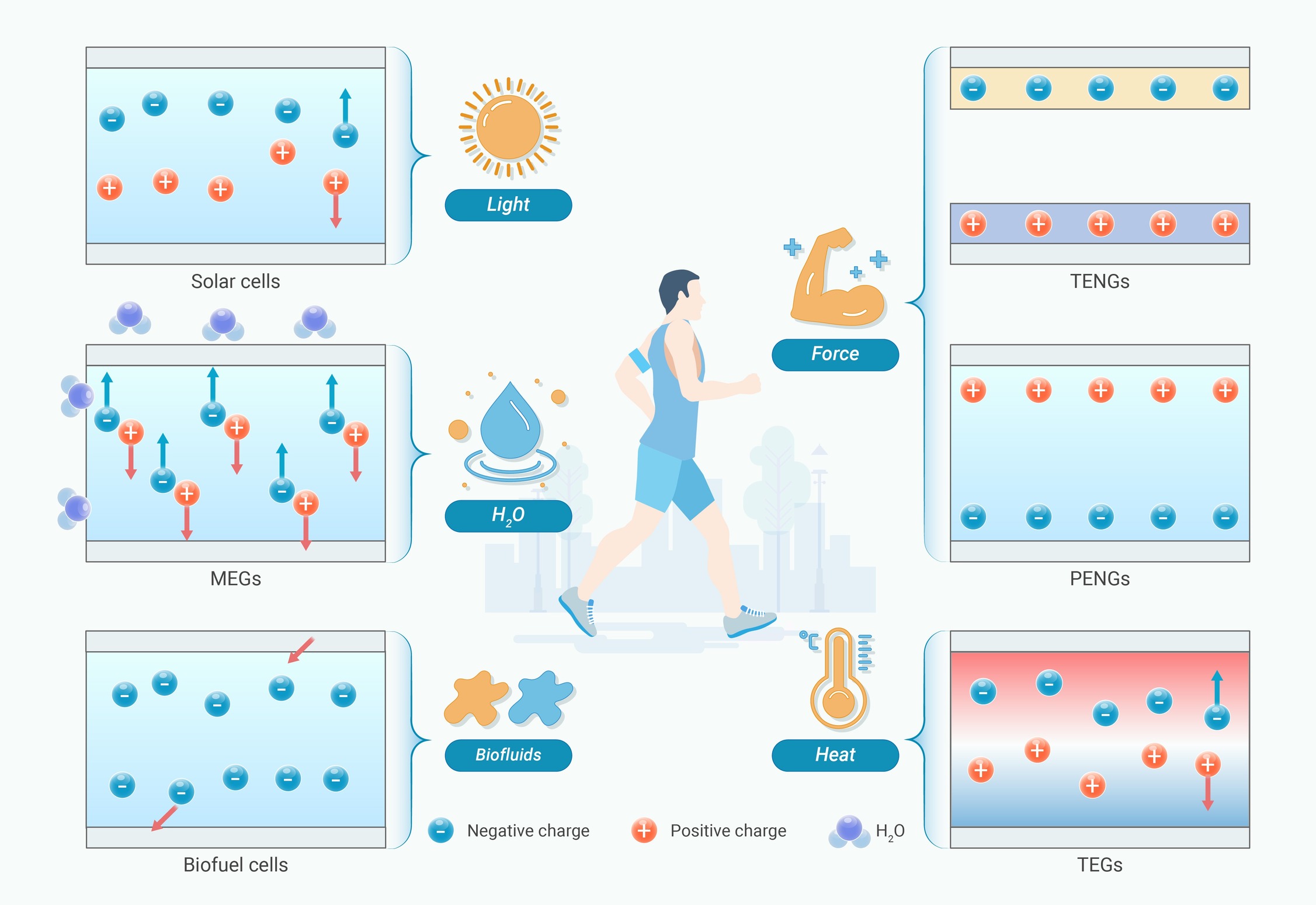
Figure 1.
Various energy sources for the power generations.
-
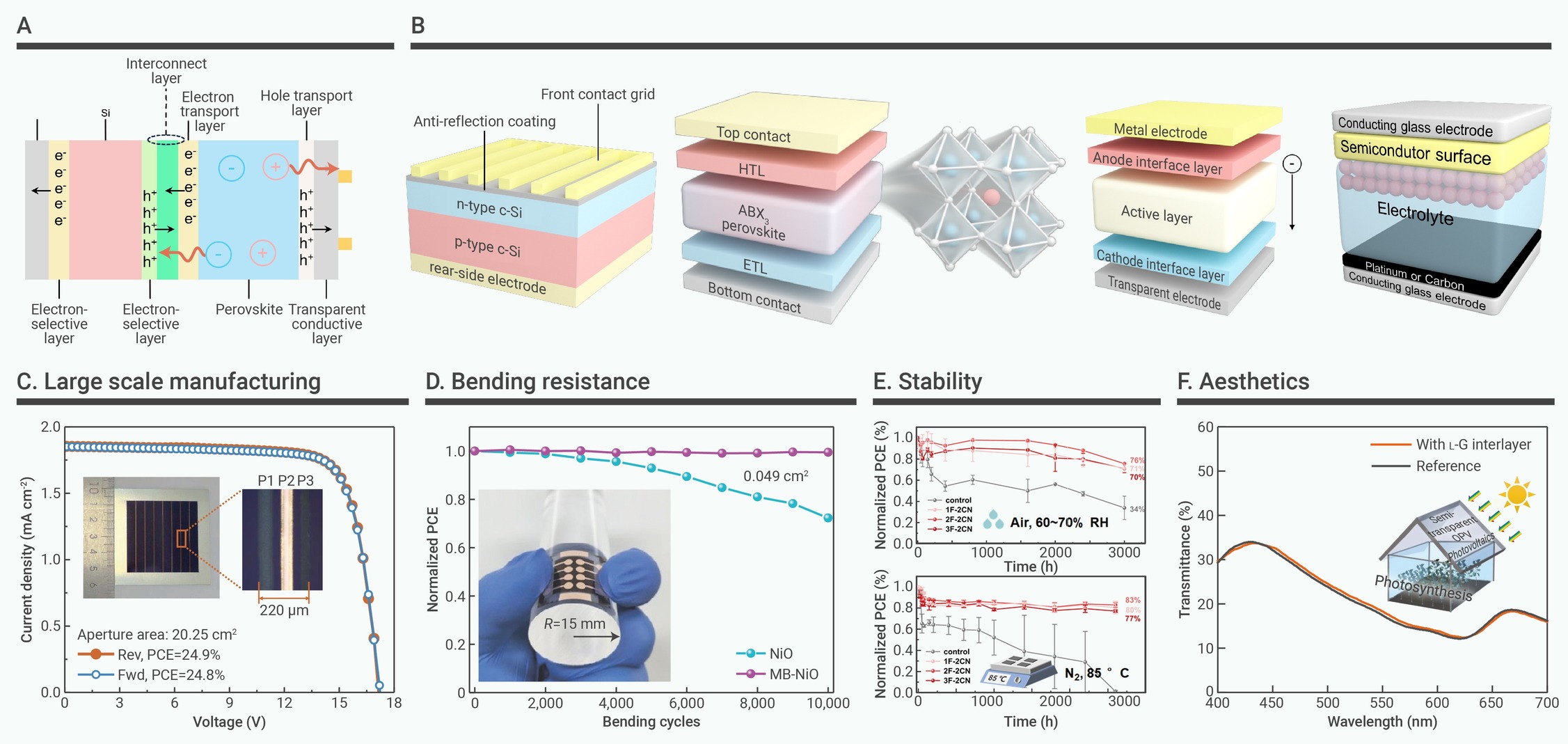
Figure 2.
The principle, structure, challenges, and solutions of solar cells
-
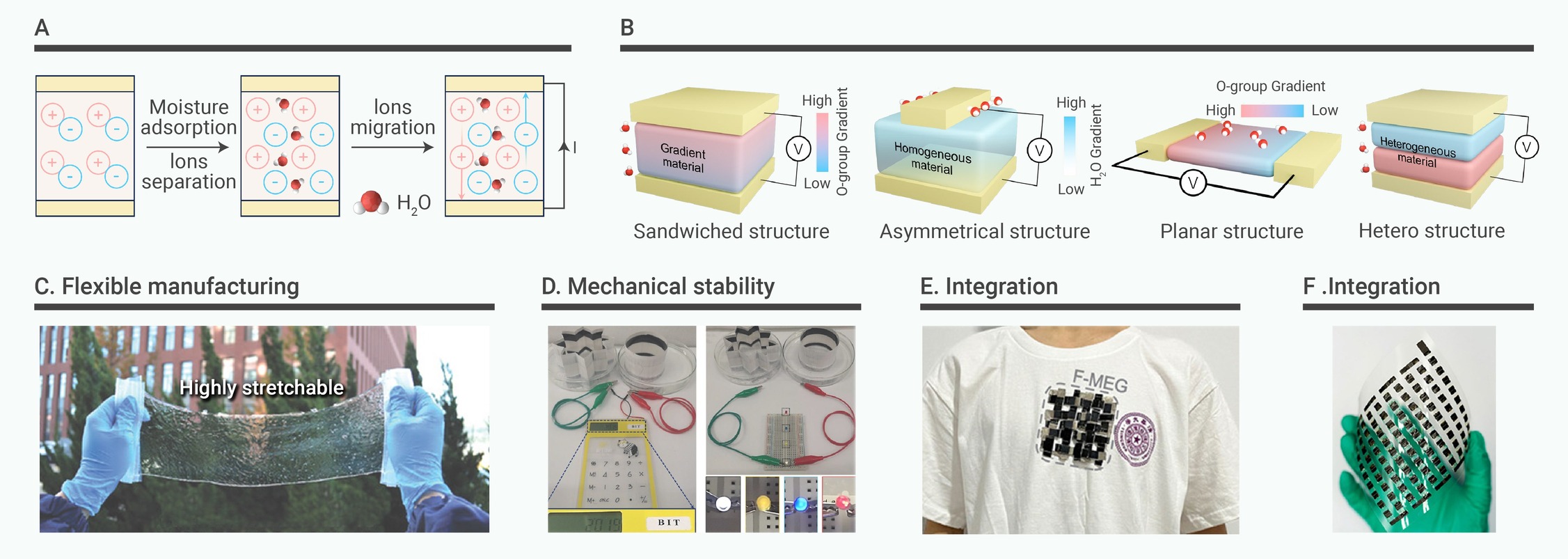
Figure 3.
The principle, structure, challenges, and solutions of MEGs
-
Figure 4.
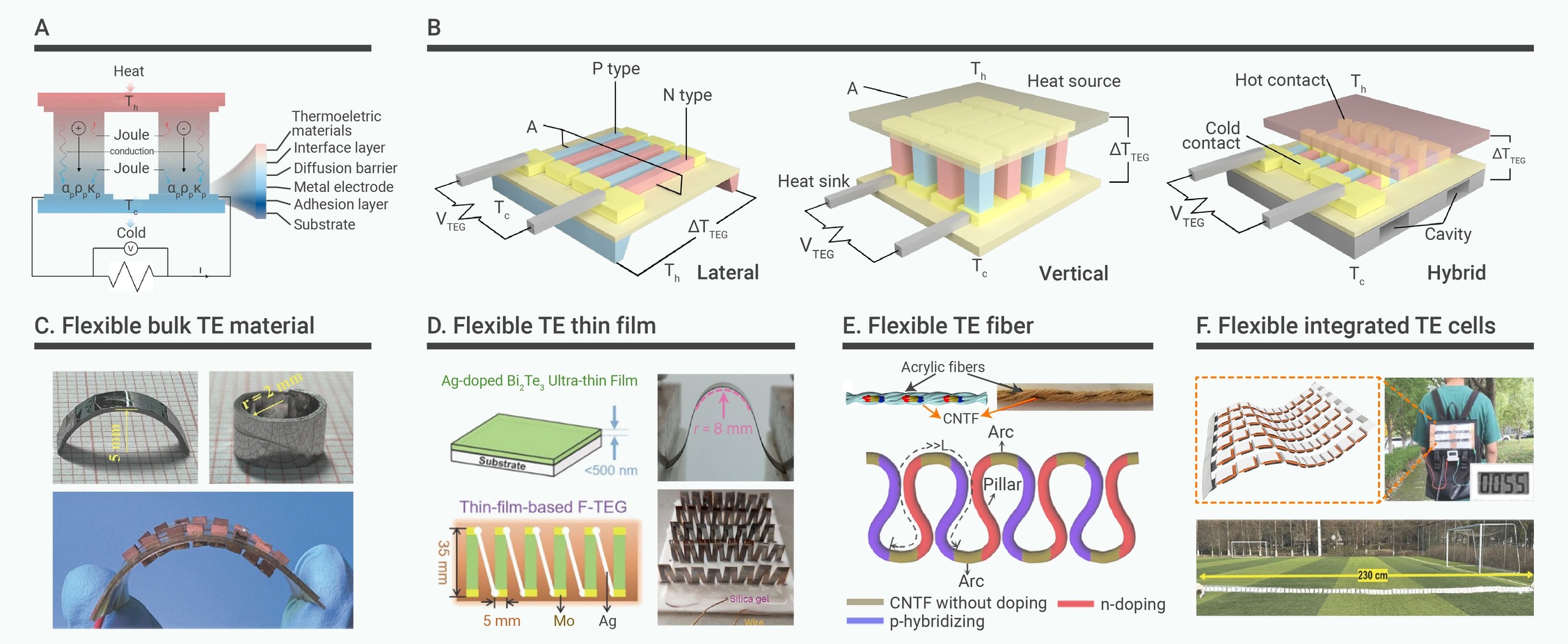
The principle, structure of TEGs and different flexible TE materials
-
Figure 5.
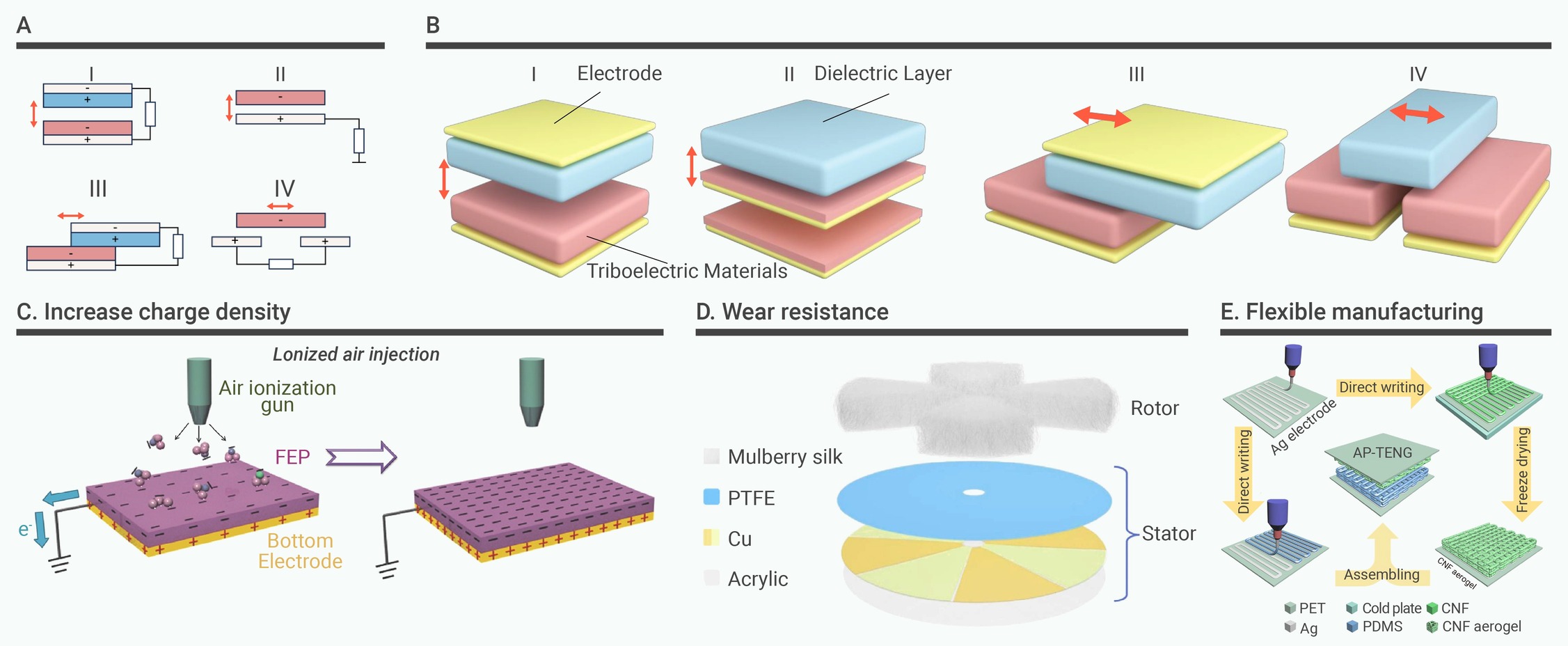
The principle, structure, challenges, and solutions of TENGs
-
Figure 6.
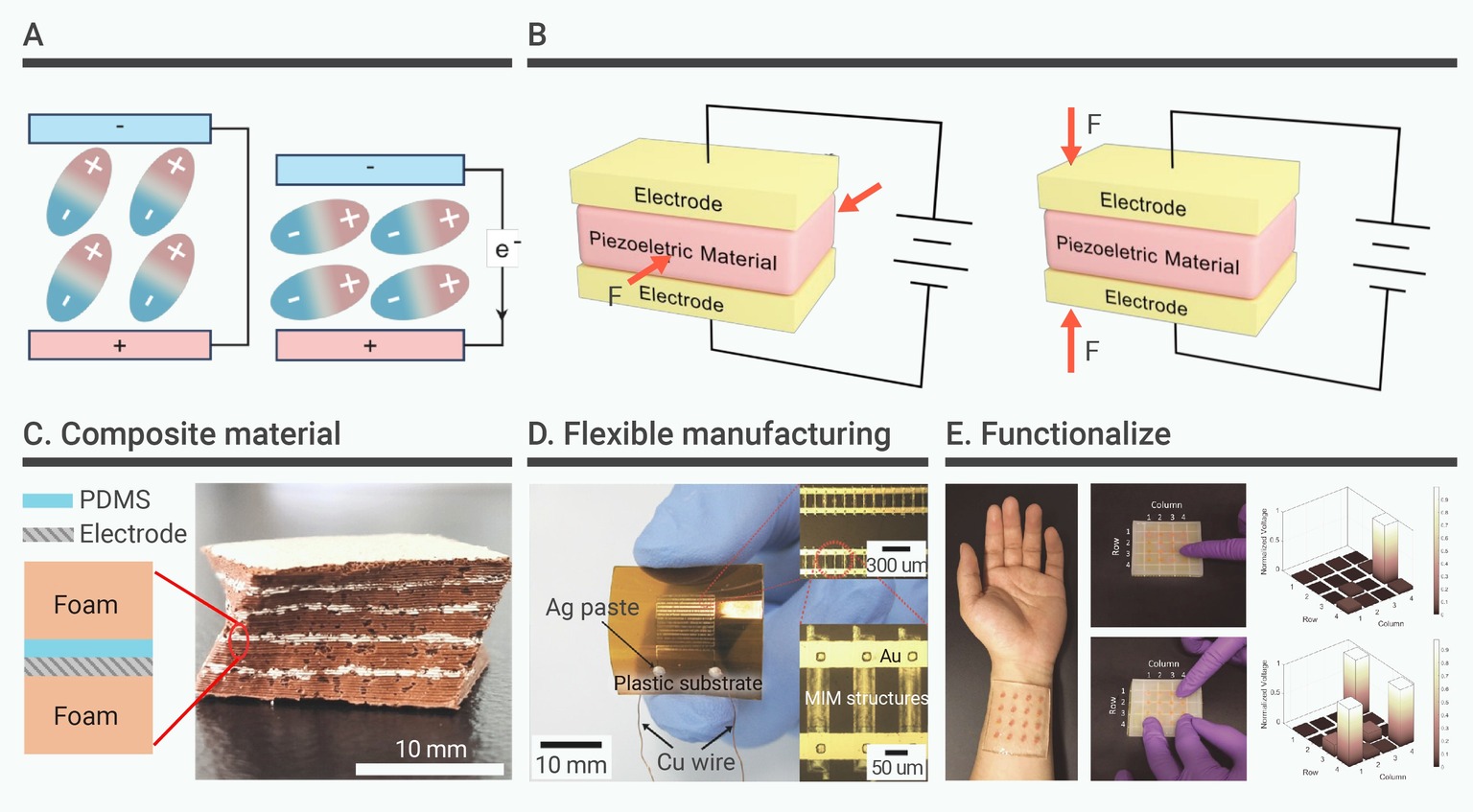
The principle, structure, challenges, and solutions of PENGs
-
Figure 7.
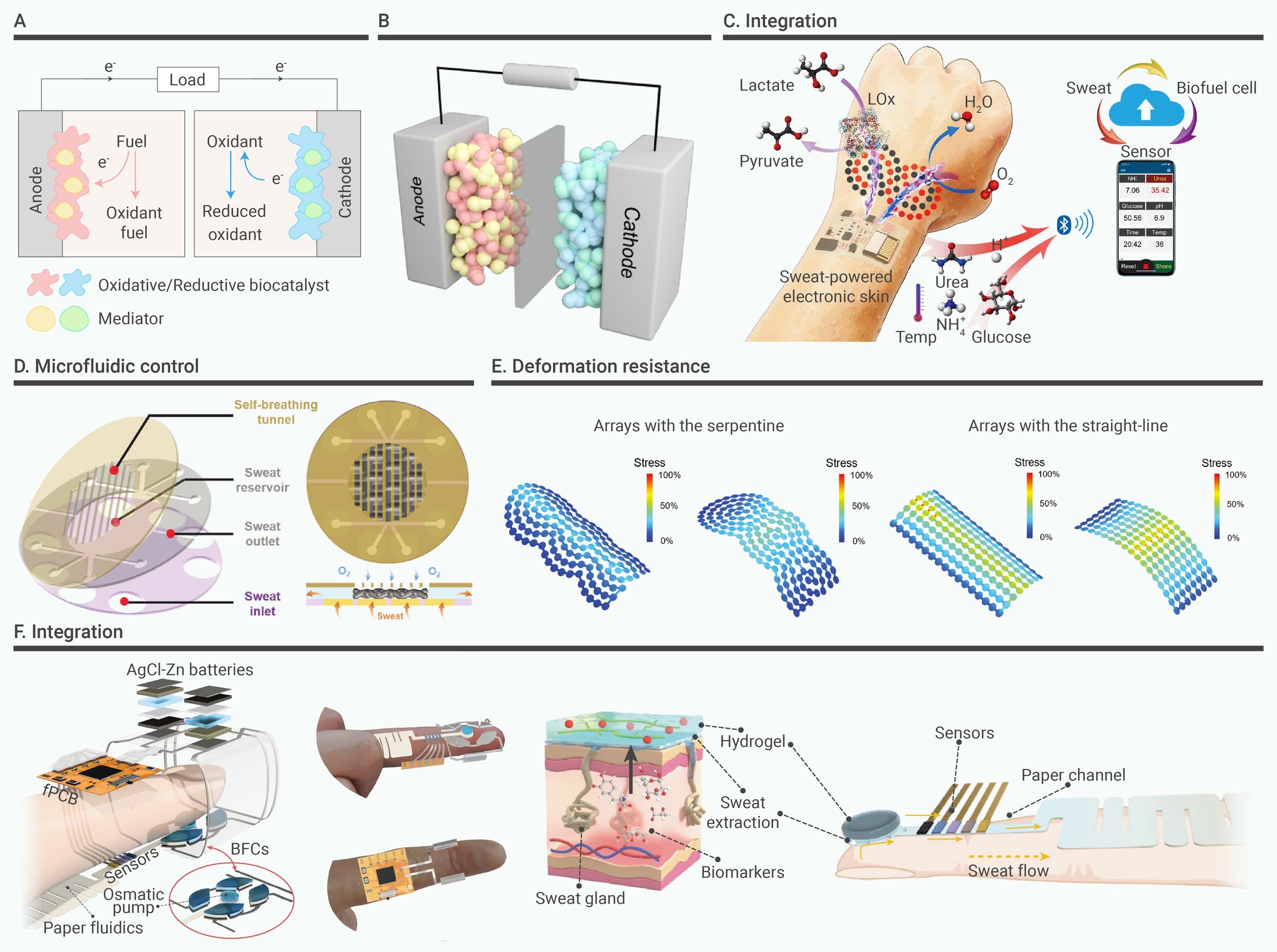
The principle, structure, challenges, and solutions of BFCs
-
Figure 8.
Application of self-powered wearables in environmental monitoring field
-
Figure 9.
Application of self-powered wearables in human body field
-
Figure 10.
Application of self-powered wearables in human-computer interaction field
