
Engineered stereomicrostructures enable tunable biodegradable adhesives
-

-
REFERENCES
[1] Sun X., Pang Z., Zhu Y., et al. (2023). All-cellulose hydrogel-based adhesive. Innov. Mater. 1:100040. DOI:10.59717/j.xinn-mater.2023.100040 [2] Pal S., Shin J., DeFrates K., et al. (2024). Recyclable surgical, consumer, and industrial adhesives of poly(α-lipoic acid). Science 385:877−883. DOI:10.1126/science.ado6292 [3] Westerman C. R., McGill B. C. and Wilker J. J. (2023). Sustainably sourced components to generate high-strength adhesives. Nature 621:306−311. DOI:10.1038/s41586-023-06335-7 [4] Westlie A. H., Quinn E. C., Parker C. R., et al. (2022). Synthetic biodegradable polyhydroxyalkanoates (PHAs): Recent advances and future challenges. Prog. Polym. Sci. 134:101608. DOI:10.1016/j.progpolymsci.2022.101608 [5] Zhang Z., Quinn E. C., Kenny J. K., et al. (2025). Stereomicrostructure-regulated biodegradable adhesives. Science 387:297−303. DOI:10.1126/science.adr7175 -
ABOUT THIS ARTICLE
Cite this article:
Zou S., Xiao L. and Sun R. (2025). Engineered stereomicrostructures enable tunable biodegradable adhesives. The Innovation Materials 3:100146. https://doi.org/10.59717/j.xinn-mater.2025.100146
Welcome!
To request copyright permission to republish or share portions of our works, please visit Copyright Clearance Center's (CCC) Marketplace website at marketplace.copyright.com.
Export File
Citation
Zou S., Xiao L. and Sun R. (2025). Engineered stereomicrostructures enable tunable biodegradable adhesives. The Innovation Materials 3:100146. https://doi.org/10.59717/j.xinn-mater.2025.100146

Format
Content
 DownLoad:
-
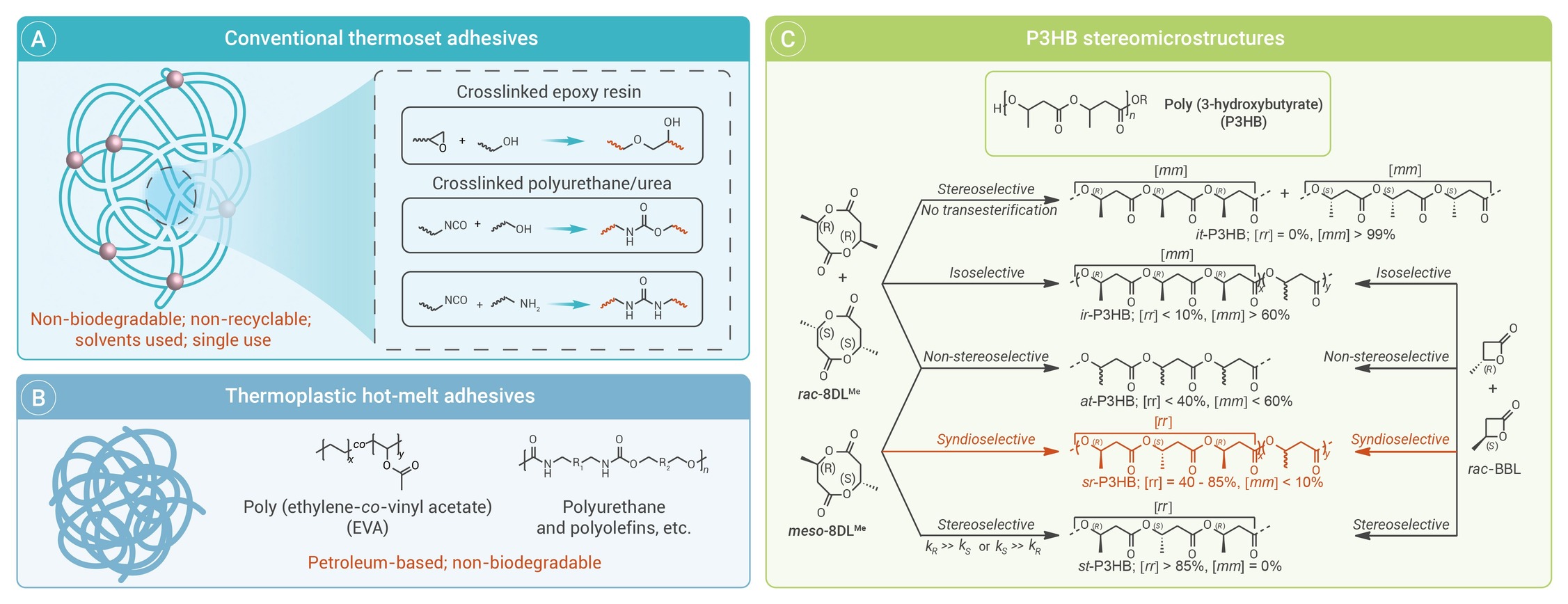
Figure 1.
Commercial adhesives and P3HB stereomicrostructures examined in this work
