
Orbital torque switching of perpendicular magnetization in Ti/ferrimagnet bilayers
-
GRAPHICAL ABSTRACT
 DownLoad:
Full size image
DownLoad:
Full size image
-
PUBLIC SUMMARY
-
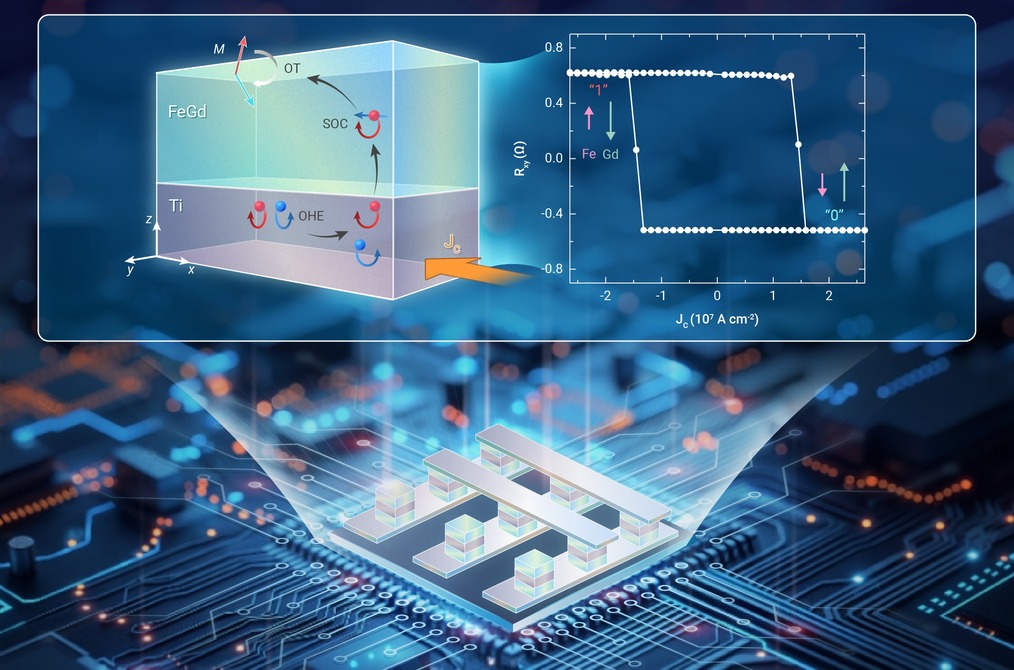
The orbital torque switching of perpendicular magnetization is achieved in Ti/ferrimagnet bilayer.
The current-induced orbital torque originates from the bulk orbital Hall effect in the light metal Ti.
The torque efficiency increases four-fold by enhancing the spin-orbit coupling in Fe1-xGdx ferrimagnets.
-
-
ABSTRACT
Orbital torque, associated with orbital current, enables light metals to efficiently manipulate magnetization with rich tunability. A clear demonstration of perpendicular magnetization switching using light metals alone is essential for understanding orbital physics and developing high-density orbitronic devices. Here, we report orbital torque switching of perpendicular magnetization of ferrimagnet (Fe1-xGdx) using Ti 3d light metal alone. The torque efficiency increases four-fold by enhancing the spin-orbit coupling in Fe1-xGdx through modulating Gd composition, which is a characteristic feature of orbital torque. Our findings demonstrate that light metals in combination with rare earth-transition metal ferrimagnets can be employed for efficient orbitronic devices and serve as a model system for studying orbitronics. -

-
REFERENCES
[1] Žutić I., Fabian J. and Das Sarma S. (2004). Spintronics: Fundamentals and applications. Rev. Mod. Phys. 76:323−410. DOI:10.1103/RevModPhys.76.323 [2] Fert A. (2008). Nobel lecture: Origin, development, and future of spintronics. Rev. Mod. Phys. 80:1517−1530. DOI:10.1103/RevModPhys.80.1517 [3] Fert A., Ramesh R., Garcia V., et al. (2024). Electrical control of magnetism by electric field and current-induced torques. Rev. Mod. Phys. 96:015005. DOI:10.1103/RevModPhys.96.015005 [4] Manchon A., Železný J., Miron I. M., et al. (2019). Current-induced spin-orbit torques in ferromagnetic and antiferromagnetic systems. Rev. Mod. Phys. 91:035004. DOI:10.1103/RevModPhys.91.035004 [5] Han X., Wang X., Wan C., et al. (2021). Spin-orbit torques: materials, physics, and devices. Appl. Phys. Lett. 118:120502. DOI:10.1063/5.0039147 [6] Song C., Zhang R., Liao L., et al. (2021). Spin-orbit torques: Materials, mechanisms, performances, and potential applications. Prog. Mater Sci. 118:100761. DOI:10.1016/j.pmatsci.2020.100761 [7] Shao Q., Li P., Liu L., et al. (2021). Roadmap of spin–orbit torques. IEEE Trans. Magn. 57:1−39. DOI:10.1109/TMAG.2021.3078583 [8] Bernevig B. A., Hughes T. L. and Zhang S.-C. (2005). Orbitronics: The intrinsic orbital current in p-doped Silicon. Phys. Rev. Lett. 95:066601. DOI:10.1103/PhysRevLett.95.066601 [9] Go D., Jo D., Lee H.-W., et al. (2021). Orbitronics: Orbital currents in solids. Eur. Phys. Lett. 135:37001. DOI:10.1209/0295-5075/ac2653 [10] Jo D., Go D., Choi G.-M., et al. (2024). Spintronics meets orbitronics: Emergence of orbital angular momentum in solids. npj Spintronics 2:19. DOI:10.1038/s44306-024-00023-6 [11] Tanaka T., Kontani H., Naito M., et al. (2008). Intrinsic spin Hall effect and orbital Hall effect in 4d and 5d transition metals. Phys. Rev. B 77:165117. DOI:10.1103/PhysRevB.77.165117 [12] Kontani H., Tanaka T., Hirashima D. S., et al. (2009). Giant orbital Hall effect in transition metals: Origin of large spin and anomalous Hall effects. Phys. Rev. Lett. 102:016601. DOI:10.1103/PhysRevLett.102.016601 [13] Kontani H., Tanaka T., Hirashima D. S., et al. (2008). Giant intrinsic spin and orbital Hall effects in Sr2MO4 (M=Ru, Rh, Mo). Phys. Rev. Lett. 100:096601. DOI:10.1103/PhysRevLett.100.096601 [14] Go D., Jo D., Kim C., et al. (2018). Intrinsic spin and orbital Hall effects from orbital texture. Phys. Rev. Lett. 121:086602. DOI:10.1103/PhysRevLett.121.086602 [15] Jo D., Go D. and Lee H.-W. (2018). Gigantic intrinsic orbital Hall effects in weakly spin-orbit coupled metals. Phys. Rev. B 98:214405. DOI:10.1103/PhysRevB.98.214405 [16] Sala G. and Gambardella P. (2022). Giant orbital Hall effect and orbital-to-spin conversion in 3d, 5d, and 4f metallic heterostructures. Physical Review Research 4:033037. DOI:10.1103/PhysRevResearch.4.033037 [17] Go D. and Lee H.-W. (2020). Orbital torque: torque generation by orbital current injection. Phys. Rev. Res. 2:013177. DOI:10.1103/PhysRevResearch.2.013177 [18] Go D., Jo D., Kim K.-W., et al. (2023). Long-range orbital torque by momentum-space hotspots. Phys. Rev. Lett. 130:246701. DOI:10.1103/PhysRevLett.130.246701 [19] Go D., Freimuth F., Hanke J.-P., et al. (2020). Theory of current-induced angular momentum transfer dynamics in spin-orbit coupled systems. Phys. Rev. Res. 2:033401. DOI:10.1103/PhysRevResearch.2.033401 [20] Ding S., Ross A., Go D., et al. (2020). Harnessing orbital-to-spin conversion of interfacial orbital currents for efficient spin-orbit torques. Phys. Rev. Lett. 125:177201. DOI:10.1103/PhysRevLett.125.177201 [21] Lee D., Go D., Park H.-J., et al. (2021). Orbital torque in magnetic bilayers. Nat. Commun. 12:6710. DOI:10.1038/s41467-021-26650-9 [22] Li T., Liu L., Li X., et al. (2023). Giant orbital-to-spin conversion for efficient current-induced magnetization switching of ferrimagnetic insulator. Nano Lett. 23:7174−7179. DOI:10.1021/acs.nanolett.3c02104 [23] Hayashi H., Jo D., Go D., et al. (2023). Observation of long-range orbital transport and giant orbital torque. Commun. Phys. 6:32. DOI:10.1038/s42005-023-01139-7 [24] Hayashi H., Go D., Haku S., et al. (2024). Observation of orbital pumping. Nat. Electron. DOI:10.1038/s41928-024-01193-1. [25] Choi Y.-G., Jo D., Ko K.-H., et al. (2023). Observation of the orbital Hall effect in a light metal Ti. Nature 619:52−56. DOI:10.1038/s41586-023-06101-9 [26] Lyalin I., Alikhah S., Berritta M., et al. (2023). Magneto-optical detection of the orbital Hall effect in chromium. Phys. Rev. Lett. 131:156702. DOI:10.1103/PhysRevLett.131.156702 [27] Bose A., Kammerbauer F., Gupta R., et al. (2023). Detection of long-range orbital-Hall torques. Phys. Rev. B 107:134423. DOI:10.1103/PhysRevB.107.134423 [28] Moriya H., Taniguchi M., Jo D., et al. (2024). Observation of long-range current-induced torque in Ni/Pt bilayers. Nano Lett. 24:6459−6464. DOI:10.1021/acs.nanolett.3c05102 [29] Ding S., Kang M.-G., Legrand W., et al. (2024). Orbital torque in rare-earth transition-metal ferrimagnets. Phys. Rev. Lett. 132:236702. DOI:10.1103/PhysRevLett.132.236702 [30] Wang P., Feng Z., Yang Y., et al. (2023). Inverse orbital Hall effect and orbitronic terahertz emission observed in the materials with weak spin-orbit coupling. npj Quantum Mater. 8:28. DOI:10.1038/s41535-023-00559-6 [31] Salemi L. and Oppeneer P. M. (2022). First-principles theory of intrinsic spin and orbital Hall and Nernst effects in metallic monoatomic crystals. Phys. Rev. Mater. 6:095001. DOI:10.1103/PhysRevMaterials.6.095001 [32] Zheng Z. C., Guo Q. X., Jo D., et al. (2020). Magnetization switching driven by current-induced torque from weakly spin-orbit coupled Zr. Phys. Rev. Res. 2:013127. DOI:10.1103/PhysRevResearch.2.013127 [33] Xie H., Zhang N., Ma Y., et al. (2023). Efficient noncollinear antiferromagnetic state switching induced by the orbital Hall effect in chromium. Nano Lett. 23:10274−10281. DOI:10.1021/acs.nanolett.3c02797 [34] Zheng Z., Zeng T., Zhao T., et al. (2024). Effective electrical manipulation of a topological antiferromagnet by orbital torques. Nat. Commun. 15:745. DOI:10.1038/s41467-024-45109-1 [35] Yang Y., Wang P., Chen J., et al. (2024). Orbital torque switching in perpendicularly magnetized materials. Nat. Commun. 15:8645. DOI:10.1038/s41467-024-52824-2 [36] Hayashi H., Go D., Haku S., et al. (2024). Observation of orbital pumping. Nat. Electron. 7:646−652. DOI:10.1038/s41928-024-01193-1 [37] Finley J. and Liu L. (2020). Spintronics with compensated ferrimagnets. Appl. Phys. Lett. 116:110501. DOI:10.1063/1.5144076 [38] Zhou H.-A., Xu T., Bai H., et al. (2021). Efficient Spintronics with fully compensated ferrimagnets. J. Phys. Soc. Jpn. 90:081006. DOI:10.7566/JPSJ.90.081006 [39] Kim S. K., Beach G. S. D., Lee K.-J., et al. (2022). Ferrimagnetic spintronics. Nat. Mater. 21:24−34. DOI:10.1038/s41563-021-01139-4 [40] Yu G., Upadhyaya P., Fan Y., et al. (2014). Switching of perpendicular magnetization by spin–orbit torques in the absence of external magnetic fields. Nat. Nanotechnol. 9:548−554. DOI:10.1038/nnano.2014.94 [41] Liu L., Zhao T., Lin W., et al. (2023). Symmetry breaking for current-induced magnetization switching. Appl. Physc. Rev. 10:021319. DOI:10.1063/5.0149290 [42] Miron I. M., Garello K., Gaudin G., et al. (2011). Perpendicular switching of a single ferromagnetic layer induced by in-plane current injection. Nature 476:189−193. DOI:10.1038/nature10309 [43] Liu L., Lee O. J., Gudmundsen T. J., et al. (2012). Current-induced switching of perpendicularly magnetized magnetic layers using spin torque from the spin Hall effect. Phys. Rev. Lett. 109:096602. DOI:10.1103/PhysRevLett.109.096602 [44] Liu L., Pai C.-F., Li Y., et al. (2012). Spin-torque switching with the giant spin Hall effect of Tantalum. Science 336:555. DOI:10.1126/science.1218197 [45] Lee J. W., Park J. Y., Yuk J. M., et al. (2020). Spin-orbit torque in a perpendicularly magnetized ferrimagnetic TbCo single layer. Phys. Rev. Appl. 13:044030. DOI:10.1103/PhysRevApplied.13.044030 [46] Zheng Z., Zhang Y., Lopez-Dominguez V., et al. (2021). Field-free spin-orbit torque-induced switching of perpendicular magnetization in a ferrimagnetic layer with a vertical composition gradient. Nat. Commun. 12:4555. DOI:10.1038/s41467-021-24854-7 [47] Liu Q., Zhu L., Zhang X. S., et al. (2022). Giant bulk spin–orbit torque and efficient electrical switching in single ferrimagnetic FeTb layers with strong perpendicular magnetic anisotropy. Appl. Physc. Rev. 9:021402. DOI:10.1063/5.0087260 [48] Krishnia S., Haltz E., Berges L., et al. (2021). Spin-orbit coupling in single-Layer ferrimagnets: direct observation of spin-orbit torques and chiral spin textures. Phys. Rev. Appl. 16:024040. DOI:10.1103/PhysRevApplied.16.024040 [49] Nguyen M.-H., Ralph D. C. and Buhrman R. A. (2016). Spin torque study of the spin Hall conductivity and spin diffusion length in Platinum thin films with varying resistivity. Phys. Rev. Lett. 116:126601. DOI:10.1103/PhysRevLett.116.126601 [50] Zhu L., Ralph D. C. and Buhrman R. A. (2021). Maximizing spin-orbit torque generated by the spin Hall effect of Pt. Appl. Physc. Rev. 8:031308. DOI:10.1063/5.0059171 [51] Xu T., Cheng Y., Dong Y., et al. (2023). Evolution of compensated magnetism and spin-torque switching in ferrimagnetic Fe1-xTbx. Phys. Rev. Appl. 19:034088. DOI:10.1103/PhysRevApplied.19.034088 [52] Lyalin I. and Kawakami R. K. (2024). Interface transparency to orbital current. Phys. Rev. B 110:104418. DOI:10.1103/PhysRevB.110.104418 [53] Hayashi M., Kim J., Yamanouchi M., et al. (2014). Quantitative characterization of the spin-orbit torque using harmonic Hall voltage measurements. Phys. Rev. B 89:144425. DOI:10.1103/PhysRevB.89.144425 [54] Garello K., Miron I. M., Avci C. O., et al. (2013). Symmetry and magnitude of spin–orbit torques in ferromagnetic heterostructures. Nat. Nanotechnol. 8:587−593. DOI:10.1038/nnano.2013.145 [55] Kim J., Sinha J., Hayashi M., et al. (2013). Layer thickness dependence of the current-induced effective field vector in Ta/CoFeB/MgO. Nat. Mater. 12:240−245. DOI:10.1038/nmat3522 [56] Avci C. O., Garello K., Gabureac M., et al. (2014). Interplay of spin-orbit torque and thermoelectric effects in ferromagnet/normal-metal bilayers. Phys. Rev. B 90:224427. DOI:10.1103/PhysRevB.90.224427 [57] Fan Y., Upadhyaya P., Kou X., et al. (2014). Magnetization switching through giant spin–orbit torque in a magnetically doped topological insulator heterostructure. Nat. Mater. 13:699−704. DOI:10.1038/nmat3973 [58] Shao Q., Yu G., Lan Y.-W., et al. (2016). Strong Rashba-Edelstein effect-induced spin–orbit torques in monolayer transition metal dichalcogenide/ferromagnet bilayers. Nano Lett. 16:7514−7520. DOI:10.1021/acs.nanolett.6b03300 [59] Wu H., Xu Y., Deng P., et al. (2019). Spin-orbit torque switching of a nearly compensated ferrimagnet by topological surface states. Adv. Mater. 31:1901681. DOI:10.1002/adma.201901681 [60] Wu H., Zhang P., Deng P., et al. (2019). Room-temperature spin-orbit torque from topological surface states. Phys. Rev. Lett. 123:207205. DOI:10.1103/PhysRevLett.123.207205 [61] Park S. R., Kim C. H., Yu J., et al. (2011). Orbital-angular-momentum based origin of Rashba-type surface band splitting. Phys. Rev. Lett. 107:156803. DOI:10.1103/PhysRevLett.107.156803 [62] Park J.-H., Kim C. H., Rhim J.-W., et al. (2012). Orbital Rashba effect and its detection by circular dichroism angle-resolved photoemission spectroscopy. Phys. Rev. B 85:195401. DOI:10.1103/PhysRevB.85.195401 [63] Go D., Hanke J.-P., Buhl P. M., et al. (2017). Toward surface orbitronics: giant orbital magnetism from the orbital Rashba effect at the surface of sp-metals. Sci. Rep. 7:46742. DOI:10.1038/srep46742 [64] Go D., Jo D., Gao T., et al. (2021). Orbital Rashba effect in a surface-oxidized Cu film. Phys. Rev. B 103:L121113. DOI:10.1103/PhysRevB.103.L121113 [65] Finley J. and Liu L. (2016). Spin-orbit-torque efficiency in compensated ferrimagnetic Cobalt-Terbium alloys. Phys. Rev. Appl. 6:054001. DOI:10.1103/PhysRevApplied.6.054001 [66] Mishra R., Yu J., Qiu X., et al. (2017). Anomalous current-induced spin torques in ferrimagnets near compensation. Phys. Rev. Lett. 118:167201. DOI:10.1103/PhysRevLett.118.167201 [67] Baek S.-h. C., Amin V. P., Oh Y.-W., et al. (2018). Spin currents and spin–orbit torques in ferromagnetic trilayers. Nat. Mater. 17:509−513. DOI:10.1038/s41563-018-0041-5 -
ABOUT THIS ARTICLE
Cite this article:
Xu T., Tang A., Wang K., et al. (2025). Orbital torque switching of perpendicular magnetization in Ti/ferrimagnet bilayers. The Innovation Materials 3:100158. https://doi.org/10.59717/j.xinn-mater.2025.100158
Welcome!
To request copyright permission to republish or share portions of our works, please visit Copyright Clearance Center's (CCC) Marketplace website at marketplace.copyright.com.
Article Metrics
Relative Articles
Cited by
Export File
Citation
Xu T., Tang A., Wang K., et al. (2025). Orbital torque switching of perpendicular magnetization in Ti/ferrimagnet bilayers. The Innovation Materials 3:100158. https://doi.org/10.59717/j.xinn-mater.2025.100158

Format
Content
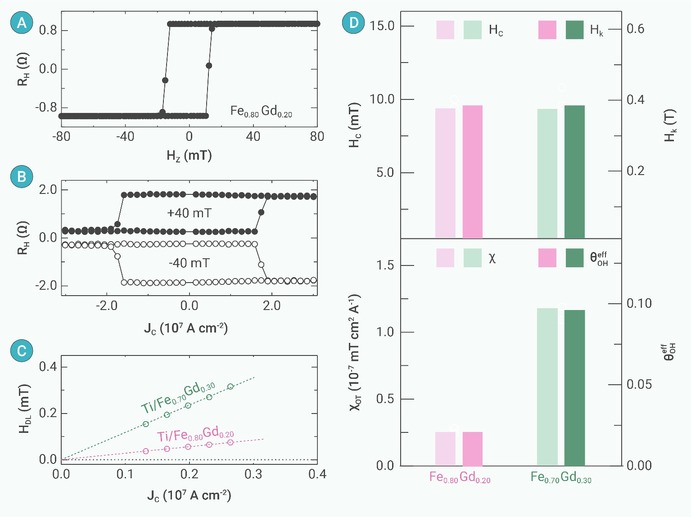
-
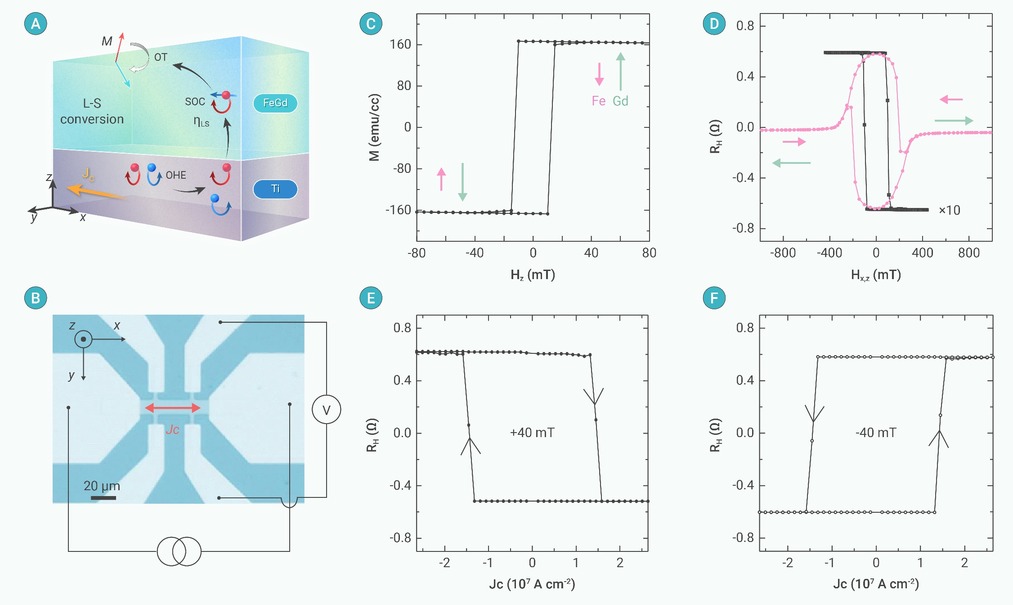
Figure 1.
Perpendicular magnetization switching with Ti
-
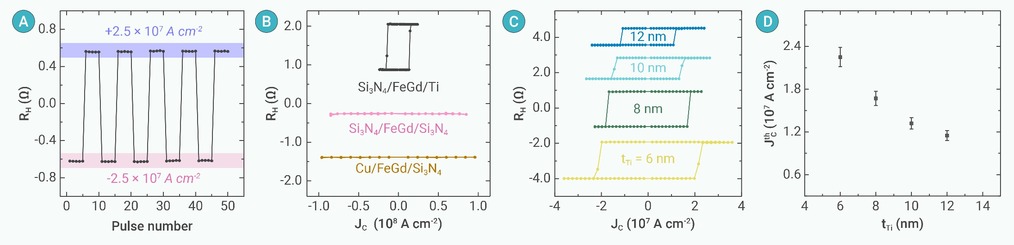
Figure 2.
Thickness dependence of the orbital torque switching
-
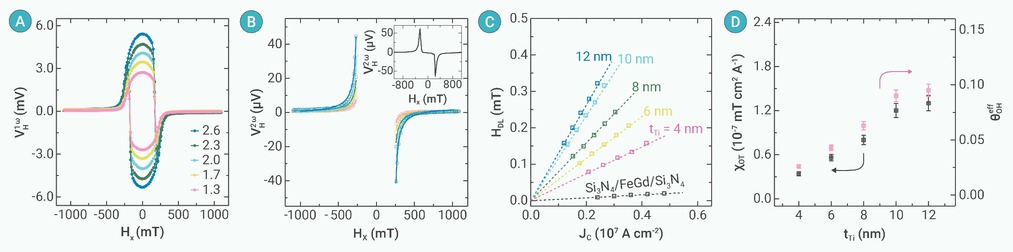
Figure 3.
Determination of orbital torque efficiency
-
Figure 4.
Correlation between orbital torque and spin-orbit coupling
