
From automation to autonomy: Embracing multimodal intelligence in materials discovery
-

-
REFERENCES
[1] Yao Y., Dong Q., Brozena A., et al. High-entropy nanoparticles: Synthesis-structure-property relationships and data-driven discovery. Science 376:eabn3103. DOI:10.1126/science.abn3103 [2] Szymanski N. J., Rendy B., Fei Y., et al. (2023). An autonomous laboratory for the accelerated synthesis of novel materials. Nature 624:86−91. DOI:10.1038/s41586-023-06734-w [3] Coley C. W., Thomas D. A., Lummiss J. A. M., et al. (2019). A robotic platform for flow synthesis of organic compounds informed by AI planning. Science 365:eaax1566. DOI:10.1126/science.aax1566 [4] Zhang Z., Ren Z., Hsu C.-W., et al. (2025). A multimodal robotic platform for multi-element electrocatalyst discovery. Nature 647:390–396. DOI:10.1038/s41586-025-09640-5 [5] Boiko D. A., MacKnight R., Kline B., et al. (2023). Autonomous chemical research with large language models. Nature 624:570−578. DOI:10.1038/s41586-023-06792-0 -
ABOUT THIS ARTICLE
Cite this article:
Liu H. and Yao Y. (2026). From automation to autonomy: Embracing multimodal intelligence in materials discovery. The Innovation Materials 4:100178. https://doi.org/10.59717/j.xinn-mater.2026.100178
Welcome!
To request copyright permission to republish or share portions of our works, please visit Copyright Clearance Center's (CCC) Marketplace website at marketplace.copyright.com.
Export File
Citation
Liu H. and Yao Y. (2026). From automation to autonomy: Embracing multimodal intelligence in materials discovery. The Innovation Materials 4:100178. https://doi.org/10.59717/j.xinn-mater.2026.100178

Format
Content
 DownLoad:
-
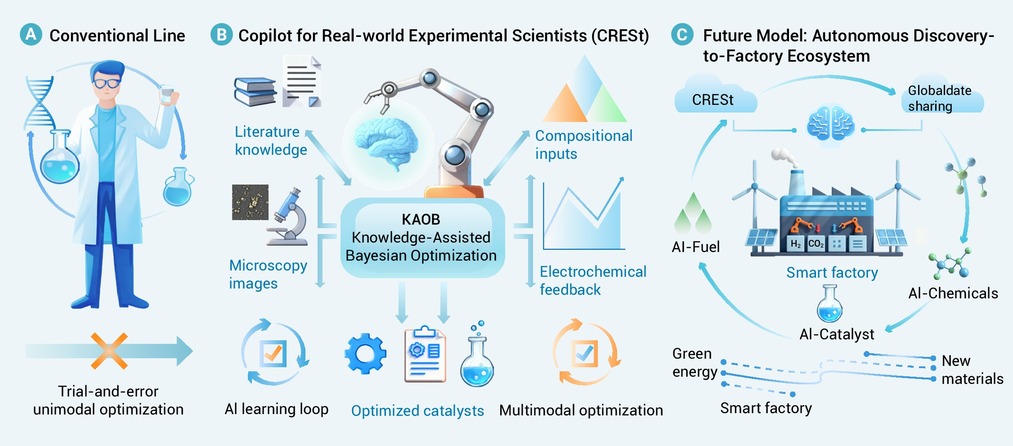
Figure 1.
Paradigm shift of catalyst discovery models
