
A femtotesla equivalent magnetic noise magnetoelectric sensor
-
GRAPHICAL ABSTRACT

 DownLoad:
Full size image
DownLoad:
Full size image
-
PUBLIC SUMMARY
-
We developed a magnetoelectric sensor achieving the equivalent magnetic noise of 927.8 fT/Hz1/2 at 1 Hz.
A multi-parameter synergistic optimization is proposed to guide the sensor design.
The multi-longitudinal-transverse mode laminates is utilized to significantly suppress the intrinsic noise.
-
-
ABSTRACT
The ability to detect weak magnetic fields at femtotesla (fT) levels remains a critical obstacle for advancing fields like biomedicine and cross-medium communication. Existing solutions have faced fundamental limitations in operation environments, power efficiency, and sensitivity. Magnetoelectric (ME) sensors offer promising room-temperature alternatives but suffer from intrinsic material noise and extrinsic circuit limitations. Here, we propose a multi-parameter synergistic optimization strategy bridging material design and circuit integration, and establish a theoretical framework for laminated ME composites analysis. Integrated theoretical modeling and experimental validation identify material noise and amplifier noise as dominant noise sources. We go beyond the constraints of material noise and develop multi-longitudinal-transverse (MLT) mode laminates, featuring longitudinally magnetized magnetostrictive layers and transversely polarized piezoelectric fibers connected electrically in series. Compared to LT-mode (longitudinal-transverse) laminates, this design shifts the effective impedance to a reduced equivalent capacitance and increased DC (Direct Current) resistance regime, enabling direct tuning of dielectric loss noise. A single MLT laminates comprising seven LT mode units in a series configuration, achieved an equivalent magnetic noise of 3.84 pT/Hz1/2 at 1 Hz. Multiple MLT laminates of parallel array configurations resulted in a threefold reduction in equivalent magnetic noise compared to the series array configuration. Further, by implementing eight MLT units of parallel array configurations, we achieved a record equivalent magnetic noise of 927.8 fT/Hz1/2 at 1 Hz—surpassing noise performance of fluxgates and approaching SQUID sensitivity without cryogenic requirements. -

-
REFERENCES
[1] Pannetier M., Fermon C., Le Goff G., et al. (2004). Femtotesla magnetic field measurement with magnetoresistive sensors. Science 304:1648−1650. DOI:10.1126/science.1096841 [2] Khan M. A., Sun J., Li B., et al. (2021). Magnetic sensors-A review and recent technologies. Eng. Res. Express 3:022005. DOI:10.1088/2631-8695/ac0838 [3] Dong C., Liang X., Gao J., et al. (2022). Thin film magnetoelectric sensors toward biomagnetism: Materials, devices, and applications. Adv. Electron. Mater. 8:2200013. DOI:10.1002/aelm.202200013 [4] Li J., Meng F., Chen S., et al. (2025). Aluminum Scandium Nitride based frequency-switchable acoustic devices for next-generation mobile communication. Innov. Mater. 3:100153. DOI:10.59717/j.xinn-mater.2025.100153 [5] Yao Z., Guan Z., Zhang S., et al. (2025). Towards energy-autonomous wearables: Multimodal harvesting technologies and sustainable applications. Innov. Mater. 3:100143. DOI:10.59717/j.xinn-mater.2025.100143 [6] Semenok D. V., Troyan I. A., Zhou D., et al. (2025). Observation of the Josephson effect in superhydrides: DC SQUID based on (La,Ce)H10+x with operating temperature of 179 K. Innov. Mater. 3:100115. DOI:10.59717/j.xinn-mater.2024.100115 [7] Eerenstein W., Mathur N. D. and Scott J. F. (2006). Multiferroic and magnetoelectric materials. Nature 442:759−765. DOI:10.1038/nature05023 [8] Nan C., Bichurin M. I., Dong S., et al. (2008). Multiferroic magnetoelectric composites: Historical perspective, status, and future directions. J. Appl. Phys. 103:031101. DOI:10.1063/1.2836410 [9] Ripka P. and Janosek M. (2010). Advances in magnetic field sensors. IEEE Sens. J. 10:1108−1116. DOI:10.1109/jsen.2010.2043429 [10] Wu H., Fu S., Wang S., et al. (2022). Electrical current visualization sensor based on magneto-electrochromic effect. Nano Energy 98:107226. DOI:10.1016/j.nanoen.2022.107226 [11] Cheng J., Jiao J., Fu S., et al. (2023). Ultra-high baud rate VLF magnetoelectric antenna based on Rosen-type composite. Appl. Phys. Lett. 123:072903. DOI:10.1063/5.0167170 [12] Fu S., Cheng J., Jiang T., et al. (2023). Bias-free very low frequency magnetoelectric antenna. Appl. Phys. Lett. 122:262901. DOI:10.1063/5.0158020 [13] Wu H., Jiang T., Liu Z., et al. (2023). Magneto-mechano-electric antenna for portable VLF transmission. Adv. Electron. Mater. 9:2300096. DOI:10.1002/aelm.202300096 [14] Fang Z., Jiao J., Wu H., et al. (2025). Crafting very low frequency magnetoelectric antenna via piezoelectric and electromechanical synergic optimization strategy. J. Materiomics 11:100900. DOI:10.1016/j.jmat.2024.05.010 [15] Viehland D., Wuttig M., McCord J., et al. (2018). Magnetoelectric magnetic field sensors. MRS Bull. 43:834−840. DOI:10.1557/mrs.2018.261 [16] Sreenivasulu G., Laletin U., Petrov V. M., et al. (2012). A permendur-piezoelectric multiferroic composite for low-noise ultrasensitive magnetic field sensors. Appl. Phys. Lett. 100:173506. DOI:10.1063/1.4705305 [17] Sreenivasulu G., Qu P., Petrov V., et al. (2016). Sensitivity enhancement in magnetic sensors based on ferroelectric-bimorphs and multiferroic composites. Sensors 16:262. DOI:10.3390/s16020262 [18] Turutin A. V., Vidal J. V., Kubasov I. V., et al. (2018). Low-frequency magnetic sensing by magnetoelectric Metglas/bidomain LiNbO3 long bars. J. Phys. D: Appl. Phys. 51:214001. DOI:10.1088/1361-6463/aabda4 [19] Thormählen L., Hayes P., Elzenheimer E., et al. (2024). Low-noise inverse magnetoelectric magnetic field sensor. Appl. Phys. Lett. 124:172402. DOI:10.1063/5.0196637 [20] Wang Y., Gao J., Li M., et al. (2014). A review on equivalent magnetic noise of magnetoelectric laminate sensors. Phil. Trans. R. Soc. A. 372:20120455. DOI:10.1098/rsta.2012.0455 [21] Liu Y., Jiao J., Li L., et al. (2014). Vibrational noise rejection in multilayer structured magnetoelectric sensor. Sens. Actuators A 211:15−18. DOI:10.1016/j.sna.2014.03.002 [22] Shen Y., Ma D. and Gao J. (2018). A man-portable magnetoelectric DC magnetic sensor with extremely high sensitivity. IEEE Electron Device Lett. 39:1417−1420. DOI:10.1109/led.2018.2858280 [23] Wang Y., Gray D., Berry D., et al. (2011). An extremely low equivalent magnetic noise magnetoelectric sensor. Adv. Mater. 23:4111−4114. DOI:10.1002/adma.201100773 [24] Wang Y., Li J. and Viehland D. (2014). Magnetoelectrics for magnetic sensor applications: status, challenges and perspectives. Mater. Today 17:269−275. DOI:10.1016/j.mattod.2014.05.004 [25] Petrie J., Viehland D., Gray D., et al. (2011). Enhancing the sensitivity of magnetoelectric sensors by increasing the operating frequency. J. Appl. Phys. 110:124506. DOI:10.1063/1.3668752 [26] Petrie J., Gray D., Viehland D., et al. (2012). Shifting the operating frequency of magnetoelectric sensors. J. Appl. Phys. 111:07C714. DOI:10.1063/1.3677840 [27] Sun C., Yang W., He Y., et al. (2022). Low-frequency magnetic field detection using magnetoelectric sensor with optimized Metglas layers by frequency modulation. IEEE Sens. J. 22:4028−4035. DOI:10.1109/jsen.2022.3143350 [28] Wang Y., Li J. and Viehland D. (2015). A differential magnetoelectric heterostructure: Internal noise reduction and external noise cancellation. J. Appl. Phys. 118:214103. DOI:10.1063/1.4936263 [29] Chu Z., Wang Y., Du Z., et al. (2024). Enhanced detection performance based on a differential ME sensor with strong suppression of vibration interference. Appl. Phys. Lett. 125:182901. DOI:10.1063/5.0232400 [30] Fetisov Y. K., Bush A. A., Kamentsev K. E., et al. (2006). Ferrite-piezoelectric multilayers for magnetic field sensors. IEEE Sens. J. 6:935−938. DOI:10.1109/jsen.2006.877989 [31] Das J., Gao J., Xing Z., et al. (2009). Enhancement in the field sensitivity of magnetoelectric laminate heterostructures. Appl. Phys. Lett. 95:092501. DOI:10.1063/1.3222914 [32] Xing Z., Zhai J., Gao J., et al. (2009). Magnetic-field sensitivity enhancement by magnetoelectric sensor arrays. IEEE Electron Device Lett. 30:445−447. DOI:10.1109/led.2009.2015342 [33] Jiao J., Li L., Ren B., et al. (2012). Parallel multilayer magnetoelectric composite based on (1−x)Pb(Mg1/3Nb2/3)−xPbTiO3 and Terfenol-D coupled with charge mode amplifier. J. Appl. Phys. 111:043909. DOI:10.1063/1.3681818 [34] Li M., Gao J., Wang Y., et al. (2012). Enhancement in magnetic field sensitivity and reduction in equivalent magnetic noise by magnetoelectric laminate stacks. J. Appl. Phys. 111:104504. DOI:10.1063/1.4718441 [35] Duc N. H. and Giang D. T. H. (2008). Magnetic sensors based on piezoelectric–magnetostrictive composites. J. Alloys Compd. 449:214−218. DOI:10.1016/j.jallcom.2006.01.121 [36] Gao J., Hasanyan D., Shen Y., et al. (2012). Giant resonant magnetoelectric effect in bi-layered Metglas/Pb(Zr,Ti)O3 composites. J. Appl. Phys. 112:104101. DOI:10.1063/1.4765724 [37] Li L., Jiao J., Chen J., et al. (2013). Magnetoelectric effect of the multi-push-pull mode in 0.35Pb(In1/2Nb1/2)O3-0.35Pb(Mg1/3Nb2/3)O3-0.30PbTiO3/Metglas magnetoelectric composite. J. Appl. Phys. 114:027011. DOI:10.1063/1.4812221. [38] Ma J., Jiao J., Fang C., et al. (2016). High sensitive nonlinear modulation magnetoelectric magnetic sensors with a magnetostrictive Metglas structure based on bell-shaped geometry. J. Magn. Magn. Mater. 405:225−230. DOI:10.1016/j.jmmm.2015.12.073 [39] Chu Z., Dong C., Tu C., et al. (2019). A low-power and high-sensitivity magnetic field sensor based on converse magnetoelectric effect. Appl. Phys. Lett. 115:162901. DOI:10.1063/1.5122774 [40] Shen L., Li M., Gao J., et al. (2011). Magnetoelectric nonlinearity in magnetoelectric laminate sensors. J. Appl. Phys. 110:114510. DOI:10.1063/1.3665130 [41] Xin Z., Sing M. L. C., Cordier C., et al. (2011). Evaluation of applied axial field modulation technique on ME sensor input equivalent magnetic noise rejection. IEEE Sens. J. 11:2266−2272. DOI:10.1109/jsen.2011.2131647 [42] Zhuang X., Lam Chok Sing M., Cordier C., et al. (2011). Analysis of noise in magnetoelectric thin-layer composites used as magnetic sensors. IEEE Sens. J. 11:2183−2188. DOI:10.1109/jsen.2011.2114648 [43] Bichurin M. I. and Petrov V. M. (2012). Modeling of magnetoelectric interaction in magnetostrictive-piezoelectric composites. Adv. Condens. Matter Phys. 2012:798310. DOI:10.1155/2012/798310 [44] Zhou H., Chen J., Fang Y., et al. (2023). Ultrasensitive modulated magnetoelectric sensors and low-noise readout circuits for DC and very low-frequency weak magnetic signal detection. IEEE Sens. J. 23:13019−13027. DOI:10.1109/jsen.2023.3269437 [45] Dong S. and Zhai J. (2008). Equivalent circuit method for static and dynamic analysis of magnetoelectric laminated composites. Sci. Bull. 53:2113−2123. DOI:10.1007/s11434-008-0304-7 [46] Fang C., Jiao J., Ma J., et al. (2015). Significant reduction of equivalent magnetic noise by in-plane series connection in magnetoelectric Metglas/Mn-doped Pb(Mg1/3Nb2/3)O3-PbTiO3 laminate composites. J. Phys. D: Appl. Phys. 48:465002. DOI:10.1088/0022-3727/48/46/465002 [47] Moriana A. D. and Zhang S. (2021). Enhancing electromechanical properties of Pb(Sc1/2Nb1/2)O3-PbZrO3-PbTiO3 piezoelectric ceramics via templated grain growth. Adv. Electron. Mater. 8:2100919. DOI:10.1002/aelm.202100919 -
ABOUT THIS ARTICLE
Cite this article:
Hu L., Jiao J., Fang Z., et al. (2026). A femtotesla equivalent magnetic noise magnetoelectric sensor. The Innovation Materials 4:100205. https://doi.org/10.59717/j.xinn-mater.2026.100205
Welcome!
To request copyright permission to republish or share portions of our works, please visit Copyright Clearance Center's (CCC) Marketplace website at marketplace.copyright.com.
Export File
Citation
Hu L., Jiao J., Fang Z., et al. (2026). A femtotesla equivalent magnetic noise magnetoelectric sensor. The Innovation Materials 4:100205. https://doi.org/10.59717/j.xinn-mater.2026.100205

Format
Content


-
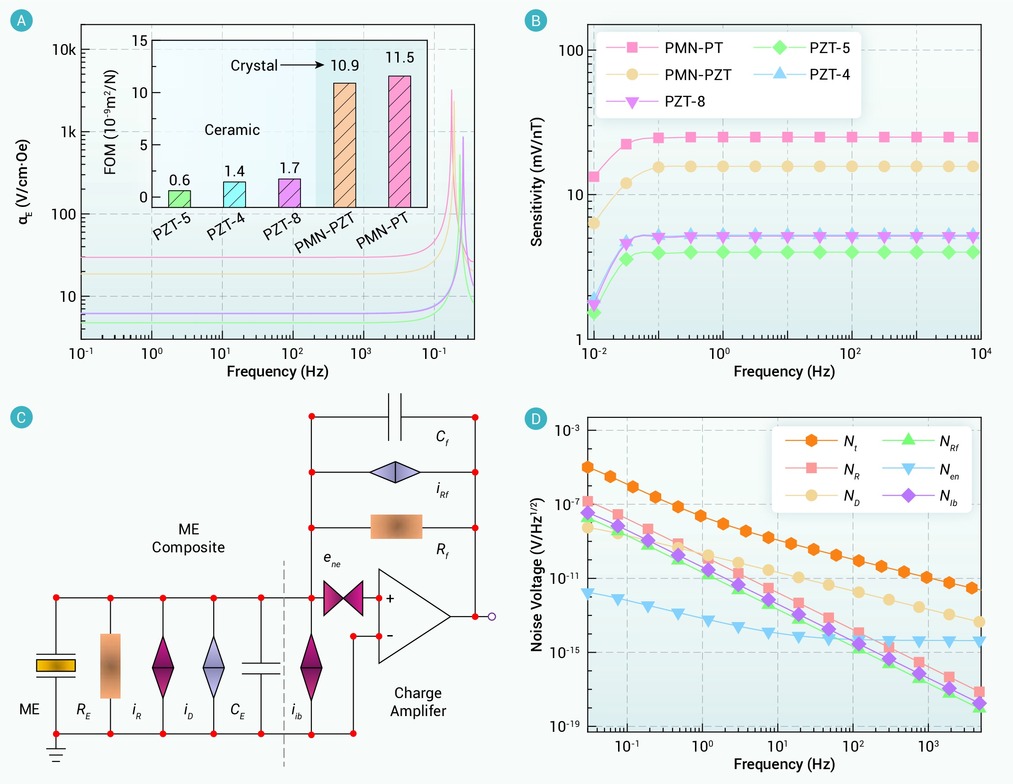
Figure 1.
Multi-parameter synergistic optimization and noise characterization of ME sensors
-
Figure 2.
MLT-mode ME laminates and strain-mediated ME coupling principle
-
Figure 3.
Performance characterization of ME laminates and sensor sensitivity
-
Figure 4.
Estimated noise and equivalent magnetic noise of ME sensor array of series or parallel configurations
-
Figure 5.
Magnetic noise spectrum, equivalent magnetic field characterization, and performance benchmarking of the magnetic sensor
