
Acoustically activatable liposomes: An innovative platform for targeted drug delivery and neuromodulation
-

-
REFERENCES
[1] Moradi Kashkooli F., Jakhmola A., Hornsby T.K., et al. (2023). Ultrasound-mediated nano drug delivery for treating cancer: Fundamental physics to future directions. J. Control Release 355:552−578. DOI:10.1016/j.jconrel.2023.02.009 [2] Sirsi S. R. and Borden M. A. (2014). State-of-the-art materials for ultrasound-triggered drug delivery. Adv. Drug Deliv. Rev. 72:3−14. DOI:10.1016/j.addr.2013.12.010 [3] Purohit M. P., Yu B. J., Roy K. S., et al. (2025). Acoustically activatable liposomes as a translational nanotechnology for site-targeted drug delivery and noninvasive neuromodulation. Nat. Nanotechnol. DOI: 10.1038/s41565-025-01990-5 [4] Mitragotri S. and Lahann J. (2009). Physical approaches to biomaterial design. Nat. Mater. 8:15−23. DOI:10.1038/nmat2344 -
ABOUT THIS ARTICLE
Cite this article:
Liu L., Chang M. and Chen Y. (2026). Acoustically activatable liposomes: An innovative platform for targeted drug delivery and neuromodulation. The Innovation Materials 4:100212. https://doi.org/10.59717/j.xinn-mater.2026.100212
Welcome!
To request copyright permission to republish or share portions of our works, please visit Copyright Clearance Center's (CCC) Marketplace website at marketplace.copyright.com.
Export File
Citation
Liu L., Chang M. and Chen Y. (2026). Acoustically activatable liposomes: An innovative platform for targeted drug delivery and neuromodulation. The Innovation Materials 4:100212. https://doi.org/10.59717/j.xinn-mater.2026.100212

Format
Content
 DownLoad:
-
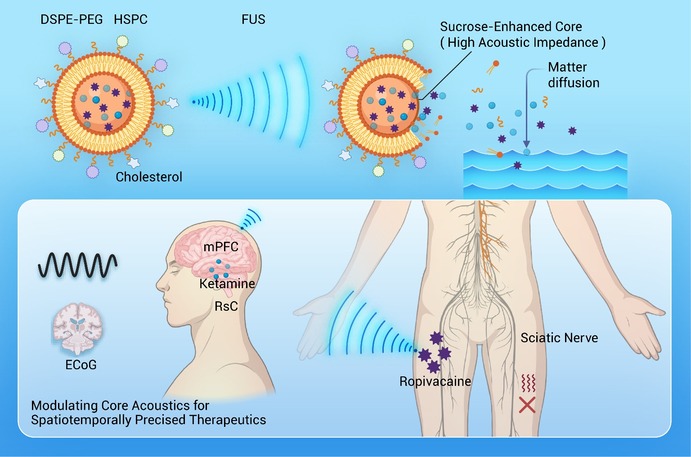
Figure 1.
This schematic diagram illustrates the working principle of AALs: after being activated by FUS
