
Accelerating the electric future: AI-driven Lithium-ion battery design
-

-
REFERENCES
[1] Goodenough J.B. and Park K.-S. (2013). The Li-ion rechargeable battery: A perspective. J. Am. Chem. Soc. 135:1167−1176. DOI:10.1021/ja3091438 [2] Merchant A., Batzner S., Schoenholz S.S., et al. (2023). Scaling deep learning for materials discovery. Nature 624:80−85. DOI:10.1038/s41586-023-06735-9 [3] Miret S. and Krishnan N.M.A. (2025). Enabling large language models for real-world materials discovery. Nat. Mach. Intell. 7:991−998. DOI:10.1038/s42256-025-01058-y [4] Ma Y., Siuzdak K. and Li G. (2025). Breaking limits in electrocatalysis design. Innov. Mater. 3:100157. DOI:10.59717/j.xinn-mater.2025.100157 [5] Severson K.A., Attia P.M., Jin N., et al. (2019). Data-driven prediction of battery cycle life before capacity degradation. Nat. Energy 4:383−391. DOI:10.1038/s41560-019-0356-8 -
ABOUT THIS ARTICLE
Cite this article:
Zhang B., Su F. and Liu X. (2026). Accelerating the electric future: AI-driven Lithium-ion battery design. The Innovation Materials 4:100215. https://doi.org/10.59717/j.xinn-mater.2026.100215
Welcome!
To request copyright permission to republish or share portions of our works, please visit Copyright Clearance Center's (CCC) Marketplace website at marketplace.copyright.com.
Export File
Citation
Zhang B., Su F. and Liu X. (2026). Accelerating the electric future: AI-driven Lithium-ion battery design. The Innovation Materials 4:100215. https://doi.org/10.59717/j.xinn-mater.2026.100215

Format
Content
 DownLoad:
-
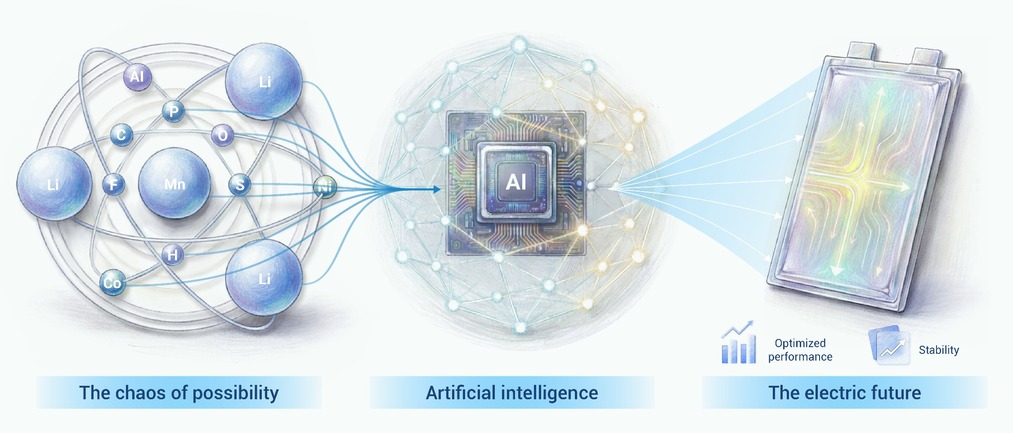
Figure 1.
Decoupling discovery from human limits: The AI-native paradigm in lithium-ion battery design.
