
Integrally formed asymmetric hydrogel for biomaterials and bioelectronic interfaces
-
ABSTRACT
Hydrogels are widely used in biomedicine due to their excellent flexibility, adhesion, and biocompatibility. However, there are some bottlenecks in their structural design and functional application. The Janus structure, inspired by the ancient Roman double-sided protector, provides a different idea for material design in complex biomedical scenarios due to its unique "asymmetric" characteristics, which has been widely used in the field of biomaterials. The asymmetric Janus hydrogel breaks the limitation of the traditional hydrogel "isotropic". The two sides of asymmetric hydrogels have different physical, chemical, or biological properties, showing the characteristics of asymmetric properties. Among them, the two asymmetric properties represented by "adhesion-antiadhesion" and "hydrophobicity/hydrophilicity" have been widely studied. In this paper, the structural characteristics and preparation techniques of different types of asymmetric hydrogels are discussed, and the possible future development of Janus hydrogels is also proposed. -

-
REFERENCES
[1] Hou L., Liu X., Ge X., et al. (2023). Designing of anisotropic gradient surfaces for directional liquid transport: Fundamentals, construction, and applications. The Innovation 4:100508. DOI:10.1016/j.xinn.2023.100508 [2] Zhuo S., Deng Z., Wu Z., et al. (2024). Janus gels for biomedical applications: Progress and future prospective. Progr. Polym. Sci. 155:101856. DOI:10.1016/j.progpolymsci.2024.101856 [3] Chen S., Zheng Y., Fang Y., et al. (2024). Unilateral antibacterial Janus hydrogel hemostatic dressing prepared by the dragging effect of a brush. Colloid. Surface. B 247:114453. DOI:10.1016/j.colsurfb.2024.114453 [4] Zhang X., Chen G., Wang Y., et al. (2024). Spatial tumor biopsy with fluorescence PCR microneedle array. The Innovation 5:100538. DOI:10.1016/j.xinn.2023.100538 [5] Tristan Hessberger, Lukas B. Braun, Rudolf Zentel, et al. (2018). Interfacial self-assembly of amphiphilic dual temperature responsive actuating Janus particles Adv. Funct. Mater. 28:201800629. DOI: 10.1002/adfm.201800629 [6] Wang H., Yi X., Liu T., et al. (2023). An integrally formed Janus hydrogel for robust wet‐tissue adhesive and anti‐postoperative adhesion. Adv. Mater.35:202300394. DOI:10.1002/adma.202300394 [7] Yi B. Yang B., et al. (2024). Surface hydrophobization of hydrogels via interface dynamics-induced network reconfiguration. Nat. Commun. 15:023−44646-5. DOI:10.1038/s41467-023-44646-5 [8] Li S., Liu L., Qiao F., et al. (2024). Bioinspired asymmetric‐adhesion Janus hydrogel patch regulating by zwitterionic polymers for wet tissues adhesion and postoperative adhesion prevention. Adv. Healthc. Mater. 13:202402268. DOI:10.1002/adhm.202402268 [9] Shao H., Wei K., Gong T., et al. (2024). Elastic Janus microarray film strain sensors with heterogeneous modulus and conductivity for healthcare and braille identification. Adv. Funct. Mater. 52:123−138. DOI:10.1016/j.bioactmat.2025.06.006 [10] Wu J., Xian J., He C., et al. (2024). Asymmetric wettability hydrogel surfaces for enduring electromyographic monitoring. Adv. Mater. 36:202405372. DOI:10.1002/adma.202405372 -
ABOUT THIS ARTICLE
Cite this article:
Lin H., Pang S., Wu J., et al. (2026). Integrally formed asymmetric hydrogel for biomaterials and bioelectronic interfaces. The Innovation Materials 4:100222. https://doi.org/10.59717/j.xinn-mater.2026.100222
Welcome!
To request copyright permission to republish or share portions of our works, please visit Copyright Clearance Center's (CCC) Marketplace website at marketplace.copyright.com.
Export File
Citation
Lin H., Pang S., Wu J., et al. (2026). Integrally formed asymmetric hydrogel for biomaterials and bioelectronic interfaces. The Innovation Materials 4:100222. https://doi.org/10.59717/j.xinn-mater.2026.100222

Format
Content
 DownLoad:
-
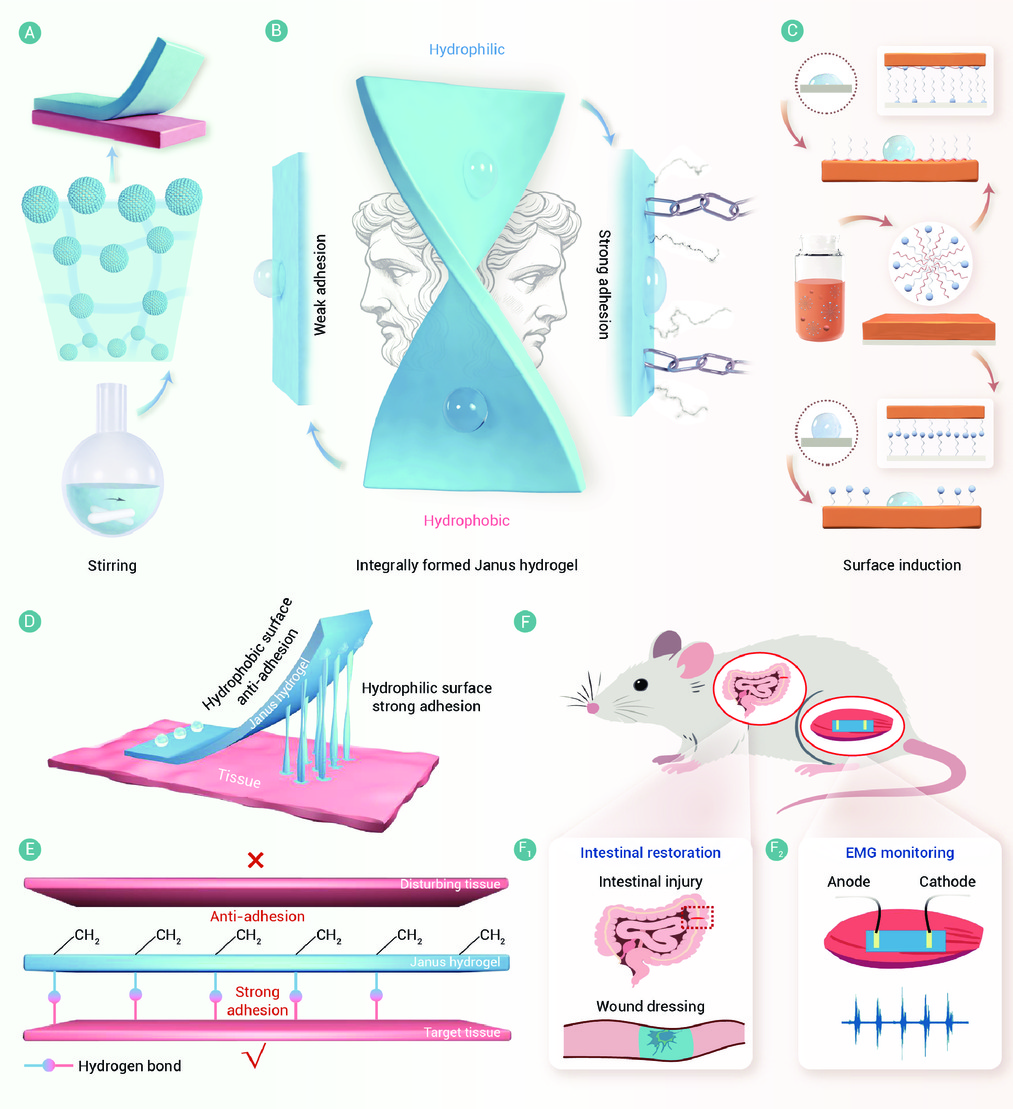
Figure 1.
The schematic illustration of heterogeneous properties of the Janus hydrogel and application of Janus hydrogel
