
MOF-based memristors for in-sensor computing: Materials, devices, and integration
-
ABSTRACT
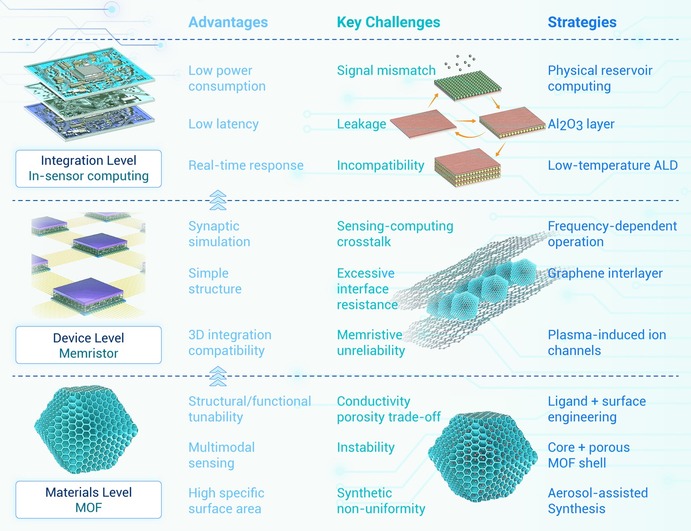
Based on the in-sensor computing strategy, integrating sensing and computing in memristors offers a promising solution to the limitations (excessive power consumption, high latency, poor compatibility) of traditional "sensing-computing separation" sensory recognition systems. However, mainstream memristive materials like metal oxides lack reliable multimodal sensing and information fusion capabilities, hindering their effectiveness. Honored by the 2025 Nobel Prize in Chemistry for their customizable structure and function, metal-organic frameworks (MOFs) uniquely address this by unifying multimodal sensing and on-site memristive computing. This perspective adopts a "materials-device-integration" framework to elaborate MOFs’ foundational role, reveal cross-scale mechanism bottlenecks (e.g., material instability, device crosstalk, integration incompatibility) and targeted solutions (e.g., ligand engineering, frequency-dependent operation, technology optimization), and outline future directions (e.g., bio-integrated systems, adaptive edge networks, AI-driven MOF design). It highlights MOFs’ potential to overcome traditional limitations and advance "material-centric computing" for next-generation intelligent systems. -

-
REFERENCES
[1] Meng Y. and Cheng G. (2024). Human somatosensory systems based on sensor-memory-integrated technology. Nanoscale 16:11928−11958. DOI:10.1039/D3NR06521A [2] Wan T., Shao B., Ma S., et al. (2023). In-sensor computing: Materials, devices, and integration technologies. Adv. Mater. 35:2203830. DOI:10.1002/adma.202203830 [3] Tang B., Sivan M., Leong J. F., et al. (2024). Solution-processable 2D materials for monolithic 3D memory-sensing-computing platforms: opportunities and challenges. Npj 2D Mater. Appl. 8:74. DOI:10.1038/s41699-024-00508-2. [4] Ding G., Zhao J., Zhou K., et al. (2023). Porous crystalline materials for memories and neuromorphic computing systems. Chem. Soc. Rev. 52:7071−7136. DOI:10.1039/D3CS00259D [5] Zhou F. and Chai Y. (2020). Near-sensor and in-sensor computing. Nat. Electron. 3:664−671. DOI:10.1038/s41928-020-00501-9 [6] Bachinin S. V., Marunchenko A., Matchenya I., et al. (2024). Metal-organic framework single crystal for in-memory neuromorphic computing with a light control. Commun. Mat. 5:128. DOI:10.1038/s43246-024-00573-6 [7] Hu G., Liu Q. and Deng H. (2025). Space exploration of metal–organic frameworks in the mesopore regime. Acc. Chem. Res. 58:73−86. DOI:10.1021/acs.accounts.4c00633 [8] Xu Z., Li Y., Xia Y., et al. (2024). Organic frameworks memristor: An emerging candidate for data storage, artificial synapse, and neuromorphic device. Adv. Funct. Mater. 34:2312658. DOI:10.1002/adfm.202312658 [9] Xing Z., Wang S. and Sun Q. (2025). Reticular framework materials as versatile platforms for controllable polymer synthesis. Chem. Soc. Rev. 54:8019−8070. DOI:10.1039/D5CS00749F [10] Guan Q., Fang Y., Wu X., et al. (2023). Stimuli responsive metal organic framework materials towards advanced smart application. Mater. Today 64:138−164. DOI:10.1016/j.mattod.2023.02.013 [11] Meng X., Gui B., Yuan D., et al. (2016). Mechanized azobenzene-functionalized zirconium metal-organic framework for on-command cargo release. Sci. Adv. 2:e1600480. DOI:10.1126/sciadv.1600480 -
ABOUT THIS ARTICLE
Cite this article:
Qian L., Xue S. and Ding G. (2026). MOF-based memristors for in-sensor computing: Materials, devices, and integration. The Innovation Materials 4:100240. https://doi.org/10.59717/j.xinn-mater.2026.100240
Welcome!
To request copyright permission to republish or share portions of our works, please visit Copyright Clearance Center's (CCC) Marketplace website at marketplace.copyright.com.
Export File
Citation
Qian L., Xue S. and Ding G. (2026). MOF-based memristors for in-sensor computing: Materials, devices, and integration. The Innovation Materials 4:100240. https://doi.org/10.59717/j.xinn-mater.2026.100240

Format
Content
 DownLoad:
-
Figure 1.
Illustration of the advantages, challenges, and strategies of MOFs for applications in in-sensor computing systems from the perspectives of materials, devices, and integrations.
