
Relative effectiveness and durability of booster doses of SARS-CoV-2 vaccines: A systematic review and meta-analysis
-
GRAPHICAL ABSTRACT
 DownLoad:
Full size image
DownLoad:
Full size image
-
PUBLIC SUMMARY
-
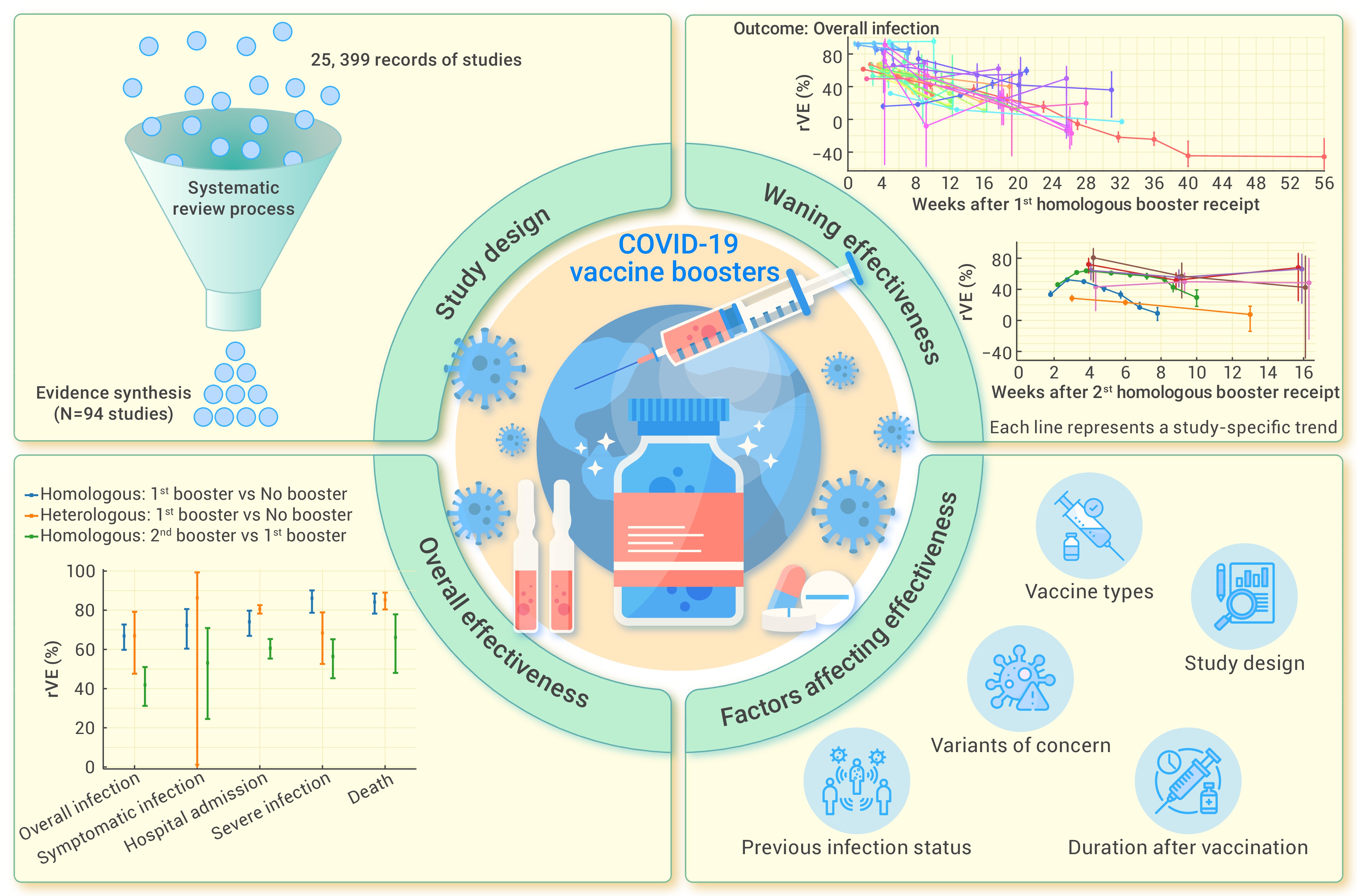
Both the 1st and 2nd booster vaccination could offer additional protection against SARS-CoV-2 infections.
The additional protection of the 1st booster vaccination may vary by variants of concern and vaccine types.
The protection of the 1st booster waned fast but that of the 2nd booster remained stable in a short period.
The sources of heterogeneity for the additional protection of the 2nd booster still remain uncertain.
-
-
ABSTRACT
Billions of people worldwide have received booster doses of SARS-CoV-2 vaccines. Continuous monitoring of the relative vaccine effectiveness (rVE) and durability of booster vaccination over previous vaccinations is important for developing vaccination strategies during the post-pandemic era. We conducted a systematic review and meta-analysis of trials and observational studies to determine the rVE of the 1st booster over no booster and that of the 2nd booster over the 1st booster. Three trials and 91 observational studies were included in this systematic review. For the 1st booster homologous vaccination, the rVE at a median of 9 weeks after booster vaccination was 66.9% (95% confidence interval: 59.8%, 72.7%), 75.9% (62.6%, 84.5%), 74.1% (66.9%, 79.8%), 86.1% (78.7%, 90.9%) and 84.2% (78.3%, 88.5%) against overall infection, symptomatic infection, hospital admission, severe infection and COVID-19-related death, respectively. The rVE against overall infection was affected by variants of concern and vaccine types and waned by average of 4.3% (3.3%, 5.4%; P-trend<0.01) per week. Heterologous regimens for the 1st booster vaccination demonstrated effectiveness comparable to that of homologous regimens. The rVE of the 2nd booster homologous vaccination at a median of 7 weeks after booster vaccination was 41.9% (31.2%, 51.0%), 53.1% (24.5%, 70.9%), 60.6% (55.3%, 65.3%), 56.4% (45.3%, 65.2%) and 68.2% (51.2%, 79.2%) against the five outcomes above, respectively, with no significant decrease in the rVE of 2nd booster vaccination. In conclusion, both the 1st and 2nd booster homologous vaccinations provided additional protection against mild and severe infections. The rVE of the 1st booster rapidly waned over time. The rVE of the 2nd booster, including heterologous vaccination, its durability and the sources of heterogeneity, however, remains uncertain and more relevant studies are needed. -

-
REFERENCES
[1] Feikin, D.R., Higdon, M.M., Abu-Raddad, L.J., et al. (2022). Duration of effectiveness of vaccines against SARS-CoV-2 infection and COVID-19 disease: Results of a systematic review and meta-regression. Lancet 399: 924−944. DOI: 10.1016/s0140-6736(22)00152-0. [2] Menegale, F., Manica, M., Zardini, A., et al. (2023). Evaluation of waning of SARS-CoV-2 vaccine–induced immunity: A systematic review and meta-analysis. JAMA Netw. Open 6: e2310650−e2310650. DOI: 10.1001/jamanetworkopen.2023.10650. [3] Yang, Z.R., Jiang, Y.W., Li, F.X., et al. (2023). Efficacy of SARS-CoV-2 vaccines and the dose-response relationship with three major antibodies: A systematic review and meta-analysis of randomised controlled trials. Lancet Microbe 4: e236−e246. DOI: 10.1016/s2666-5247(22)00390-1. [4] Bar-On, Y.M., Goldberg, Y., Mandel, M., et al. (2021). Protection of BNT162b2 vaccine booster against Covid-19 in Israel. N. Engl. J. Med. 385: 1393−1400. DOI: 10.1056/NEJMoa2114255. [5] Bar-On, Y.M., Goldberg, Y., Mandel, M., et al. (2022). Protection by a fourth dose of BNT162b2 against Omicron in Israel. N. Engl. J. Med. 386: 1712−1720. DOI: 10.1056/NEJMoa2201570. [6] Moreira, E.D., Jr., Kitchin, N., Xu, X., et al. (2022). Safety and efficacy of a third dose of BNT162b2 Covid-19 vaccine. N. Engl. J. Med. 386: 1910−1921. DOI: 10.1056/NEJMoa2200674. [7] Wang, X.Y., Mahmood, S.F., Jin, F., et al. (2022). Efficacy of heterologous boosting against SARS-CoV-2 using a recombinant interferon-armed fusion protein vaccine (V-01): a randomized, double-blind and placebo-controlled phase III trial. Emerg. Microbes Infect. 11: 1910−1919. DOI: 10.1080/22221751.2022.2088406. [8] Au, W.Y., and Cheung, P.P.-H. (2022). Effectiveness of heterologous and homologous covid-19 vaccine regimens: Living systematic review with network meta-analysis. BMJ 377: e069989. DOI: 10.1136/bmj-2022-069989. [9] Pratama, N.R., Wafa, I.A., Budi, D.S., et al. (2022). Effectiveness of Covid-19 vaccines against SARS-CoV-2 Omicron variant (B.1.1.529): A systematic review with meta-analysis and meta-regression. Vaccines (Basel) 10 : 2180. DOI: 10.1101/2022.04.29.22274454. [10] Higdon, M.M., Baidya, A., Walter, K.K., et al. (2022). Duration of effectiveness of vaccination against COVID-19 caused by the omicron variant. Lancet Infect. Dis. 22: 1114−1116. DOI: 10.1016/s1473-3099(22)00409-1. [11] Guo, K., Ni, P., Chang, S., et al. (2023). Effectiveness of mRNA vaccine against Omicron-related infections in the real world: A systematic review and meta-analysis. Am. J. Infect. Control 51 : 1049-1055. DOI: https://doi.org/10.1016/j.ajic.2023.02.005. [12] Song, S., Madewell, Z.J., Liu, M., et al. (2023). Effectiveness of SARS-CoV-2 vaccines against Omicron infection and severe events: A systematic review and meta-analysis of test-negative design studies. Front. Public Health 11: 1195908. DOI: 10.3389/fpubh.2023.1195908. [13] Xu, J., Lan, X., Zhang, L., et al. (2023). The effectiveness of the first dose COVID-19 booster vs. full vaccination to prevent SARS-CoV-2 infection and severe COVID-19 clinical event: A meta-analysis and systematic review of longitudinal studies. Front. Public Health 11 :1165611. DOI: 10.3389/fpubh.2023.1165611. [14] Chenchula, S., Karunakaran, P., Sharma, S., et al. (2022). Current evidence on efficacy of COVID-19 booster dose vaccination against the Omicron variant: A systematic review. J. Med. Virol. 94(7): 2969−2976. DOI: 10.1002/jmv.27697. [15] Petrelli, F., Luciani, A., Borgonovo, K., et al. (2022). Third dose of SARS-CoV-2 vaccine: A systematic review of 30 published studies. J. Med. Virol. 94: 2837−2844. DOI: 10.1002/jmv.27644. [16] Wu, N., Joyal-Desmarais, K., Ribeiro, P.A.B., et al. (2023). Long-term effectiveness of COVID-19 vaccines against infections, hospitalisations, and mortality in adults: Findings from a rapid living systematic evidence synthesis and meta-analysis up to December, 2022. Lancet Respir. Med. 11 : 439-452. DOI: 10.1016/s2213-2600(23)00015-2. [17] WHO Coronavirus (COVID-19) Dashboard. https://covid19.who.int/table. [18] Page, M.J., McKenzie, J.E., Bossuyt, P.M., et al. (2021). The PRISMA 2020 statement: An updated guideline for reporting systematic reviews. BMJ 372: n71. DOI: 10.1136/bmj.n71. [19] Sterne, J.A., Hernán, M.A., Reeves, B.C., et al. (2016). ROBINS-I: A tool for assessing risk of bias in non-randomised studies of interventions. BMJ 355: i4919. DOI: 10.1136/bmj.i4919. [20] Higgins, J.P., Altman, D.G., Gøtzsche, P.C., et al. (2011). The Cochrane Collaboration's tool for assessing risk of bias in randomised trials. BMJ 343: d5928. DOI: 10.1136/bmj.d5928. [21] Scammacca, N., Roberts, G., and Stuebing, K.K. (2014). Meta-analysis with complex research designs: Dealing with dependence from multiple measures and multiple group comparisons. Rev. Educ. Res. 84: 328−364. DOI: 10.3102/0034654313500826. [22] Balshem, H., Helfand, M., Schünemann, H.J., et al. (2011). GRADE guidelines: 3. Rating the quality of evidence. J. Clin. Epidemiol. 64: 401−406. DOI: 10.1016/j.jclinepi.2010.07.015. [23] Atmar, R.L., Lyke, K.E., Deming, M.E., et al. (2022). Homologous and heterologous Covid-19 booster vaccinations. N. Engl. J. Med. 386: 1046−1057. DOI: 10.1056/NEJMoa2116414. [24] Garcia-Beltran, W.F., St Denis, K.J., Hoelzemer, A., et al. (2022). mRNA-based COVID-19 vaccine boosters induce neutralizing immunity against SARS-CoV-2 Omicron variant. Cell 185: 457−466.e454. DOI: 10.1016/j.cell.2021.12.033. [25] Gao, B., He, L., Bao, Y., et al. (2023). Repeated vaccination of inactivated SARS-CoV-2 vaccine dampens neutralizing antibodies against Omicron variants in breakthrough infection. Cell Res. 33: 258−261. DOI: 10.1038/s41422-023-00781-8. [26] Chalkias, S., Harper, C., Vrbicky, K., et al. (2022). A bivalent omicron-containing booster vaccine against Covid-19. N. Engl. J. Med. 387: 1279−1291. DOI: 10.1056/NEJMoa2208343. [27] Mayr, F.B., Talisa, V.B., Shaikh, O., et al. (2022). Effectiveness of homologous or heterologous Covid-19 boosters in veterans. N. Engl. J. Med. 386: 1375−1377. DOI: 10.1056/NEJMc2200415. [28] Schmidt, T., Klemis, V., Schub, D., et al. (2021). Immunogenicity and reactogenicity of heterologous ChAdOx1 nCoV-19/mRNA vaccination. Nat. Med. 27: 1530−1535. DOI: 10.1038/s41591-021-01464-w. [29] Duarte-Salles, T., and Prieto-Alhambra, D. (2021). Heterologous vaccine regimens against COVID-19. Lancet 398: 94−95. DOI: 10.1016/s0140-6736(21)01442-2. [30] McMenamin, M.E., Nealon, J., Lin, Y., et al. (2022). Vaccine effectiveness of one, two, and three doses of BNT162b2 and CoronaVac against COVID-19 in Hong Kong: A population-based observational study. Lancet Infect. Dis. 22: 1435−1443. DOI: 10.1016/s1473-3099(22)00345-0. [31] Magen, O., Waxman, J.G., Makov-Assif, M., et al. (2022). Fourth dose of BNT162b2 mRNA Covid-19 vaccine in a nationwide setting. N. Engl. J. Med. 386: 1603−1614. DOI: 10.1056/NEJMoa2201688. -
ABOUT THIS ARTICLE
Cite this article:
Liu D., Jiang Y., Wang S., et al., (2024). Relative effectiveness and durability of booster doses of SARS-CoV-2 vaccines: A systematic review and meta-analysis. The Innovation Medicine 2(1): 100051. https://doi.org/10.59717/j.xinn-med.2024.100051
Welcome!
To request copyright permission to republish or share portions of our works, please visit Copyright Clearance Center's (CCC) Marketplace website at marketplace.copyright.com.
Supplementary Information
-
download_supplementary
Table(S1-S15)
Article Metrics
Relative Articles
Cited by
Export File
Citation
Liu D., Jiang Y., Wang S., et al., (2024). Relative effectiveness and durability of booster doses of SARS-CoV-2 vaccines: A systematic review and meta-analysis. The Innovation Medicine 2(1): 100051. https://doi.org/10.59717/j.xinn-med.2024.100051

Format
Content


-
Figure 1.
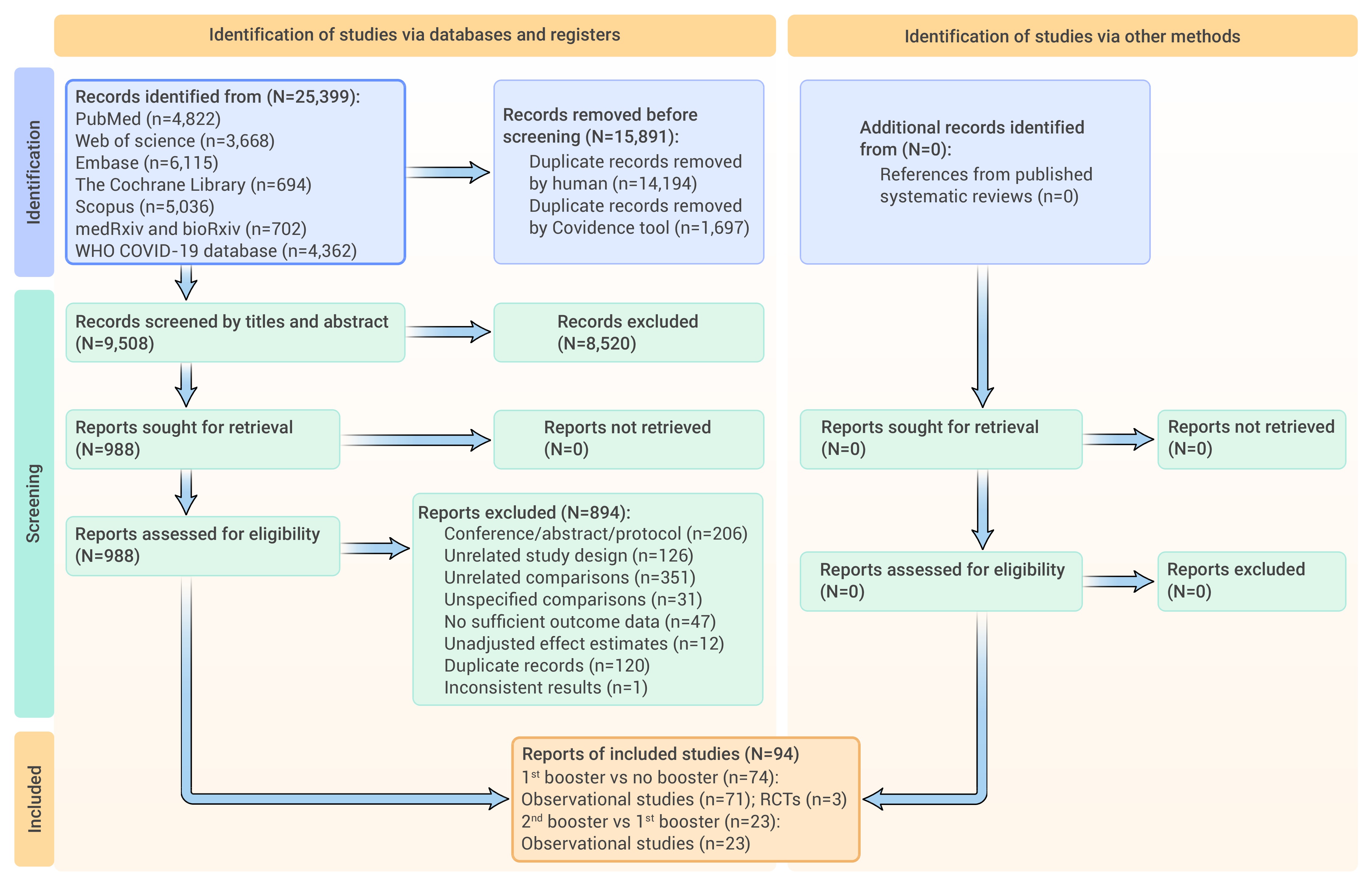
Flowchart of the study selection process
-
Figure 2.
Relative vaccine effectiveness of booster vaccination in preventing infections of different severities, stratified by the median period after the receipt of the latest booster dose
-
Figure 3.
Changes over time in relative vaccine effectiveness of booster vaccination in preventing infections of different severities
