
Racial disparity in PM2.5 species and DNA methylation in CARDIA: An epigenome-wide association study
-
GRAPHICAL ABSTRACT
 DownLoad:
Full size image
DownLoad:
Full size image
-
PUBLIC SUMMARY
-
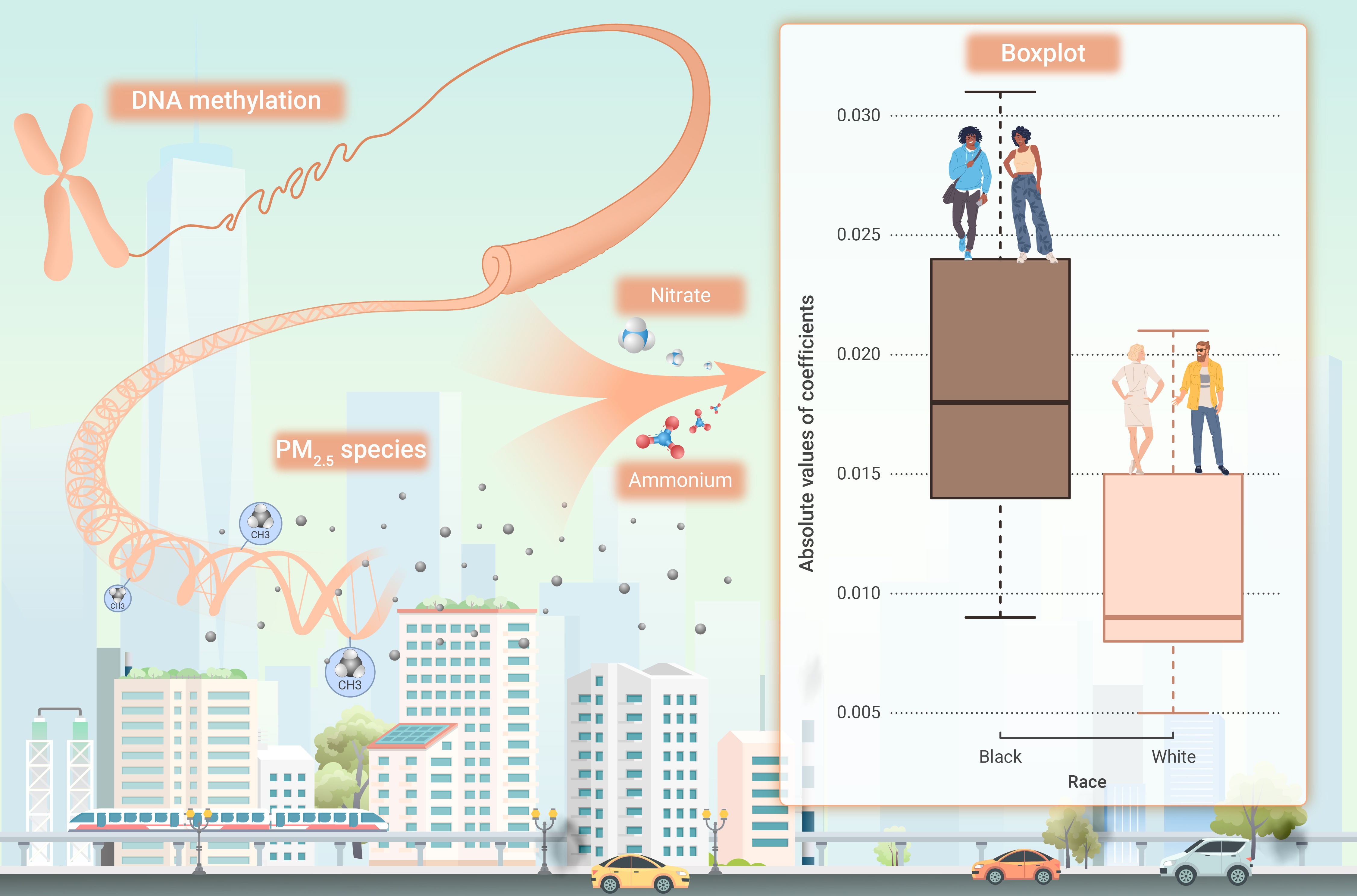
There are statistically significant associations between DNA methylation level and PM2.5 species.
Black participants exhibited stronger associations compared to White participants.
Gene targets had relevance to pathways to basal cancers, platelet activation, signaling, and aggregation.
-
-
ABSTRACT
Minorities experience a disproportionate impact from PM2.5 pollution, and biological mechanisms remain unclear. No studies have examined the epigenome-wide association between DNA methylation level and PM2.5 species using longitudinal measurements of methylation among Blacks. This study aims to evaluate the relationship between exposure to PM2.5 species and DNA methylation as well as assess possible race-specific effects. Genome-wide DNA methylation levels were profiled on 1,081 longitudinally followed participants (432 Black and 649 White adults) using the Infinium MethylationEPIC array. We examined the association between one-year average PM2.5 species (black carbon, ammonium, nitrate, organic matter, sulfate, soil, and sea salt) exposure prior to exam year (Y)15 (2000-2001) and methylation at 841,639 CpG sites at Y15 and Y20 (2005-2006), respectively. In the association analysis of PM2.5 species at Y15 with DNA methylation at Y20, methylation in 17 and 2 CpG sites, respectively, was significantly associated with nitrate and ammonium exposure. The magnitudes of coefficients of these significant CpG sites at Y20 increased by 2- to 48-fold compared to the cross-sectional association analysis of PM2.5 species exposure prior to Y15 and DNA methylation at Y15. Black participants had stronger associations than White participants. Gene enrichment analysis indicated gene targets might be relevant to pathways including basal cancers, platelet activation, signaling, and aggregation. This study represents the first one to investigate the association between PM2.5 species exposure and DNA methylation among Black and White adults using longitudinal measurement, highlighting the significance of considering race-specific epigenetic regulation in relation to air pollution-related health issues. -

-
REFERENCES
[1] Ostro, B., Roth, L., Malig, B., et al. (2009). The effects of fine particle components on respiratory hospital admissions in children. Environ. Health Perspect. 117: 475−480. DOI: 10.1289/ehp.11848. [2] Hayes, R.B., Lim, C., Zhang, Y., et al. (2020). PM2.5 air pollution and cause-specific cardiovascular disease mortality. Int. J. Epidemiol. 49 : 25-35. DOI: 10.1093/ije/dyz114. [3] Fu, P., Guo, X., Cheung, F.M.H., et al. (2019). The association between PM2.5 exposure and neurological disorders: A systematic review and meta-analysis. Sci. Total Environ. 655 : 1240-1248. DOI: 10.1016/j.scitotenv.2018.11.218. [4] U.S. EPA. (2019). Supplement to the 2019 integrated science assessment for particulate matter. U.S. Environmental Protection Agency https://cfpub.epa.gov/ncea/isa/recordisplay.cfm?deid=354490. [5] Lozano, R., Naghavi, M., Foreman, K., et al. (2012). Global and regional mortality from 235 causes of death for 20 age groups in 1990 and 2010: A systematic analysis for the Global Burden of Disease Study 2010. Lancet 380: 2095−2128. DOI: 10.1016/S0140-6736(12)61728-0. [6] Zhou, J., Ito, K., Lall, R., et al. (2011). Time-series analysis of mortality effects of fine particulate matter components in Detroit and Seattle. Environ. Health Perspect. 119: 461−466. DOI: 10.1289/ehp.1002613. [7] Franklin, M., Koutrakis, P., and Schwartz, P. (2008). The role of particle composition on the association between PM2.5 and mortality. Epidemiology 19 : 680-689. DOI: 10.1097/ede.0b013e3181812bb7. [8] Zanobetti, A., Franklin, M., Koutrakis, P., et al. (2009). Fine particulate air pollution and its components in association with cause-specific emergency admissions. Environ. Health 8: 58. DOI: 10.1186/1476-069X-8-58. [9] Madrigano, J., Baccarelli, A., Mittleman, M.A., et al. (2011). Prolonged exposure to particulate pollution, genes associated with glutathione pathways, and DNA methylation in a cohort of older men. Environ. Health Perspect. 119: 977−982. DOI: 10.1289/ehp.1002773. [10] Chen, R., Qiao, L., Li, H., et al. (2015). Fine particulate matter constituents, nitric oxide synthase DNA methylation and exhaled nitric oxide. Environ. Sci. Technol. 49: 11859−11865. DOI: 10.1021/acs.est.5b02527. [11] Chen, H., Li, S., Liu, J., et al. (2004). Chronic inorganic arsenic exposure induces hepatic global and individual gene hypomethylation: Implications for arsenic hepatocarcinogenesis. Carcinogenesis 25: 1779−1786. DOI: 10.1093/carcin/bgh161. [12] Belinsky, S.A., Palmisano, W.A., Gilliland, F.D., et al. (2002). Aberrant promoter methylation in bronchial epithelium and sputum from current and former smokers. Cancer Res. 62: 2370−2377. [13] Moen, E.L., Mariani, C.J., Zullow, H., et al. (2015). New themes in the biological functions of 5-methylcytosine and 5-hydroxymethylcytosine. Immunol. Rev. 263: 36−49. DOI: 10.1111/imr.12242. [14] Rider, C.F., and Carlsten, C. (2019). Air pollution and DNA methylation: Effects of exposure in humans. Clin. Epigenetics 11: 131. DOI: 10.1186/s13148-019-0713-2. [15] Poursafa, P., Kamali, Z., Fraszczyk, E., et al. (2022). DNA methylation: A potential mediator between air pollution and metabolic syndrome. Clin. Epigenetics 14: 82. DOI: 10.1186/s13148-022-01301-y. [16] Rakyan, V.K., Down, T.A., Balding, D.J., et al. (2011). Epigenome-wide association studies for common human diseases. Nat. Rev. Genet. 12: 529−541. DOI: 10.1038/nrg3000. [17] Plusquin, M., Guida, F., Polidoro, S., et al. (2017). DNA methylation and exposure to ambient air pollution in two prospective cohorts. Environ. Int. 108: 127−136. DOI: 10.1016/j.envint.2017.08.006. [18] Lee, M.K., Xu, C.J., Carnes, M.U., et al. (2019). Genome-wide DNA methylation and long-term ambient air pollution exposure in Korean adults. Clin. Epigenetics 11: 37. DOI: 10.1186/s13148-019-0635-z. [19] Callahan, C.L., Bonner, M.R., Nie, J., et al. (2018). Lifetime exposure to ambient air pollution and methylation of tumor suppressor genes in breast tumors. Environ. Res. 161: 418−424. DOI: 10.1016/j.envres.2017.11.040. [20] Gondalia, R., Baldassari, A., Holliday, K.M., et al. (2019). Methylome-wide association study provides evidence of particulate matter air pollution-associated DNA methylation. Environ. Int. 132: 104723. DOI: 10.1016/j.envint.2019.03.071. [21] Ho, S.M. (2010). Environmental epigenetics of asthma: An update. J. Allergy Clin. Immunol. 126: 453−465. DOI: 10.1016/j.jaci.2010.07.030. [22] Gruzieva, O., Xu, C.J., Yousefi, P., et al. (2019). Prenatal particulate air pollution and DNA methylation in newborns: An epigenome-wide meta-analysis. Environ. Health Perspect. 127: 57012. DOI: 10.1289/EHP4522. [23] Panni, T., Mehta, A.J., Schwartz, J.D., et al. (2016). Genome-wide analysis of DNA methylation and fine particulate matter air pollution in three study populations: KORA F3, KORA F4, and the normative aging study. Environ. Health Perspect. 124: 983−990. DOI: 10.1289/ehp.1509966. [24] Dai, L., Mehta, A., Mordukhovich, I., et al. (2017). Differential DNA methylation and PM2.5 species in a 450K epigenome-wide association study. Epigenetics 12 : 139-148. DOI: 10.1080/15592294.2016.1271853. [25] Friedman, G.D., Cutter, G.R., Donahue, R.P., et al. (1988). CARDIA: Study design, recruitment, and some characteristics of the examined subjects. J. Clin. Epidemiol. 41: 1105−1116. DOI: 10.1016/0895-4356(88)90080-7. [26] Cutter, G.R., Burke, G.L., Dyer, A.R., et al. (1991). Cardiovascular risk factors in young adults. The CARDIA baseline monograph. Control. Clin. Trials 12 : 1S-77S. DOI: 10.1016/0197-2456(91)90002-4. [27] van, D.A., Martin, R.V., Li, C., et al. (2019). Regional estimates of chemical composition of fine particulate matter using a combined geoscience-statistical method with information from satellites, models, and monitors. Environ. Sci. Technol. 53: 2595−2611. DOI: 10.1021/acs.est.8b06392. [28] Zheng, Y., Joyce, B.T., Hwang, S.J., et al. (2022). Association of cardiovascular health through young adulthood with genome-wide DNA methylation patterns in midlife: The CARDIA study. Circulation 146: 94−109. DOI: 10.1161/CIRCULATIONAHA.121.055484. [29] Xu, Z., Niu, L., Li, L., et al. (2016). Enmix: A novel background correction method for Illumina HumanMethylation450 BeadChip. Nucleic Acids Res. 44: e20. DOI: 10.1093/nar/gkv907. [30] Xu, Z., Langie, S.A., De, B.P., et al. (2017). RELIC: A novel dye-bias correction method for Illumina Methylation BeadChip. BMC Genomics 18: 4. DOI: 10.1186/s12864-016-3426-3. [31] Houseman, E.A., Accomando, W.P., Koestler, D.C., et al. (2012). DNA methylation arrays as surrogate measures of cell mixture distribution. BMC Bioinformatics 13: 86. DOI: 10.1186/1471-2105-13-86. [32] R Core Team. (2021). R: A language and environment for statistical computing. R Foundation for Statistical Computing, Vienna, Austria. http://www.R-project.org/. [33] Wu, T., Hu, E., Xu, S., et al. (2021). clusterProfiler 4.0: A universal enrichment tool for interpreting omics data. The Innovation 2 : 100141. DOI: 10.1016/j.xinn.2021.100141. [34] Kanehisa, M., Goto, S., Kawashima, S., et al. (2002). The KEGG databases at GenomeNet. Nucleic Acids Res. 30: 42−46. DOI: 10.1093/nar/30.1.42. [35] Carbon, S., Ireland, A., Mungall, C.J., et al. (2009). AmiGO: Online access to ontology and annotation data. Bioinformatics 25: 288−289. DOI: 10.1093/bioinformatics/btn615. [36] Fabregat, A., Korninger, F., Viteri, G., et al. (2018). Reactome graph database: Efficient access to complex pathway data. PloS Comput. Biol. 14: e1005968. DOI: 10.1371/journal.pcbi.1005968. [37] Queralt-Rosinach, N., Piñero, J., Bravo, À., et al. (2016). DisGeNET-RDF: Harnessing the innovative power of the Semantic Web to explore the genetic basis of diseases. Bioinformatics 32: 2236−2238. DOI: 10.1093/bioinformatics/btw214. [38] Subramanian, A., Tamayo, P., Mootha, V.K., et al. (2005). Gene set enrichment analysis: A knowledge-based approach for interpreting genome-wide expression profiles. Proc. Natl. Acad. Sci. U. S. A. 102: 15545−15550. DOI: 10.1073/pnas.0506580102. [39] Estevez, B., and Du, X. (2017). New concepts and mechanisms of platelet activation signaling. Physiology (Bethesda) 32: 162−177. DOI: 10.1152/physiol.00020.2016. [40] Münzel, T., Feil, R., Mülsch, A., et al. (2003). Physiology and pathophysiology of vascular signaling controlled by guanosine 3’,5’-cyclic monophosphate-dependent protein kinase [corrected]. Circulation 108: 2172−2183. DOI: 10.1161/01.CIR.0000094403.78467.C3. [41] Besprozvannaya, M., Dickson, E., Li, H., et al. (2018). GRAM domain proteins specialize functionally distinct ER-PM contact sites in human cells. Elife 7: e31019. DOI: 10.7554/eLife.31019. [42] Wu, Y.W., and Waldmann, H. (2019). Toward the role of cholesterol and cholesterol transfer protein in autophagosome biogenesis. Autophagy 15: 2167−2168. DOI: 10.1080/15548627.2019.1666595. [43] Laraia, L., Friese, A., Corkery, D.P., et al. (2019). The cholesterol transfer protein GRAMD1A regulates autophagosome biogenesis. Nat. Chem. Biol. 15: 710−720. DOI: 10.1038/s41589-019-0307-5. [44] Fu, B., Meng, W., Zhao, H., et al. (2016). GRAM domain-containing protein 1A (GRAMD1A) promotes the expansion of hepatocellular carcinoma stem cell and hepatocellular carcinoma growth through STAT5. Sci. Rep. 6: 31963. DOI: 10.1038/srep31963. [45] VoPham, T., Bertrand, K.A., Tamimi, R.M., et al. (2018). Ambient PM2.5 air pollution exposure and hepatocellular carcinoma incidence in the United States. Cancer Causes Control 29 : 563-572. DOI: 10.1007/s10552-018-1036-x. [46] Gu, C., Zhao, K., Zhou, N., et al. (2020). UBAC2 promotes bladder cancer proliferation through BCRC-3/miRNA-182-5p/p27 axis. Cell Death Dis. 11: 733. DOI: 10.1038/s41419-020-02935-7. [47] Wijk, S.C., Prabhala, P., Michaliková, B., et al. (2021). Human primary airway basal cells display a continuum of molecular phases from health to disease in chronic obstructive pulmonary disease. Am. J. Respir. Cell Mol. Biol. 65: 103−113. DOI: 10.1165/rcmb.2020-0464OC. [48] Harms, J.F., Menniti, F.S., and Schmidt, C.J. (2019). Phosphodiesterase 9A in brain regulates cGMP signaling independent of nitric-oxide. Front. Neurosci. 13: 837. DOI: 10.3389/fnins.2019.00837. [49] Rudez, G., Janssen, N.A., Kilinc, E., et al. (2009). Effects of ambient air pollution on hemostasis and inflammation. Environ. Health Perspect. 117: 995−1001. DOI: 10.1289/ehp.0800437. -
ABOUT THIS ARTICLE
Cite this article:
Yao J., Zheng Y., Shen J., et al., (2024). Racial disparity in PM2.5 species and DNA methylation in CARDIA: An epigenome-wide association study. The Innovation Medicine 2(2): 100061. https://doi.org/10.59717/j.xinn-med.2024.100061
Welcome!
To request copyright permission to republish or share portions of our works, please visit Copyright Clearance Center's (CCC) Marketplace website at marketplace.copyright.com.

Article Metrics
Relative Articles
Cited by
Export File
Citation
Yao J., Zheng Y., Shen J., et al., (2024). Racial disparity in PM2.5 species and DNA methylation in CARDIA: An epigenome-wide association study. The Innovation Medicine 2(2): 100061. https://doi.org/10.59717/j.xinn-med.2024.100061

Format
Content


-
Figure 1.
Epigenome-wide associations of Ammonium species at Y15 (2000-2001) with DNA methylation at Y20 (2005-2006), displayed by Manhattan plots
-
Figure 2.
Epigenome-wide associations of Nitrate species at Y15 (2000-2001) with DNA methylation at Y20 (2005-2006), displayed by Manhattan plots
-
Figure 3.
Reactome pathway enrichment analysis for significant gene targets of CpGs in the overall model.
-
Figure 4.
Disease gene network pathway enrichment analysis for significant gene targets of CpGs in the overall model.
