
A threat or not? A global-scale investigation on microplastics inhalation during the first-ever worldwide face-mask wearing against the COVID-19 pandemic
-
GRAPHICAL ABSTRACT

 DownLoad:
Full size image
DownLoad:
Full size image
-
PUBLIC SUMMARY
-
Developed a microplastic inhalation simulator system with a ventilation rate similar to that of an average person.
Conduct a global study microplastic inhalation using 209 face masks with varying filtration grades and qualities.
Investigate the kinetics of microplastic inhalation during mask usage in laboratory and laminar flow hood.
Analyzed the potential global impact and risks associated with significant mask-wearing on microplastic inhalation.
Wearing a high-standard face mask could decrease total microplastic inhalation as compared to the pre-pandemic era.
-
-
ABSTRACT
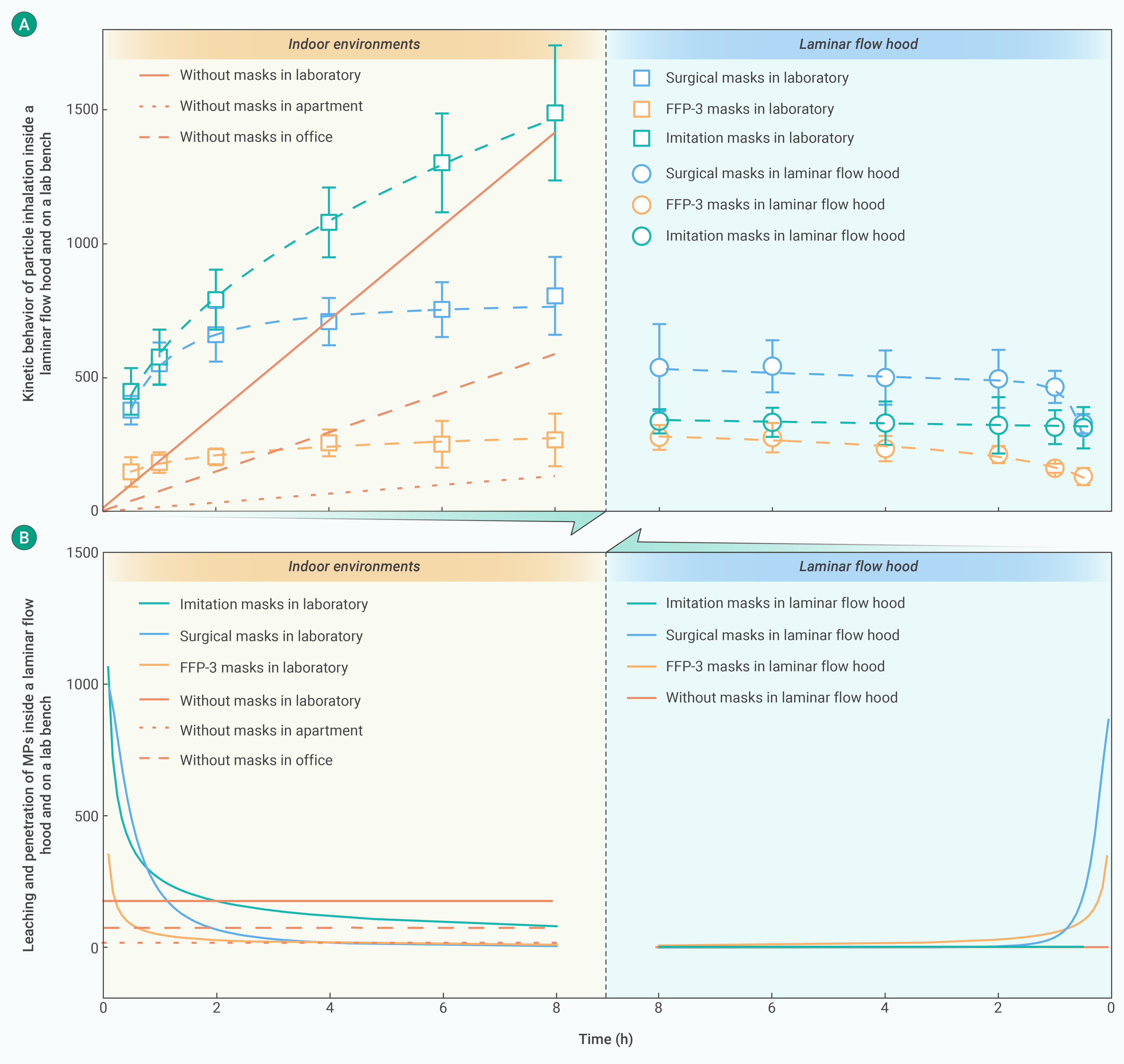
A spike in public attention on whether wearing masks will increase microplastics (MPs) inhalation has recently been triggered by the major transformation in widespread masking in public ever since the pandemic. To timely address this question and provide reliable insights for public health recommendations, mask users, and producers, we developed a platform based on a custom inhalation simulator, and conducted comparative measurements to investigate masks as both a source of MP release and a barrier to MP inhalation. We examined 209 mask brands from 46 countries/regions, covering multiple filtration and quality levels. Our kinetic study revealed that MP leaching primarily occurs during the initial period of wearing a new mask. Subsequently, masks act as a barrier, reducing MP inhalation compared to not wearing a mask. Hence, frequently changing masks or using masks from unproper manufacture process may not be a wise choice. We also observed significant variations in MP inhalation character among different quality levels and brands, indicating the need of future safety standards to this end. Overall, the estimated worldwide inhalation of MPs during the pandemic office hours is 1.16 times that of the pre-pandemic era. However, the impact of MP inhalation could be changed by wearing masks with higher filtration grade (and better quality). For instance, if everyone were to wear FFP-3 masks, a 28.8% reduction in MP inhalation would be expected compared to not wearing a mask. -

-
REFERENCES
[1] World Health Organization. (2020). Coronavirus disease (COVID-19) advice for the public: When and how to use masks. https://www.who.int/emergencies/diseases/novel-coronavirus-2019/advice-for-public/when-and-how-to-use-masks. [2] Statista. (2022). Annual production volume of face masks in China from 2017 to 2021. https://www.statista.com/statistics/1099824/china-face-mask-annual-production-volume/. [3] World Wildlife Fund. (2020). Responsibility is required when disposing of masks and gloves. https://www.wwf.it/pandanews/ambiente/nello-smaltimento-di-mascherine-e-guanti-serve-responsabilita/. [4] Mitze, T., Kosfeld, R., Rode, J., et al. (2020). Face masks considerably reduce COVID-19 cases in Germany. Proc. Natl. Acad. Sci. U. S. A. 117: 32293−32301. DOI: 10.1073/pnas.201595411. [5] Kim, J., Mayorga-Martinez, C.C., and Pumera, M. (2023). Magnetically boosted 1D photoactive microswarm for COVID-19 face mask disruption. Nat. Commun. 14: 935. DOI: 10.1038/s41467-023-36650-6. [6] Kwon, S., Joshi, A.D., Lo, C.H., et al. (2021). Association of social distancing and face mask use with risk of COVID-19. Nat. Commun. 12: 1−10. DOI: 10.1038/s41467-021-24115-7. [7] Worby, C.J., and Chang, H.-H. (2020). Face mask use in the general population and optimal resource allocation during the COVID-19 pandemic. Nat. Commun. 11: 4049. DOI: 10.1038/s41467-020-17922-x. [8] Tian, F., Liu, X., Chao, Q., et al. (2021). Ambient air pollution and low temperature associated with case fatality of COVID-19: A nationwide retrospective cohort study in China. The Innovation 2: 100139. DOI: 10.1016/j.xinn.2021.100139. [9] Zheng, M. (2024). Autoimmune imprinting in the post-COVID-19 era. The Innovation Medicine 2: 100054. DOI: 10.59717/j.xinn-med.2024.100054. [10] Peng, Y., Wu, P., Schartup, A.T., et al. (2021) Plastic waste release caused by COVID-19 and its fate in the global ocean. Proc. Natl. Acad. Sci. U. S. A. 118 : 2111530118. DOI: 10.1073/pnas.2111530118. [11] Kwak, J.I., and An, Y.J. (2021). Post COVID-19 pandemic: Biofragmentation and soil ecotoxicological effects of microplastics derived from face masks. J. Hazard. Mater. 416: 126169. DOI: 10.1016/j.jhazmat.2021.126169. [12] Li, M., Hou, Z., Meng, R., et al. (2022). Unraveling the potential human health risks from used disposable face mask-derived micro/nanoplastics during the COVID-19 pandemic scenario: A critical review. Environ. Int. 170: 107644. DOI: 10.1016/j.envint.2022.107644. [13] Faustman, E.M., Silbernagel, S.M., Fenske, R.A., et al. (2000) Mechanisms underlying children’s susceptibility to environmental toxicants. Environ. Health Perspect. 108 : 13-21. DOI: 10.1289/ehp.00108s113. [14] Gao, L., Arango-Franco, C.A., Feng, G. et al. (2024). Upsurge of acute respiratory infections among children post-COVID-19 pandemic. The Innovation Medicine 2: 100070. DOI: 10.59717/j.xinn-med.2024.100070. [15] Howard, J., Huang, A, Li, Z., et al. (2021). An evidence review of face masks against COVID-19. Proc. Natl. Acad. Sci. U. S. A. 118: 1−12. DOI: 10.1073/pnas.201456411. [16] Leung, N.H.L., Chu, D.K., Shiu, E.Y., et al. (2020). Respiratory virus shedding in exhaled breath and efficacy of face masks. Nat. Med. 26: 676−680. DOI: 10.1038/s41591-020-0843-2. [17] Perencevich, E.N., Diekema, D.J., and Edmond, M.B. (2020). Moving personal protective equipment into the community face shields and containment of COVID-19. JAMA 323: 22. DOI: 10.1001/jama.2020.7477. [18] Cheng, Y. Ma, N., Witt, C., et al. (2021). Face masks effectively limit the probability of SARS-CoV-2 transmission. Science 372: 1439−1443. DOI: 10.1126/science.abg6296. [19] Wang, R., Xiong, Y., Xing, X. et al. (2020). Daily CO2 emission reduction indicates the control of activities to contain COVID-19 in China. The Innovation 1: 100062. DOI: 10.1016/j.xinn.2020.100062. [20] Jiang, Q., Xu, Z., and Zhang, H. (2022). Global impacts of COVID-19 on sustainable ocean development. The Innovation 3: 100250. DOI: 10.1016/j.xinn.2022.100250. [21] Wu, Y., and Li, J. (2024). Considering the health hazards associated with the growing prevalence of plastic kitchen utensils. The Innovation Medicine 2: 100059. DOI: 10.59717/j.xinn-med.2024.100059. [22] Li, L., Zhao, X., Li, Z. et al. (2021). COVID-19: Performance study of microplastic inhalation risk posed by wearing masks. J. Hazard. Mater. 411: 124955. DOI: 10.1016/j.jhazmat.2020.124955. [23] Sullivan, G.L., Delgado-Gallardo, J., Watson, T.M. et al. (2021). An investigation into the leaching of micro and nano particles and chemical pollutants from disposable face masks - linked to the COVID-19 pandemic. Water Res. 196: 117033. DOI: 10.1016/j.watres.2021.117033. [24] Greenhalgh, T., Schmid, M.B., Czypionka, T., et al. (2020). Face masks for the public during the covid-19 crisis. BMJ 369: 1−4. DOI: 10.1136/bmj.m1435. [25] Hutten, I.M. (2016). Processes for Nonwoven Filter Media. Handb. Nonwoven Filter Media (Elsevier). DOI:10.1016/b978-185617441-1/50020-2. [26] Pinlova, B., and Nowack, B. (2023). Characterization of fiber fragments released from polyester textiles during UV weathering. Environ. Pollut. 322: 121012. DOI: 10.1016/j.envpol.2023.121012. [27] Yang, T., Luo, J., and Nowack, B. (2021). Characterization of nanoplastics, fibrils, and microplastics released during washing and abrasion of polyester textiles. Environ. Sci. Technol. 55: 15873−15881. DOI: 10.1021/acs.est.1c04826. [28] Yang, T., Xu, Y., Liu, G., et al. (2024). Oligomers are a major fraction of the submicrometre particles released during washing of polyester textiles. Nat. Water 2: 151−160. DOI: 10.1038/s44221-024-00214-9. [29] Yang, T., Gao, M., and Nowack, B. (2023). Formation of microplastic fibers and fibrils during abrasion of a representative set of 12 polyester textiles. Sci. Total Environ. 862: 160758. DOI: 10.1016/j.scitotenv.2022.160758. [30] Wu, P., Li, J., Lu, X., et al. (2022). Release of tens of thousands of microfibers from discarded face masks under simulated environmental conditions. Sci. Total Environ. 806: 150458. DOI: 10.1016/j.scitotenv.2021.150458. [31] Cai, Y., Mitrano, D.M., Heuberger, M., et al. (2020). The origin of microplastic fiber in polyester textiles: The textile production process matters. J. Clean. Prod. 267: 121970. DOI: 10.1016/j.jclepro.2020.121970. [32] Pinlova, B., Hufenus, R., and Nowack, B. (2022). Systematic study of the presence of microplastic fibers during polyester yarn production. J. Clean. Prod. 363: 132247. DOI: 10.1016/j.jclepro.2022.132247. [33] Torres-Agullo, A., Karanasiou, A., Moreno, T., et al. (2021). Overview on the occurrence of microplastics in air and implications from the use of face masks during the COVID-19 pandemic. Sci. Total Environ. 800: 149555. DOI: 10.1016/j.scitotenv.2021.149555. [34] ASTM F2299/F2299M-03. (2017). Standard Test Method for Determining the Initial Efciency of Materials Usedin Medical Face Masks to Penetration by Particulates Using Latex Spheres. https://www.astm.org. [35] NIOSH. (2019). Determination of Particulate Filter Efciency Level for N95 Series Filters against Solid Particulates forNon-Powered, Air-Purifying Respirators Standard Testing Procedure TEB-APR-STP-0059. 1-9. https://www.cdc.gov/niosh/npptl/stps/apresp.html. [36] Mitrano, D.M., and Wohlleben, W. (2020). Microplastic regulation should be more precise to incentivize both innovation and environmental safety. Nat. Commun. 11: 1−12. DOI: 10.1038/s41467-020-19069-1. [37] Koelmans, A.A. Redondo-Hasselerharm, P.E., Nor, N.H.M., et al. (2022). Risk assessment of microplastic particles. Nat. Rev. Mater. 7: 138−152. DOI: 10.1038/s41578-021-00411-y. [38] Mitrano, D.M., Wick, P., and Nowack, B. (2021). Placing nanoplastics in the context of global plastic pollution. Nat. Nanotechnol. 16: 491−500. DOI: 10.1038/s41565-021-00888-2. [39] ASTM F2101-19. (2001). Standard Test Method for Evaluating the Bacterial Filtration Efficiency (BFE) of Medical Face Mask Materials, Using a Biological Aerosol of Staphylococcus aureus. Ann. ASTM Stand. (F2101-01). https://www.astm.org/f2101-19.html. [40] Zeng, L., Balachandar, S., and Fischer, P. (2005). Wall-induced forces on a rigid sphere at finite Reynolds number. J. Fluid Mech. 536: 1−25. DOI: 10.1017/S0022112005004738. [41] Bluemink, J.J., Lohse, D., Prosperetti, A. et al. (2010). Drag and lift forces on particles in a rotating flow. J. Fluid Mech. 643: 1−31. DOI: 10.1017/S0022112009991881. [42] Lindsley, W.G., Derk, R.C., Coyle, J.P., et al. (2021). Efficacy of portable air cleaners and masking for reducing indoor exposure to simulated exhaled SARS-CoV-2 aerosols — United States, 2021. Morb. Mortal. Wkly Rep. 70 : 972-976. DOI: 10.15585/mmwr.mm7027e1. [43] Gilbert, R., Auchincloss, J.H., Brodsky, J. et al. (1972). Changes in tidal volume, frequency, and ventilation induced by their measurement. J. Appl. Physiol. 33: 252−254. DOI: 10.1152/jappl.1972.33.2.252. [44] Tobin, M.J., Chadha, T.S., Jenouri, G., et al. (1983). Breathing patterns 1. Normal subjects. Chest 84: 202−205. DOI: 10.1378/chest.84.2.202. [45] Acute Respiratory Distress Syndrome Network. (2000). Ventilation with lower tidal volumes as compared with traditional tidal volumes for acute lung injury and the acute respiratory distress Syndrome. N. Engl. J. Med. 342: 1301−1308. DOI: 10.1056/NEJM200005043421801. [46] Wu, P., Tang, Y., Dang, M., et al. (2020). Spatial-temporal distribution of microplastics in surface water and sediments of Maozhou River within Guangdong-Hong Kong-Macao Greater Bay Area. Sci. Total Environ. 717: 135187. DOI: 10.1016/j.scitotenv.2019.135187. [47] Bhangare, R.C., Tiwari, M., Ajmal, P.Y., et al. (2022). Exudation of microplastics from commonly used face masks in COVID-19 pandemic. Environ. Sci. Pollut. Res. 30: 35258−35268. DOI: 10.1007/s11356-022-24702-1. [48] Wang, Z., An, C., Chen, X., et al. (2021). Disposable masks release microplastics to the aqueous environment with exacerbation by natural weathering. J. Hazard. Mater. 417: 126036. DOI: 10.1016/j.jhazmat.2021.126036. [49] Inglezakis, V.J., Fyrillas, M.M., and Park, J. (2019). Variable diffusivity homogeneous surface diffusion model and analysis of merits and fallacies of simplified adsorption kinetics equations. J. Hazard. Mater. 367: 224−245. DOI: 10.1016/j.jhazmat.2018.12.023. [50] Yang, Y. Li, Z., Yan, C., et al. (2022). Kinetics of microplastic generation from different types of mulch films in agricultural soil. Sci. Total Environ. 814: 152572. DOI: 10.1016/j.scitotenv.2021.152572. [51] Liang, H., Ji, Y., Ge, W., et al. (2021). Release kinetics of microplastics from disposable face masks into the aqueous environment. Sci. Total Environ. 860: 151650. DOI: 10.1016/j.scitotenv.2021.151650. [52] Kobwanthanakun, W., Silpa-archa, N., Wongpraparut, C., et al. (2021). An evaluation of the course of facial sunscreen coverage and sustainability over an 8-hour workday among outdoor workers. Heal. Sci. Reports 4: 1−6. DOI: 10.1002/hsr2.350. [53] Jones, S.P. (2020). Imperial College London Big Data Analytical Unit and YouGov Plc. Imperial College London YouGov Covid Data Hub v1.0 https://github.com/YouGov-Data/covid-19-tracker. [54] Statista. (2020). COVID-19 pandemic statistics. https://www.statista.com/. [55] Badillo-Goicoechea, E., Chang, T.H., Kim, E., et al. (2021). Global trends and predictors of face mask usage during the COVID-19 pandemic. BMC Public Health 21: 2099. DOI: 10.1186/s12889-021-12175-9. [56] Chowdhury, H., Chowdhury, T., and Sait, S.M. (2021). Estimating marine plastic pollution from COVID-19 face masks in coastal regions. Mar. Pollut. Bull. 168: 112419. DOI: 10.1016/j.marpolbul.2021.112419. [57] Wu, P., Cai, Z., Jin, H., et al. (2019). Adsorption mechanisms of five bisphenol analogues on PVC microplastics. Sci. Total Environ. 650: 671−678. DOI: 10.1016/j.scitotenv.2018.09.049. [58] Cabrejos-Cardeña, U., De-la-Torre, G.E., Dobaradaran, S., et al. (2023). An ecotoxicological perspective of microplastics released by face masks. J. Hazard. Mater. 443: 130273. DOI: 10.1016/j.jhazmat.2022.130273. [59] Konda, A., Prakash, A., Moss, G.A., et al. (2020). Aerosol filtration efficiency of common fabrics used in respiratory cloth masks. ACS Nano 14: 6339−6347. DOI: 10.1021/acsnano.0c03252. [60] De-la-Torre, G.E., Dioses-Salinas, D.C., Pizarro-Ortega, C.I. et al. (2021). New plastic formations in the anthropocene. Sci. Total Environ. 754: 142216. DOI: 10.1016/j.scitotenv.2020.142216. [61] Cao, J., Shi, Y., Yan, M., et al. (2023). Face mask: As a source or protector of human exposure to microplastics and phthalate plasticizers. Toxics 11: 87. DOI: 10.3390/toxics11020087. [62] Haldane, V., De Foo, C., Abdalla, S.M., et al. (2021). Health systems resilience in managing the COVID-19 pandemic: Lessons from 28 countries. Nat. Med. 27: 964−980. DOI: 10.1038/s41591-021-01381-y. [63] Sanyal, G., Särnefält, A., and Kumar, A. (2021). Considerations for bioanalytical characterization and batch release of COVID-19 vaccines. npj Vaccines 6: 53. DOI: 10.1038/s41541-021-00317-4. [64] Khandelwal, A. (2010). The long and short (of) quality ladders. Rev. Econ. Stud. 77: 1450−1476. DOI: 10.1111/j.1467-937X.2010.00602.x. [65] Ma, J., Chen, F., Xu, H., et al. (2021). Face masks as a source of nanoplastics and microplastics in the environment: Quantification, characterization, and potential for bioaccumulation. Environ. Pollut. 288: 117748. DOI: 10.1016/j.envpol.2021.117748. [66] Wu, P., Wang, B., Lu, Y., et al. (2024). Machine learning-assisted insights into sources and fate of microplastics in wastewater treatment plants. ACS EST Water 4: 1107−1118. DOI: 10.1021/acsestwater.3c00386. [67] Ma, J., Zhao, J., Zhu, Z., et al. (2019). Effect of microplastic size on the adsorption behavior and mechanism of triclosan on polyvinyl chloride. Environ. Pollut. 254: 113104. DOI: 10.1016/j.envpol.2019.113104. [68] Kannan, K., and Vimalkumar, K. (2021). A review of human exposure to microplastics and insights into microplastics as obesogens. Front. Endocrinol. (Lausanne). 12: 1−19. DOI: 10.3389/fendo.2021.724989. [69] Dris, R., Gasperi, J., Mirande, C., et al. (2017). A first overview of textile fibers, including microplastics, in indoor and outdoor environments. Environ. Pollut. 221: 453−458. DOI: 10.1016/j.envpol.2016.12.013. [70] Bahrina, I., Syafei, A.D., Satoto, R., et al. (2020). An occupant-based overview of microplastics in indoor environments in the city of Surabaya, Indonesia. J. Ecol. Eng. 21: 236−242. DOI: 10.12911/22998993/126876. [71] Jin, L., Griffith, S.M., Sun, Z., et al. (2021). On the flip side of mask wearing: Increased exposure to volatile organic compounds and a risk-reducing solution. Environ. Sci. Technol. 55: 14095−14104. DOI: 10.1021/acs.est.1c04591. [72] Atangana, E., and Atangana, A. (2020). Facemasks simple but powerful weapons to protect against COVID-19 spread: Can they have sides effects. Results Phys. 19: 103425. DOI: 10.1016/j.rinp.2020.103425. [73] Li, X., Ding, P., Deng, F., et al. (2022). Wearing time and respiratory volume affect the filtration efficiency of masks against aerosols at different sizes. Environ. Technol. Innov. 25: 102165. DOI: 10.1016/j.eti.2021.102165. [74] Sharma, A., Omidvarborna, H., and Kumar, P. (2022). Efficacy of facemasks in mitigating respiratory exposure to submicron aerosols. J. Hazard. Mater. 422: 126783. DOI: 10.1016/j.jhazmat.2021.126783. [75] Guan, X., Lin, J., Han, J., et al. (2022). Prolonged use of surgical masks and respirators affects the protection and comfort for healthcare workers. Materials (Basel). 15: 7918. DOI: 10.3390/ma15227918. -
ABOUT THIS ARTICLE
Cite this article:
Wu P., Chan C., Tan H., et al., (2024). A threat or not? A global-scale investigation on microplastics inhalation during the first-ever worldwide face-mask wearing against the COVID-19 pandemic. The Innovation Medicine 2(4): 100097. https://doi.org/10.59717/j.xinn-med.2024.100097
Welcome!
To request copyright permission to republish or share portions of our works, please visit Copyright Clearance Center's (CCC) Marketplace website at marketplace.copyright.com.

Article Metrics
Relative Articles
Cited by
Export File
Citation
Wu P., Chan C., Tan H., et al., (2024). A threat or not? A global-scale investigation on microplastics inhalation during the first-ever worldwide face-mask wearing against the COVID-19 pandemic. The Innovation Medicine 2(4): 100097. https://doi.org/10.59717/j.xinn-med.2024.100097

Format
Content



-
Figure 1.
A worldwide investigation of microplastics found in face masks by microplastic inhalation simulator (MIS)
-
Figure 2.
Testing and characterization schemes employed in the present investigation
-
Figure 3.
The abundances, sizes, and potential origins of collected MPs from the surgical, FFP (Levels 1-3), and imitation masks
-
Figure 4.
The kinetic behaviors and rates of MPs during simulated MP inhalation using surgical, FFP-3, and imitation masks in both laboratory and laminar flow hoods
-
Figure 5.
The global impact of substantial mask wearing to MP inhalation
