
Glucose-responsive oral insulin: A leap toward high-efficiency and safe diabetes management
-

-
REFERENCES
[1] Sun H., Saeedi P., Karuranga S., et al. (2022). IDF Diabetes Atlas: Global, regional and country-level diabetes prevalence estimates for 2021 and projections for 2045. Diabetes Res. Clin. Pract. 183:109119. DOI:10.1016/j.diabres.2021.109119 [2] Ji K., Wei X., Kahkoska A. R., et al. (2024). An orally administered glucose-responsive polymeric complex for high-efficiency and safe delivery of insulin in mice and pigs. Nat. Nanotechnol. 19:1880−1891. DOI:10.1038/s41565-024-01764-5 [3] Spoorthi Shetty S., Halagali P., Johnson, A. P., et al. (2023). Oral insulin delivery: Barriers, strategies, and formulation approaches: A comprehensive review. Int. J. Biol. Macromol. 242:125114. DOI:10.1016/j.ijbiomac.2023.125114 [4] Blair H. A. (2024). Insulin icodec: First approval. BioDrugs 38:717−724. DOI:10.1007/s40259-024-00670-5 [5] Harris, E. (2023). FDA greenlights automated insulin dosing system for type 1 diabetes. JAMA 329:2011. DOI:10.1001/jama.2023.9602 -
ABOUT THIS ARTICLE
Cite this article:
Li S., Zheng D. and Ruan R. (2025). Glucose-responsive oral insulin: A leap toward high-efficiency and safe diabetes management. The Innovation Medicine 3:100108. https://doi.org/10.59717/j.xinn-med.2024.100108
Welcome!
To request copyright permission to republish or share portions of our works, please visit Copyright Clearance Center's (CCC) Marketplace website at marketplace.copyright.com.
Export File
Citation
Li S., Zheng D. and Ruan R. (2025). Glucose-responsive oral insulin: A leap toward high-efficiency and safe diabetes management. The Innovation Medicine 3:100108. https://doi.org/10.59717/j.xinn-med.2024.100108

Format
Content
 DownLoad:
-
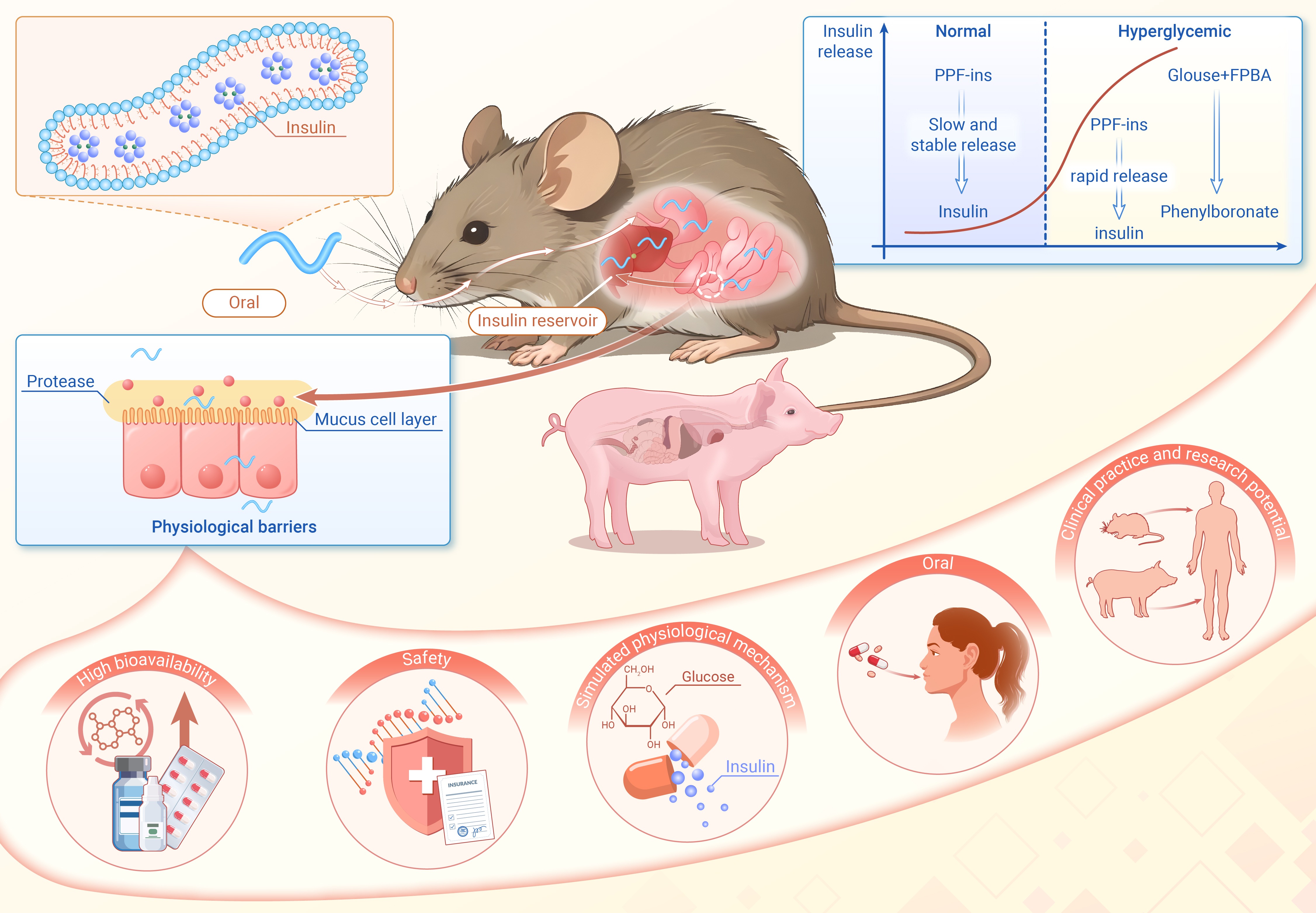
Figure 1.
The mechanism of action of PPF-ins in mice.
