
-
ABSTRACT
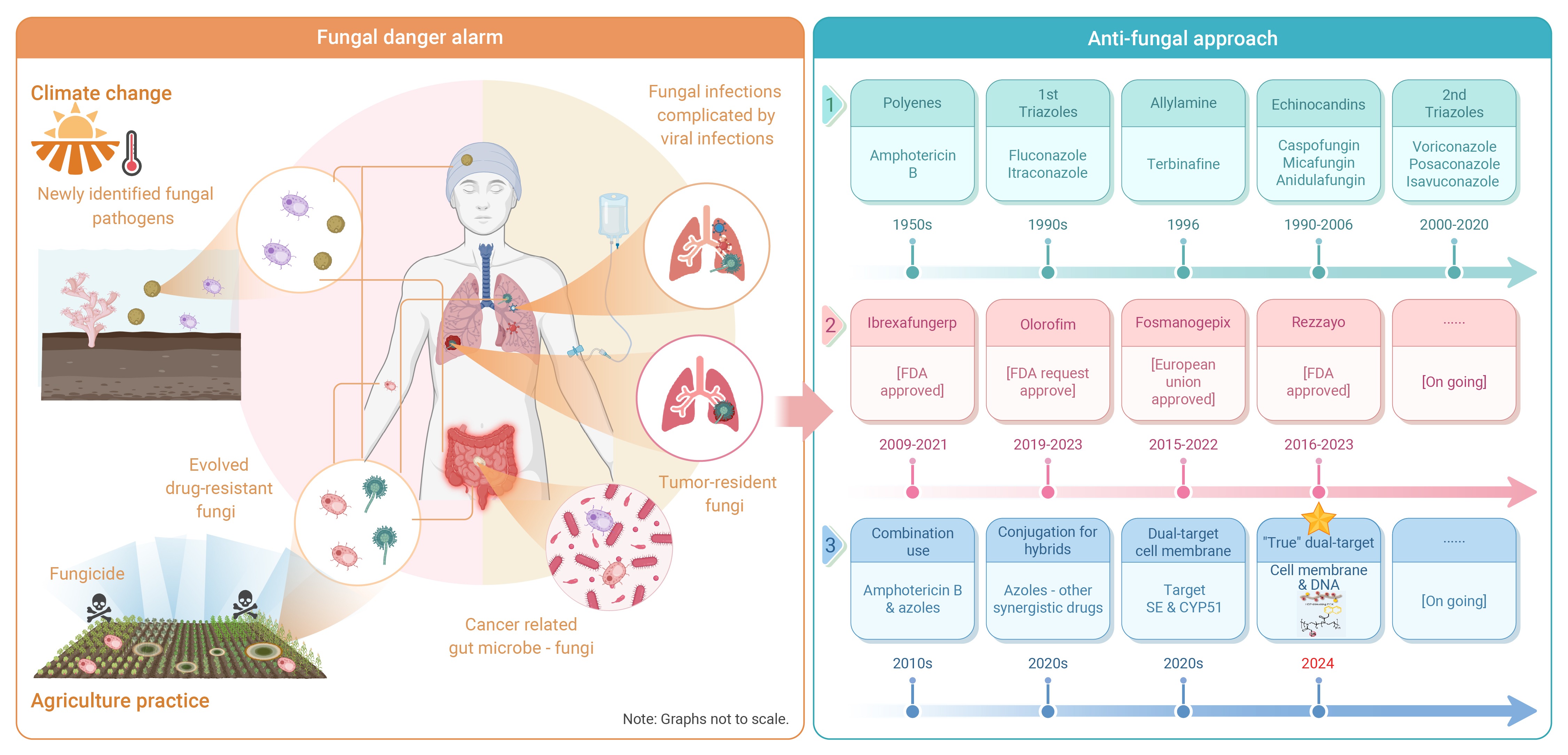
Fungal infections have emerged as a major global health concern now but are often overshadowed by the focus on bacterial infections. With the increasing prevalence and mortality associated with fungal diseases, the Fungal Priority Pathogen List (FPPL), published in 2022, and appeals from fungal research groups worldwide have highlighted the growing threat of fungal infections and antifungal resistance. Over the recent years, great efforts and multiple approaches have been made by scientists to address this challenge. In this perspective, we outline the alarming threat posed by fungal infections and antifungal resistance, including the rise in fungal infections complicated by viral infections, the identification of new tumor-resident fungal species, the emergence of novel fungal pathogens, and antifungal resistance driven by climate change or agriculture practices. We summarize the strategies and limitations of current drug development methods and explore innovative approaches for creating effective antifungal therapies. Furthermore, we propose future research directions, particularly focusing on dual-target antifungal agents as a promising avenue for the development of innovative therapeutic molecules. This article aims to provide a concise overview of recent initiatives and novel approaches to advance effective antifungal drug development, ultimately improving therapeutic options for human health. -

-
REFERENCES
[1] Hoenigl M., Seidel D., Sprute R., et al. (2022). COVID-19-associated fungal infections. Nat. Microbiol. 7:1127−1140 DOI:10.1038/s41564-022-01172-2 [2] Liu N. N., Yi C. X., Wei L. Q., et al. (2024). The intratumor mycobiome promotes lung cancer progression via myeloid-derived suppressor cells. Cancer cell 42:318−322 DOI:10.1016/j.ccell.2024.01.005 [3] Huang J., Hu P., Ye L., et al. (2024). Pan-drug resistance and hypervirulence in a human fungal pathogen are enabled by mutagenesis induced by mammalian body temperature. Nat. Microbiol. 9:1686−1699 DOI:10.1038/s41564-024-01720-y [4] van Rhijn N., Storer I. S. R., Birch M., et al. (2023). Aspergillus fumigatus strains that evolve resistance to the agrochemical fungicide ipflufenoquin in vitro are also resistant to olorofim. Nat. Microbiol. 9:29−34 DOI:10.1038/s41564-023-01542-4 [5] Trzoss M., Covel J. A., Kapoor M., et al. (2019). Synthesis of analogs of the Gwt1 inhibitor manogepix (APX001A) and in vitro evaluation against Cryptococcus spp. Bioorg. Med. Chem. Lett. 29:126713 DOI:10.1016/j.bmcl.2019.126713 [6] Mann P. A., McLellan C. A., Koseoglu S., et al. (2015). Chemical genomics-based antifungal drug discovery: Targeting glycosylphosphatidylinositol (GPI) precursor biosynthesis. ACS Infect. Dis. 1:59−72 DOI:10.1021/id5000212 [7] Oliver J. D., Sibley G. E. M., Beckmann N., et al. (2016). F901318 represents a novel class of antifungal drug that inhibits dihydroorotate dehydrogenase. Proc. Natl. Acad. Sci. U. S. A. 113:12809−12814 DOI:10.1073/pnas.1608304113 [8] Zhou M., Liu L., Cong Z., et al. (2024). A dual-targeting antifungal is effective against multidrug-resistant human fungal pathogens. Nat. Microbiol. 9:1325−1339 DOI:10.1038/s41564-024-01662-5 [9] Dong Y., Liu X., An Y., et al. (2020). Potent arylamide derivatives as dual-target antifungal agents: Design, synthesis, biological evaluation, and molecular docking studies. Bioorg. Chem. 99:103749 DOI:10.1016/j.bioorg.2020.103749 [10] Elias R., Basu P. and Fridman M. (2022). Fluconazole-COX inhibitor hybrids: A dual-acting class of antifungal azoles. J. Med. Chem. 65:2361−2373 DOI:10.1021/acs.jmedchem.1c01807 -
ABOUT THIS ARTICLE
Cite this article:
Wang F., Han R. and Chen S. (2025). Initiatives and approaches for antifungal research. The Innovation Medicine 3:100116. https://doi.org/10.59717/j.xinn-med.2025.100116
Welcome!
To request copyright permission to republish or share portions of our works, please visit Copyright Clearance Center's (CCC) Marketplace website at marketplace.copyright.com.
Export File
Citation
Wang F., Han R. and Chen S. (2025). Initiatives and approaches for antifungal research. The Innovation Medicine 3:100116. https://doi.org/10.59717/j.xinn-med.2025.100116

Format
Content
 DownLoad:
-
Figure 1.
Initiatives and approaches for antifungal research.
