
Harnessing the power of lifestyle interventions to combat biological aging: Insights from the DO-HEALTH trial
-

-
REFERENCES
[1] López-Otin C., Blasco M. A., Partridge L., et al. (2023). Hallmarks of aging: An expanding universe. Cell 186:243−278. DOI:10.1016/j.cell.2022.11.001 [2] Zheng Z. K., Li J. M., Liu T. Z., et al. (2024). DNA methylation clocks for estimating biological age in Chinese cohorts. Protein Cell 15:575−593. DOI:10.1093/procel/pwae011 [3] Johnstone S. E., Gladyshev V. N., Aryee M. J., et al. (2022). Epigenetic clocks, aging, and cancer. Science 378:1276−1277. DOI:10.1126/science.abn4009 [4] Bischoff-Ferrari H. A., Gängler S., Wieczorek M., et al. (2025). Individual and additive effects of vitamin D, omega-3 and exercise on DNA methylation clocks of biological aging in older adults from the DO-HEALTH trial. Nat. Aging 5:376−385. DOI:10.1038/s43587-024-00793-y [5] Oh D. Y., Talukdar S., Bae E. J., et al. (2010). GPR120 is an omega-3 fatty acid receptor mediating potent anti-inflammatory and insulin-sensitizing effects. Cell 142:687−698. DOI:10.1016/j.cell.2010.07.041 -
ABOUT THIS ARTICLE
Cite this article:
Guo K. and Luo R. (2025). Harnessing the power of lifestyle interventions to combat biological aging: Insights from the DO-HEALTH trial. The Innovation Medicine 3:100131. https://doi.org/10.59717/j.xinn-med.2025.100131
Welcome!
To request copyright permission to republish or share portions of our works, please visit Copyright Clearance Center's (CCC) Marketplace website at marketplace.copyright.com.
Export File
Citation
Guo K. and Luo R. (2025). Harnessing the power of lifestyle interventions to combat biological aging: Insights from the DO-HEALTH trial. The Innovation Medicine 3:100131. https://doi.org/10.59717/j.xinn-med.2025.100131

Format
Content
 DownLoad:
-
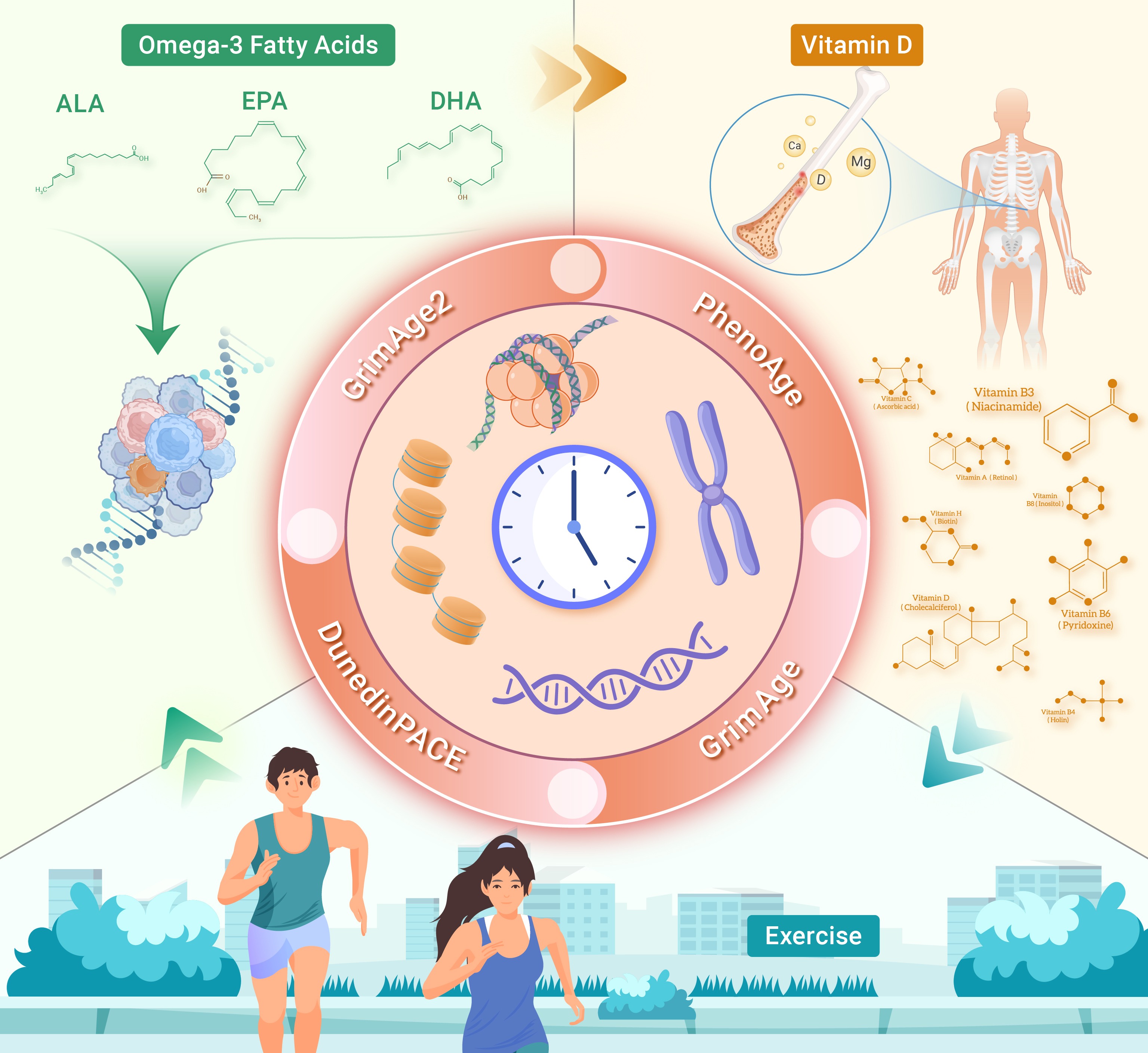
Figure 1.
Schematic illustration of the potential mechanisms underlying the effects of vitamin D, omega-3 fatty acids, and exercise on biological aging
