
Environmental neurotoxicity revisited: Evaluating microplastics as a potential risk factor for autism spectrum disorder
-

-
REFERENCES
[1] Hirota T. and King B. H. (2023). Autism spectrum disorder: A review. JAMA 329:157−168. DOI:10.1001/jama.2022.23661 [2] Symeonides C., Vacy K., Thomson S., et al. (2024). Male autism spectrum disorder is linked to brain aromatase disruption by prenatal BPA in multimodal investigations and 10HDA ameliorates the related mouse phenotype. Nat. Commun. 15:6367. DOI:10.1038/s41467-024-48897-8 [3] Wang L., Li S., Hao Y., et al. (2024). Exposure to polystyrene microplastics reduces sociality and brain oxytocin levels through the gut-brain axis in mice. Sci. Total Environ. 945:174026. DOI:10.1016/j.scitotenv.2024.174026 [4] Żebrowska P., Łaczmańska I. and Łaczmański Ł. (2021). Future directions in reducing gastrointestinal disorders in children with ASD using fecal microbiota transplantation. Front. Cell. Infect. Microbiol. 11:630052. DOI:10.3389/fcimb.2021.630052 [5] Genovese A. and Butler M. G. (2020). Clinical assessment, genetics, and treatment approaches in autism spectrum disorder (ASD). Int. J. Mol. Sci. 21:4726. DOI:10.3390/ijms21134726 -
ABOUT THIS ARTICLE
Cite this article:
Li L., Yang J., Wang Y., et al. (2025). Environmental neurotoxicity revisited: Evaluating microplastics as a potential risk factor for autism spectrum disorder. The Innovation Medicine 3:100156. https://doi.org/10.59717/j.xinn-med.2025.100156
Welcome!
To request copyright permission to republish or share portions of our works, please visit Copyright Clearance Center's (CCC) Marketplace website at marketplace.copyright.com.
Export File
Citation
Li L., Yang J., Wang Y., et al. (2025). Environmental neurotoxicity revisited: Evaluating microplastics as a potential risk factor for autism spectrum disorder. The Innovation Medicine 3:100156. https://doi.org/10.59717/j.xinn-med.2025.100156

Format
Content
 DownLoad:
-
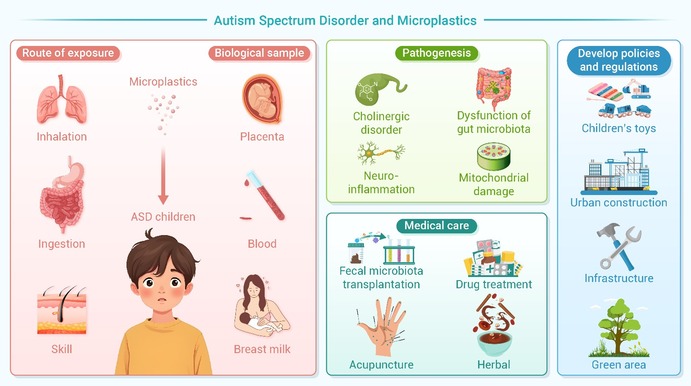
Figure 1.
ASD and microplastics: Exposure routes, established etiology, treatment approaches, and future prospects
