
Connecting the cell-type-specific microenvironment dynamics and function of organism through multimodal spatial omics profiling
-

-
REFERENCES
[1] Xia C.R., Cao Z.J., Tu X.M., et al. (2023). Spatial-linked alignment tool (SLAT) for aligning heterogenous slices. Nat. Comm. 14:7236. DOI:10.1038/s41467-023-43105-5 [2] Miao Z., Tian T., Chen W., et al. (2024). Spatial resolved transcriptomics: Computational insights into gene transcription across tissue and organ architecture in diverse applications. Innov. Life 2:100097. DOI:10.59717/j.xinn-life.2024.100097 [3] Peixoto R.D.S., Miller B.F., Brusko M.A., et al. (2025). Characterizing cell-type spatial relationships across length scales in spatially resolved omics data. Nat. Comm. 16:350. DOI:10.1038/s41467-024-55700-1 [4] Reynolds D.E., Roh Y.H., Oh D., et al. (2025). Temporal and spatial omics technologies for 4D profiling. Nat. Meth. 22:1408−1419. DOI:10.1038/s41592-025-02683-6 [5] Qiu X.J., Zhu D.Y., Lu Y.F., et al. (2024). Spatiotemporal modeling of molecular holograms. Cell 187:7351−7373. DOI:10.1016/j.cell.2024.10.011 -
ABOUT THIS ARTICLE
Cite this article:
Zhao C., Li B., Yang Z., et al. (2025). Connecting the cell-type-specific microenvironment dynamics and function of organism through multimodal spatial omics profiling. The Innovation Medicine 3:100167. https://doi.org/10.59717/j.xinn-med.2025.100167
Welcome!
To request copyright permission to republish or share portions of our works, please visit Copyright Clearance Center's (CCC) Marketplace website at marketplace.copyright.com.
Export File
Citation
Zhao C., Li B., Yang Z., et al. (2025). Connecting the cell-type-specific microenvironment dynamics and function of organism through multimodal spatial omics profiling. The Innovation Medicine 3:100167. https://doi.org/10.59717/j.xinn-med.2025.100167

Format
Content
 DownLoad:
-
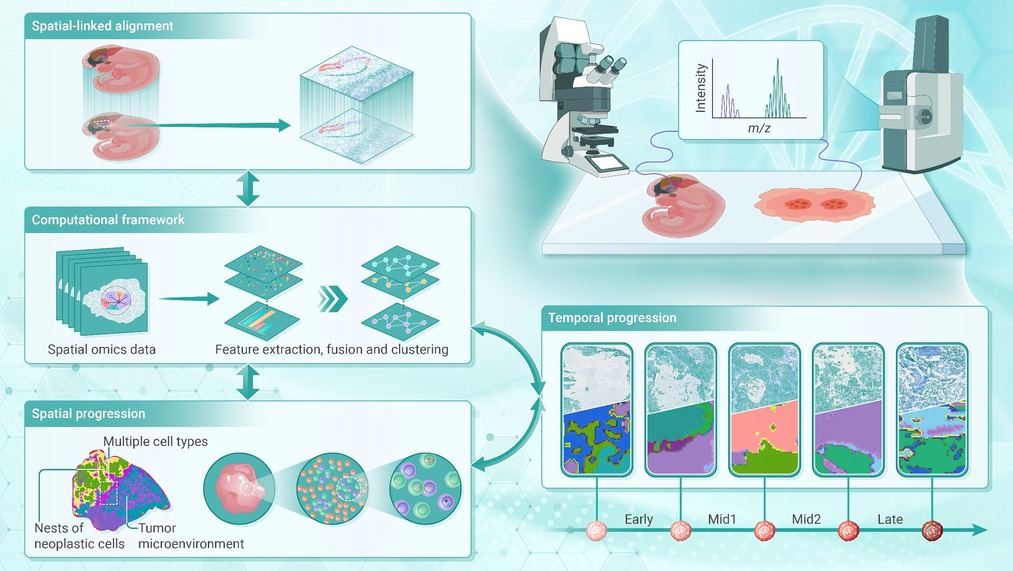
Figure 1.
Multimodal spatial omics profiling for tumor progression and embryonic development.
