
A microbial key to unlock immunotherapy resistance: Clostridium butyricum
-

-
REFERENCES
[1] Zhang Z., Gao Q., Ren X., et al. (2023). Characterization of intratumor microbiome in cancer immunotherapy. The Innovation 4:100482. DOI:10.1016/j.xinn.2023.100482 [2] Xie M., Yuan K., Zhang Y., et al. (2025). Tumor-resident probiotic Clostridium butyricum improves aPD-1 efficacy in colorectal cancer models by inhibiting IL-6-mediated immunosuppression. Cancer Cell 43:1885−1901.e10. DOI:10.1016/j.ccell.2025.07.012 [3] Stoeva M. K., Garcia-So J., Justice N., et al. (2021). Butyrate-producing human gut symbiont, Clostridium butyricum, and its role in health and disease. Gut Microbes 13:1−28. DOI:10.1080/19490976.2021.1907272 [4] Gurbatri C. R., Arpaia N. and Danino T. (2022). Engineering bacteria as interactive cancer therapies. Science 378:858−864. DOI:10.1126/science.add9667 [5] Han X., Cai C., Deng W., et al. (2024). Landscape of human organoids: Ideal model in clinics and research. The Innovation 5:100620. DOI:10.1016/j.xinn.2024.100620 -
ABOUT THIS ARTICLE
Cite this article:
Chen Y., Xu L., Jia X., et al. (2026). A microbial key to unlock immunotherapy resistance: Clostridium butyricum. The Innovation Medicine 4:100177. https://doi.org/10.59717/j.xinn-med.2026.100177
Welcome!
To request copyright permission to republish or share portions of our works, please visit Copyright Clearance Center's (CCC) Marketplace website at marketplace.copyright.com.
Export File
Citation
Chen Y., Xu L., Jia X., et al. (2026). A microbial key to unlock immunotherapy resistance: Clostridium butyricum. The Innovation Medicine 4:100177. https://doi.org/10.59717/j.xinn-med.2026.100177

Format
Content
 DownLoad:
-
Figure 1.
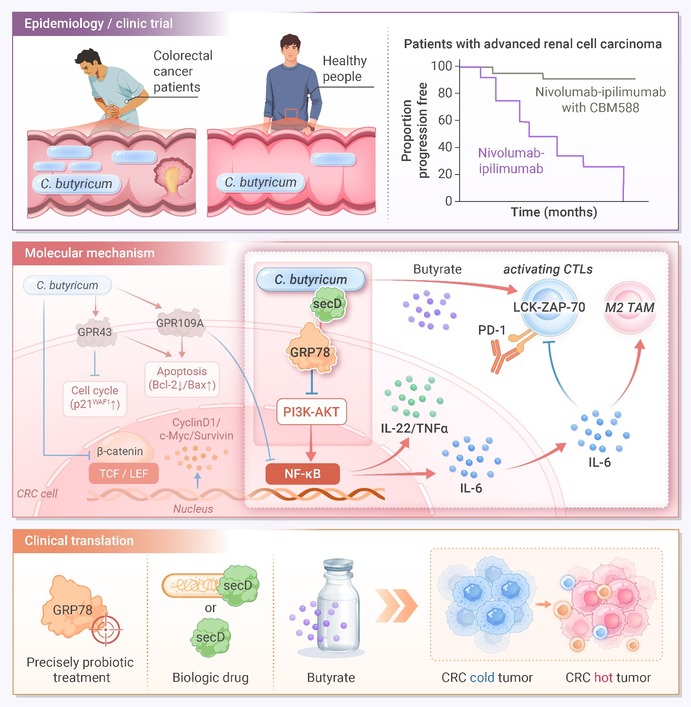
From bed to bench to bed: mechanism of Clostridium butyricum in suppressing colorectal cancer via direct binding and immune activation C.butyricum is significantly reduced in CRC patients compared to healthy individuals. And a clinical study in patients with advanced renal cell carcinoma showed that combining CBM588 (which contains C. butyricum) with immunotherapy significantly improved progression-free survival rates. The bacterial surface protein SecD binds specifically to GRP78 overexpressed on CRC cells. This binding inhibits the PI3K-AKT-NF-κB oncogenic signaling pathway, resulting in decreased secretion of IL-6, an immunosuppressive cytokine. Reduced IL-6 levels alleviate suppression of cytotoxic T lymphocytes (CTLs), leading to reactivation of the LCK-ZAP-70 signaling axis and enhanced production of effector cytokines IFNγ and TNFα. Meanwhile, previous studies have shown that C. butyricum fights colorectal cancer through apoptosis, cell cycle arrest, and the suppression of pro-tumorigenic inflammation. From a translational perspective, the findings of this study suggest that GRP78 represents a novel therapeutic target. Additionally, the bacterial surface protein SecD and SecD-expressing engineered bacteria also demonstrate therapeutic potential. Furthermore, butyrate produced by C. butyricum has been shown to suppress colorectal tumor. All these diverse clinical translation strategies hold the potential to convert cold tumors into hot ones.
