
AI-powered organoids and organ chips: Advancing human-specific models for biomedical research
-

-
REFERENCES
[1] Reardon S. (2025). Beyond lab animals. Science 389:676-679. DOI:10.1126/science.aeb3933 [2] Zhao Y., Landau S., Okhovatian S., et al. (2024). Integrating organoids and organ-on-a-chip devices. Nat. Rev. Bioeng. 2:588−608. DOI:10.1038/s44222-024-00207-z [3] Han X., Cai C., Deng W., et al. (2024). Landscape of human organoids: Ideal model in clinics and research. The Innovation 5:1−18. DOI:10.1016/j.xinn.2024.100620 [4] Kagan B.J., Kitchen A.C., Tran N.T., et al. (2022). In vitro neurons learn and exhibit sentience when embodied in a simulated game-world. Neuron 110:3952−3969.e3958. DOI:10.1016/j.neuron.2022.09.001 [5] Li S., Liu Y., Hua S., et al. (2025). Advanced brain-on-a-chip for wetware computing: A review. Adv. Sci. 12:e08120. DOI:10.1002/advs.202508120 -
ABOUT THIS ARTICLE
Cite this article:
Lu X., He J., Zhang H., et al. (2026). AI-powered organoids and organ chips: Advancing human-specific models for biomedical research. The Innovation Medicine 4:100186. https://doi.org/10.59717/j.xinn-med.2026.100186
Welcome!
To request copyright permission to republish or share portions of our works, please visit Copyright Clearance Center's (CCC) Marketplace website at marketplace.copyright.com.
Export File
Citation
Lu X., He J., Zhang H., et al. (2026). AI-powered organoids and organ chips: Advancing human-specific models for biomedical research. The Innovation Medicine 4:100186. https://doi.org/10.59717/j.xinn-med.2026.100186

Format
Content
 DownLoad:
-
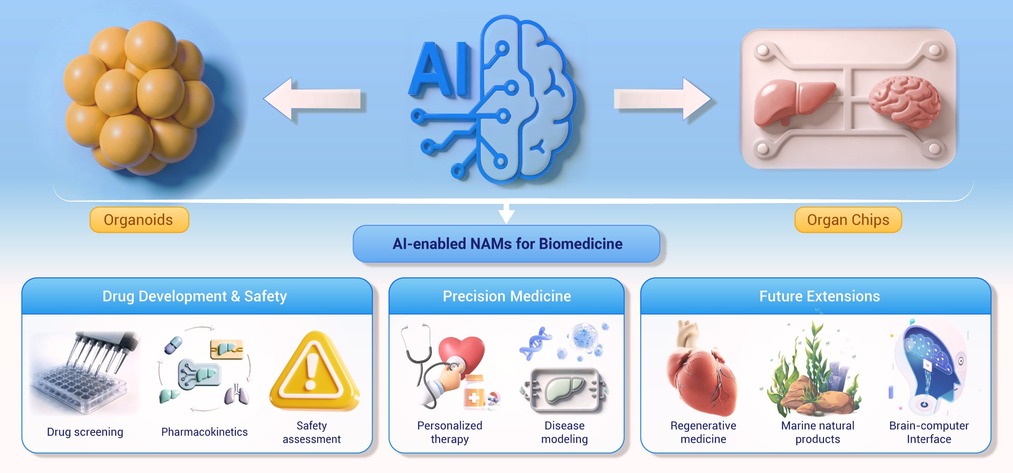
Figure 1.
AI-enabled New Alternative Methods (NAMs), such as organoids and organ chips, could leverage computational intelligence to advance drug development, precision medicine, and future biomedical extensions.
