
Pioneering depression treatment with temporal interference stimulation: Intracranial and clinical evidence in humans
-

-
REFERENCES
[1] Grossman N., Bono D., Dedic N., et al. (2017). Noninvasive deep brain stimulation via temporally interfering electric fields. Cell 169:1029−1041.e16. DOI:10.1016/j.cell.2017.05.024 [2] Wessel M.J., Beanato E., Popa T., et al. (2023). Noninvasive theta-burst stimulation of the human striatum enhances striatal activity and motor skill learning. Nat. Neurosci. 26:2005−2016. DOI:10.1038/s41593-023-01457-7 [3] Vassiliadis P., Beanato E., Popa T., et al. (2024). Non-invasive stimulation of the human striatum disrupts reinforcement learning of motor skills. Nat. Hum. Behav. 8:1581−1598. DOI:10.1038/s41562-024-01901-z [4] Violante I.R., Alania K., Cassarà A.M., et al. (2023). Non-invasive temporal interference electrical stimulation of the human hippocampus. Nat. Neurosci. 26:1994−2004. DOI:10.1038/s41593-023-01456-8 [5] Lamoš M., Bočková M., Missey F., et al. (2025). Noninvasive temporal interference stimulation of the subthalamic nucleus in Parkinson’s disease reduces beta activity. Mov. Disord. 40:1051−1060. DOI:10.1002/mds.30134 [6] Yang C., Xu Y., Feng X., et al. (2025). Transcranial temporal interference stimulation of the right globus pallidus in Parkinson’s disease. Mov. Disord. 40:1061−1069. DOI:10.1002/mds.29967 [7] Fitzgerald P.B. (2021). Targeting repetitive transcranial magnetic stimulation in depression: Do we really know what we are stimulating and how best to do it. Brain Stimul. 14:730−736. DOI:10.1016/j.brs.2021.04.018 [8] Li B., Friston K., Mody M., et al. (2018). A brain network model for depression: From symptom understanding to disease intervention. CNS Neurosci. Ther. 24:1004−1019. DOI:10.1111/cns.12998 [9] Johnson K.A., Okun M.S., Scangos K. et al. (2024). Deep brain stimulation for refractory major depressive disorder: A comprehensive review. Mol. Psychiatry 29:1075−1087. DOI:10.1038/s41380-023-02394-4 [10] Langevin J.-P. (2012). The amygdala as a target for behavior surgery. Surg. Neurol. Int. 3:S40−46. DOI:10.4103/2152-7806.91609 -
ABOUT THIS ARTICLE
Cite this article:
Yan J., Zhou S., Chen Y., et al. (2026). Pioneering depression treatment with temporal interference stimulation: Intracranial and clinical evidence in humans. The Innovation Medicine 4:100207. https://doi.org/10.59717/j.xinn-med.2026.100207
Welcome!
To request copyright permission to republish or share portions of our works, please visit Copyright Clearance Center's (CCC) Marketplace website at marketplace.copyright.com.
Export File
Citation
Yan J., Zhou S., Chen Y., et al. (2026). Pioneering depression treatment with temporal interference stimulation: Intracranial and clinical evidence in humans. The Innovation Medicine 4:100207. https://doi.org/10.59717/j.xinn-med.2026.100207

Format
Content
 DownLoad:
-
Figure 1.
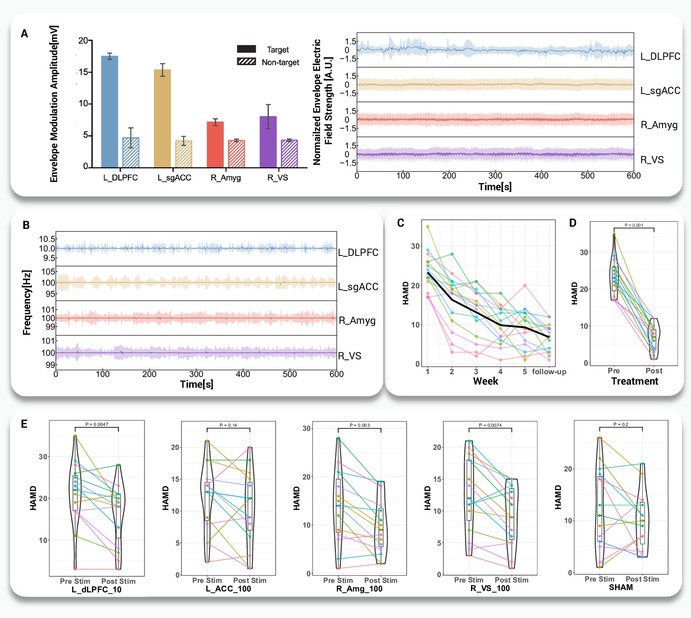
Intracranial EEG data by brain target (n = 2 epilepsy patients) and clinical outcome data (n = 15 MDD patients)
