
Reframing Parkinson's disease: From motor circuitry to somato-cognitive network dysfunction
-

-
REFERENCES
[1] Schapira A.H.V., Chaudhuri K.R. and Jenner P. (2017). Non-motor features of Parkinson disease. Nat. Rev. Neurosci. 18:435−450. DOI:10.1038/nrn.2017.62 [2] Rajamani N., Friedrich H., Butenko K., et al. (2024). Deep brain stimulation of symptom-specific networks in Parkinson's disease. Nat. Commun. 15:4662. DOI:10.1038/s41467-024-48731-1 [3] Gordon E.M., Chauvin R.J., Van A.N., et al. (2023). A somato-cognitive action network alternates with effector regions in motor cortex. Nature 617:351−359. DOI:10.1038/s41586-023-05964-2 [4] Ren J., Zhang W., Dahmani L., et al. (2026). Parkinson's disease as a somato-cognitive action network disorder. Nature 651:1030−1038. DOI:10.1038/s41586-025-10059-1 [5] Henderson M.X., Cornblath E.J., Darwich A., et al. (2019). Spread of alpha-synuclein pathology through the brain connectome is modulated by selective vulnerability and predicted by network analysis. Nat. Neurosci. 22:1248−1257. DOI:10.1038/s41593-019-0457-5 -
ABOUT THIS ARTICLE
Cite this article:
Liu H., Qi Y., Yi S., et al. (2026). Reframing Parkinson's disease: From motor circuitry to somato-cognitive network dysfunction. The Innovation Medicine 4:100234. https://doi.org/10.59717/j.xinn-med.2026.100234
Welcome!
To request copyright permission to republish or share portions of our works, please visit Copyright Clearance Center's (CCC) Marketplace website at marketplace.copyright.com.
Export File
Citation
Liu H., Qi Y., Yi S., et al. (2026). Reframing Parkinson's disease: From motor circuitry to somato-cognitive network dysfunction. The Innovation Medicine 4:100234. https://doi.org/10.59717/j.xinn-med.2026.100234

Format
Content
 DownLoad:
-
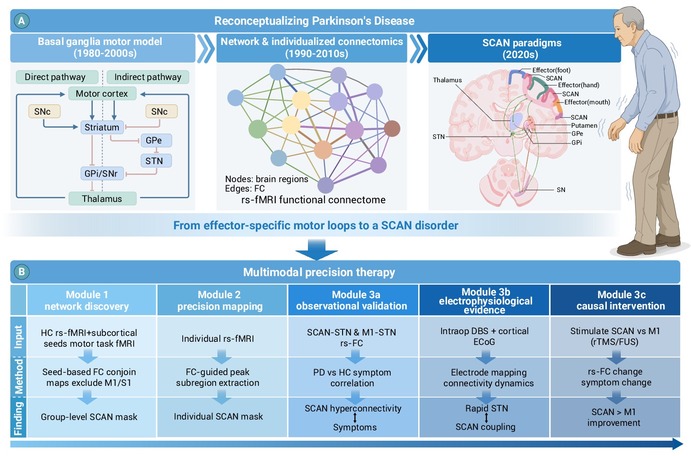
Figure 1.
Reconceptualizing Parkinson’s disease from effector-specific motor loops to SCAN disorder
