
Integrating Lanbuzheng into cerebrovascular health strategies worldwide: A policy-focused perspective
-
ABSTRACT
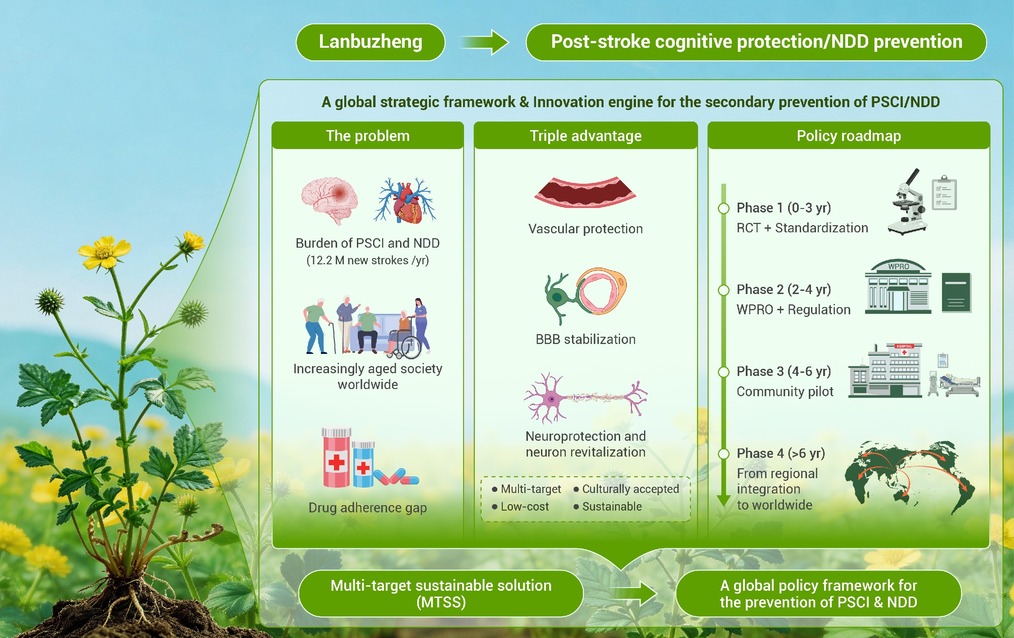
Vascular cognitive impairment (VCI), post-stroke dementia, and neurodegenerative diseases (NDD) are burgeoning public health crises worldwide, particularly in regions undergoing rapid population aging. While current prevention relies on pharmaceutical management of risk factors, adherence and access remain significant barriers across diverse healthcare settings. This Perspective argues that Geum japonicumvar. Chinense (Lanbuzheng), a traditional herb with emerging real-world evidence from Western China, warrants systematic investigation as a cost-effective, multi-target preventive agent—with a primary focus on post-stroke cognitive protection (secondary prevention of post-stroke cognitive impairment, PSCI), while acknowledging preliminary signals for primary prevention in high-risk elderly populations (e.g., hypertension with cerebral small vessel disease). To operationalize this approach, we introduce the Multi-Target Sustainable Solution (MTSS) framework—a Lanbuzheng-based conceptual model that integrates vascular protection, blood-brain barrier stabilization, and neuroprotective strategies into a scalable, culturally adapted intervention for PSCI/NDD secondary prevention. We present a focused analysis of its plausible biological mechanisms, preliminary observational data from Chinese cohorts, and propose a concrete translational pathway grounded in the MTSS paradigm. Rather than advocating for immediate clinical adoption, we call for global stakeholders to collaboratively develop this botanical resource through targeted clinical trials, standardized cultivation, and its potential integration into community-based non-communicable disease (NCD) management programs, offering a globally rooted, evidence-informed complementary strategy for cerebrovascular resilience. -

-
REFERENCES
[1] Mark F. B., Barry W. C. and Michael A.P. (2007). NEUROSCIENCE: Exploring the Brain. Lippincott Williams & Wikins.Walters Kluwer Health,Inc., USA. PP:19 [2] GBD 2023 Stroke Collaborators. (2024). Global burden of stroke and its risk factors, 1990–2021. Lancet Neurol. In Press [3] Wang Y., et al. (2022). Prevention and management of stroke in China: challenges and strategies. Lancet Reg Health West Pac.25:100502 [4] Liu Q., et al. (2023). Urolithin A attenuates blood-brain barrier disruption in cerebral hypoperfusion. Mol Nutr Food Res. 67:e2300098 [5] Internal Cohort Data] Zhejiang Provincial Hospital TCM Neurology Unit. (2023). Post-Stroke Cognition and Lanbuzheng Adjunct Therapy: 24-Month Observational Data. [6] World Health Organization. (2024). WHO Traditional Medicine Strategy: 2025–2034 -
ABOUT THIS ARTICLE
Cite this article:
Shen J., Shen S. and Gu S. (2026). Integrating Lanbuzheng into cerebrovascular health strategies worldwide: A policy-focused perspective. The Innovation Neurology 1:100008. https://doi.org/10.59717/j.tine.2026.100008
Welcome!
To request copyright permission to republish or share portions of our works, please visit Copyright Clearance Center's (CCC) Marketplace website at marketplace.copyright.com.
Export File
Citation
Shen J., Shen S. and Gu S. (2026). Integrating Lanbuzheng into cerebrovascular health strategies worldwide: A policy-focused perspective. The Innovation Neurology 1:100008. https://doi.org/10.59717/j.tine.2026.100008

Format
Content
 DownLoad:
-
Figure 1.
The MTSS framework for integrating Lanbuzheng into global cerebrovascular health strategies
