
Transcranial focused ultrasound meets brain–computer interfaces: Emerging applications and future directions
-

-
REFERENCES
[1] Chen M., Peng C., Wu H., et al. (2023). Numerical and experimental evaluation of low-intensity transcranial focused ultrasound wave propagation using human skulls for brain neuromodulation. Med. Phys. 50:38−49. DOI:10.1002/mp.16090 [2] Lipsman N., Hynynen K., Chen R., et al. (2026). Transcranial focused ultrasound in the human brain. Neuron 114:601−621. DOI:10.1016/j.neuron.2025.11.015 [3] Griggs W.S., Norman S.L., Deffieux T., et al. (2024). Decoding motor plans using a closed-loop ultrasonic brain-machine interface. Nat. Neurosci. 27:196−207. DOI:10.1038/s41593-023-01500-7 [4] Kosnoff J., Yu K., Liu C., et al. (2024). Transcranial focused ultrasound to V5 enhances human visual motion brain-computer interface by modulating feature-based attention. Nat. Commun. 15:4382. DOI:10.1038/s41467-024-48576-8 [5] Xhima K., Davidson B., Rabin J., et al. (2026). Focused ultrasound ablation for psychiatric disorders. Biol. Psychiatry. DOI:10.1016/j.biopsych.2026.05.018 -
ABOUT THIS ARTICLE
Cite this article:
Hao F., Li Y., Cheng G., et al. (2026). Transcranial focused ultrasound meets brain–computer interfaces: Emerging applications and future directions. The Innovation Neurology 1:100009. https://doi.org/10.59717/j.xinn-tine.2026.100009
Welcome!
To request copyright permission to republish or share portions of our works, please visit Copyright Clearance Center's (CCC) Marketplace website at marketplace.copyright.com.
Export File
Citation
Hao F., Li Y., Cheng G., et al. (2026). Transcranial focused ultrasound meets brain–computer interfaces: Emerging applications and future directions. The Innovation Neurology 1:100009. https://doi.org/10.59717/j.xinn-tine.2026.100009

Format
Content
 DownLoad:
-
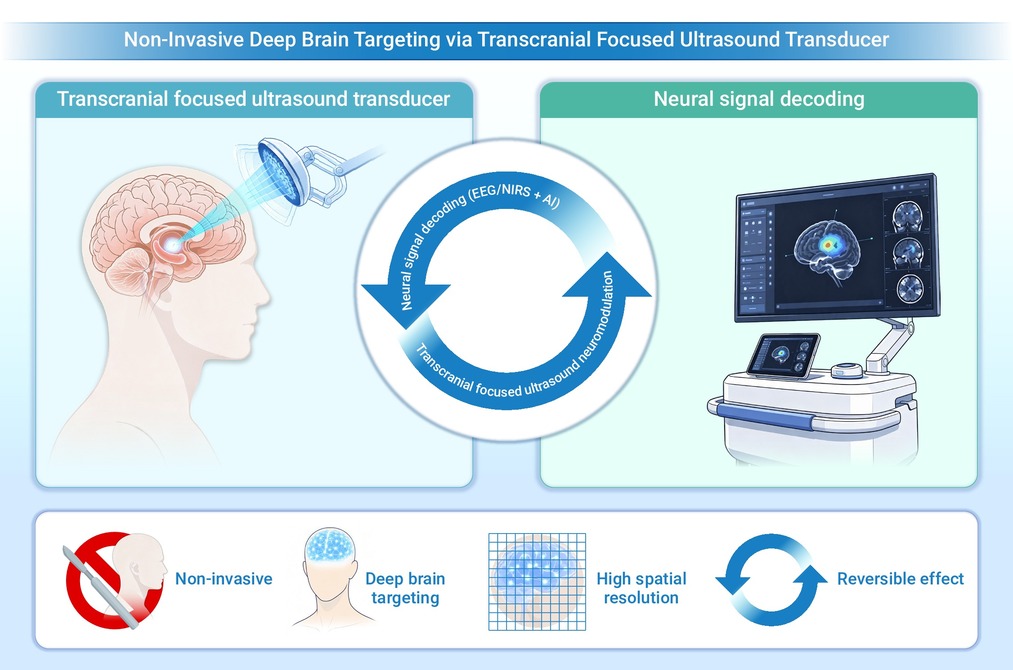
Figure 1.
Schematic illustration of the transcranial focused ultrasound mediated brain computer interface system
