
Rethinking ultra-processed foods: Controversies, health evidence, and policy directions
-

-
REFERENCES
[1] Monteiro C. A., Louzada M. L. C., Steele-Martinez E., et al. (2025). Ultra-processed foods and human health: the main thesis and the evidence. Lancet 406:2667−2684. DOI:10.1016/S0140-6736(25)01565-X [2] Lane M. M., Gamage E., Du S., et al. (2024). Ultra-processed food exposure and adverse health outcomes: Umbrella review of epidemiological meta-analyses. BMJ 384:e077310. DOI:10.1136/bmj-2023-077310 [3] Du M., Wang X., Hang D., et al. (2026). Metabolomic pattern of ultraprocessed food intake and its association with colorectal cancer risk. Gut 75:538−547. DOI:10.1136/gutjnl-2025-335618 [4] Hall K. D., Ayuketah A., Brychta R., et al. (2019). Ultra-processed diets cause excess calorie intake and weight gain: An inpatient randomized controlled trial of ad libitum food intake. Cell Metab. 30:67−77.e63. DOI:10.1016/j.cmet.2019.05.008 [5] Menichetti G., Barabási A.-L. and Loscalzo J. (2025). Chemical complexity of food and implications for therapeutics. Engl. J. Med. 392:1836−1845. DOI:10.1056/NEJMra2413243 -
ABOUT THIS ARTICLE
Cite this article:
Wei W., Han T., Ma Y., et al. (2026). Rethinking ultra-processed foods: Controversies, health evidence, and policy directions. The Innovation Nutrition 1:100003. https://doi.org/10.59717/j.xinn-nutri.2026.100003
Welcome!
To request copyright permission to republish or share portions of our works, please visit Copyright Clearance Center's (CCC) Marketplace website at marketplace.copyright.com.
Export File
Citation
Wei W., Han T., Ma Y., et al. (2026). Rethinking ultra-processed foods: Controversies, health evidence, and policy directions. The Innovation Nutrition 1:100003. https://doi.org/10.59717/j.xinn-nutri.2026.100003

Format
Content
 DownLoad:
-
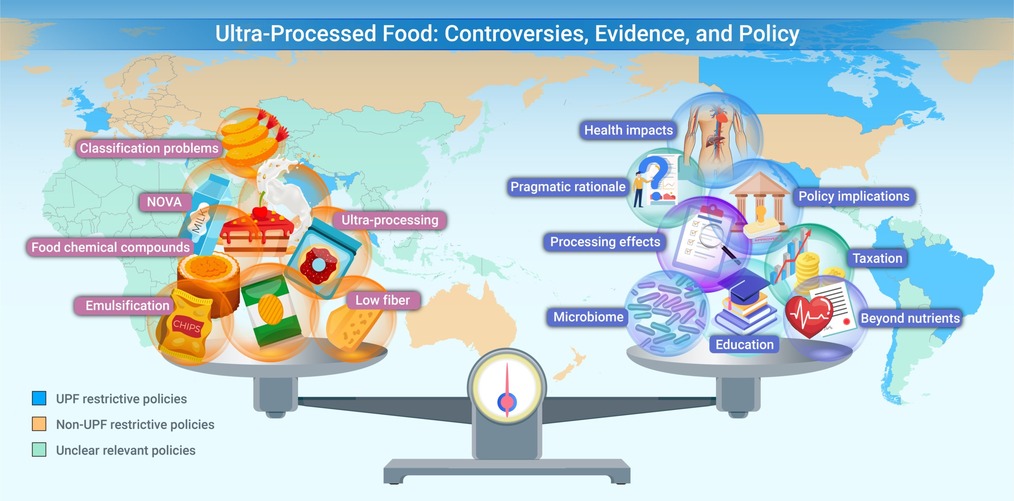
Figure 1.
Reconsidering Ultra-processed foods (UPFs): classification challenges, mechanistic uncertainties, and policy implications
