
Coffee and tea consumption in relation to chronic disease: An epidemiological perspective
-

-
REFERENCES
[1] Ma L., Hu Y., Alperet D. J., et al. (2023). Beverage consumption and mortality among adults with type 2 diabetes: prospective cohort study. BMJ 381:e073406. DOI:10.1136/bmj-2022-073406 [2] Farraj A., Akeredolu T., Wijeyesekera A., et al. (2024). Coffee and cardiovascular health: A review of literature. Nutrients 16:4257. DOI:10.3390/nu16244257 [3] Zhang Y., Liu Y., Li Y., et al. (2026). Coffee and Tea Intake, Dementia Risk, and Cognitive Function. JAMA 335:961-974. DOI:10.1001/jama.2025.27259 [4] Alperet D. J., Wang X., Zhu L., et al. (2024). Influence of consuming coffee and other beverages in adolescence on risk of type 2 diabetes in adulthood. Eur. J. Epidemiol. 39:1183−1197. DOI:10.1007/s10654-024-01165-x [5] Wang Q., Hu G. L., Qiu M. H., et al. (2024). Coffee, tea, and cocoa in obesity prevention: Mechanisms of action and future prospects. Curr. Res. Food Sci. 8:100741. DOI:10.1016/j.crfs.2024.100741 -
ABOUT THIS ARTICLE
Cite this article:
Wang X., Li C., Zhang Y., et al. (2026). Coffee and tea consumption in relation to chronic disease: An epidemiological perspective. The Innovation Nutrition 1:100007. https://doi.org/10.59717/j.xinn-nutri.2026.100007
Welcome!
To request copyright permission to republish or share portions of our works, please visit Copyright Clearance Center's (CCC) Marketplace website at marketplace.copyright.com.
Export File
Citation
Wang X., Li C., Zhang Y., et al. (2026). Coffee and tea consumption in relation to chronic disease: An epidemiological perspective. The Innovation Nutrition 1:100007. https://doi.org/10.59717/j.xinn-nutri.2026.100007

Format
Content
 DownLoad:
-
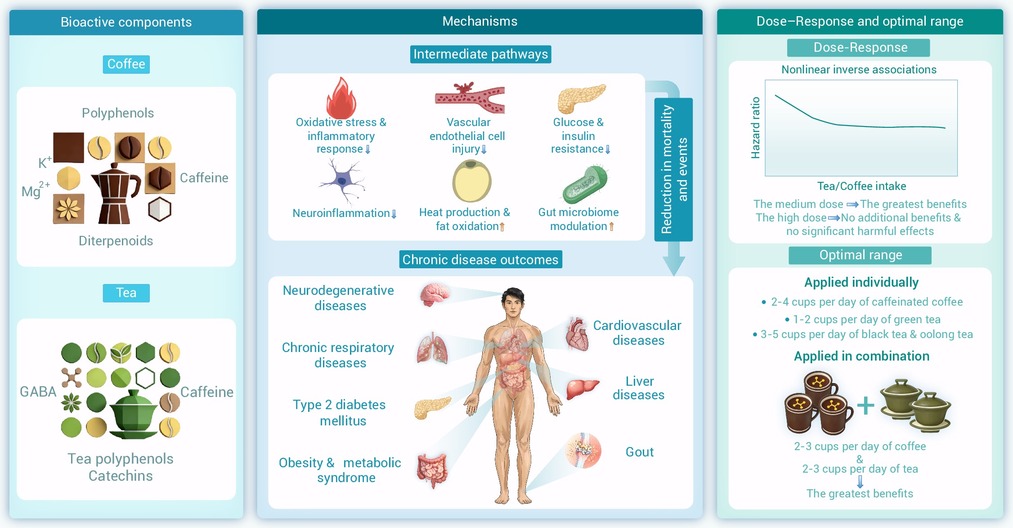
Figure 1.
Proposed epidemiological framework linking coffee and tea consumption with intermediate pathways, dose–response patterns and major chronic disease outcomes
