
Revisiting computational immunogenicity prediction for novel food ingredients
-

-
REFERENCES
[1] FAO/WHO (2001). Evaluation of allergenicity of genetically modified foods: Report of a joint FAO/WHO expert consultation on allergenicity of foods derived from biotechnology, 22–25 January 2001. Rome/Geneva: FAO/WHO. https://iris.who.int/handle/10665/340572 [2] Sharma N., Patiyal S., Dhall A., et al. (2021). AlgPred 2.0: An improved method for predicting allergenic proteins and mapping of IgE epitopes. Brief Bioinform. 22:bbaa294. DOI:10.1093/bib/bbaa294 [3] Liu J., Negi S. S., Yang C., et al. (2025). AllergenAI: A deep learning model predicting allergenicity based on protein sequence. BMC Bioinform. 26:279. DOI:10.1186/s12859-025-06302-1 [4] Vojdani A., Gushgari L. R. and Vojdani E. (2020). Interaction between food antigens and the immune system: Association with autoimmune disorders. Autoimmun. Rev. 19:102459. DOI:10.1016/j.autrev.2020.102459 [5] Huang T. and Li Y. (2023). Current progress, challenges, and future perspectives of language models for protein representation and protein design. The Innovation 4:100446. DOI:10.1016/j.xinn.2023.100446 -
ABOUT THIS ARTICLE
Cite this article:
Liu J., Cai H., Luo L., et al. (2026). Revisiting computational immunogenicity prediction for novel food ingredients. The Innovation Nutrition 1:100008. https://doi.org/10.59717/j.xinn-nutri.2026.100008
Welcome!
To request copyright permission to republish or share portions of our works, please visit Copyright Clearance Center's (CCC) Marketplace website at marketplace.copyright.com.
Export File
Citation
Liu J., Cai H., Luo L., et al. (2026). Revisiting computational immunogenicity prediction for novel food ingredients. The Innovation Nutrition 1:100008. https://doi.org/10.59717/j.xinn-nutri.2026.100008

Format
Content
 DownLoad:
-
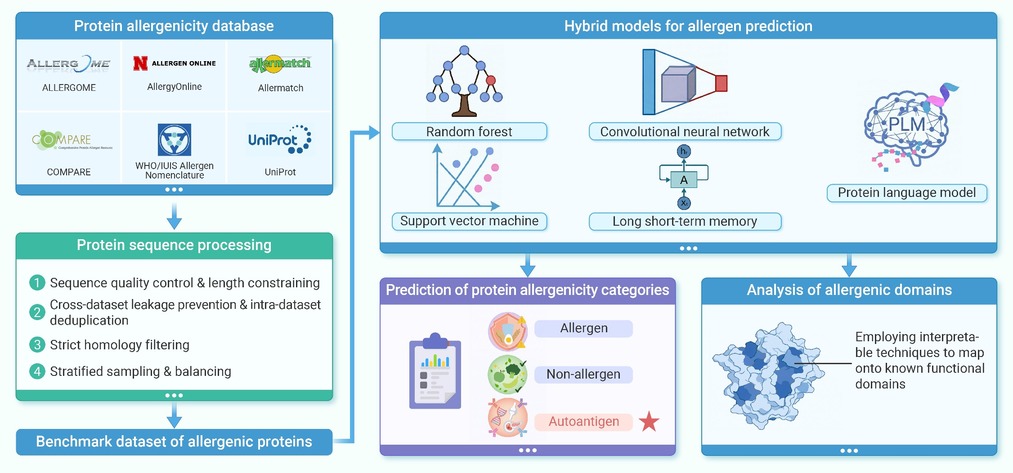
Figure 1.
Conceptual framework for next-generation immunogenicity prediction
