
The role of AI in shaping future functional foods: Targeted delivery, biosynthesis, and personalized nutrition
-
ABSTRACT
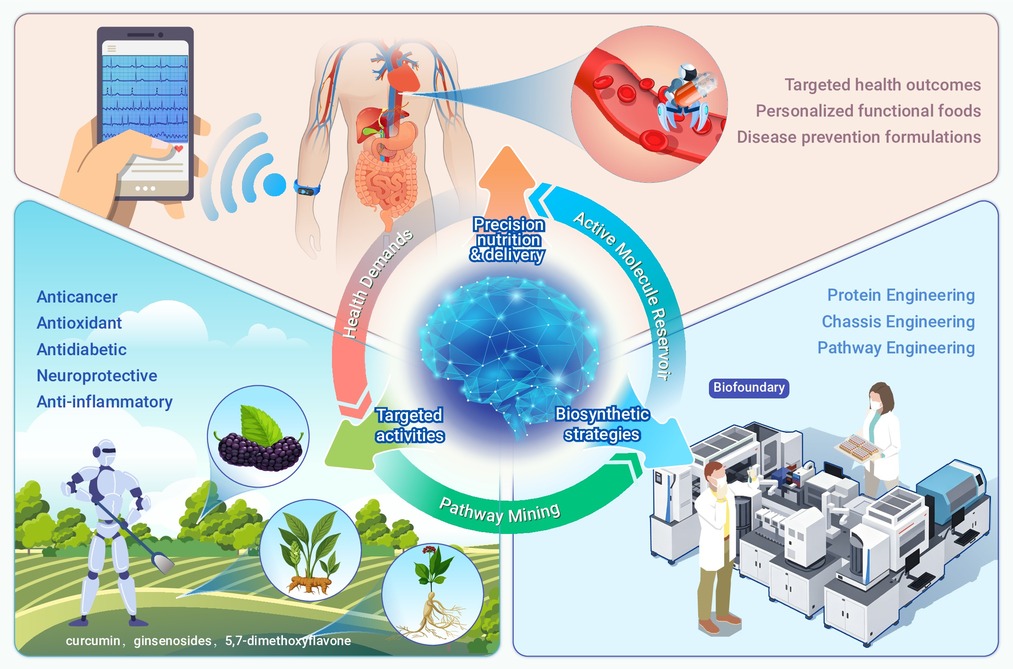
The functional food industry is shifting from general fortification to precision nutrition. However, conventional methodologies face bottlenecks in bioactive discovery, manufacturing, and delivery. This perspective articulates how artificial intelligence (AI) serves as the central orchestrator to resolve these challenges. We present a roadmap where AI converges with biotechnology: First, AI-driven algorithms and synthetic biology enable the efficient discovery and microbial biosynthesis of high-purity bioactives, replacing traditional agriculture. Second, AI models decode individual metabolic responses, facilitating evidence-based personalized dietary interventions. Third, delivery systems are evolving into autonomous, stimuli-responsive nanosystems capable of closed-loop navigation and real-time feedback. By integrating these pillars, AI transforms functional foods from static supplements into dynamic, closed-loop therapeutic systems. This paradigm shift promises a new era of predictive, personalized, and precisely engineered intelligent nutrition. -

-
REFERENCES
[1] Hua Z., Zhang X., Su W., et al. (2026). Advancements in precision nutrition: Targeted strategies for personalized health. Innov. Life 4:100191. DOI:10.59717/j.xinn-life.2026.100191 [2] Xu Q., Fu Q., Li Z., et al. (2021). The flavonoid procyanidin C1 has senotherapeutic activity and increases lifespan in mice. Nat. Metab. 3:1706−1726. DOI:10.1038/s42255-021-00491-8 [3] Qin K., Liu F., Zhang C., et al. (2025). Systems and synthetic biology for plant natural product pathway elucidation. Cell Rep. 44:115715. DOI:10.1016/j.celrep.2025.115715 [4] Jiang B., Gao L., Wang H., et al. (2024). Characterization and heterologous reconstitution of Taxus biosynthetic enzymes leading to baccatin III. Science 383:622−629. DOI:10.1126/science.adj3484 [5] Watson J.L., Juergens D., Bennett N.R., et al. (2023). De novo design of protein structure and function with RFdiffusion. Nature 620:1089−1100. DOI:10.1038/s41586-023-06415-8 [6] Fu Y., Zhang K., MiaoZ., et al. (2026). Advancing precision nutrition through multimodal data and artificial intelligence. Adv. Sci. 13:2198−3844. DOI:10.1002/advs.202521111 [7] Wu X., Oniani D., Shao Z., et al. (2025). A scoping review of artificial intelligence for precision nutrition. Adv. Nutr. 16:100398. DOI:10.1016/j.advnut.2025.100398 [8] Nie L., Ding X., Li M., et al. (2025). Quaternary ammonium chitosan hydrogel platform with zinc-enhanced bioactivity toward scar-free wound healing. ACS Appl. Mater. Interfaces 17:53270−53284. DOI:10.1021/acsami.5c13677 [9] Luo K., Li Q., Chen S., et al. (2026). Pullulan-stabilized gliadin nanocomplexes loaded with astragaloside IV: Fabrication, characterization and treatment of ulcerative colitis. Carbohydr. Polym. 378:124899. DOI:10.1016/j.carbpol.2026.124899 [10] Ma J., Chen K., Zhang X., et al. (2025). A multimodal energy-depletion strategy for cooperative tumor metabolism regulation in enhanced cancer therapy. Biomater. Res. 29:0246. DOI:10.34133/bmr.0246 -
ABOUT THIS ARTICLE
Cite this article:
Wang J., Wen L., Huang Y., et al. (2026). The role of AI in shaping future functional foods: Targeted delivery, biosynthesis, and personalized nutrition. The Innovation Nutrition 1:100014. https://doi.org/10.59717/j.xinn-nutri.2026.100014
Welcome!
To request copyright permission to republish or share portions of our works, please visit Copyright Clearance Center's (CCC) Marketplace website at marketplace.copyright.com.
Export File
Citation
Wang J., Wen L., Huang Y., et al. (2026). The role of AI in shaping future functional foods: Targeted delivery, biosynthesis, and personalized nutrition. The Innovation Nutrition 1:100014. https://doi.org/10.59717/j.xinn-nutri.2026.100014

Format
Content
 DownLoad:
-
Figure 1.
The AI-driven ecosystem of future functional foods
