
11-Oxygenated androgens: An underrecognized endocrine axis for precision nutrition research
-

-
REFERENCES
[1] Turcu A. F., Rege J., Auchus R.J., et al. (2020). 11-oxygenated androgens in health and disease. Nat. Rev. Endocrinol. 16:284−296. DOI:10.1038/s41574-020-0336-x [2] Walzer D., Turcu A. F., Jha S., et al. (2022). Excess 11-oxygenated androgens in women with severe insulin resistance are mediated by adrenal insulin receptor signaling. J. Clin. Endocrinol. Metab. 107:2626−2635. DOI:10.1210/clinem/dgac365 [3] McDonnell T., Anthony A. V., Clarke G., et al. (2025). Hepatic metabolism of 11-oxygenated androgens in humans: An integrated in vivo and ex vivo approach. Eur. J. Endocrinol. 193:340−347. DOI:10.1093/ejendo/lvaf166 [4] Xu H., Zhang H., Yang R., et al. (2026). From testosterone to 11-oxygenated androgens: Integrating endocrine biology, nutrition, and systemic health across the lifespan. Innov. Nutri. 1:100004. DOI:10.59717/j.xinn-nutri.2026.100004 [5] O'Reilly M. W., Kempegowda P., Jenkinson C., et al. (2017). 11-oxygenated C19 steroids are the predominant androgens in polycystic ovary syndrome. J. Clin. Endocrinol. Metab. 102:840−848. DOI:10.1210/jc.2016-3285 -
ABOUT THIS ARTICLE
Cite this article:
Zhang X., Xu H., Li J., et al. (2026). 11-Oxygenated androgens: An underrecognized endocrine axis for precision nutrition research. The Innovation Nutrition 1:100018. https://doi.org/10.59717/j.xinn-nutri.2026.100018
Welcome!
To request copyright permission to republish or share portions of our works, please visit Copyright Clearance Center's (CCC) Marketplace website at marketplace.copyright.com.
Export File
Citation
Zhang X., Xu H., Li J., et al. (2026). 11-Oxygenated androgens: An underrecognized endocrine axis for precision nutrition research. The Innovation Nutrition 1:100018. https://doi.org/10.59717/j.xinn-nutri.2026.100018

Format
Content
 DownLoad:
-
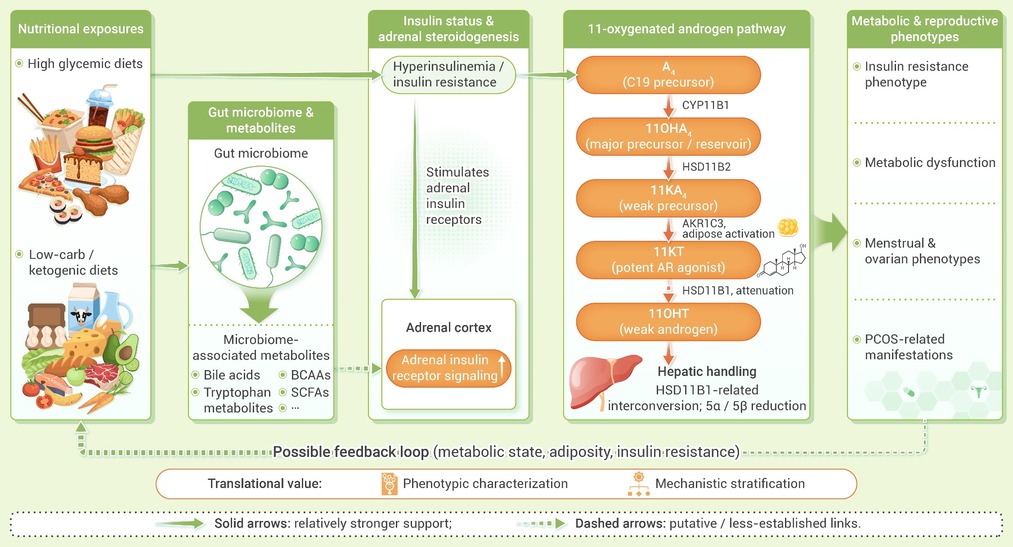
Figure 1.
Proposed nutrition–microbiome–insulin framework for 11-oxygenated androgen regulation
