
How does the probiotic empower immunotherapy for colorectal cancer?
-

-
REFERENCES
[1] Xie M., Yuan K., Zhang Y., et al. (2025). Tumor-resident probiotic Clostridium butyricum improves aPD-1 efficacy in colorectal cancer models by inhibiting IL-6-mediated immunosuppression. Cancer Cell 43:1885–1901.e10. DOI:10.1016/j.ccell.2025.07.012 [2] Stoeva M.K., Garcia-So J., Justice N., et al. (2021). Butyrate-producing human gut symbiont, Clostridium butyricum, and its role in health and disease. Gut Microbes 13:1−28. DOI:10.1080/19490976.2021.1907272 [3] Yu L., Guo Q., Gu X., et al. (2025). Impact of gut microbiome on radiotherapy and immunotherapy efficacy in microsatellite-stable colorectal cancer: Role of propionic acid and B. fragili. Br. J. Cancer 133:956−969. DOI:10.1038/s41416-025-03105-2 [4] Qiu Y.-S., Ye C., Li Q., et al. (2025). Improved gut microbiota by selenium-enriched Bifidobacterium longum DD98 alleviates chemotherapy-induced intestinal mucositis via inhibiting the STING pathway. npj Sci. Food 9:107. DOI:10.1038/s41538-025-00473-0 [5] Redenti A., Im J., Redenti B., et al. (2024). Probiotic neoantigen delivery vectors for precision cancer immunotherapy. Nature 635:453−461. DOI:10.1038/s41586-024-08033-4 -
ABOUT THIS ARTICLE
Cite this article:
Liu W., Wang J. and Gao Y.-Z. (2026). How does the probiotic empower immunotherapy for colorectal cancer? The Innovation Oncology 1:100006. https://doi.org/10.59717/j.xinn-oncol.2026.100006
Welcome!
To request copyright permission to republish or share portions of our works, please visit Copyright Clearance Center's (CCC) Marketplace website at marketplace.copyright.com.
Export File
Citation
Liu W., Wang J. and Gao Y.-Z. (2026). How does the probiotic empower immunotherapy for colorectal cancer? The Innovation Oncology 1:100006. https://doi.org/10.59717/j.xinn-oncol.2026.100006

Format
Content
 DownLoad:
-
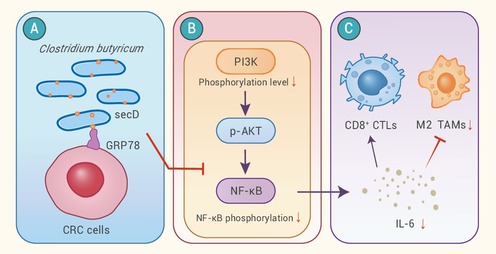
Figure 1.
A molecular model of the direct interaction between probiotics and tumor cells
