
New framework for precision clinical translation of gut microbiota in cancer: From individual variation to functional universality
-

-
REFERENCES
[1] Abdill R.J., Graham S.P., Rubinetti V., et al. (2025). Integration of 168,000 samples reveals global patterns of the human gut microbiome. Cell 188:1100−1118.e1117. DOI:10.1016/j.cell.2024.12.017 [2] Lin N.Y., Fukuoka S., Koyama S., et al. (2025). Microbiota-driven antitumour immunity mediated by dendritic cell migration. Nature 644:1058−1068. DOI:10.1038/s41586-025-09249-8 [3] Wu G., Xu T., Zhao N., et al. (2024). A core microbiome signature as an indicator of health. Cell 187:6550−6565.e6511. DOI:10.1016/j.cell.2024.09.019 [4] Qu R., Zhang Y., Kim B., et al. (2025). Microbial riboflavin inhibits ceramide synthase 3 to lower ceramide (d18:1/26:0) and delay colorectal cancer progression. Cell Metab. 37:1852−1869.e1858. DOI:10.1016/j.cmet.2025.06.002 [5] Zhang F., Zuo T., Wan Y., et al. (2022). Multi-omic analyses identify mucosa bacteria and fecal metabolites associated with weight loss after fecal microbiota transplantation. The Innovation 3:100304. DOI:10.1016/j.xinn.2022.100304 -
ABOUT THIS ARTICLE
Cite this article:
Qu R., Weng J., Yang Q., et al. (2026). New framework for precision clinical translation of gut microbiota in cancer: From individual variation to functional universality. The Innovation Oncology 1:100015. https://doi.org/10.59717/j.xinn-oncol.2026.100015
Welcome!
To request copyright permission to republish or share portions of our works, please visit Copyright Clearance Center's (CCC) Marketplace website at marketplace.copyright.com.
Export File
Citation
Qu R., Weng J., Yang Q., et al. (2026). New framework for precision clinical translation of gut microbiota in cancer: From individual variation to functional universality. The Innovation Oncology 1:100015. https://doi.org/10.59717/j.xinn-oncol.2026.100015

Format
Content
 DownLoad:
-
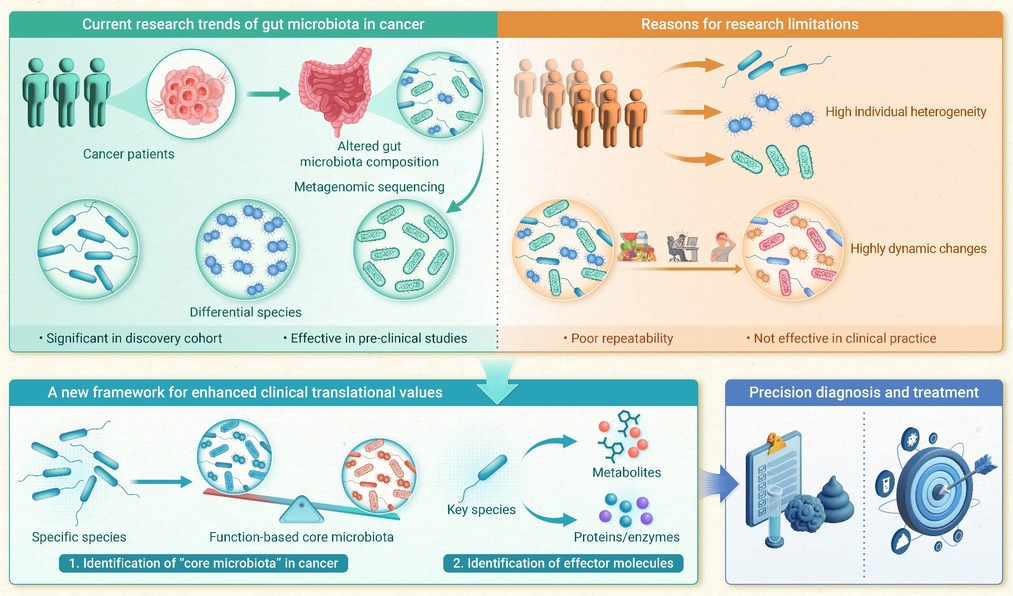
Figure 1.
A new framework for precision clinical translation of gut microbiota in cancer
