
When AI meets physics: Beyond prediction, towards understanding
-
-
Keywords:
- Artificial intelligence /
- physics /
- interpretability /
- physical priors /
- scientific discovery
-

-
REFERENCES
[1] Xu Y., Liu X., Cao X., et al. (2021). Artificial intelligence: A powerful paradigm for scientific research. The Innovation 2:100179. DOI:10.1016/j.xinn.2021.100179 [2] Batzner S., Musaelian A., Sun L., et al. (2022). E(3)-equivariant graph neural networks for data-efficient and accurate interatomic potentials. Nat. Commun. 13:2453. DOI:10.1038/s41467-022-29939-5 [3] Cory-Wright R., Cornelio C., Dash S., et al. (2024). Evolving scientific discovery by unifying data and background knowledge with AI Hilbert. Nat. Commun. 15:5922. DOI:10.1038/s41467-024-50074-w [4] Zeni C., Pinsler R., Zügner D., et al. (2025). A generative model for inorganic materials design. Nature 639:624-632. DOI:10.1038/s41586-025-08628-5 [5] Gao D., Lu S., Zhang C., et al. (2026). Autonomous closed-loop framework for reproducible perovskite solar cells.Nature 653:707-714. DOI:10.1038/s41586-026-10482-y -
ABOUT THIS ARTICLE
Cite this article:
Li J., Ren R.C ., Zhao Z.X., et al. (2026). When AI meets physics: Beyond prediction, towards understanding. The Innovation Physics 1:100006. https://doi.org/10.59717/j.tip.2026.100006
Welcome!
To request copyright permission to republish or share portions of our works, please visit Copyright Clearance Center's (CCC) Marketplace website at marketplace.copyright.com.
Export File
Citation
Li J., Ren R.C ., Zhao Z.X., et al. (2026). When AI meets physics: Beyond prediction, towards understanding. The Innovation Physics 1:100006. https://doi.org/10.59717/j.tip.2026.100006

Format
Content
 DownLoad:
-
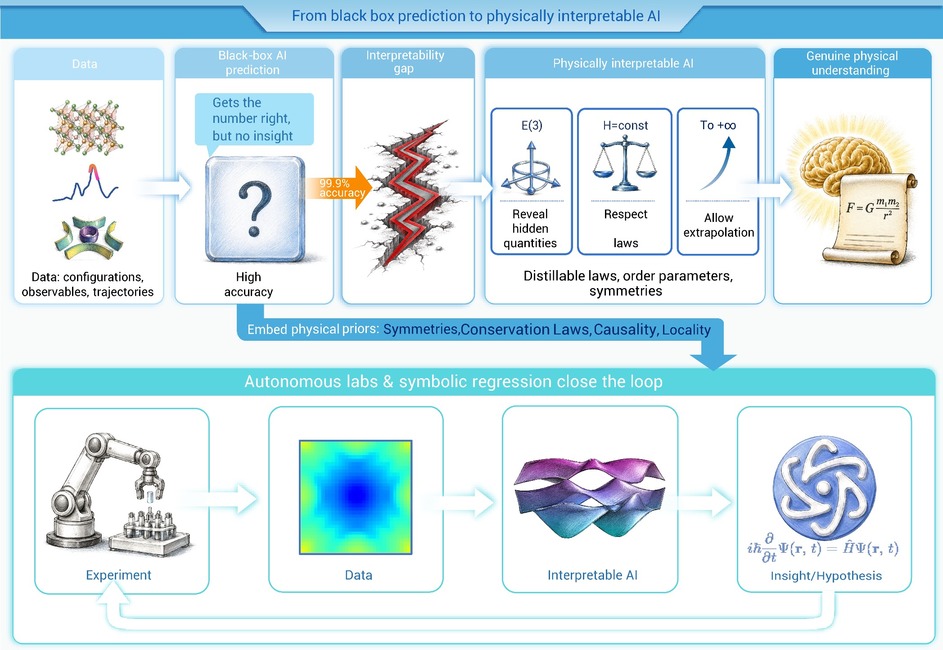
Figure 1.
From prediction to understanding in AI-driven physics Black-box models achieve high accuracy but lack insight. Embedding physical priors enables interpretable AI that reveals laws, respects constraints, and supports extrapolation.
