
Self-assembly and manipulation of Te clusters on WTe2 surface
-
GRAPHICAL ABSTRACT
 DownLoad:
Full size image
DownLoad:
Full size image
-
PUBLIC SUMMARY
-
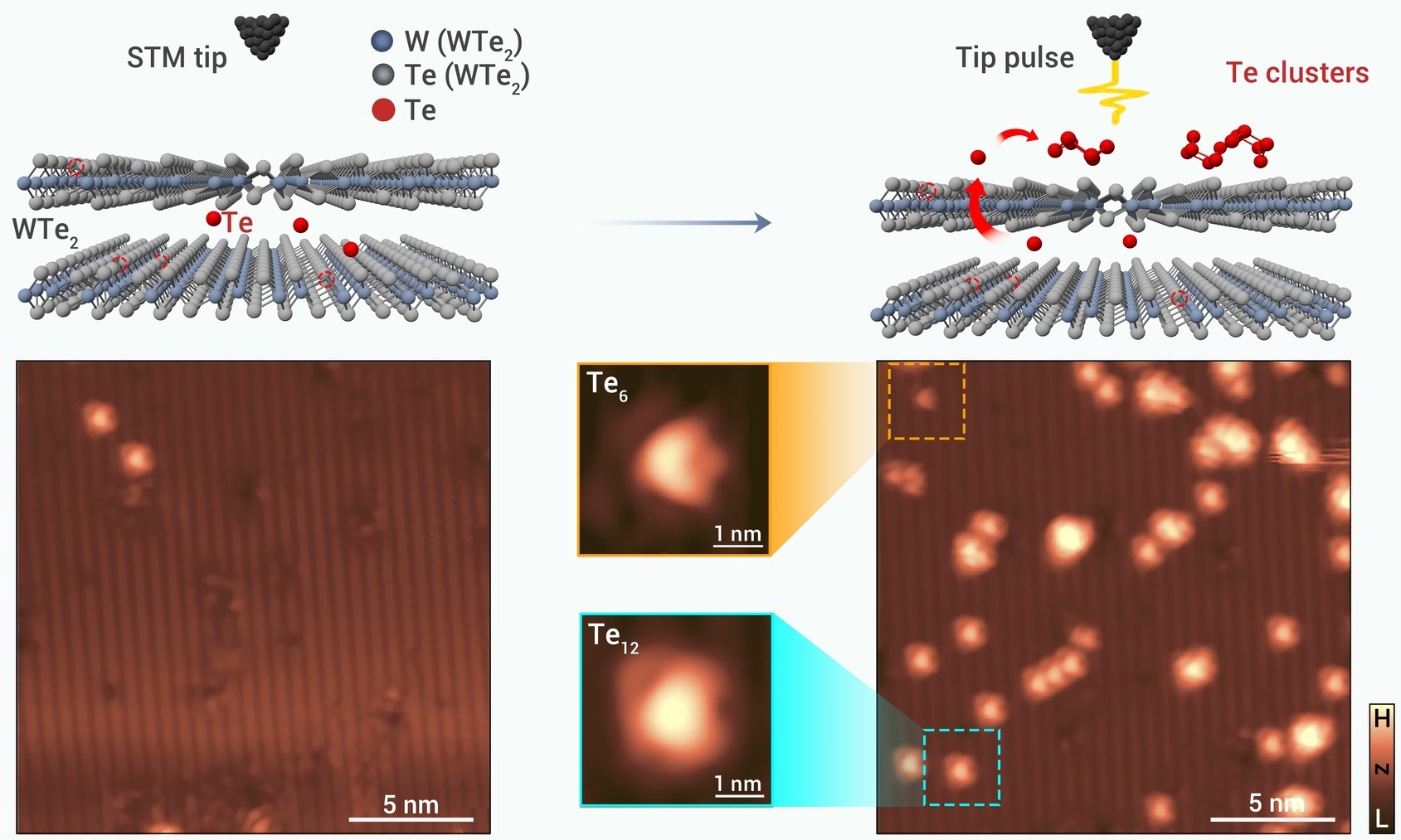
Self-assembly and tip manipulation are combined to construct atomically precise tellurium (Te) clusters.
Ring-like Te clusters on 1T’-WTe2 can be created, manipulated, and reshaped with atomic precision.
This work opens new avenues for tailoring atomic-scale assemblies and exploring emergent quantum phenomena.
-
-
ABSTRACT
The ability to build matter with atomic precision is central to nanoscience, with profound implications for engineering functional quantum materials and fabricating nanoscale devices. Two different methods, i.e., molecular self-assembly and atomic manipulation, are developed to achieve such a goal. Although both have advanced considerably, their integration within a single system remains largely unexplored, hampering the construction of more complex nanostructures with greater control. Here, we report a method to trigger self-assembly of Te clusters on 1T’-WTe2 surface and show the ability to further manipulate the Te clusters via scanning tunnelling microscopy tip engineering. This enables us to change the position and number of atoms of the Te clusters with atomic precision. Our results indicate that the seamless combination of self-assembly and manipulation in a single system opens new avenues for constructing and tailoring atomic-scale architectures, providing an ideal platform with atomic precision to explore emergent quantum phenomena. -

-
REFERENCES
[1] Barth J. V., Costantini G. and Kern K. (2005). Engineering atomic and molecular nanostructures at surfaces. Nature 437:671−679. DOI:10.1038/nature04166 [2] He Y., Gorman S. K., Keith D. et al. (2019). A two-qubit gate between phosphorus donor electrons in silicon. Nature 571:371−375. DOI:10.1038/s41586-019-1381-2 [3] Chou C.-W., Kurz C., Hume D. B. et al. (2017). Preparation and coherent manipulation of pure quantum states of a single molecular ion. Nature 545:203−207. DOI:10.1038/nature22338 [4] Imre A., Csaba G., Ji L. et al. (2006). Majority logic gate for magnetic quantum-dot cellular automata. Science 311:205−208. DOI:10.1126/science.1120506 [5] Yan H., Lin Y., Wu H. et al. (2017). Bottom-up precise synthesis of stable platinum dimers on graphene. Nat. Commun. 8:1070. DOI:10.1038/s41467-017-01259-z [6] Kalff F. E., Rebergen M. P., Fahrenfort E. et al. (2016). A kilobyte rewritable atomic memory. Nat. Nanotechnol. 11:926−929. DOI:10.1038/nnano.2016.131 [7] Piquero-Zulaica I., Lobo-Checa J., Abd El-Fattah Z. M. et al. (2022). Engineering quantum states and electronic landscapes through surface molecular nanoarchitectures. Rev. Mod. Phys. 94:045008. DOI:10.1103/RevModPhys.94.045008 [8] Grill L., Dyer M., Lafferentz L. et al. (2007). Nano-architectures by covalent assembly of molecular building blocks. Nat. Nanotechnol. 2:687−691. DOI:10.1038/nnano.2007.346 [9] Chen Q., Bae S. C. and Granick S. (2011). Directed self-assembly of a colloidal kagome lattice. Nature 469:381−384. DOI:10.1038/nature09713 [10] Shang J., Wang Y., Chen M. et al. (2015). Assembling molecular Sierpiński triangle fractals. Nat. Chem. 7:389−393. DOI:10.1038/nchem.2211 [11] Chen J., Zhu E., Liu J. et al. (2018). Building two-dimensional materials one row at a time: Avoiding the nucleation barrier. Science 362:1135−1139. DOI:10.1126/science.aau4146 [12] Zhang Y.-Q., Paszkiewicz M., Du P. et al. (2018). Complex supramolecular interfacial tessellation through convergent multi-step reaction of a dissymmetric simple organic precursor. Nat. Chem. 10:296−304. DOI:10.1038/nchem.2924 [13] Montis R., Fusaro L., Falqui A. et al. (2021). Complex structures arising from the self-assembly of a simple organic salt. Nature 590:275−278. DOI:10.1038/s41586-021-03194-y [14] Fang H., Mahalingam H., Li X. et al. (2023). Atomically precise vacancy-assembled quantum antidots. Nat. Nanotechnol. 18:1401−1408. DOI:10.1038/s41565-023-01495-z [15] Crommie M. F., Lutz C. P. and Eigler D. M. (1993). Confinement of electrons to quantum corrals on a metal surface. Science 262:218−220. DOI:10.1126/science.262.5131.218 [16] Kim H. W., Han M., Shin H.-J. et al. (2011). Control of molecular rotors by selection of anchoring sites. Phys. Rev. Lett. 106:146101. DOI:10.1103/PhysRevLett.106.146101 [17] Gomes K. K., Mar W., Ko W. et al. (2012). Designer Dirac fermions and topological phases in molecular graphene. Nature 483:306−310. DOI:10.1038/nature10941 [18] Fölsch S., Martínez-Blanco J., Yang J. et al. (2014). Quantum dots with single-atom precision. Nat. Nanotechnol. 9:505−508. DOI:10.1038/nnano.2014.129 [19] Slot M. R., Gardenier T. S., Jacobse P. H. et al. (2017). Experimental realization and characterization of an electronic Lieb lattice. Nat. Phys. 13:672−676. DOI:10.1038/nphys4105 [20] Drost R., Ojanen T., Harju A. et al. (2017). Topological states in engineered atomic lattices. Nat. Phys. 13:668−671. DOI:10.1038/nphys4080 [21] Khajetoorians A. A., Wegner D., Otte A. F. et al. (2019). Creating designer quantum states of matter atom-by-atom. Nat. Rev. Phys. 1:703−715. DOI:10.1038/s42254-019-0108-5 [22] Chen I. J., Aapro M., Kipnis A. et al. (2022). Precise atom manipulation through deep reinforcement learning. Nat. Commun. 13:7499. DOI:10.1038/s41467-022-35149-w [23] Sierda E., Huang X., Badrtdinov D. I. et al. (2023). Quantum simulator to emulate lower-dimensional molecular structure. Science 380:1048−1052. DOI:10.1126/science.adf2685 [24] Calavalle F., Suárez-Rodríguez M., Martín-García B. et al. (2022). Gate-tuneable and chirality-dependent charge-to-spin conversion in tellurium nanowires. Nat. Mater. 21:526−532. DOI:10.1038/s41563-022-01211-7 [25] Ghosh P., Bhattacharjee J. and Waghmare U. V. (2008). The origin of stability of helical structure of tellurium. J. Phys. Chem. C 112:983−989. DOI:10.1021/jp077070d [26] Li X., Mitchell S., Fang Y. et al. (2023). Advances in heterogeneous single-cluster catalysis. Nat. Rev. Chem. 7:754−767. DOI:10.1038/s41570-023-00540-8 [27] Hu K.-J., Plant S. R., Ellis P. R. et al. (2015). Atomic resolution observation of a size-dependent change in the ripening modes of mass-selected Au nanoclusters involved in CO oxidation. J. Am. Chem. Soc. 137:15161−15168. DOI:10.1021/jacs.5b08720 [28] Li Z., Chen H.-Y. T., Schouteden K. et al. (2020). Unraveling the atomic structure, ripening behavior, and electronic structure of supported Au20 clusters. Sci. Adv. 6:eaay4289. DOI:10.1126/sciadv.aay4289 [29] Bonanni S., Aït-Mansour K., Harbich W. et al. (2012). Effect of the TiO2 reduction state on the catalytic CO oxidation on deposited size-selected Pt clusters. J. Am. Chem. Soc. 134:3445−3450. DOI:10.1021/ja2098854 [30] Haldar S., Vovusha H., Yadav M. K. et al. (2015). Systematic study of structural, electronic, and optical properties of atomic-scale defects in the two-dimensional transition metal dichalcogenides MX2 (M = Mo, W; X = S, Se, Te). Phys. Rev. B 92:235408. DOI:10.1103/PhysRevB.92.235408 [31] Zhao Y.-X., Jin H., Han Z.-Y. et al. (2025). Realization of fractional-layer transition metal dichalcogenides. Nat. Commun. 16:3659. DOI:10.1038/s41467-025-59007-7 [32] Lu W., Zhang Y., Zhu Z. et al. (2016). Thin tungsten telluride layer preparation by thermal annealing. Nanotechnology 27:414006. DOI:10.1088/0957-4484/27/41/414006 [33] Blades W. H., Frady N. J., Litwin P. M. et al. (2020). Thermally induced defects on WSe2. J. Phys. Chem. C 124:15337−15346. DOI:10.1021/acs.jpcc.0c04440 [34] Evans P. E., Wang Y., Sushko P. V. et al. (2023). Understanding palladium-tellurium cluster formation on WTe2: From a kinetically hindered distribution to thermodynamically controlled monodispersity. PNAS Nexus 2:pgad212. DOI:10.1093/pnasnexus/pgad212 [35] Sugawara K., Gotoh T. and Tanaka K. (2004). Nanoscale phase change in telluride films induced with scanning tunneling microscopes. Jpn. J. Appl. Phys. 43:L676. DOI:10.1143/JJAP.43.L676 [36] Ren Y.-N., Zhang M.-H., Zhou X.-F. et al. (2024). In situ creation and tailoring of interfacial quantum dots in graphene/transition metal dichalcogenide heterostructures. Phys. Rev. B 110:125416. DOI:10.1103/PhysRevB.110.125416 [37] Degtyareva O., Gregoryanz E., Somayazulu M. et al. (2005). Novel chain structures in group VI elements. Nat. Mater. 4:152−155. DOI:10.1038/nmat1294 [38] Jin Y., Maroulis G., Kuang X. et al. (2015). Geometries, stabilities and fragmental channels of neutral and charged sulfur clusters: SnQ (n = 3-20, Q = 0, ±1). Phys. Chem. Chem. Phys. 17:13590−13597. DOI:10.1039/C5CP00728C [39] Millefiori S. and Alparone A. (2001). Ab initio study of the structure and polarizability of sulfur clusters, Sn (n = 2-12). J. Phys. Chem. A 105:9489−9497. DOI:10.1021/jp0121466 [40] Alexander A. D. and Otto F. S. (2001). Theory of zeolite supralattices: Se in zeolite Linde type A. J. Phys.: Condens. Matter 13:10433. DOI:10.1088/0953-8984/13/46/313 [41] Guo J., Meng X., Chen J. et al. (2014). Real-space imaging of interfacial water with submolecular resolution. Nat. Mater. 13:184−189. DOI:10.1038/nmat3848 [42] Kowalczyk H., Biscaras J., Pistawala N. et al. (2023). Gate and temperature driven phase transitions in few-layer MoTe2. ACS Nano 17:6708−6718. DOI:10.1021/acsnano.2c12610 [43] Pawbake A., Bellin C., Paulatto L. et al. (2019). Pressure-induced phase transitions in germanium telluride: Raman signatures of anharmonicity and oxidation. Phys. Rev. Lett. 122:145701. DOI:10.1103/PhysRevLett.122.145701 [44] Kresse G. and Furthmüller J. (1996). Efficiency of ab-initio total energy calculations for metals and semiconductors using a plane-wave basis set. Comput. Mater. Sci. 6:15−50. DOI:10.1016/0927-0256(96)00008-0 [45] Kresse G. and Furthmüller J. (1996). Efficient iterative schemes for ab initio total-energy calculations using a plane-wave basis set. Phys. Rev. B 54:11169−11186. DOI:10.1103/PhysRevB.54.11169 [46] Blöchl P. E. (1994). Projector augmented-wave method. Phys. Rev. B 50:17953−17979. DOI:10.1103/PhysRevB.50.17953 [47] Kresse G. and Joubert D. (1999). From ultrasoft pseudopotentials to the projector augmented-wave method. Phys. Rev. B 59:1758−1775. DOI:10.1103/PhysRevB.59.1758 [48] Perdew J. P., Burke K. and Ernzerhof M. (1996). Generalized gradient approximation made simple. Phys. Rev. Lett. 77:3865−3868. DOI:10.1103/PhysRevLett.77.3865 [49] Tersoff J. and Hamann D. R. (1983). Theory and application for the scanning tunneling microscope. Phys. Rev. Lett. 50:1998−2001. DOI:10.1103/PhysRevLett.50.1998 [50] Tersoff J. and Hamann D. R. (1985). Theory of the scanning tunneling microscope. Phys. Rev. B 31:805−813. DOI:10.1103/PhysRevB.31.805 -
ABOUT THIS ARTICLE
Cite this article:
Han Z.-Y., Zhao X., Zhao Y.-X., et al. (2026). Self-assembly and manipulation of Te clusters on WTe2 surface. The Innovation Physics 1:100008. https://doi.org/10.59717/j.tip.2026.100008
Welcome!
To request copyright permission to republish or share portions of our works, please visit Copyright Clearance Center's (CCC) Marketplace website at marketplace.copyright.com.
Export File
Citation
Han Z.-Y., Zhao X., Zhao Y.-X., et al. (2026). Self-assembly and manipulation of Te clusters on WTe2 surface. The Innovation Physics 1:100008. https://doi.org/10.59717/j.tip.2026.100008

Format
Content
-
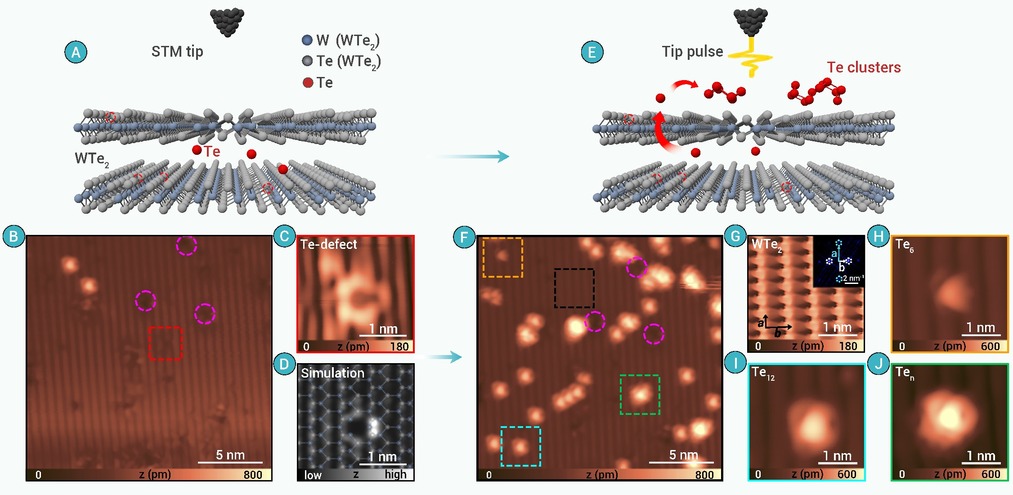
Figure 1.
Atomic-precision self-assembly of Te clusters on the 1T’-WTe2 surface
-
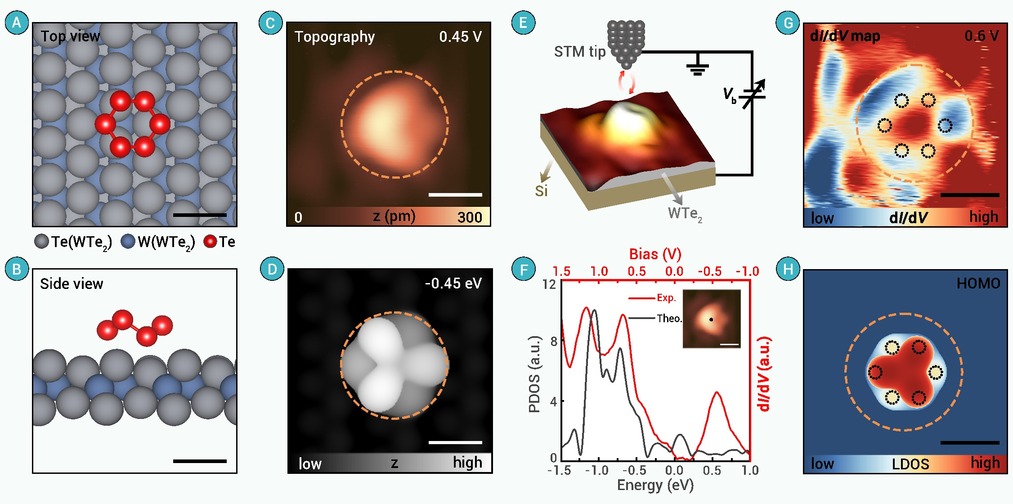
Figure 2.
Atomic structure and electronic state distribution of Te6 cluster
-
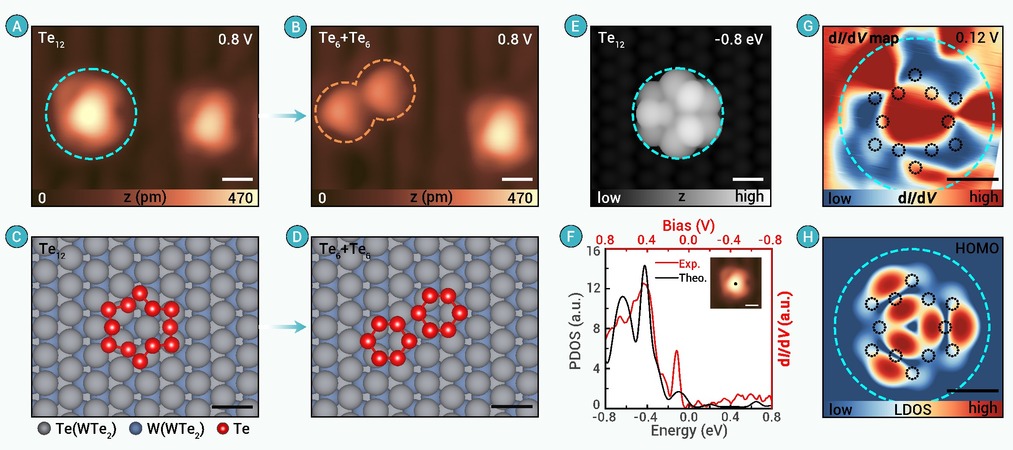
Figure 3.
Atomic structure and electronic state distribution of the Te12 cluster
-
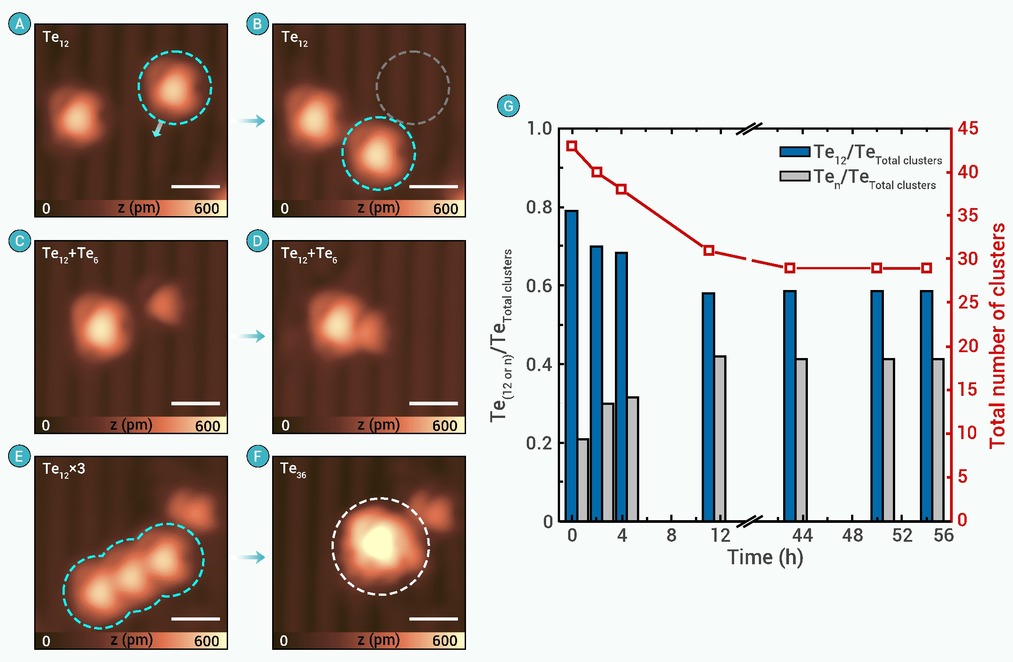
Figure 4.
STM tip manipulation of Te clusters
