
Beyond depth: Decoupling the astronaut from coring in crewed lunar drilling
-
ABSTRACT
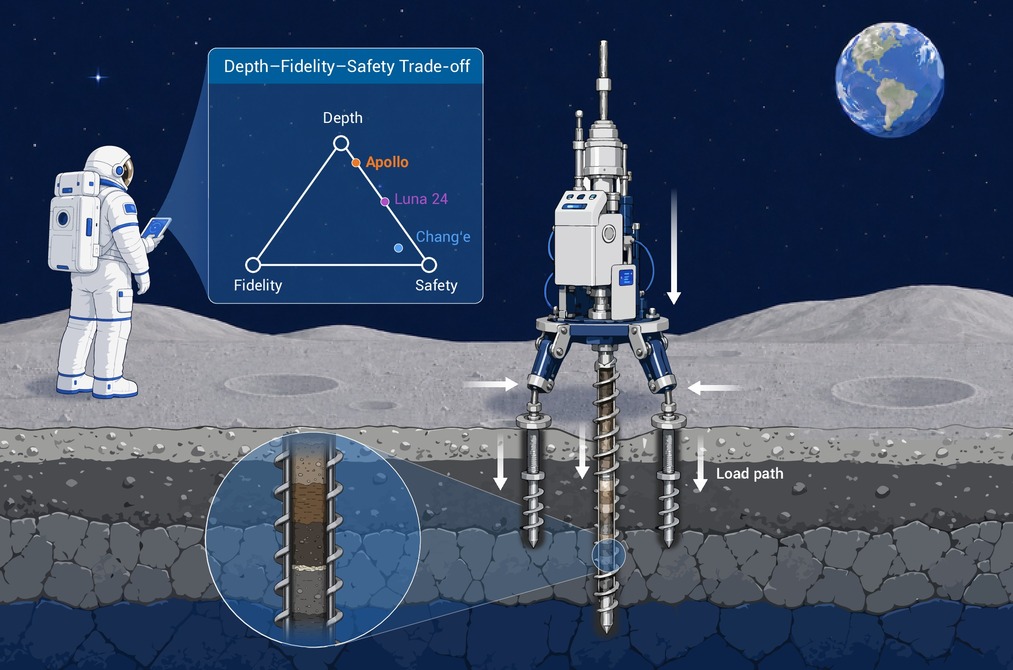
Fifty years of lunar drilling—three crewed campaigns and a succession of robotic missions from Luna 24 to Chang’e-6—has converged on a consistent pattern: no coring architecture has yet preserved the uppermost stratigraphic interval intact while reaching multi-meter depth safely. The Apollo record, through the lens of engineering failure-mode insights, shows that coupling the astronaut’s body into the drill’s load path was the common root of its extraction, stratigraphic, and thermal disturbances. The robotic record shows the mirror image: crew risk was eliminated, but reliable penetration stalled near one meter and, even in the deepest success of Luna 24, the top 50–60 cm of the core returned empty. As China prepares for a crewed lunar landing before 2030, we contend that the design question is not “astronaut or robot” but how completely a system decouples human presence and mechanical actuation from the geological record it seeks to preserve. We propose a functional-decoupling paradigm—load-path, operational, and stratigraphic decoupling—supported by early-stage prototype hardware now under development, and call for an explicit sample-integrity budget to stand alongside mass and power budgets in future mission design. -

-
REFERENCES
[1] McKay, D.S., Heiken, G., Basu, A., et al. (1991). The lunar regolith. Heiken, G., Vaniman, D., and French, B.M. (eds). Lunar Sourcebook: A User's Guide to the Moon (Cambridge University Press), pp: 285–356. [2] Carrier, W.D., III. (1974). Apollo drill core depth relationships. The Moon 10:183−194. DOI:10.1007/BF00655719 [3] Meyer, C. (2007). 15001–15006 Deep drill core. Lunar sample compendium. https://www.lpi.usra.edu/lunar/samples/atlas/compendium/A15drill.pdf [4] Jones, E.M. (1996). Extracting the core and losing the north complex. https://apollojournals.org/alsj/a15/a15.coreextract.html [5] Meyer, C. (2007). 60007–60001 Deep drill core. Lunar sample compendium. https://www.lpi.usra.edu/lunar/samples/atlas/compendium/A16drill.pdf [6] Jones, E.M. (1996). Drilling the deep core. https://apollojournals.org/alsj/a16/a16.deepcore.html [7] Meyer, C. (2007). 70001–70006 Deep drill core. Lunar sample compendium. https://www.lpi.usra.edu/lunar/samples/atlas/compendium/70009.pdf [8] Jones, E.M. (1996). The deep core. https://apollojournals.org/alsj/a17/a17.deepcore.html [9] Barsukov, V.L. (1977). Preliminary data for the regolith core brought to Earth by the automatic lunar station Luna 24. Proc. Lunar Sci. Conf. 8th, pp: 3303–3318. [10] Meyer, C. (2009). Luna 24. Lunar sample compendium. https://www.lpi.usra.edu/lunar/samples/atlas/compendium/Luna24Core.pdf -
ABOUT THIS ARTICLE
Cite this article:
Wang, K., Wang, S., Guo, D., et al. (2026). Beyond depth: Decoupling the astronaut from coring in crewed lunar drilling. The Innovation Reviews 1:100005. https://doi.org/10.59717/j.tirv.2026.100005
Welcome!
To request copyright permission to republish or share portions of our works, please visit Copyright Clearance Center's (CCC) Marketplace website at marketplace.copyright.com.
Export File
Citation
Wang, K., Wang, S., Guo, D., et al. (2026). Beyond depth: Decoupling the astronaut from coring in crewed lunar drilling. The Innovation Reviews 1:100005. https://doi.org/10.59717/j.tirv.2026.100005

Format
Content
 DownLoad:
-
Figure 1.
Functional decoupling framework for crewed lunar coring
