
Ice, light and the hadronic sky: Francis Halzen and the 2026 Nobel Prize in Physics
-

-
REFERENCES
[1] The Royal Swedish Academy of Sciences. (2026). The Nobel Prize in Physics 2026. Press release, 6 October 2026. https://www.nobelprize.org/prizes/physics/2026/press-release/ [2] The Nobel Committee for Physics. (2026). Scientific background to the Nobel Prize in Physics 2026. The Royal Swedish Academy of Sciences, 6 October 2026. https://www.nobelprize.org/uploads/2026/10/advanced-physicsprize2026.pdf [3] IceCube Collaboration, Aartsen M.G., Ackermann M., et al. (2018). Multimessenger observations of a flaring blazar coincident with high-energy neutrino IceCube-170922A. Science 361:eaat1378. DOI:10.1126/science.aat1378 [4] IceCube Collaboration, Abbasi R., Ackermann M., et al. (2022). Evidence for neutrino emission from the nearby active galaxy NGC 1068. Science 378:538−543. DOI:10.1126/science.abg3395 [5] Abbasi R., Ackermann M., Adams J., et al. (2026). High-energy neutrino emission from the Milky Way. arXiv preprint. DOI:10.48550/arXiv.2607.25966 -
ABOUT THIS ARTICLE
Cite this article:
Tao An (2027). Ice, light and the hadronic sky: Francis Halzen and the 2026 Nobel Prize in Physics. The Innovation Astronomy 1:100005. https://doi.org/10.59717/j.tias.2027.100005
Welcome!
To request copyright permission to republish or share portions of our works, please visit Copyright Clearance Center's (CCC) Marketplace website at marketplace.copyright.com.
Export File
Citation
Tao An (2027). Ice, light and the hadronic sky: Francis Halzen and the 2026 Nobel Prize in Physics. The Innovation Astronomy 1:100005. https://doi.org/10.59717/j.tias.2027.100005

Format
Content
 DownLoad:
-
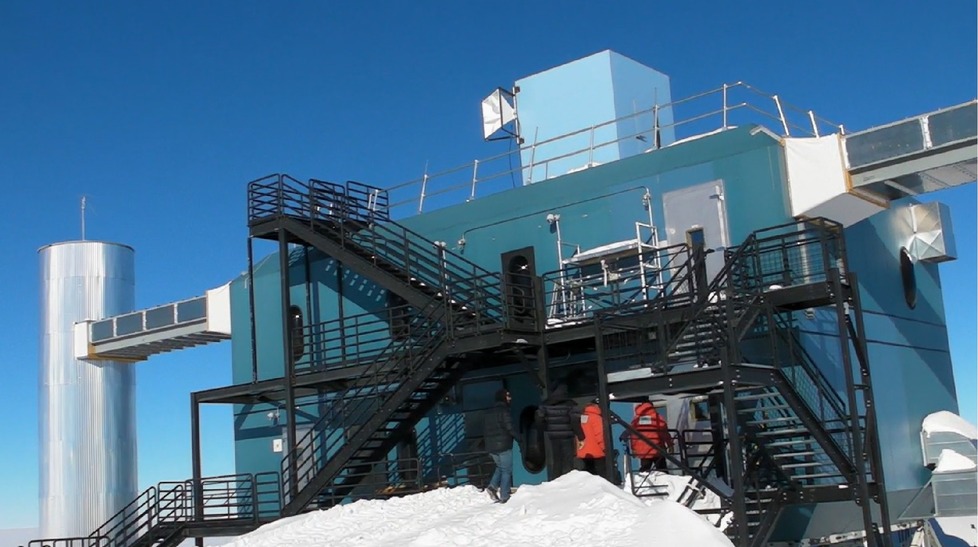
Figure 1.
IceCube work area at the South Pole Science Lab.
