
Radiopharmaceuticals driving the transition from metabolic to targeted precision molecular imaging in neurodegenerative diseases
-
ABSTRACT
Neurodegenerative diseases (NDDs) are characterized by overlapping clinical phenotypes and heterogeneous proteinopathies, which pose substantial challenges for early and accurate diagnosis. Molecular imaging with radiopharmaceuticals has revolutionized the field by enabling the in vivo visualization of disease-specific biological processes. Historically, the field has progressed from glucose metabolism imaging toward the increasingly selective detection of pathological protein aggregates. Amyloid-β and tau are established biomarkers in Alzheimer’s disease, and their imaging is now integrated into diagnostic and therapeutic pathways. Nevertheless, ongoing efforts continue to refine these radiopharmaceuticals, particularly in enhancing target specificity and minimizing off-target binding. In parallel, emerging targets such as α-synuclein, mutant huntingtin, transactive response DNA binding protein 43, and other pathological aggregates are expanding the molecular imaging toolbox beyond Alzheimer’s disease to encompass a broader spectrum of NDDs. Neuroinflammation-targeted PET provides an additional window into disease-associated biological processes beyond protein aggregation. Nevertheless, a critical need persists for radiopharmaceuticals targeting these emerging molecular targets. Addressing these challenges and advancing multi-target PET platforms will not only enable in vivo detection of mixed proteinopathies and precise disease subtyping, but also provide a core infrastructure for target validation, companion diagnostics, and therapeutic monitoring across the drug development pipeline, ultimately ushering in an era of biologically defined precision medicine for NDDs. -

-
REFERENCES
[1] Arbizu J., Morbelli S., Minoshima S., et al. (2025). SNMMI Procedure Standard/EANM Practice Guideline for Brain [18F]FDG PET Imaging Version 2.0. J. Nucl. Med. 66:S45-S60. DOI:10.2967/jnumed.124.268754 [2] Chapleau M., Iaccarino L., Soleimani-Meigooni D., et al. (2022). The Role of Amyloid PET in Imaging Neurodegenerative Disorders: A Review. J. Nucl. Med. 63:13S−19S. DOI:10.2967/jnumed.121.263195 [3] Liang S. H. (2025). Development of Novel PET Tracers for Imaging Non-AD Tauopathies. ACS Med. Chem. Lett. 16:1884−1888. DOI:10.1021/acsmedchemlett.5c00487 [4] Zeng Q. and Cui M. (2022). Current Progress in the Development of Probes for Targeting α-Synuclein Aggregates. ACS Chem. Neurosci. 13:552−571. DOI:10.1021/acschemneuro.1c0087 [5] Smith R., Capotosti F., Schain M., et al. (2023). The α-synuclein PET tracer [18F] ACI-12589 distinguishes multiple system atrophy from other neurodegenerative diseases. Nat. Commun. 14:6750. DOI:10.1038/s41467-023-42305-3 [6] Saw R. S., Haas S., Schmidt F., et al. (2026). The PET tracer [11C]MODAG-005 targets alpha-synuclein aggregates in the brain. Sci. Transl. Med. 18:eaec0813. DOI:10.1126/scitranslmed.aec0813 [7] Li Y., Wang L., Pei Z., et al. (2025). Isoindolinone-Derived PET Tracers for Molecular Imaging of mHTT Aggregates in Huntington's Disease. ACS Med. Chem. Lett. 16:2097−2102. DOI:10.1021/acsmedchemlett.5c00557 [8] Vokali E., Chevalier E., Dreyfus N., et al. (2025). Development of [18F]ACI-19626 as a first-in-class brain PET tracer for imaging TDP-43 pathology. Nat. Commun. 16:9358. DOI:10.1038/s41467-025-64540-6 [9] Croteau E., Rousseau E., Tremblay S., et al. (2026). A phase I study to evaluate the dosimetry and safety of [89Zr]Zr-DFO-AP-101, a new antibody-based radiopharmaceutical to detect misfolded SOD1 in amyotrophic lateral sclerosis. Eur. J. Nucl. Med. Mol. Imaging 53:4639−4651. DOI:10.1007/s00259-026-07853-y [10] Jin H. (2026). PET Molecular Probes for Neuroinflammation in Neurodegenerative Diseases: Progress and Prospects. ACS Chem. Neurosci. 17:2229−2237. DOI:10.1021/acschemneuro.6c00338 -
ABOUT THIS ARTICLE
Cite this article:
Zhou Y., Fang H., Lan X., et al. (2027). Radiopharmaceuticals driving the transition from metabolic to targeted precision molecular imaging in neurodegenerative diseases. The Innovation Drug Discovery 2:100042. https://doi.org/10.59717/j.xinn-drugdisc.2026.100042
Welcome!
To request copyright permission to republish or share portions of our works, please visit Copyright Clearance Center's (CCC) Marketplace website at marketplace.copyright.com.
Export File
Citation
Zhou Y., Fang H., Lan X., et al. (2027). Radiopharmaceuticals driving the transition from metabolic to targeted precision molecular imaging in neurodegenerative diseases. The Innovation Drug Discovery 2:100042. https://doi.org/10.59717/j.xinn-drugdisc.2026.100042

Format
Content
 DownLoad:
-
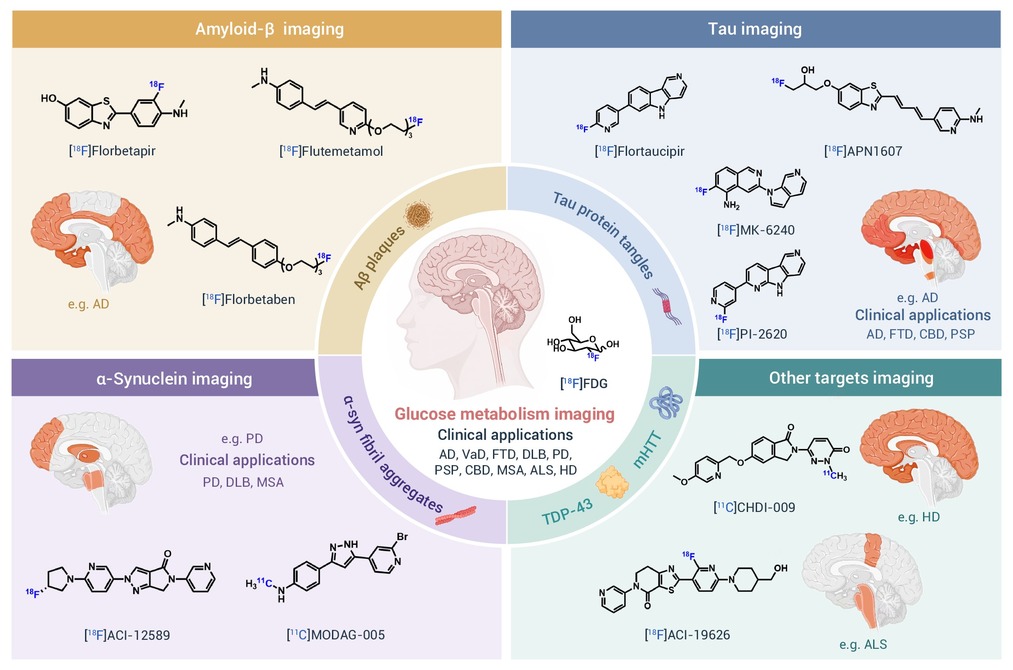
Figure 1.
Molecular imaging landscape of neurodegenerative diseases from metabolic to protein-targeted PET imaging
