
Deciphering the synergistic mechanism for thermal stability improvement in Ni-rich single-crystal cathode materials via LiNbO3 coating and Nb5+ surface doping
-
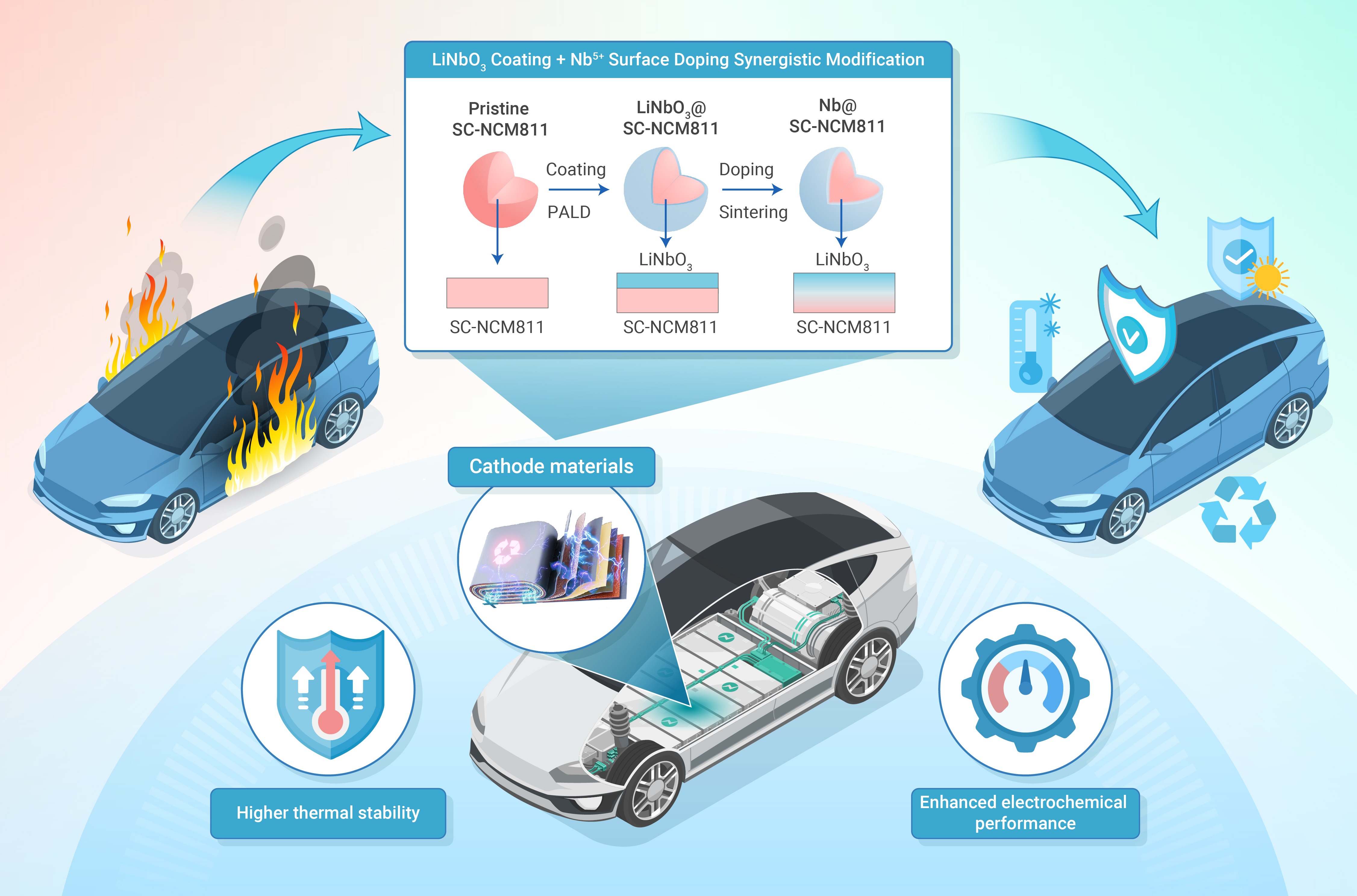
GRAPHICAL ABSTRACT
 DownLoad:
Full size image
DownLoad:
Full size image
-
PUBLIC SUMMARY
-
Ni-rich cathodes' thermal stability improved by LiNbO3 coating and Nb5+ doping.
Nb@SC-NCM811 shows better electrochemical performance and higher thermal stability.
Enhanced stability due to oxygen vacancy formation and increased migration barrier.
-
-
ABSTRACT
Ni-rich cathode materials are highly regarded for their potential in high-energy density lithium-ion batteries (LIBs). Nonetheless, their intrinsic thermal instability poses a significant risk of thermal runaway, which is a major obstacle to their commercial application. This study presents a novel approach to enhancing the thermal stability of Ni-rich cathode materials for LIBs through a synergistic modification strategy combining LiNbO3 coating and Nb5+ surface doping. By applying particle atomic layer deposition and high-temperature sintering, the modified cathode material Nb@SC-NCM811 shows better electrochemical performance. Thermal analysis reveals that Nb@SC-NCM811 has a higher thermal decomposition temperature, generates less heat, and releases less oxygen under thermal induction, indicating enhanced thermal stability. The microscopic mechanisms underlying the improvement of thermal stability are further revealed through aberration-corrected transmission electron microscopy and density functional theory calculations, which shows that the enhancement in thermal stability is due to the increased formation energy of oxygen vacancies and the raised energy barrier for interlayer migration of transition metal cations. This work provides insight into the Nb-modified mechanism of Ni-rich cathode materials and offers a promising avenue for designing safer, high-energy density LIBs. -

-
REFERENCES
[1] Liu L., Li M., Chu L., et al. (2020). Layered ternary metal oxides: Performance degradation mechanisms as cathodes, and design strategies for high-performance batteries. Prog. Mater. Sci. 111:100655. DOI:10.1016/j.pmatsci.2020.100655 [2] Liu J., Wang J., Ni Y., et al. (2021). Recent breakthroughs and perspectives of high-energy layered oxide cathode materials for lithium ion batteries. Mater. Today 43:132−165. DOI:10.1016/j.mattod.2020.10.028 [3] Zhang S.S. (2020). Problems and their origins of Ni-rich layered oxide cathode materials. Energy Storage Mater. 24:247−254. DOI:10.1016/j.ensm.2019.08.013 [4] Wang Y., Feng X., Huang W., et al. (2023). Challenges and Opportunities to Mitigate the Catastrophic Thermal Runaway of High-Energy Batteries. Adv. Energy Mater. 13:2203841. DOI:10.1002/aenm.202203841 [5] Noh H.-J., Youn S., Yoon C.S., et al. (2013). Comparison of the structural and electrochemical properties of layered Li[NixCoyMnz]O2 (x = 1/3, 0.5, 0.6, 0.7, 0.8 and 0.85) cathode material for lithium-ion batteries. J. Power Sources 233:121-130. DOI:10.1016/j.jpowsour.2013.01.063 [6] Bak, S.M., Hu, E., Zhou, Y., et al. (2014). Structural changes and thermal stability of charged LiNixMnyCozO(2) cathode materials studied by combined in situ time-resolved XRD and mass spectroscopy. ACS Appl Mater Interfaces 6(24):22594−22601. DOI:10.1021/am506712c [7] Wang Q., Mao B., Stoliarov S.I., et al. (2019). A review of lithium ion battery failure mechanisms and fire prevention strategies. Prog. Energy Combus. Sci. 73:95−131. DOI:10.1016/j.pecs.2019.03.002 [8] Nam K.-W., Bak S.-M., Hu E., et al. (2013). Combining In Situ Synchrotron X-Ray Diffraction and Absorption Techniques with Transmission Electron Microscopy to Study the Origin of Thermal Instability in Overcharged Cathode Materials for Lithium-Ion Batteries. Adv. Funct. Mater. 23:1047−1063. DOI:10.1002/adfm.201200693 [9] Lee E., Muhammad S., Kim T., et al. (2020). Tracking the Influence of Thermal Expansion and Oxygen Vacancies on the Thermal Stability of Ni-Rich Layered Cathode Materials. Adv. Sci. 7:1902413. DOI:10.1002/advs.201902413 [10] Alvarado J., Wei C., Nordlund D., et al. (2020). Thermal stress-induced charge and structure heterogeneity in emerging cathode materials. Mater. Today 35:87−98. DOI:10.1016/j.mattod.2019.11.009 [11] Huang Q., Li C., Li X., et al. (2024). Multifunction composite phase change material with inorganic flame retardant and organic form stability for improving battery thermal safety. Innov. Mater. 2:100048. DOI:10.59717/j.xinn-mater.2024.100048 [12] Li C., Wu Y., Li X., et al. (2024). Flame-retardant composite phase change material with silicone resin and melamine phosphate for battery thermal safety. Innov. Energy 1:100021. DOI:10.59717/j.xinn-energy.2024.100021 [13] Wang G., Ping P., Kong D., et al. (2024). Advances and challenges in thermal runaway modeling of lithium-ion batteries. The Innovation 5:100624. DOI:10.1016/j.xinn.2024.100624 [14] Li Y., Liu X., Ren D., et al. (2020). Toward a high-voltage fast-charging pouch cell with TiO2 cathode coating and enhanced battery safety. Nano Energy 71:104643. DOI:10.1016/j.nanoen.2020.104643 [15] Kim J.W., Travis J.J., Hu E., et al. (2014). Unexpected high power performance of atomic layer deposition coated Li[Ni1/3Mn1/3Co1/3]O2 cathodes. J. Power Sources 254:190−197. DOI:10.1016/j.jpowsour.2013.12.119 [16] Wu J., Zuo X., Chen Q., et al. (2019). Functional composite polymer electrolytes with imidazole modified SiO2 nanoparticles for high-voltage cathode lithium ion batteries. Electrochimica Acta 320:134567. DOI:10.1016/j.electacta.2019.134567 [17] Huang Y., Chen J., Ni J., et al. (2009). A modified ZrO2-coating process to improve electrochemical performance of Li(Ni1/3Co1/3Mn1/3)O2. J. Power Sources 188:538−545. DOI:10.1016/j.jpowsour.2008.12.037 [18] Liu J., Wu Z., Yu M., et al. (2022). Building Homogenous Li(2) TiO(3) Coating Layer on Primary Particles to Stabilize Li-Rich Mn-Based Cathode Materials. Small 18:e2106337. DOI:10.1002/smll.202106337 [19] Yin S., Chen H., Chen J., et al. (2022). Chemical-Mechanical Effects in Ni-Rich Cathode Materials. Chem. Mater. 34:1509−1523. DOI:10.1021/acs.chemmater.1c03051 [20] Wang B., Zhao H., Cai F., et al. (2022). Surface engineering with ammonium niobium oxalate: A multifunctional strategy to enhance electrochemical performance and thermal stability of Ni-rich cathode materials at 4.5V cutoff potential. Electrochimica Acta 403. DOI:10.1016/j.electacta.2021.139636 [21] Zhang C., Wei B., Jiang W., et al. (2021). Insights into the Enhanced Structural and Thermal Stabilities of Nb-Substituted Lithium-Rich Layered Oxide Cathodes. ACS Appl. Mater. Interfaces 13:45619−45629. DOI:10.1021/acsami.1c13908 [22] Gao S., Zhan X., and Cheng Y.-T. (2019). Structural, electrochemical and Li-ion transport properties of Zr-modified LiNi0.8Co0.1Mn0.1O2 positive electrode materials for Li-ion batteries. J. Power Sources 410-411:45-52. DOI:10.1016/j.jpowsour.2018.10.094 [23] Zhang D., Liu Y., Wu L., et al. (2019). Effect of Ti ion doping on electrochemical performance of Ni-rich LiNi0.8Co0.1Mn0.1O2 cathode material. Electrochimica Acta 328:135086. DOI:10.1016/j.electacta.2019.135086 [24] Chu B., You L., Li G., et al. (2021). Revealing the Role of W-Doping in Enhancing the Electrochemical Performance of the LiNi0.6Co0.2Mn0.2O2 Cathode at 4.5 V. ACS Appl. Mater. Interfaces 13:7308-7316. DOI:10.1021/acsami.0c21501 [25] Sim S.-J., Lee S.-H., Jin B.-S., et al. (2019). Improving the electrochemical performances using a V-doped Ni-rich NCM cathode. Sci. Rep. 9:8952. DOI:10.1038/s41598-019-45556-7 [26] Yang P., Zhang S., Wei Z., et al. (2023). A Gradient Doping Strategy toward Superior Electrochemical Performance for Li-Rich Mn-Based Cathode Materials. Small 19:2207797. DOI:10.1002/smll.202207797 [27] Wu H., Zhou X., Yang C., et al. (2023). Concentration-Gradient Nb-Doping in a Single-Crystal LiNi0.83Co0.12Mn0.05O2 Cathode for High-Rate and Long-Cycle Lithium-Ion Batteries. ACS Appl. Mater. Interfaces 15:18828-18835. DOI: 10.1021/acsami.2c23076 [28] Kam D., Choi M., Park D., et al. (2023). Unveiling the potential of surface–beneath region doping by induced-diffusion in nickel-rich single crystal cathode for high-performance lithium-ion batteries. Chem. Eng. J. 472:144885. DOI:10.1016/j.cej.2023.144885 [29] Xin F., Zhou H., Zong Y., et al. (2021). What is the Role of Nb in Nickel-Rich Layered Oxide Cathodes for Lithium-Ion Batteries. ACS Energy Lett. 4:1377−1382. DOI:10.1021/acsenergylett.1c00190 [30] Park N.-Y., Kim S.-B., Kim M.-C., et al. (2023). Mechanism of Doping with High-Valence Elements for Developing Ni-Rich Cathode Materials. Adv. Energy Mater. 13:2301530. DOI:10.1002/aenm.202301530 [31] Lee M., Ahmad W., Kim D.W., et al. (2022). Powder Coatings via Atomic Layer Deposition for Batteries: A Review. Chem. Mater. 34:3539−3587. DOI:10.1021/acs.chemmater.1c02944 [32] Nano F. (2024). Better materials for a better world. https://www.forgenano.com/. [33] Zhang Q., Cui C., Chen H., et al. (2024). Surface cobaltization for boosted kinetics and excellent stability of nickel-rich layered cathodes. Nation. Sci. Open 3. DOI:10.1360/nso/20240010 [34] Li J., Zhu Y., Pang B., et al. (2022). Research on Nb doping–coating composite modification of LiNiO2 cathode material for lithium-ion batteries. J. Mater. Sci. 57:17722−17734. DOI:10.1007/s10853-022-07777-6 [35] Liu X., Shi J., Zheng B., et al. (2021). Constructing a High-Energy and Durable Single-Crystal NCM811 Cathode for All-Solid-State Batteries by a Surface Engineering Strategy. ACS Appl. Mater. Interfaces 13(35):41669−41679. DOI:10.1021/acsami.1c11419 [36] Cui Z. and Manthiram A. (2023). Thermal Stability and Outgassing Behaviors of High-nickel Cathodes in Lithium-ion Batteries. Angew. Chem. Int. Ed. 62:e202307243. DOI:10.1002/anie.202307243 [37] Wei Z., Liang C., Jiang L., et al. (2022). In-depth study on diffusion of oxygen vacancies in Li(NixCoyMnz)O2 cathode materials under thermal induction. Energy Storage Mater. 47:51−60. DOI:10.1016/j.ensm.2022.01.054 [38] Wei Z., Liang C., Jiang L., et al. (2023). Probing the thermal degradation mechanism of polycrystalline and single-crystal Li(Ni0.8Co0.1Mn0.1)O2 cathodes from the perspective of oxygen vacancy diffusion. Energy Storage Mater. 56:495-505. DOI:10.1016/j.ensm.2023.01.029 [39] Qian D., Xu B., Chi M., et al. (2014). Uncovering the roles of oxygen vacancies in cation migration in lithium excess layered oxides. Phys. Chem. Chem. Phys. 16:14665−14668. DOI:10.1039/c4cp01799d [40] Roychoudhury S., Qiao R., Zhuo Z., et al. (2020). Deciphering the Oxygen Absorption Pre‐edge: A Caveat on its Application for Probing Oxygen Redox Reactions in Batteries. Energy Environ. Mater. 4:246−254. DOI:10.1002/eem2.12119 [41] Guan D., Hu G., Peng Z., et al. (2022). A nonflammable low-concentration electrolyte for lithium-ion batteries. J. Mater. Chem. A 10(2:12575-12587. DOI:10.1039/d2ta01760a -
ABOUT THIS ARTICLE
Cite this article:
Wei Z., Fang Z., Liang C., et al. (2025). Deciphering the synergistic mechanism for thermal stability improvement in Ni-rich single-crystal cathode materials via LiNbO3 coating and Nb5+ surface doping. The Innovation Energy 2:100083. https://doi.org/10.59717/j.xinn-energy.2025.100083
Welcome!
To request copyright permission to republish or share portions of our works, please visit Copyright Clearance Center's (CCC) Marketplace website at marketplace.copyright.com.
Article Metrics
Relative Articles
Cited by
Export File
Citation
Wei Z., Fang Z., Liang C., et al. (2025). Deciphering the synergistic mechanism for thermal stability improvement in Ni-rich single-crystal cathode materials via LiNbO3 coating and Nb5+ surface doping. The Innovation Energy 2:100083. https://doi.org/10.59717/j.xinn-energy.2025.100083

Format
Content




-
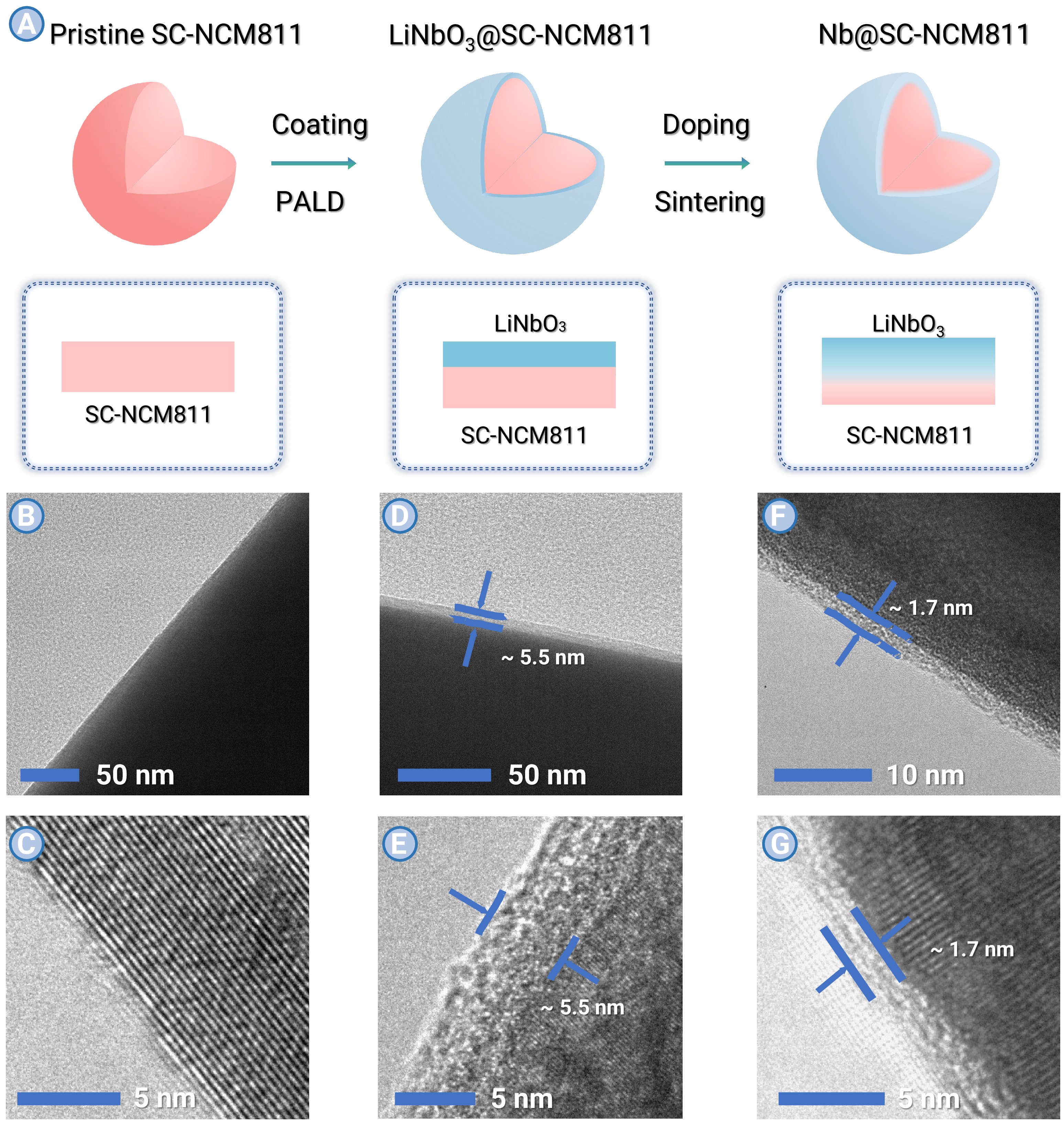
Figure 1.
(A) Modification strategy of LiNbO3 coating and Nb5+ surface doping for the Pristine SC-NCM811. TEM images and HR-TEM images of Ni-rich cathode materials. (B & C) Pristine SC-NCM811. (D & E) LiNbO3@SC-NCM811. (F & G) Nb@SC-NCM811
-
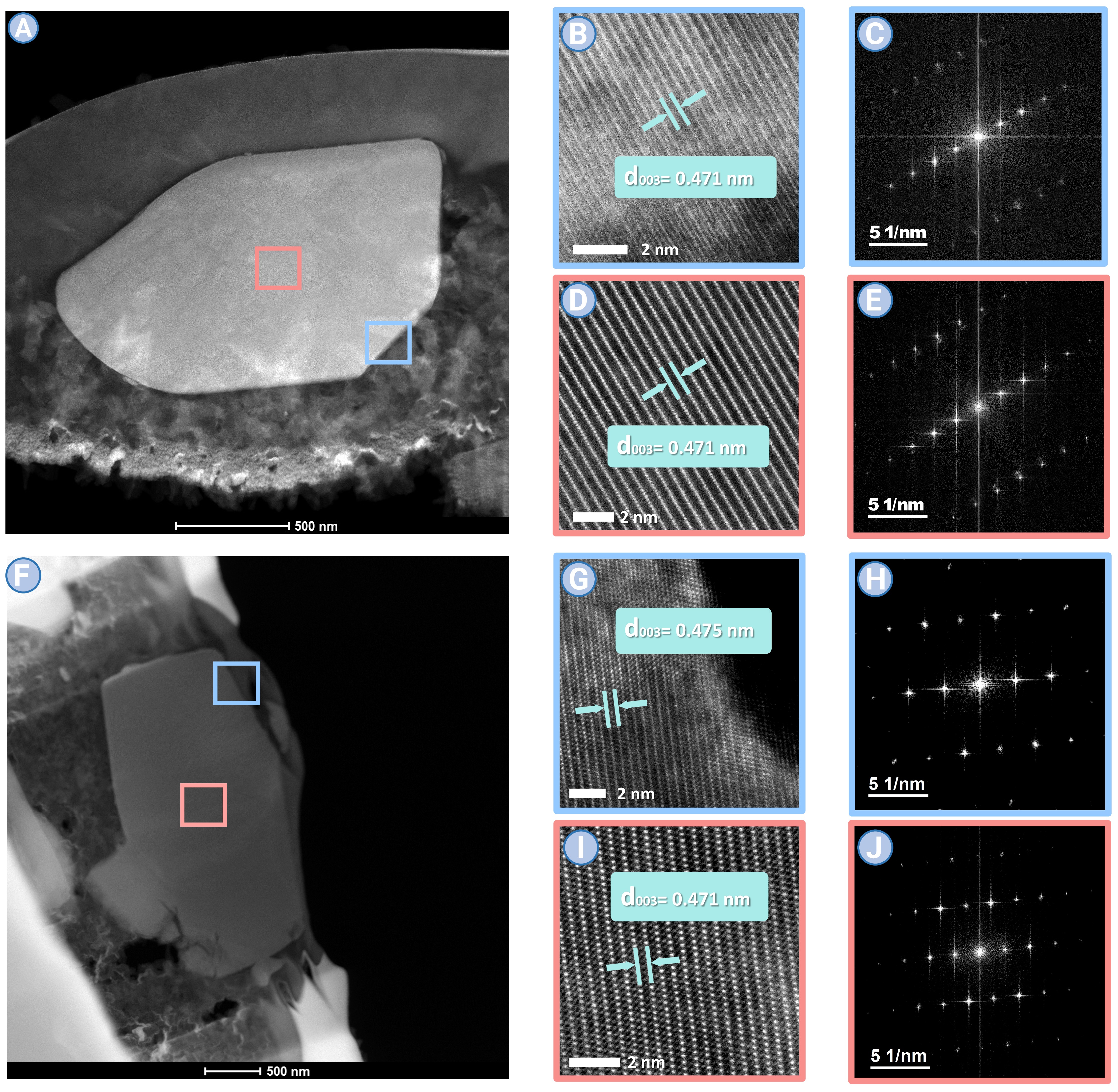
Figure 2.
(A) HAADF-STEM image of LiNbO3@SC-NCM811, atomic arrangement images and corresponding FFT patterns of (B & C) surface region, and (D & E) bulk region; (F) HAADF-STEM image of Nb@SC-NCM811 cathode particles, atomic arrangement images and corresponding FFT patterns of (G & H) surface region, and (I & J) bulk region.
-
Figure 3.
Electrochemical performance of Pristine SC-NCM811 and Nb@SC-NCM811
-
Figure 4.
(A) TG curves and (B) DSC curves of delithiated cathode materials. (C) Heat flow curves of the delithiated cathode-electrolyte mixed system by C80 micro-calorimeter. TG/MS results of delithiated cathode materials, (D) O2, (E) CO2 signals.
-
Figure 5.
The dynamic heat flow curves of coin batteries during the charge-discharge cycle of
-
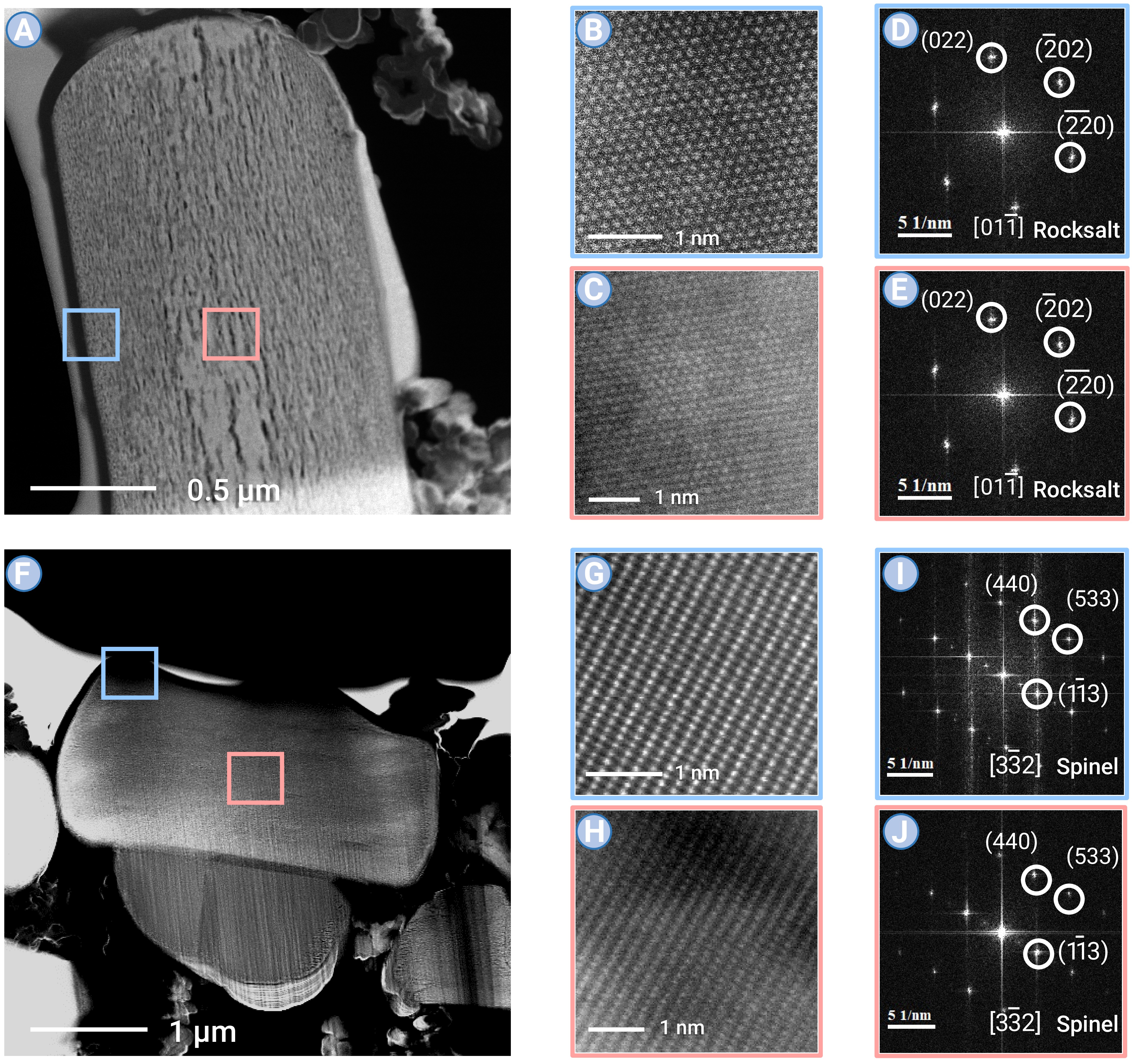
Figure 6.
Low-magnification HAADF-STEM image of (A) Pristine SC-NCM811, (F) Nb@SC-NCM811 after thermal failure at 400 °C. Atomic arrangements in the (B & G) surface region and (C & H) bulk region, and corresponding FFT images in the (D & I) surface region and (E & J) bulk region. (A-E) Reproduced with permission.38 Copyright 2023, Elsevier.
-
Figure 7.
O K-edge spectrum obtained by the EELS line scan results from the surface to the central region of
-
Figure 8.
The projected density of states (PDOS) diagram for various elements in
