
A comprehensive review of physics-informed deep learning and its applications in geoenergy development
-
GRAPHICAL ABSTRACT

 DownLoad:
Full size image
DownLoad:
Full size image
-
PUBLIC SUMMARY
-
Physics-informed deep learning (PIDL) integrates physical laws with deep learning.
Advances in loss weighting, network design, and PDE integration enhance geoenergy simulations.
PIDL excels in surrogate modeling and inverse modeling for subsurface resource management.
Case studies highlight PIDL's potential as a powerful tool in geoenergy system modeling.
Challenges remain in PIDL's costs, generalization, tuning, and physics-AI balance for complex geoenergy systems.
-
-
ABSTRACT
Deep learning models have been widely utilized in various scientific and engineering problems; however, their application still faces practical challenges, including high data volume requirements, limited physical consistency, and insufficient interpretability. Physics-informed deep learning (PIDL) has emerged as a promising paradigm to address these challenges by incorporating physical laws into the training process of deep learning models. By integrating data-driven approaches with physics-based constraints, PIDL enhances the accuracy and reliability of deep learning models, making it a powerful tool across diverse fields. Numerous variants of PIDL models have been developed to cater to different applications. This review provides a comprehensive examination of recent advancements in PIDL, with a particular focus on its applications in geoenergy development. We discuss key methodologies underlying PIDL, including weighting strategies in loss functions, network architectures, derivative calculations, and various forms of physical equations. Furthermore, we summarize the three most common application scenarios of PIDL models, including solving partial differential equations (PDEs), surrogate modeling, and inverse modeling. A series of case studies highlighting PIDL’s role in geoenergy development are also presented. Finally, current challenges and future directions of PIDL in the geoenergy field are summarized. This review aims to serve as a foundational and valuable resource for researchers and practitioners newly entering this field, while also highlighting the potential of PIDL in advancing geoenergy development. -

-
REFERENCES
[1] Azad R., Aghdam E. K., Rauland A., et al. (2024). Medical image segmentation review: The success of u-net. IEEE Trans. Pattern Anal. Mach. Intell. 46:10076−10095. DOI:10.1109/TPAMI.2024.3435571 [2] Minaee S., Boykov Y., Porikli F., et al. (2022). Image segmentation using deep learning: A survey. IEEE Trans. Pattern Anal. Mach. Intell. 44:3523−3542. DOI:10.1109/TPAMI.2021.3059968 [3] Zhou Y. (2024). A yolo-nl object detector for real-time detection. Expert Sys. Appl. 238:122256. DOI:10.1016/j.eswa.2023.122256 [4] Popel M., Tomkova M., Tomek J., et al. (2020). Transforming machine translation: A deep learning system reaches news translation quality comparable to human professionals. Nat. Commun. 11:4381. DOI:10.1038/s41467-020-18073-9 [5] Singh S. P., Kumar A., Darbari H., et al. (2017). Machine translation using deep learning: An overview. Comptelix. DOI:10.1109/COMPTELIX.2017.8003957 [6] Yadav A. and Vishwakarma D. K. (2020). Sentiment analysis using deep learning architectures: A review. Artific. Intel. Rev. 53:4335−4385. DOI:10.1007/s10462-019-09794-5 [7] Hager P., Jungmann F., Holland R., et al. (2024). Evaluation and mitigation of the limitations of large language models in clinical decision-making. Nat. Med. 30:2613−2622. DOI:10.1038/s41591-024-03097-1 [8] Liévin V., Hother C. E., Motzfeldt A. G., et al. (2024). Can large language models reason about medical questions. Patterns 5:100943. DOI:10.1016/j.patter.2024.100943 [9] Khojaste-Sarakhsi, M., Haghighi, S. S., Ghomi, S. M. T. F., & Marchiori, E. (2022). Deep learning for alzheimer's disease diagnosis: A survey. Artific. Intel. Med. 130:102332. DOI:10.1016/j.artmed.2022.102332 [10] Lavecchia A. (2019). Deep learning in drug discovery: Opportunities, challenges and future prospects. Drug Disc. Today 24:2017−2032. DOI:10.1016/j.drudis.2019.07.006 [11] Ye Z., Wang N., Zhou J., et al. (2024). Organic crystal structure prediction via coupled generative adversarial networks and graph convolutional networks. The Innovation 5:100562. DOI:10.1016/j.xinn.2023.100562 [12] Litjens G., Kooi T., Bejnordi B. E., Setio A. A. A., et al. (2017). A survey on deep learning in medical image analysis. Med. Image Anal. 42:60−88. DOI:10.1016/j.media.2017.07.005 [13] Salman A. G., Kanigoro B. and Heryadi Y. (2015). Weather forecasting using deep learning techniques. ICACSIS. DOI:10.1109/ICACSIS.2015.7415154 [14] Zhang B., Ouyang C., Cui P., et al. (2024). Deep learning for cross-region streamflow and flood forecasting at a global scale. The Innovation 5:100617. DOI:10.1016/j.xinn.2024.100617 [15] Roy A., Sun J., Mahoney R., et al. (2018). Deep learning detecting fraud in credit card transactions. SIEDS. DOI:10.1109/SIEDS.2018.8374722. [16] Jiang W. (2021). Applications of deep learning in stock market prediction: Recent progress. Expert Sys. Appl. 184:115537. DOI:10.1016/j.eswa.2021.115537 [17] Kamilaris A. and Prenafeta-Boldú F. X. (2018). Deep learning in agriculture: A survey. Comput. Electron. Agricul. 147:70−90. DOI:10.1016/j.compag.2018.02.016 [18] Luo X., Zhang D. and Zhu X. (2021). Deep learning based forecasting of photovoltaic power generation by incorporating domain knowledge. Energy, 225:120240. DOI:10.1016/j.energy.2021.120240 [19] Wang N., Chang H., Kong X.-Z., et al. (2023). Deep learning based closed-loop well control optimization of geothermal reservoir with uncertain permeability. Renew. Energy 211:379−394. DOI:10.1016/j.renene.2023.04.088 [20] Cai H., Liu X., Sun L., et al. (2024). Battery internal short circuit diagnosis based on vision transformer without real data. Innov. Energy 1:100041. DOI:10.59717/j.xinn-energy.2024.100041 [21] Reichstein M., Camps-Valls G., Stevens B., et al. (2019). Deep learning and process understanding for data-driven earth system science. Nature 566:195−204. DOI:10.1038/s41586-019-0912-1 [22] Yuan Q., Shen H., Li T., et al. (2020). Deep learning in environmental remote sensing: Achievements and challenges. Remote Sens. Environ. 241:111716. DOI:10.1016/j.rse.2020.111716 [23] Karniadakis G. E., Kevrekidis I. G., Lu L., et al. (2021). Physics-informed machine learning. Nat. Rev. Phy. 3:422−440. DOI:10.1038/s42254-021-00314-5 [24] Chen Y. and Zhang D. (2020). Physics-constrained deep learning of geomechanical logs. IEEE Trans. Geo. Remote Sens. 58:5932−5943. DOI:10.1109/TGRS.2020.2973171 [25] Hong S. H., Ou J. and Wang Y. (2023). Physics-guided neural network and gpu-accelerated nonlinear model predictive control for quadcopter. Neural Comput. Appl. 35:393−413. DOI:10.1007/s00521-022-07783-4 [26] Qin Z., Jiang A., Faulder D., et al. (2024). Physics-guided deep learning for prediction of energy production from geothermal reservoirs. Geothermics, 116:102824. DOI:10.1016/j.geothermics.2023.102824 [27] Yu Y., Yao H. and Liu Y. (2020). Structural dynamics simulation using a novel physics-guided machine learning method. Eng. Appl. Artif. Intel. 96:103947. DOI:10.1016/j.engappai.2020.103947 [28] Karumuri S., Tripathy R., Bilionis I., et al. (2020). Simulator-free solution of high-dimensional stochastic elliptic partial differential equations using deep neural networks. J. Comput. Phy. 404:109120. DOI:10.1016/j.jcp.2019.109120 [29] Raissi M., Perdikaris P. and Karniadakis G. E. (2019). Physics-informed neural networks: A deep learning framework for solving forward and inverse problems involving nonlinear partial differential equations. J. Comput. Phy. 378:686−707. DOI:10.1016/j.jcp.2018.10.045 [30] Wang N., Zhang D., Chang H., et al. (2020). Deep learning of subsurface flow via theory-guided neural network. J. Hydro. 584:124700. DOI:10.1016/j.jhydrol.2020.124700 [31] Xu R., Zhang D., Rong M., et al. (2021). Weak form theory-guided neural network (tgnn-wf) for deep learning of subsurface single- and two-phase flow. J. Comput. Phy. 436:110318. DOI:10.1016/j.jcp.2021.110318 [32] Gao J., Chen Y., Hu W., et al. (2023). An adaptive deep-learning load forecasting framework by integrating transformer and domain knowledge. Adv. Appl. Energy 10:100142. DOI:10.1016/j.adapen.2023.100142 [33] Kim J., Yang H. and Choe J. (2020). Robust optimization of the locations and types of multiple wells using cnn based proxy models. J. Petrol. Sci. Eng. 193:107424. DOI:10.1016/j.petrol.2020.107424 [34] Kharazmi E., Zhang Z. and Karniadakis G. E. (2019). Variational physics-informed neural networks for solving partial differential equations. arXiv preprint. DOI:10.48550/arXiv.1912.00873 [35] Jagtap A. D., Kharazmi E. and Karniadakis G. E. (2020). Conservative physics-informed neural networks on discrete domains for conservation laws: Applications to forward and inverse problems. Comput. Meth. Appl. Mech. Eng. 365:113028. DOI:10.1016/j.cma.2020.113028 [36] Pang G., D'Elia M., Parks M., et al. (2020). Npinns: Nonlocal physics-informed neural networks for a parametrized nonlocal universal laplacian operator. Algorithms and applications. J. Comput. Phys. 422:109760. DOI:10.1016/j.jcp.2020.109760 [37] McClenny L. D. and Braga-Neto U. M. (2023). Self-adaptive physics-informed neural networks. J. Comput. Phy. 474:111722. DOI:10.1016/j.jcp.2022.111722 [38] Yang L., Zhang D. and Karniadakis G. E. (2020). Physics-informed generative adversarial networks for stochastic differential equations. SIAM J. Sci. Comput. 42:A292−A317. DOI:10.1137/18M1225409 [39] Wang N., Chang H. and Zhang D. (2021). Theory-guided auto-encoder for surrogate construction and inverse modeling. Comput. Meth. Appl. Mech. Eng. 385:114037. DOI:10.1016/j.cma.2021.114037 [40] Gao H., Zahr M. J. and Wang J.-X. (2022). Physics-informed graph neural galerkin networks: A unified framework for solving pde-governed forward and inverse problems. Comput. Meth. Appl. Mech. Eng. 390:114502. DOI:10.1016/j.cma.2021.114502 [41] Li Z., Zheng H., Kovachki N., et al. (2024). Physics-informed neural operator for learning partial differential equations. ACM/IMS J. Data Sci. 1:1−27. DOI:10.1145/3648506 [42] Lu L., Meng X., Mao Z., et al. (2021). Deepxde: A deep learning library for solving differential equations. SIAM Rev. 63:208−228. DOI:10.1137/19M1274067 [43] Haghighat E. and Juanes R. (2021). Sciann: A keras/tensorflow wrapper for scientific computations and physics-informed deep learning using artificial neural networks. Comput. Meth. Appl. Mech. Eng. 373:113552. DOI:10.1016/j.cma.2020.113552 [44] Du M., Chen Y. and Zhang D. (2023). Autoke: An automatic knowledge embedding framework for scientific machine learning. IEEE Trans. Artif. Intel. 4:1564−1578. DOI:10.48550/arXiv.2205.05390 [45] Cai S., Mao Z., Wang Z., et al. (2021). Physics-informed neural networks (pinns) for fluid mechanics: A review. Acta Mech. Sinicai 37:1727−1738. DOI:10.1007/s10409-021-01148-1 [46] Mao Z., Jagtap A. D. and Karniadakis G. E. (2020). Physics-informed neural networks for high-speed flows. Comput. Meth. Appl. Mech. Eng. 360:112789. DOI:10.1016/j.cma.2019.112789 [47] Sun L., Gao H., Pan S., et al. (2020). Surrogate modeling for fluid flows based on physics-constrained deep learning without simulation data. Comput. Meth. Appl. Mech. Eng. 361:112732. DOI:10.1016/j.cma.2019.112732 [48] Zhang D., Chen Y. and Chen S. (2024). Filtered partial differential equations: A robust surrogate constraint in physics-informed deep learning framework. J. Fluid Mech. 999:A40. DOI:10.1017/jfm.2024.471 [49] Chen Y., de Ridder S. A. L., Rost S., et al. (2022). Eikonal tomography with physics-informed neural networks: Rayleigh wave phase velocity in the northeastern margin of the tibetan plateau. Geophy. Res. Lett. 49:e2022GL099053. DOI:10.1029/2022GL099053 [50] Rasht-Behesht M., Huber C., Shukla K., et al. (2022). Physics-informed neural networks (pinns) for wave propagation and full waveform inversions. J. Geophy. Res. Solid Earth 127:e2021JB023120. DOI:10.1029/2021JB023120 [51] De Florio M., Schiassi E. and Furfaro R. (2022). Physics-informed neural networks and functional interpolation for stiff chemical kinetics. Chaos Interdis. J. Nonlinear Sci. 32:063107. DOI:10.1063/5.0086649 [52] Ji W., Qiu W., Shi Z., et al. (2021). Stiff-pinn: Physics-informed neural network for stiff chemical kinetics. J. Phy. Chem. A 125:8098−8106. DOI:10.1021/acs.jpca.1c05102 [53] Xu R. and Zhang D. (2024). Forward prediction and surrogate modeling for subsurface hydrology: A review of theory-guided machine-learning approaches. Comput. Geosci. 188:105611. DOI:10.1016/j.cageo.2024.105611 [54] Lu L., Dao M., Kumar P., et al. (2020). Extraction of mechanical properties of materials through deep learning from instrumented indentation. Proceedings of the Nation. Acad. Sci. 117:7052−7062. DOI:10.1073/pnas.1922210117 [55] Zhang E., Dao M., Karniadakis G. E., et al. (2022). Analyses of internal structures and defects in materials using physics-informed neural networks. Sci. Adv. 8:eabk0644. DOI:10.1126/sciadv.abk0644 [56] E W. and Yu B. (2018). The deep ritz method: A deep learning-based numerical algorithm for solving variational problems. Commun. Math. Stat. 6:1−12. DOI:10.1007/s40304-018-0127-z [57] Wang N., Chang H. and Zhang, D. (2022). Surrogate and inverse modeling for two-phase flow in porous media via theory-guided convolutional neural network. J. Comput. Phy. 466:111419. DOI:10.1016/j.jcp.2022.111419 [58] Li S., Feng X. T., Zhang D., et al. (2019). Coupled thermo-hydro-mechanical analysis of stimulation and production for fractured geothermal reservoirs. Appl. Energy 247:40−59. DOI:10.1016/j.apenergy.2019.04.036 [59] Hou W., Yan J., Ma D., et al. (2025). Effects of extraction well assisted by the fault on thermal recovery performance in hydrothermal system. Case Stu. Thermal Eng. 69:105962. DOI:10.1016/j.csite.2025.105962 [60] Wang S., Teng Y. and Perdikaris P. (2021). Understanding and mitigating gradient flow pathologies in physics-informed neural networks. SIAM J. Sci. Comput. 43:A3055−A3081. DOI:10.1137/20M1318043 [61] Wang S., Yu X. and Perdikaris P. (2022). When and why pinns fail to train: A neural tangent kernel perspective. J. Comput. Phy. 449:110768. DOI:10.1016/j.jcp.2021.110768 [62] Liu D. and Wang, Y. (2021). A dual-dimer method for training physics-constrained neural networks with minimax architecture. Neural Net. 136:112−125. DOI:10.1016/j.neunet.2020.12.028 [63] Rong M., Zhang D. and Wang, N. (2022). A lagrangian dual-based theory-guided deep neural network. Complex Intel. Sys. 8:4849−4862. DOI:10.1007/s40747-022-00738-1 [64] Xu H., Chen Y. and Zhang D. (2024). Worth of prior knowledge for enhancing deep learning. Nexus, 1:100003. DOI:10.1016/j.ynexs.2024.100003 [65] Baydin A. G., Pearlmutter B. A., Radul A. A., et al. (2017). Automatic differentiation in machine learning: A survey. J. Mach. Learn. Res. 18:5595−5637. DOI:10.48550/arXiv.1502.05767 [66] Abadi M., Barham P., Chen J., et al. (2016). Tensorflow: A system for large-scale machine learning. OSDI '16. DOI:10.48550/arXiv.1605.08695. [67] Paszke A., Gross S., Chintala S., et al. (2017). Automatic differentiation in pytorch. NIPS. DOI:openreview.net/pdf?id=BJJsrmfCZ. [68] Sun L., Gao H., Pan S., et al. (2020). Surrogate modeling for fluid flows based on physics-constrained deep learning without simulation data. Comput. Meth. Appl. Mech. Eng. 361:112732. DOI:10.1016/j.cma.2019.112732 [69] Tartakovsky A. M., Marrero C. O., Perdikaris P., et al. (2020). Physics‐informed deep neural networks for learning parameters and constitutive relationships in subsurface flow problems. Water Resour. Res. 56. DOI:10.1029/2019WR026731. [70] Gidaris S. and Komodakis N. (2015). Object detection via a multi-region and semantic segmentation-aware cnn model. Proceed. IEEE ICCV. DOI:10.1109/ICCV.2015.135. [71] Ronneberger O., Fischer P. and Brox, T. (2015). U-net: Convolutional networks for biomedical image segmentation. MICCAI. DOI:10.1007/978-3-319-24574-4_28. [72] Ilesanmi A. E. and Ilesanmi T. O. (2021). Methods for image denoising using convolutional neural network: A review. Complex Intel. Sys. 7:2179−2198. DOI:10.1007/s40747-021-00428-4 [73] Zhu Y., Zabaras N., Koutsourelakis P.-S., et al. (2019). Physics-constrained deep learning for high-dimensional surrogate modeling and uncertainty quantification without labeled data. J. Comput. Phy. 394:56−81. DOI:10.1016/j.jcp.2019.05.024 [74] Zhang Z. (2022). A physics-informed deep convolutional neural network for simulating and predicting transient darcy flows in heterogeneous reservoirs without labeled data. J. Petrol. Sci. Eng. 211:110179. DOI:10.1016/j.petrol.2022.110179 [75] Wang N., Chang H. and Zhang D. (2021). Efficient uncertainty quantification and data assimilation via theory-guided convolutional neural network. SPE J. 26:4128−4156. DOI:10.2118/203904-PA [76] Gao H., Sun L. and Wang J.-X. (2021). Super-resolution and denoising of fluid flow using physics-informed convolutional neural networks without high-resolution labels. Phy. Fluids, 33:073603. DOI:10.1063/5.0054312 [77] Zhao X., Gong Z., Zhang Y., et al. (2023). Physics-informed convolutional neural networks for temperature field prediction of heat source layout without labeled data. Eng. Appl. A.I. 117:105516. DOI:10.1016/j.engappai.2022.105516 [78] Kipf T. N. and Welling M. (2016). Semi-supervised classification with graph convolutional networks. arXiv preprint. DOI: 10.48550/arXiv.1609.02907. [79] Veličković P., Cucurull G., Casanova A., et al. (2017). Graph attention networks. arXiv preprint. DOI:10.48550/arXiv.1710.10903. [80] Xu B., Shen H., Cao Q., et al. (2019). Graph wavelet neural network. arXiv preprint. DOI:10.48550/arXiv.1904.07785. [81] Gao H. and Ji S. (2019). Graph u-nets. Proceed. ICML. PMLR. DOI:proceedings.mlr.press/v97/gao19a.html. [82] Wu P., Pan K., Ji L., et al. (2022). Navier–stokes generative adversarial network: A physics-informed deep learning model for fluid flow generation. Neural Comput. Appl. 34:11539−11552. DOI:10.1007/s00521-022-07042-6 [83] Bode M., Gauding M., Lian Z., et al. (2021). Using physics-informed enhanced super-resolution generative adversarial networks for subfilter modeling in turbulent reactive flows. Proceedings of the Combustion Institute, 38(2), 2617-2625. https://www.sciencedirect.com/science/article/pii/S1540748920300481. [84] Ren P., Rao C., Liu Y., et al. (2022). Phycrnet: Physics-informed convolutional-recurrent network for solving spatiotemporal pdes. Comput. Meth. Appl. Mech. Eng. 389:114399. DOI:10.1016/j.cma.2021.114399 [85] Chen Z., Gao J., Wang W., et al. (2021). Physics-informed generative neural network: An application to troposphere temperature prediction. Environ. Res. Lett. 16:065003. DOI:10.1088/1748-9326/abfde9 [86] Kharazmi E., Zhang Z. and Karniadakis G. E. M. (2021). Hp-vpinns: Variational physics-informed neural networks with domain decomposition. Comput. Meth. Appl. Mech. Eng. 374:113547. DOI:10.1016/j.cma.2020.113547 [87] Du H., Zhao Z., Cheng H., et al. (2023). Modeling density-driven flow in porous media by physics-informed neural networks for co2 sequestration. Comput. Geotech. 159:105433. DOI:10.1016/j.compgeo.2023.105433 [88] Zhang X., Zhu Y., Wang J., et al. (2022). Gw-pinn: A deep learning algorithm for solving groundwater flow equations. Adv. Water Res. 165:104243. DOI:10.1016/j.advwatres.2022.104243 [89] Abueidda D. W., Lu Q. and Koric S. (2021). Meshless physics-informed deep learning method for three-dimensional solid mechanics. Int. J. Numerical Meth. Eng. 122:7182−7201. DOI:10.1002/nme.6828 [90] Jin X., Cai S., Li H., et al. (2021). Nsfnets (navier-stokes flow nets): Physics-informed neural networks for the incompressible navier-stokes equations. J. Comput. Phy. 426:109951. DOI:10.1016/j.jcp.2020.109951 [91] Zobeiry N. and Humfeld K. D. (2021). A physics-informed machine learning approach for solving heat transfer equation in advanced manufacturing and engineering applications. Eng. Appl. A.I. 101:104232. DOI:10.1016/j.engappai.2021.104232 [92] Zheng J., Li F. and Huang H. (2024). T-phpinn: Physics-informed neural networks for solving 2d non-fourier heat conduction equations. Int. J. Heat Mass Trans. 235:126216. DOI:10.1016/j.ijheatmasstransfer.2024.126216 [93] Shokouhi P., Kumar V., Prathipati S., et al. (2021). Physics-informed deep learning for prediction of co2 storage site response. J. Contamin. Hydro. 241:103835. DOI:10.1016/j.jconhyd.2021.103835 [94] Ishitsuka K. and Lin W. (2023). Physics-informed neural network for inverse modeling of natural-state geothermal systems. Appl. Energy, 337:120855. DOI:10.1016/j.apenergy.2023.120855 [95] Wang N., Kong X.-Z. and Zhang D. (2024). Physics-informed convolutional decoder (picd): A novel approach for direct inversion of heterogeneous subsurface flow. Geophy. Res. Lett. 51:e2024GL108163. DOI:10.1029/2024GL108163 [96] He Q., Barajas-Solano D., Tartakovsky G., et al. (2020). Physics-informed neural networks for multiphysics data assimilation with application to subsurface transport. Adv. Water Resour. 141:103610. DOI:10.1016/j.advwatres.2020.103610 [97] Zhang Y., Fu H., Qin Y., et al. (2022). Physics-informed deep neural network for inhomogeneous magnetized plasma parameter inversion. IEEE Anten. Wirel. Propag. Lett. 21:828−832. DOI:10.1109/LAWP.2022.3149889 [98] Eivazi H., Tahani M., Schlatter P., et al. (2022). Physics-informed neural networks for solving reynolds-averaged navier–stokes equations. Phy. Fluids, 34:075117. DOI:10.1063/5.0095270 [99] Pang G., Lu L. and Karniadakis G. E. (2019). Fpinns: Fractional physics-informed neural networks. SIAM J. Sci. Comput. 41:A2603−A2626. DOI:10.1137/18M1229845 [100] Sivalingam S. M., Kumar P. and Govindaraj V. (2023). A neural networks-based numerical method for the generalized caputo-type fractional differential equations. Math. Comput. Simul. 213:302−323. DOI:10.1016/j.matcom.2023.06.012 [101] Ren H., Meng X., Liu R., et al. (2023). A class of improved fractional physics informed neural networks. Neurocomputing 562:126890. DOI:10.1016/j.neucom.2023.126890 [102] Ma Z., Hou J., Zhu W., et al. (2023). Pmnn: Physical model-driven neural network for solving time-fractional differential equations. Chaos Solit. Fract. 177:114238. DOI:10.1016/j.chaos.2023.114238 [103] Sivalingam S. M., Kumar P. and Govindaraj V. (2023). A novel optimization-based physics-informed neural network scheme for solving fractional differential equations. Eng. Comput. DOI:10.1007/s00366-023-01830-x. [104] Nabian M. A., Gladstone R. J. and Meidani, H. (2021). Efficient training of physics-informed neural networks via importance sampling. Comput. Aided Civil Infrastr. Eng. 36:962−977. DOI:10.1111/mice.12685 [105] Meng X., Li Z., Zhang D., et al. (2020). Ppinn: Parareal physics-informed neural network for time-dependent pdes. Comput. Meth. Appl. Mech. Eng. 370:113250. DOI:10.1016/j.cma.2020.113250 [106] Wang N., Chang H. and Zhang D. (2021). Efficient uncertainty quantification for dynamic subsurface flow with surrogate by theory-guided neural network. Comput. Meth. Appl. Mech. Eng. 373:113492. DOI:10.1016/j.cma.2020.113492 [107] Wang N., Chang H., Zhang D., et al. (2021). Efficient well placement optimization based on theory-guided convolutional neural network. J. Petrol. Sci. Eng. 208:109545. DOI:10.1016/j.petrol.2021.109545 [108] Song S., Mukerji T. and Zhang, D. (2024). Physics-informed multi-grid neural operator: Theory and an application to porous flow simulation. J. Comput. Phy. 520:113438. DOI:10.1016/j.jcp.2024.113438 [109] Oliver D. S., Reynolds A. C. and Liu, N. (2008). Inverse theory for petroleum reservoir characterization and history matching. New York: Cambridge University Press. DOI:10.1017/CBO9780511535642. [110] Xu R., Zhang D. and Wang N. (2022). Uncertainty quantification and inverse modeling for subsurface flow in 3d heterogeneous formations using a theory-guided convolutional encoder-decoder network. J. Hydro. 613:128321. DOI:10.1016/j.jhydrol.2022.128321 [111] Wang N., Chang H. and Zhang D. (2021). Deep-learning-based inverse modeling approaches: A subsurface flow example. J. Geophy. Res. Solid Earth 126:e2020JB020549. DOI:10.1029/2020JB020549 [112] Oommen V. and Srinivasan B. (2022). Solving inverse heat transfer problems without surrogate models - a fast, data-sparse, physics informed neural network approach. J. Comput. Inform. Sci. Eng. 22:1−12. DOI:10.1115/1.4053800 [113] Li J. and Tartakovsky A. M. (2022). Physics-informed karhunen-loéve and neural network approximations for solving inverse differential equation problems. J. Comput. Phy. 462:111230. DOI:10.1016/j.jcp.2022.111230 [114] Tartakovsky A. M., Barajas-Solano D. A. and He Q. (2021). Physics-informed machine learning with conditional karhunen-loève expansions. J. Comput. Phy. 426:109904. DOI:10.1016/j.jcp.2020.109904 [115] Li J., Zhang D., Wang N., et al. (2021). Deep learning of two-phase flow in porous media via theory-guided neural networks. SPE J. 27:1−19. DOI:10.2118/208602-PA [116] Tang J., Zhang Z., Xie J., et al. (2024). Re-evaluation of co2 storage capacity of depleted fractured-vuggy carbonate reservoir. Innov. Energy 1:100019. DOI:10.59717/j.xinn-energy.2024.100019 [117] Wang Y.-W., Dai Z.-X., Wang G.-S., et al. (2023). A hybrid physics-informed data-driven neural network for co2 storage in depleted shale reservoirs. Petrol. Sci. 21:286−301. DOI:10.1016/j.petsci.2023.08.032 [118] Xu K. and Darve E. (2022). Physics constrained learning for data-driven inverse modeling from sparse observations. J. Comput. Phy. 453:110938. DOI:10.1016/j.jcp.2021.110938 [119] Chen Y., Huang D., Zhang D., et al. (2021). Theory-guided hard constraint projection (hcp): A knowledge-based data-driven scientific machine learning method. J. Comput. Phy. 445:110624. DOI:10.1016/j.jcp.2021.110624 [120] Chen Z., Liu Y. and Sun, H. (2021). Physics-informed learning of governing equations from scarce data. Nat. Commun. 12:6136. DOI:10.1038/s41467-021-26434-1 [121] Du M., Chen Y., Nie L., et al. (2024). Physics-constrained robust learning of open-form partial differential equations from limited and noisy data. Phy. Fluids, 36:057123. DOI:10.1063/5.0204187 [122] Yang L., Meng X. and Karniadakis G. E. (2021). B-PINNs: Bayesian physics-informed neural networks for forward and inverse PDE problems with noisy data. J. Comput. Phy. 425:109913. DOI:10.1016/j.jcp.2020.109913 [123] Gao H., Sun L. and Wang J.-X. (2021). PhyGeoNet: Physics-informed geometry-adaptive convolutional neural networks for solving parameterized steady-state PDEs on irregular domain. J. Comput. Phy. 428:110079. DOI:10.1016/j.jcp.2020.110079 [124] Pang G., D'Elia M., Parks M., et al. (2020). nPINNs: Nonlocal physics-informed neural networks for a parametrized nonlocal universal Laplacian operator. Algorithms and applications. J. Comput. Phy. 422:109760. DOI:10.1016/j.jcp.2020.109760 [125] Jagtap A. D. and Karniadakis G. E. (2020). Extended Physics-Informed Neural Networks (XPINNs): A Generalized Space-Time Domain Decomposition Based Deep Learning Framework for Nonlinear Partial. Diff. Eqns. 28:0164. DOI:10.4208/cicp.oa-2020-0164 [126] Shukla K., Jagtap A. D. and Karniadakis G. E. (2021). Parallel physics-informed neural networks via domain decomposition. J. Comput. Phy. 447:110683. DOI:10.1016/j.jcp.2021.110683 [127] Moseley B., Markham A. and Nissen-Meyer T. (2023). Finite basis physics-informed neural networks (FBPINNs): a scalable domain decomposition approach for solving differential equations. Adv. Comput. Math. 49:62. DOI:10.1007/s10444-023-10065-9 [128] Chiu P.-H., Wong J. C., Ooi C., et al. (2022). CAN-PINN: A fast physics-informed neural network based on coupled-automatic–numerical differentiation method. Comput. Meth. Appl. Mech. Eng. 395:114909. DOI:10.1016/j.cma.2022.114909 [129] Yu J., Lu L., Meng X., et al. (2022). Gradient-enhanced physics-informed neural networks for forward and inverse PDE problems. Comput. Meth. Appl. Mech. Eng. 393:114823. DOI:10.1016/j.cma.2022.114823 [130] Yuan L., Ni Y.-Q., Deng X.-Y., et al. (2022). A-PINN: Auxiliary physics informed neural networks for forward and inverse problems of nonlinear integro-differential equations. J. Comput. Phy. 462:111260. DOI:10.1016/j.jcp.2022.111260 [131] Sahli Costabal F., Pezzuto S. and Perdikaris P. (2024). Δ-PINNs: Physics-informed neural networks on complex geometries. Eng. Appl. A.I. 127:107324. DOI:10.1016/j.engappai.2023.107324 [132] Hu Z., Jagtap A. D., Karniadakis G. E., et al. (2023). Augmented Physics-Informed Neural Networks (APINNs): A gating network-based soft domain decomposition methodology. Eng. Appl. A.I. 126:107183. DOI:10.1016/j.engappai.2023.107183 [133] Cho J., Nam S., Yang H., et al. (2022). Separable PINN: Mitigating the curse of dimensionality in physics-informed neural networks. arXiv preprint . DOI:10.48550/arXiv.2211.08761 [134] Wang Y. and Zhong L. (2024). NAS-PINN: Neural architecture search-guided physics-informed neural network for solving PDEs. J. Comput. Phy. 496:112603. DOI:10.1016/j.jcp.2023.112603 [135] Meng Z., Qian Q., Xu M., et al. (2023). PINN-FORM: A new physics-informed neural network for reliability analysis with partial differential equation. Comput. Meth. Appl. Mech. Eng. 414:116172. DOI:10.1016/j.cma.2023.116172 [136] Anagnostopoulos S. J., Toscano J. D., Stergiopulos N., et al. (2024). Residual-based attention in physics-informed neural networks. Comput. Meth. Appl. Mech. Eng. 421:116805. DOI:10.1016/j.cma.2024.116805 [137] Hedayatrasa S., Fink O., Van Paepegem W., et al. (2025). k-space physics-informed neural network (k-PINN) for compressed spectral mapping and efficient inversion of vibrations in thin composite laminates. Mech. Sys. Signal Process. 223:111920. DOI:10.1016/j.ymssp.2024.111920 -
ABOUT THIS ARTICLE
Cite this article:
Wang N., Chen Y. and Zhang D. (2025). A comprehensive review of physics-informed deep learning and its applications in geoenergy development. The Innovation Energy 2:100087. https://doi.org/10.59717/j.xinn-energy.2025.100087
Welcome!
To request copyright permission to republish or share portions of our works, please visit Copyright Clearance Center's (CCC) Marketplace website at marketplace.copyright.com.
Export File
Citation
Wang N., Chen Y. and Zhang D. (2025). A comprehensive review of physics-informed deep learning and its applications in geoenergy development. The Innovation Energy 2:100087. https://doi.org/10.59717/j.xinn-energy.2025.100087

Format
Content




-
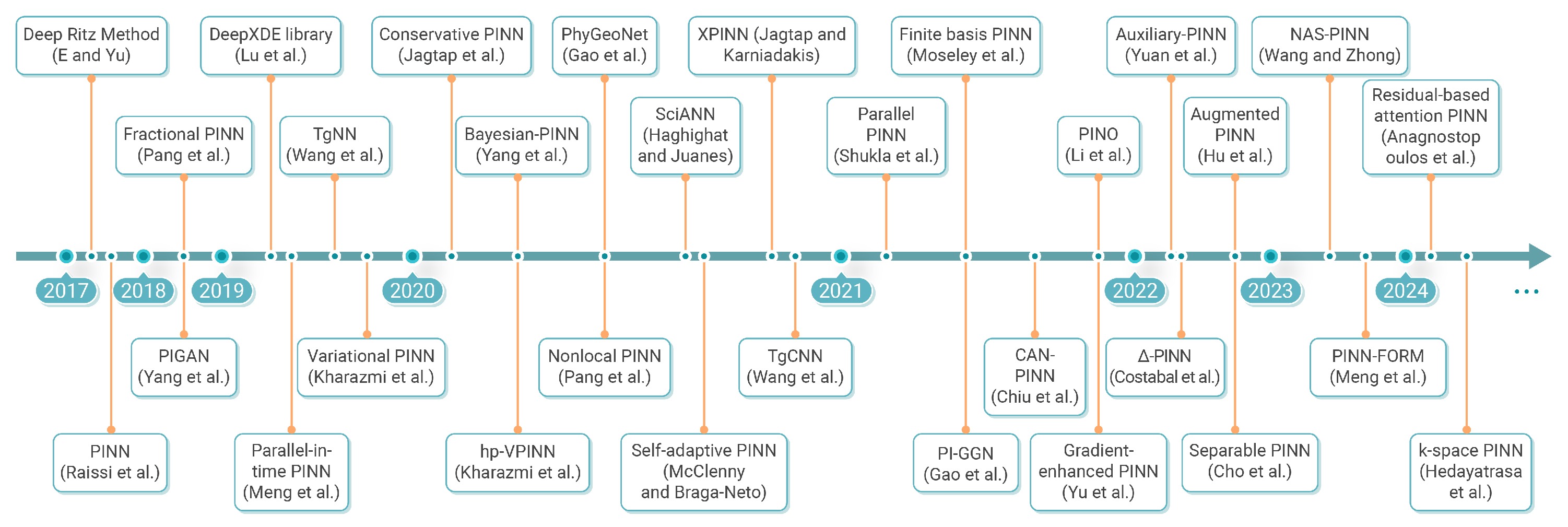
Figure 1.
Timeline of the development of PINN models, based on their initial publication in arXiv preprints or peer-reviewed journals.
-
Figure 2.
The role of physics-informed deep learning models in the geoenergy production process.
-
Figure 3.
(A) Schematic diagram of the physics-informed neural network (PINN); (B) Automatic differentiation for fully connected neural networks (FCNN); (C) Automatic differentiation for convolutional neural networks (CNN); (D) Derivative calculation using the finite difference method for CNN.
-
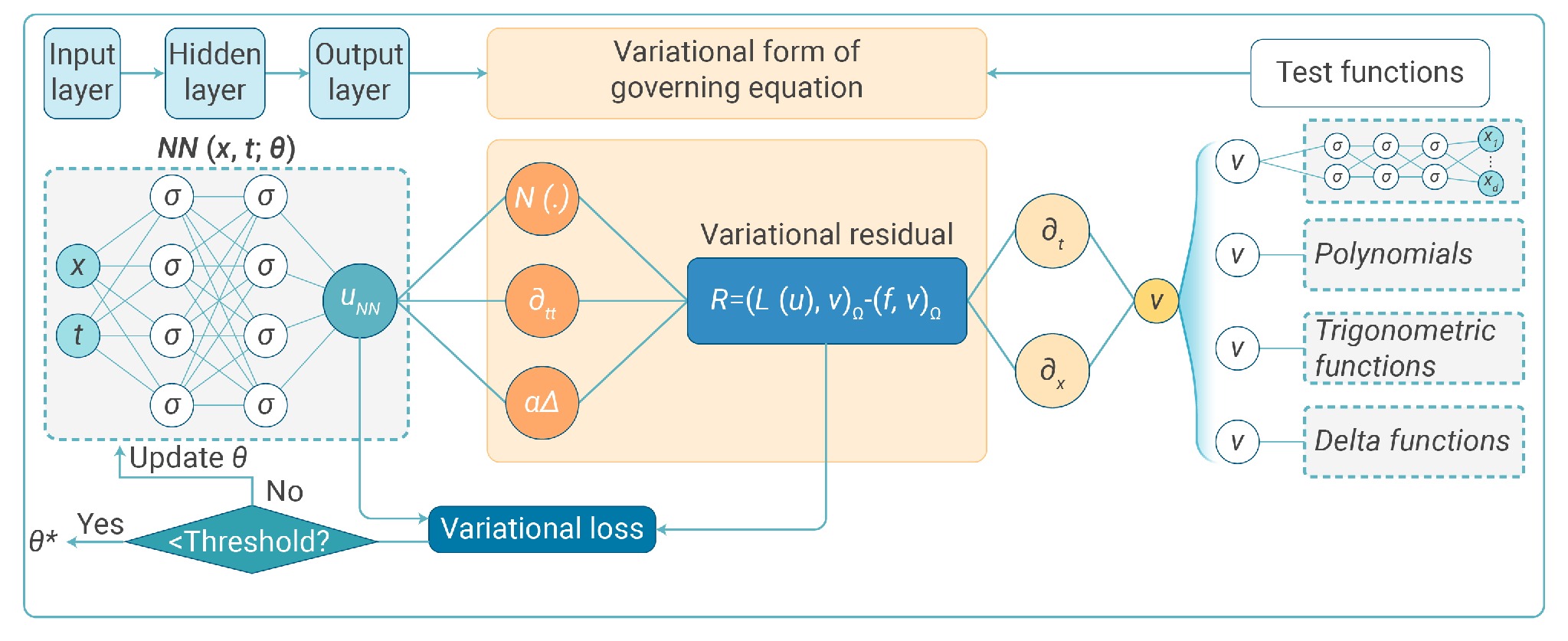
Figure 4.
Schematic diagram of the variational physics-informed neural network (VPINN).34
-
Figure 5.
Application scenarios of physics-informed deep learning models.
-
Figure 6.
(A) Surrogate modeling based on physics-informed neural network. (B) Direct inversion with multiple physics-informed neural networks.
-
Figure 7.
Schematic diagram of TgCNN for two-phase flow problems.57
-
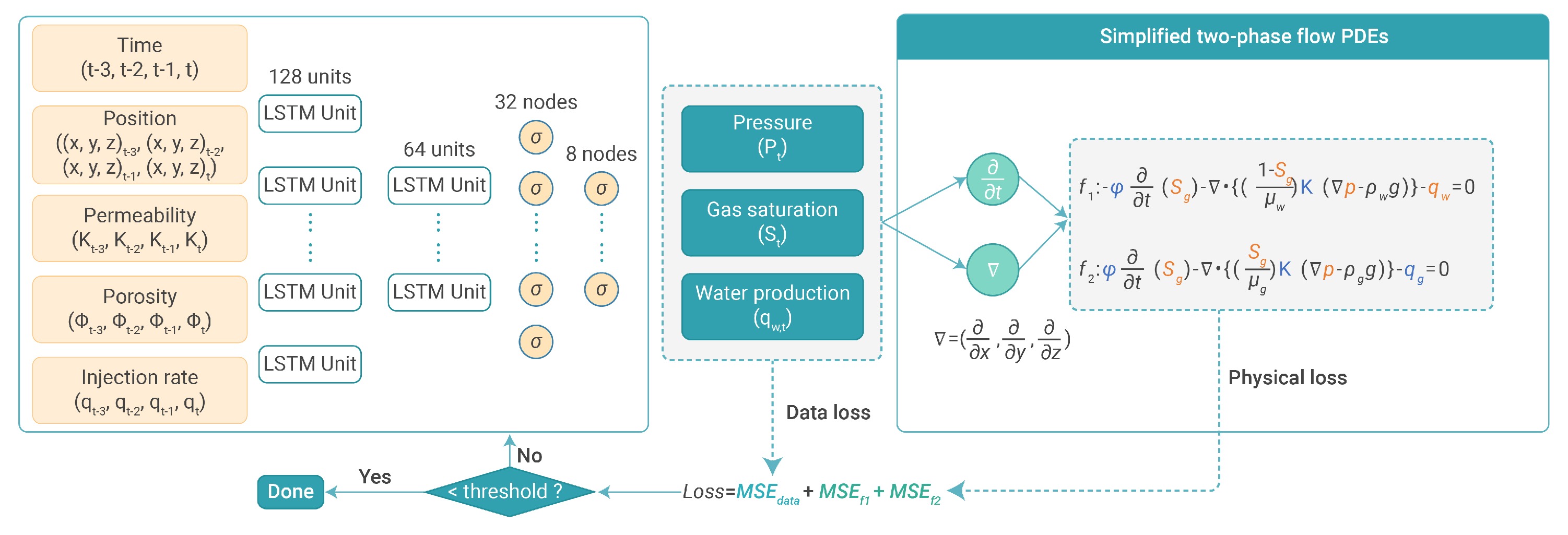
Figure 8.
Schematic diagram of physics-informed LSTM for prediction of pressure, gas saturation and water production in GCS problems.93
