
Synergistic pore-acidity engineering of hierarchical ZSM-5 for hydrogen-free upcycling of Polyethylene to C8–C12 Methylated Aromatics
-
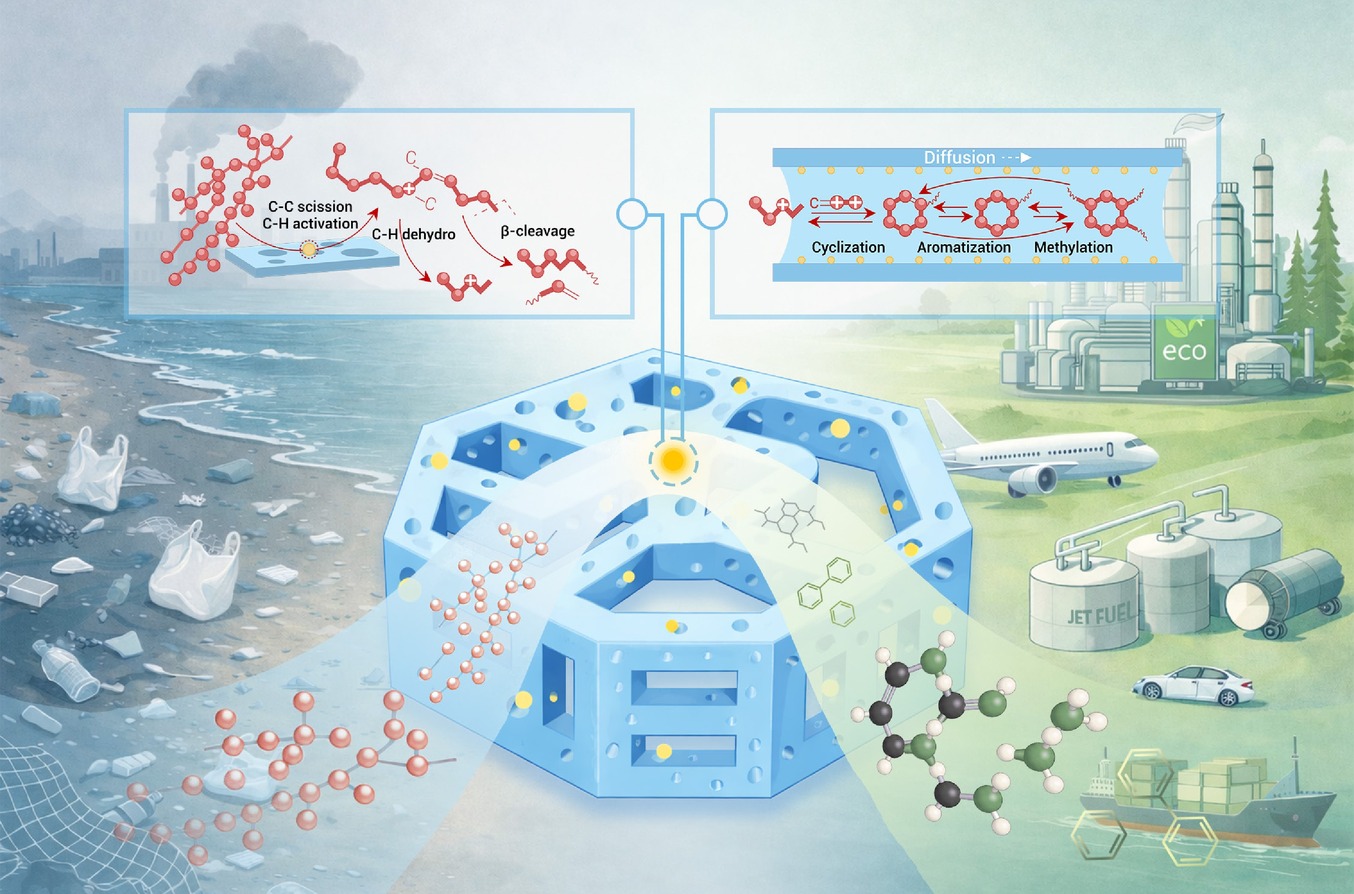
GRAPHICAL ABSTRACT
 DownLoad:
Full size image
DownLoad:
Full size image
-
PUBLIC SUMMARY
-
A pore-engineered ZSM-5 enables hydrogen-free conversion of polyethylene into valuable chemicals.
Optimal pore–acidity synergy boosts conversion to 98.8% and aromatics yield to 37.4% at 280 °C.
Mesopores enhance diffusion, speeding reactions and preventing over-cracking.
The catalyst shows strong stability and works well for real-world plastic waste.
Process cuts energy use and reduces emissions by over 55% vs fossil routes.
-
-
ABSTRACT
Transforming polyethylene (PE) into high-value chemicals is often hindered by diffusion barriers. Here, we report a hydrogen-free strategy using pore-engineered hierarchical ZSM-5. By tuning desilication, we identified a critical pore–acidity synergy at an optimal Vmeso/Vmicro ratio of ~2.7 within this specific low Si/Al (25~50) framework. The optimal catalyst achieved near-complete conversion (98.8%) and an aromatic yield of 37.4% at a mild temperature of 280 °C. In-situ FTIR and molecular dynamics simulations reveal that this synergy facilitates a cascade reaction mechanism. The introduced mesoporosity enhances the effective diffusion coefficient of C10 intermediates by an order of magnitude (from 0.1 ×10⁻⁹ m2s−1 to 2.2×10⁻⁹ m2s−1), thus enabling rapid turnover and suppressing over-cracking. The hierarchical catalyst (Hier-Z5-43) demonstrated exceptional stability and versatility for real-world plastic upcycling. Techno-economic and life cycle analyses confirm substantial advantages, reducing energy consumption by 10.9 MJ/kg and decreasing global warming potential by >55% compared to conventional fossil-based routes. This study highlights the importance of synergistically optimizing pore structure and acidity to enhance catalytic performance in polyolefin upcycling.-
Keywords:
- Plastic upcycling /
- Hierarchical ZSM-5 /
- Mesoporous /
- Aromatics /
- Hydrogen-free
-

-
REFERENCES
[1] Ellis L.D., Rorrer N.A., Sullivan K.P., et al. (2021). Chemical and biological catalysis for plastics recycling and upcycling. Nat. Catal. 4:539−556. DOI:10.1038/s41929-021-00648-4 [2] Jehanno C., Alty J.W., Roosen M., et al. (2022). Critical advances and future opportunities in upcycling commodity polymers. Nature 603:803−814. DOI:10.1038/s41586-021-04350-0 [3] Tang Y. (2017). Efficient and selective degradation of polyethylenes into liquid fuels and waxes under mild conditions. Sci. Adv. 2. DOI: 10.1126/sciadv.1501591 [4] MacLeo M., Arp H.P.H., Tekman M.B. and Jahnke A. (2021). The global threat from plastic pollution. Science 373:61−65. DOI:10.1126/science.abg5433 [5] Chamas A., Moon H., Zheng J., et al. (2020). Degradation rates of plastics in the environment. ACS Sustain. Chem. Eng. 8:3494−3511. DOI:10.1021/acssuschemeng.9b06635 [6] Hu K., Yang Y., Wang Y., et al. (2022). Catalytic carbon and hydrogen cycles in plastics chemistry. Chem Catal. 2:724−761. DOI:10.1016/j.checat.2022.02.003 [7] Vollmer I., Jenks M.J.F., Roelands M.C.P., et al. (2020). Beyond mechanical recycling: Giving new life to plastic waste. Angew. Chem. Int. Ed. 59:15402−15423. DOI:10.1002/anie.201915651 [8] Yu Z., Fan Y. and Lin F. (2025). Base-metal heterogeneous catalysts for upgrading plastics to light olefins. Research 8:0731. DOI:10.34133/research.0731 [9] Korley L.T.J., Epps T.H., Helms B.A. and Ryan A.J. (2021). Toward polymer upcycling-adding value and tackling circularity. Science 373:66−69. DOI:10.1126/science.abg4503 [10] Shi Y., Diao X., Ji N., et al. (2024). Advances and challenges for catalytic recycling and upgrading of real-world mixed plastic waste. ACS Catal. 15:841−868. DOI:10.1021/acscatal.4c06344 [11] Chin M.T. and Diao T. (2024). Industrial and laboratory technologies for the chemical recycling of plastic waste. ACS Catal. 14:12437−12453. DOI:10.1021/acscatal.4c03194 [12] Yan J., Li G., Lei Z., et al. (2025). Upcycling polyolefins to methane-free liquid fuel by a Ru1-ZrO2 catalyst. Nat. Commun. 16:2800. DOI:10.1038/s41467-025-57998-x [13] Li L., Luo H., Shao Z., et al. (2023). Converting plastic wastes to naphtha for closing the plastic loop. J. Am. Chem. Soc. 145:1847−1854. DOI:10.1021/jacs.2c11407 [14] Zhou Q., Wang D., Wang Q., et al. (2023). Mechanistic understanding of efficient polyethylene hydrocracking over two-dimensional platinum-anchored tungsten trioxide. Angew. Chem. Int. Ed. 62:e202305644. DOI:10.1002/anie.202305644 [15] Cen Z., Han X., Lin L., et al. (2024). Upcycling of polyethylene to gasoline through a self-supplied hydrogen strategy in a layered self-pillared zeolite. Nat. Chem. 16:871−880. DOI:10.1038/s41557-024-01506-z [16] Chen S., Tennakoon A., You K.-E., et al. (2023). Ultrasmall amorphous zirconia nanoparticles catalyse polyolefin hydrogenolysis. Nat. Catal. 6:161−173. DOI:10.1038/s41929-023-00910-x [17] Qiu Z., Lin S., Chen Z., et al. (2023). A reusable, impurity-tolerant and noble metal-free catalyst for hydrocracking of waste polyolefins. Sci. Adv. 9. DOI:10.1126/sciadv.adg5332 [18] Ran H., Zhang S., Ni W. and Jing Y. (2024). Precise activation of C-C bonds for recycling and upcycling of plastics. Chem. Sci. 15:795−831. DOI:10.1039/D3SC05701A [19] Chu M., Wang X., Wang X., et al. (2023). Site-selective polyolefin hydrogenolysis on atomic Ru for methanation suppression and liquid fuel production. Research 6:0032. DOI:10.34133/research.0032 [20] Gao R., Mao S., Lu B., et al. (2025). Efficient upcycling of polyolefin waste to light aromatics via coupling C—C scission and carbonylation. Angew. Chem. Int. Ed. 64:e202424334. DOI:10.1002/anie.202424334 [21] Lebreton L. and Andrady A. (2019). Future scenarios of global plastic waste generation and disposal. Palgrave Commun. 5:6. DOI:10.1057/s41599-018-0212-7 [22] Li H., Wu J., Jiang Z., et al. (2023). Hydroformylation of pyrolysis oils to aldehydes and alcohols from polyolefin waste. Science 381:660−665. DOI:10.1126/science.adh1853 [23] Li S., Li Z., Zhang F. and Chen J. (2024). Upgrading waste plastics to value-added aromatics. Chem Catal. 4:100928. DOI:10.1016/j.checat.2024.100928 [24] Hancock J.N. and Rorrer J.E. (2023). Hydrogen-free catalytic depolymerization of waste polyolefins at mild temperatures. Appl. Catal. B: Environ. Energy 338:123071. DOI:10.1016/j.apcatb.2023.123071 [25] Kwon T., Kim J. and Ro I. (2025). Hydrogen-free catalytic strategies for the upcycling of polyolefin plastics. Korean J. Chem. Eng. 43:109−164. DOI:10.1007/s11814-025-00535-9 [26] Cui Y., Xu Y., Zhang X. and Li Z. (2024). Sustainable aviation fuel: Biomass fostered future aviation. Innov. Energy 1:100007. DOI:10.59717/j.xinn-energy.2024.100007 [27] Duan J., Wang H., Li H., et al. (2023). Selective conversion of polyethylene wastes to methylated aromatics through cascade catalysis. EES Catal. 1:529−538. DOI:10.1039/D3EY00011G [28] Fang Z., Wen C., Zhang X., et al. (2025). Advance, challenge, and outlook of carbon-increasing strategies for producing sustainable high-energy-density jet fuels from lignocellulosic derivatives. Innov. Energy 2:100093. DOI:10.59717/j.xinn-energy.2025.100093 [29] Mukhopadhyay R. and Kunzru D. (1993). Catalytic pyrolysis of naphtha on calcium aluminate catalysts - effect of potassium carbonate impregnation. Ind. Eng. Chem. Res. 32:1914−1920. DOI:10.1021/ie00021a015 [30] Qian K., Tian W., Yin L., et al. (2023). Aromatic production from high-density polyethylene over zinc promoted HZSM-5. Appl. Catal. B: Environ. Energy 339:123159. DOI:10.1016/j.apcatb.2023.123159 [31] Costa C.S., Thi H.D., Van Geem K.M. and Ribeiro M.R. (2022). Assessment of acidity and the zeolite porous structure on hydrocracking of HDPE. Sustain. Energy Fuels 6:3611−3625. DOI:10.1039/D2SE00497F [32] Tang H., Li M., Chen D., et al. (2025). One-step production of isoalkane-rich sustainable aviation fuel fractions via catalytic pyrolysis of low-density polyethylene over Y-type zeolite. ACS Sustain. Chem. Eng. 13:876−8772. DOI:10.1021/acssuschemeng.5c02722 [33] Zhang F., Zeng M., Yappert R.D., et al. (2020). Polyethylene upcycling to long-chain alkylaromatics by tandem hydrogenolysis/aromatization. Science 370:437−441. DOI:10.1126/science.abc544 [34] Chen Z., Qiu Z., Lin S. and Lin B. (2025). Methanol-facilitated cascaded polyolefin upcycling enabling the efficient generation of high-value C9+ alkylaromatics. Angew. Chem. Int. Ed. 64:e202503355. DOI:10.1002/anie.202503355 [35] Du J., Zeng L., Yan T., et al. (2023). Efficient solvent- and hydrogen-free upcycling of high-density polyethylene into separable cyclic hydrocarbons. Nat. Nanotechnol. 18:772−779. DOI:10.1038/s41565-023-01429-9 [36] Han X., Zhang J., Qu Z., et al. (2025). Engineering noble metal-free nickel catalysts for highly efficient liquid fuel production from waste polyolefins under mild conditions. Fuel 382:133733. DOI:10.1016/j.fuel.2024.133733 [37] Vance B.C., Yuliu Z., Najmi S., et al. (2024). Unlocking naphtha from polyolefins using Ni-based hydrocracking catalysts. Chem. Eng. J. 487:150468. DOI:10.1016/j.cej.2024.150468 [38] Sun B., Xu H., Li T., et al. (2025). Hydrogen-free upcycling of polyethylene waste to methylated aromatics over Ni/ZSM-5 under mild conditions. J. Hazard. Mater. 482:136564. DOI:10.1016/j.jhazmat.2024.136564 [39] Zhan J., Li L., Dai R., et al. (2025). Engineering porous Beta zeolite-encapsulated nickel catalyst for waste polyolefins upcycling. Appl. Catal. B: Environ. Energy 373:125359. DOI:10.1016/j.apcatb.2025.125359 [40] Lee W.-T., van Muyden A., Bobbink F.D., et al. (2022). Mechanistic classification and benchmarking of polyolefin depolymerization over silica-alumina-based catalysts. Nat. Commun. 13:4850. DOI:10.1038/s41467-022-32563-y [41] Gounder R. and Iglesia E. (2013). The catalytic diversity of zeolites: confinement and solvation effects within voids of molecular dimensions. Chem. Commun. 49:3491−3509. DOI:10.1039/C3CC40731D [42] Sastre G. and Corma A. (2009). The confinement effect in zeolites. J. Mol. Catal. A: Chem. 305:3−7. DOI:10.1016/j.molcata.2008.10.042 [43] Wu X., Tennakoon A., Yappert R., et al. (2022). Size-controlled nanoparticles embedded in a mesoporous architecture leading to efficient and selective hydrogenolysis of polyolefins. J. Am. Chem. Soc. 144:5323−5334. DOI:10.1021/jacs.1c11694 [44] Tsubota S., Kokuryo S., Miyake K., et al. (2024). Understanding the role of the surface acidity of MFI zeolites during LDPE cracking: Decomposition temperature and product distribution. ACS Catal. 14:18145−18155. DOI:10.1021/acscatal.4c06190 [45] Wang Z., Gao L., Zhong X., et al. (2025). Accurately tuning the pore size and acidity of mesoporous zeolites for enhancing the catalytic hydrocracking of polypropylene. J. Mater. Chem. A 13:2875−2883. DOI:10.1039/D4TA07329K [46] Tarach K.A., Pyra K., Siles S., et al. (2019). Operando study reveals the superior cracking activity and stability of hierarchical ZSM-5 catalyst for the cracking of low-density polyethylene. ChemSusChem 12:633−638. DOI:10.1002/cssc.201802190 [47] Hong W., Ahn J., Shin J.W., et al. (2025). Polyethylene hydrogenolysis over Ru supported on mesoporous MFI zeolite: Effects of mesoporosity and external acid sites. ACS Catal. 15:10578−10590. DOI:10.1021/acscatal.5c00032 [48] Tan J.Z., Ortega M., Miller S.A., et al. (2024). Catalytic consequences of hierarchical pore architectures within MFI and FAU zeolites for polyethylene conversion. ACS Catal. 14:7536−7552. DOI:10.1021/acscatal.4c01213 [49] Tan J.Z., Hullfish C.W., Zheng Y., et al. (2023). Conversion of polyethylene waste to short chain hydrocarbons under mild temperature and hydrogen pressure with metal-free and metal-loaded MFI zeolites. Appl. Catal. B: Environ. Energy 338:123028. DOI:10.1016/j.apcatb.2023.123028 [50] Azam M.U., Fernandes A., Ferreira M.J. and Graca I. (2024). Pore-structure engineering of hierarchical β zeolites for the enhanced hydrocracking of waste plastics to liquid fuels. ACS Catal. 14:16148−16165. DOI:10.1021/acscatal.4c05354 [51] Zhou X., Han X., Qu Z., et al. (2024). Hierarchical FAU zeolites boosting the hydrocracking of polyolefin waste into liquid fuels. ACS Sustain. Chem. Eng. 12:6013−6022. DOI:10.1021/acssuschemeng.4c01097 [52] Xu W., Huang Y., Lin Z., et al. (2025). Bayesian optimization of hierarchical ZSM-5 for high-efficiency polyolefin waste recycling to light olefins. ACS Catal. 15:20926−20938. DOI:10.1021/acscatal.5c06271 [53] Ruan Q., Xia H., Yuan Z., et al. (2025). Decoupling acidity from micropore confinement in an amorphous–crystalline composite for selective polyolefin waste cracking. J. Am. Chem. Soc. 148:474−482. DOI:10.1021/jacs.5c14336 [54] Duan J., Chen W., Wang C., et al. (2022). Coking-resistant polyethylene upcycling modulated by zeolite micropore diffusion. J. Am. Chem. Soc. 144:14269−14277. DOI:10.1021/jacs.2c05125 [55] Feng J., Duan J., Hung C.-T., et al. (2024). Micelles cascade assembly to tandem porous catalyst for waste plastics upcycling. Angew. Chem. Int. Ed. 63:e202405252. DOI:10.1002/anie.202405252 [56] Lee S., Park Y. and Choi M. (2024). Cooperative interplay of micropores/mesopores of hierarchical zeolite in chemical production. ACS Catal. 14:2031−2048. DOI:10.1021/acscatal.3c05170 [57] Christensen C.H., Johannsen K., Törnqvist E., et al. (2007). Mesoporous zeolite single crystal catalysts: Diffusion and catalysis in hierarchical zeolites. Catal. Today 128:117−122. DOI:10.1016/j.cattod.2007.06.082 [58] Thommes M., Kaneko K., Neimark A.V., et al. (2015). Physisorption of gases, with special reference to the evaluation of surface area and pore size distribution (IUPAC Technical Report). Pure Appl. Chem. 87:1051−1069. DOI:10.1515/pac-2014-1117 [59] Rejman S., Reverdy Z.M., Bör Z., et al. (2025). External acidity as performance descriptor in polyolefin cracking using zeolite-based materials. Nat. Commun. 16:2980. DOI:10.1038/s41467-025-57158-1 [60] Hullfish C.W., Tan J.Z., Adawi H.I. and Sarazen M.L. (2023). Toward intrinsic catalytic rates and selectivities of zeolites in the presence of limiting diffusion and deactivation. ACS Catal. 13:13140−13150. DOI:10.1021/acscatal.3c03559 [61] Gulmine J., Janissek P., Heise H. and Akcelrud L. (2002). Polyethylene characterization by FTIR. Polym. Test. 21:557−563. DOI:10.1016/S0142-9418(01)00124-6 [62] Zhou Q., Wang D., Wang Q., et al. (2023). Mechanistic understanding of efficient polyethylene hydrocracking over two-dimensional platinum-anchored tungsten trioxide. Angew. Chem. Int. Ed. 62:e202305644. DOI:10.1016/S0142-9418(01)00124-6 [63] Wang S., Wang W., Chu M., et al. (2024). Ultra-narrow alkane product distribution in polyethylene waste hydrocracking by zeolite micro-mesopore diffusion optimization. Angew. Chem. Int. Ed. 63:e202409288. DOI:10.1002/anie.202409288 [64] Wang W., Wang S., Li W., et al. (2025). Coordinating cracking and hydrogenation of polyethylene waste via acid-metal site isolation for selective hydrocarbon production. Chem. Eng. Sci. 315:121882. DOI:10.1016/j.ces.2025.121882 [65] Bu L., Nimlos M.R., Robichaud D.J., et al. (2018). Diffusion of aromatic hydrocarbons in hierarchical mesoporous H-ZSM-5 zeolite. Catal. Today 312:73−81. DOI:10.1016/j.cattod.2018.02.012 [66] Zhao Z., Chong K., Jiang J., et al. (2018). Low-carbon roadmap of chemical production: A case study of ethylene in China. Renew. Sustain. Energy Rev. 97:580−591. DOI:10.1016/j.rser.2018.08.008 [67] Luo H., Li L., Sun T., et al. (2025). Green upcycling of waste agricultural plastic film under mild conditions. CCS Chem. 7:3185−3195. DOI:10.31635/ccschem.025.202404851 -
ABOUT THIS ARTICLE
Cite this article:
Sun B., Li B., Marc M., et al. (2026). Synergistic pore-acidity engineering of hierarchical ZSM-5 for hydrogen-free upcycling of Polyethylene to C8–C12 Methylated Aromatics. The Innovation Energy 3:100155. https://doi.org/10.59717/j.xinn-energy.2026.100155
Welcome!
To request copyright permission to republish or share portions of our works, please visit Copyright Clearance Center's (CCC) Marketplace website at marketplace.copyright.com.
Export File
Citation
Sun B., Li B., Marc M., et al. (2026). Synergistic pore-acidity engineering of hierarchical ZSM-5 for hydrogen-free upcycling of Polyethylene to C8–C12 Methylated Aromatics. The Innovation Energy 3:100155. https://doi.org/10.59717/j.xinn-energy.2026.100155

Format
Content
-
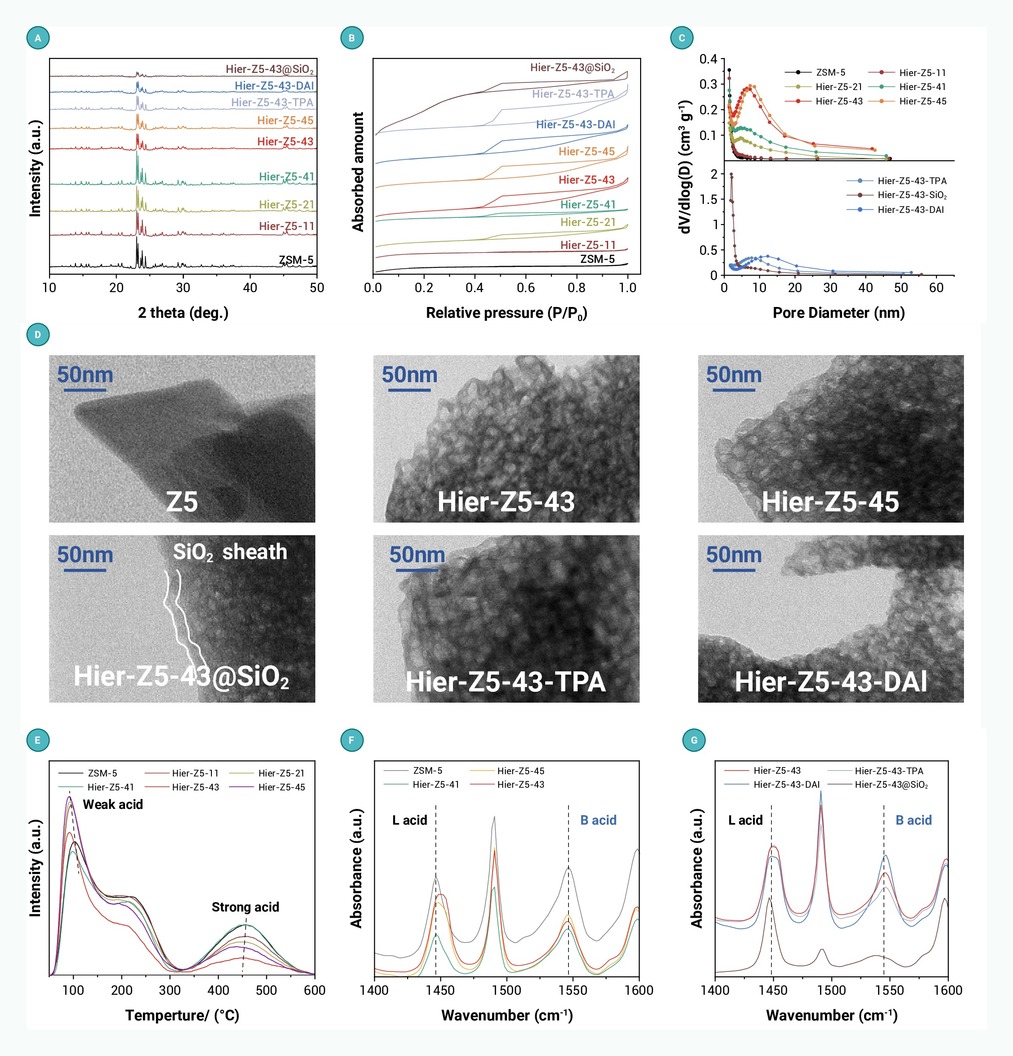
Figure 1.
Structural and acidic characterization of the catalysts
-
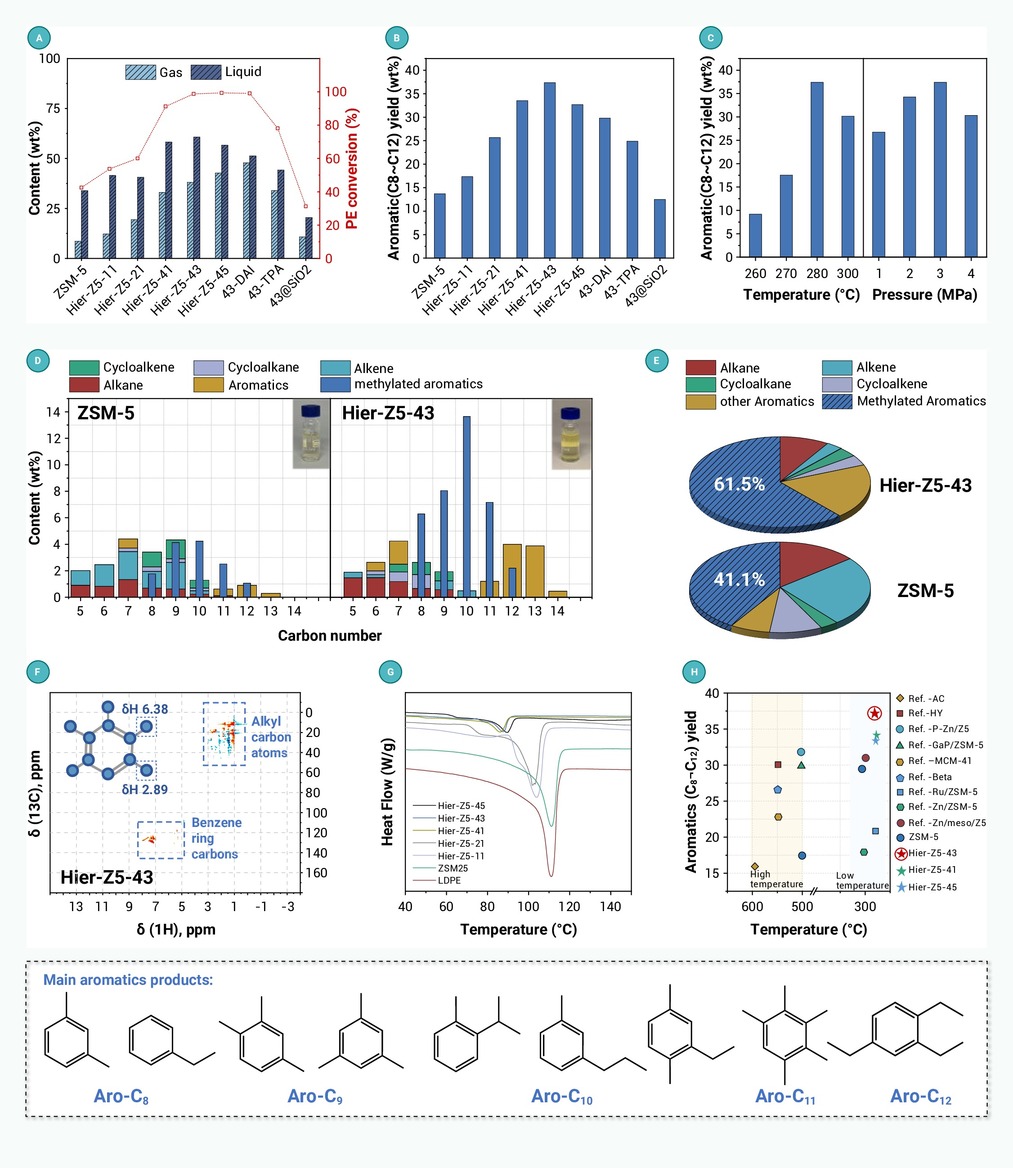
Figure 2.
(A) Screening of catalytic performance (PE conversion and product distribution) over parent ZSM-5 and the series of pore-engineered Hier-Z5 catalysts (Reaction conditions: 280 °C,3 MPa N2,1h). (B) Yield of C8–C12 aromatics as a function of desilication intensity. (C) Optimization of reaction temperature and pressure over Hier-Z5-43. (D) Carbon number distribution and (E) selectivity of liquid products compared between ZSM-5 and Hier-Z5-43. (F) 1H NMR spectra of liquid products. (G) DSC curves of post-reaction residues. (H) Comparison of C8–C12 aromatic yield and reaction temperature with literature benchmarks.
-
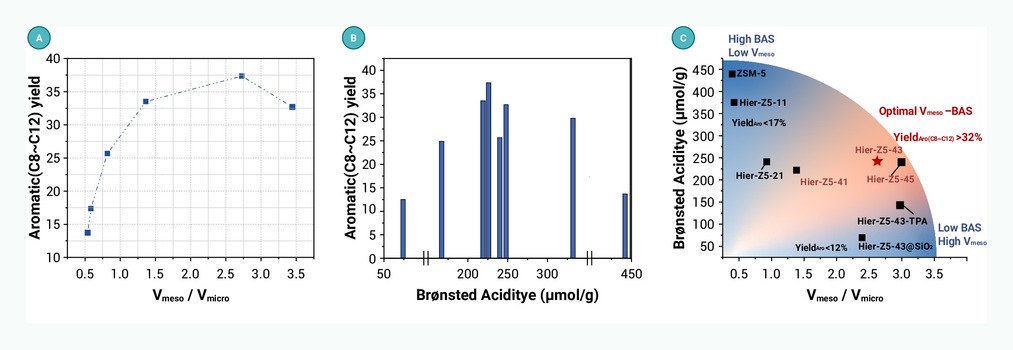
Figure 3.
Quantitative correlation between structural properties and catalytic performance
-
Figure 4.
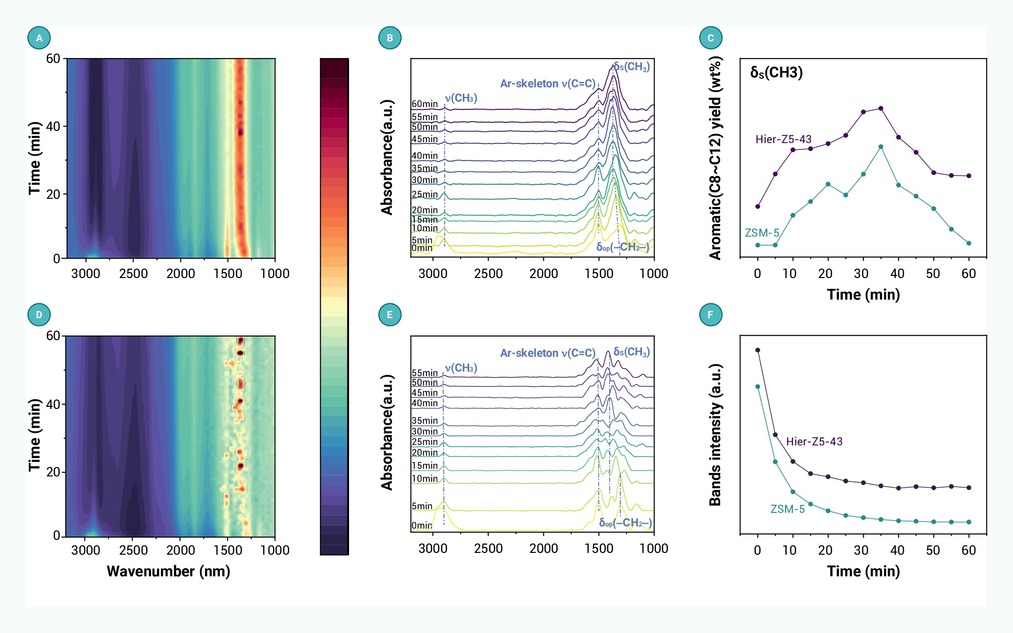
(A) 2D correlation/contour map of in-situ IR spectra over Hier-Z5-43 (visualizing band evolution with time). (B) Time-series in-situ IR spectra over Hier-Z5-43 (0–60 min), highlighting ν(CH3) (~
2897 cm-1), aromatic skeleton ν(C=C) (~1501 cm-1), δs(CH3) (~1369 cm-1), and δop(–CH2–) (~1319 cm-1). (C) Kinetics of δs(CH3) (~1369 cm-1) intensity vs. time: comparison between ZSM-5 and Hier-Z5-43. (D) 2D correlation/contour map of in-situ IR spectra over ZSM-5. (E) Time-series in-situ IR spectra over ZSM-5 (0–60 min), assigned as in panel. (F) Kinetics of ν(CH3) (~2897 cm-1) intensity vs. time: comparison between ZSM-5 and Hier-Z5-43. -
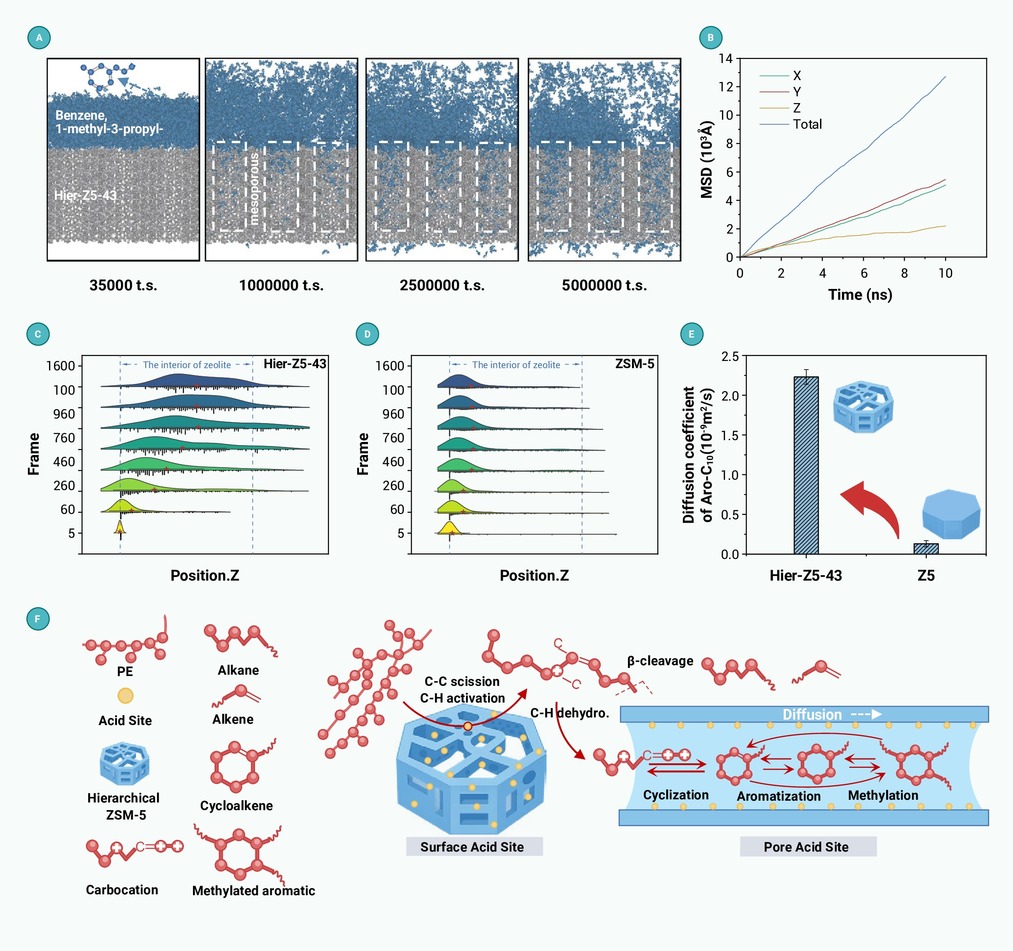
Figure 5.
Molecular simulations reveal mesopore-enabled diffusion and a meso–micro cascade to methylated aromatics
-
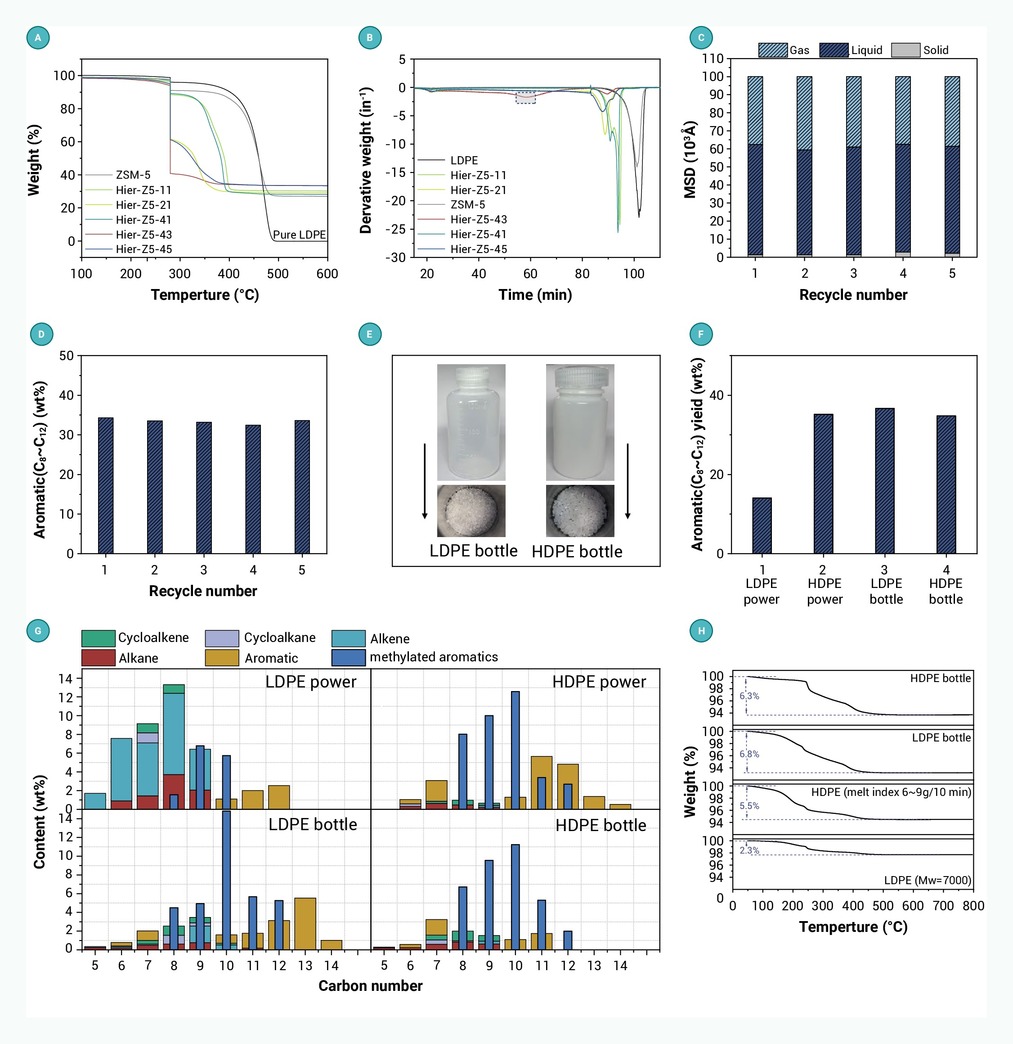
Figure 6.
Stability, regenerability, and real-world waste upcycling.
-
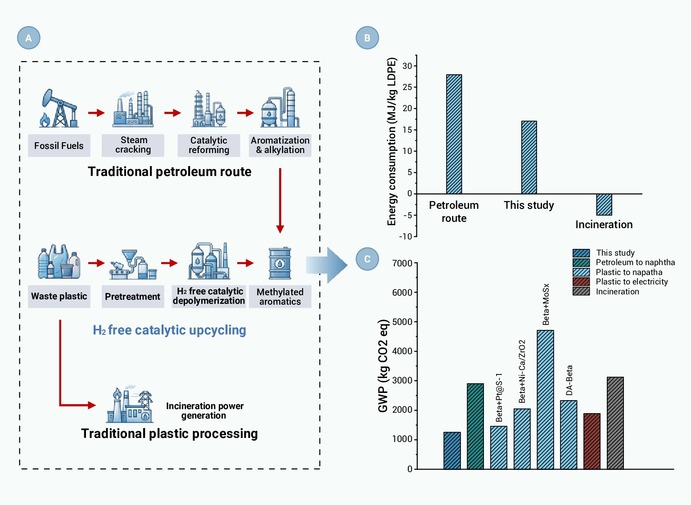
Figure 7.
Techno-Economic and Environmental Assessment of H2-Free Polyethylene Upcycling.
