
Rethinking marine trace element cycling: Combining top-down scavenging with bottom-up transformation
-

-
REFERENCES
[1] Siddall M., Khatiwala S., van de Flierdt T., et al. (2008). Towards explaining the Nd paradox using reversible scavenging in an ocean general circulation model. Earth Planet. Sci. Lett. 274:448−61. DOI:10.1016/j.epsl.2008.07.044 [2] Lacan F., Jeandel C. (2005). Neodymium isotopes as a new tool for quantifying exchange fluxes at the continent–ocean interface. Earth Planet. Sci. Lett. 232:245−57. DOI:10.1016/j.epsl.2005.01.004 [3] Jeandel C. (2016). Overview of the mechanisms that could explain the ‘Boundary Exchange’at the land–ocean contact. Philos. T. R. Soc. A. 374:20150287. DOI:10.1098/rsta.2015.0287 [4] Yu Z., Song Z., Tang X., et al. (2026). Neodymium isotopes in marginal seawater trace continental weathering inputs. Geochim. Cosmochim. Acta. 415:313−26. DOI:10.1016/j.gca.2025.12.003 [5] Du J., Haley B. A., McManus J., et al. (2025). Abyssal seafloor as a key driver of ocean trace-metal biogeochemical cycles. Nature 642:620−627. DOI:10.1038/s41586-025-09038-3 -
ABOUT THIS ARTICLE
Cite this article:
Yu Z., Colin C. and Wan S. (2026). Rethinking marine trace element cycling: Combining top-down scavenging with bottom-up transformation. The Innovation Geoscience 4:100255. https://doi.org/10.59717/j.xinn-geo.2026.100255
Welcome!
To request copyright permission to republish or share portions of our works, please visit Copyright Clearance Center's (CCC) Marketplace website at marketplace.copyright.com.
Export File
Citation
Yu Z., Colin C. and Wan S. (2026). Rethinking marine trace element cycling: Combining top-down scavenging with bottom-up transformation. The Innovation Geoscience 4:100255. https://doi.org/10.59717/j.xinn-geo.2026.100255

Format
Content
 DownLoad:
-
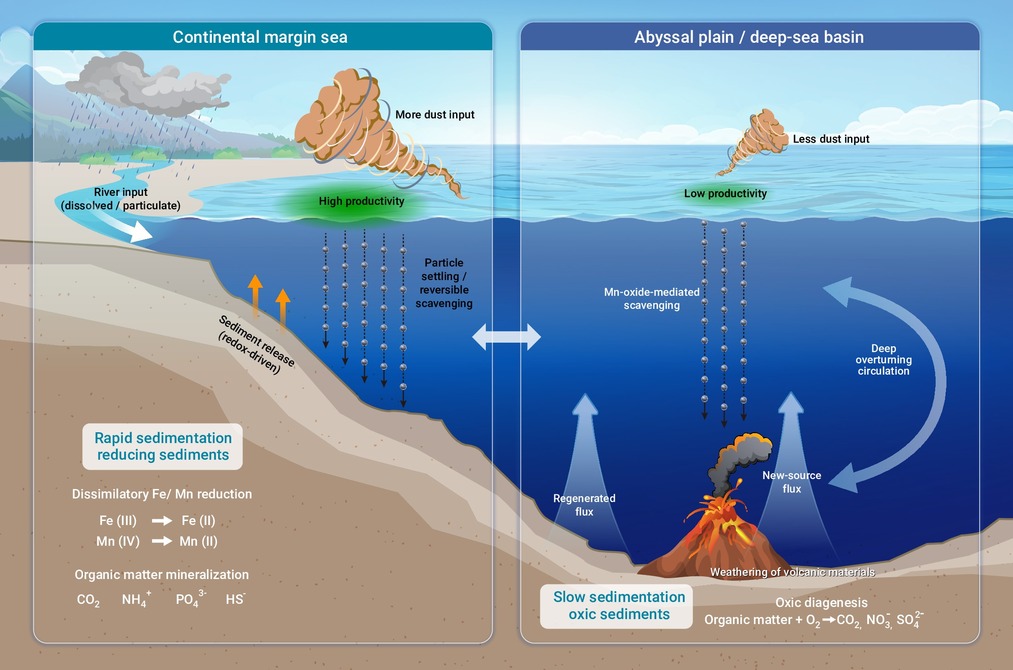
Figure 1.
Schematic of trace-element cycling in marginal seas and abyssal plains
