
Local observation, global investment: A framework for next-generation precipitation monitoring networks
-

-
REFERENCES
[1] Su J., Miao C., Zwiers F., et al. (2026). Precipitation observing network gaps limit climate change impact assessment. Nature 652:119−125. DOI:10.1038/s41586-026-10300-5 [2] OECD. (2021). Strengthening climate resilience: Guidance for governments and development co-operation. OECD Publishing. DOI:10.1787/4b08b7be-en [3] Reichstein M., Camps-Valls G., Stevens B., et al. (2019). Deep learning and process understanding for data-driven Earth system science. Nature 566:195−204. DOI:10.1038/s41586-019-0912-1 [4] Wang X., Shi S., Zhu L., et al. (2023). Traditional and novel methods of rainfall observation and measurement: A review. J. Hydrometeorol. 24:2153−2176. DOI:10.1175/JHM-D-22-0122.1 [5] Lin J., Bryan B. A., Zhou X., et al. (2023). Making China’s water data accessible, usable and shareable. Nat. Water 1:328−335. DOI:10.1038/s44221-023-00039-y -
ABOUT THIS ARTICLE
Cite this article:
Wu X. and Zhou X. (2026). Local observation, global investment: A framework for next-generation precipitation monitoring networks. The Innovation Geoscience 4:100256. https://doi.org/10.59717/j.xinn-geo.2026.100256
Welcome!
To request copyright permission to republish or share portions of our works, please visit Copyright Clearance Center's (CCC) Marketplace website at marketplace.copyright.com.
Export File
Citation
Wu X. and Zhou X. (2026). Local observation, global investment: A framework for next-generation precipitation monitoring networks. The Innovation Geoscience 4:100256. https://doi.org/10.59717/j.xinn-geo.2026.100256

Format
Content
 DownLoad:
-
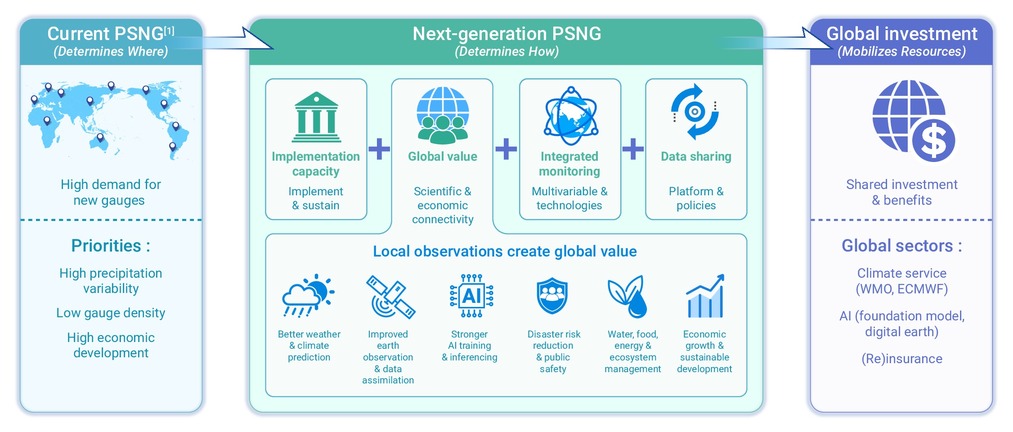
Figure 1.
From identifying observational gaps1 to guiding global investment: A conceptual framework for the next generation of PSNG.
