
Wildfires are testing the limits of emission-control gains
-

-
REFERENCES
[1] Deng W., Wang J., Zhou M., et al. (2026). Fires reverse progress toward ozone air quality standards in the United States. Science 392:1088−1092. DOI:10.1126/science.aed3197 [2] Burke M., Childs M.L., de la Cuesta B., et al. (2023). The contribution of wildfire to PM2.5 trends in the USA. Nature 622:761–766. DOI:10.1038/s41586-023-06522-6 [3] Abatzoglou J.T., Kolden C.A., Cullen A.C., et al. (2025). Climate change has increased the odds of extreme regional forest fire years globally. Nat. Commun. 16:6390. DOI:10.1038/s41467-025-61608-1 [4] Byrne B., Liu J., Bowman K.W., et al. (2024). Carbon emissions from the 2023 Canadian wildfires. Nature 633:835−839. DOI:10.1038/s41586-024-07878-z [5] Huang X., Ding K., Liu J., et al. (2023). Smoke-weather interaction affects extreme wildfires in diverse coastal regions. Science 379:457−461. DOI:10.1126/science.add9843 -
ABOUT THIS ARTICLE
Cite this article:
Wang N., Yang F., Liu S., et al. (2027). Wildfires are testing the limits of emission-control gains. The Innovation Geoscience 5:100265. https://doi.org/10.59717/j.xinn-geo.2026.100265
Welcome!
To request copyright permission to republish or share portions of our works, please visit Copyright Clearance Center's (CCC) Marketplace website at marketplace.copyright.com.
Export File
Citation
Wang N., Yang F., Liu S., et al. (2027). Wildfires are testing the limits of emission-control gains. The Innovation Geoscience 5:100265. https://doi.org/10.59717/j.xinn-geo.2026.100265

Format
Content
 DownLoad:
-
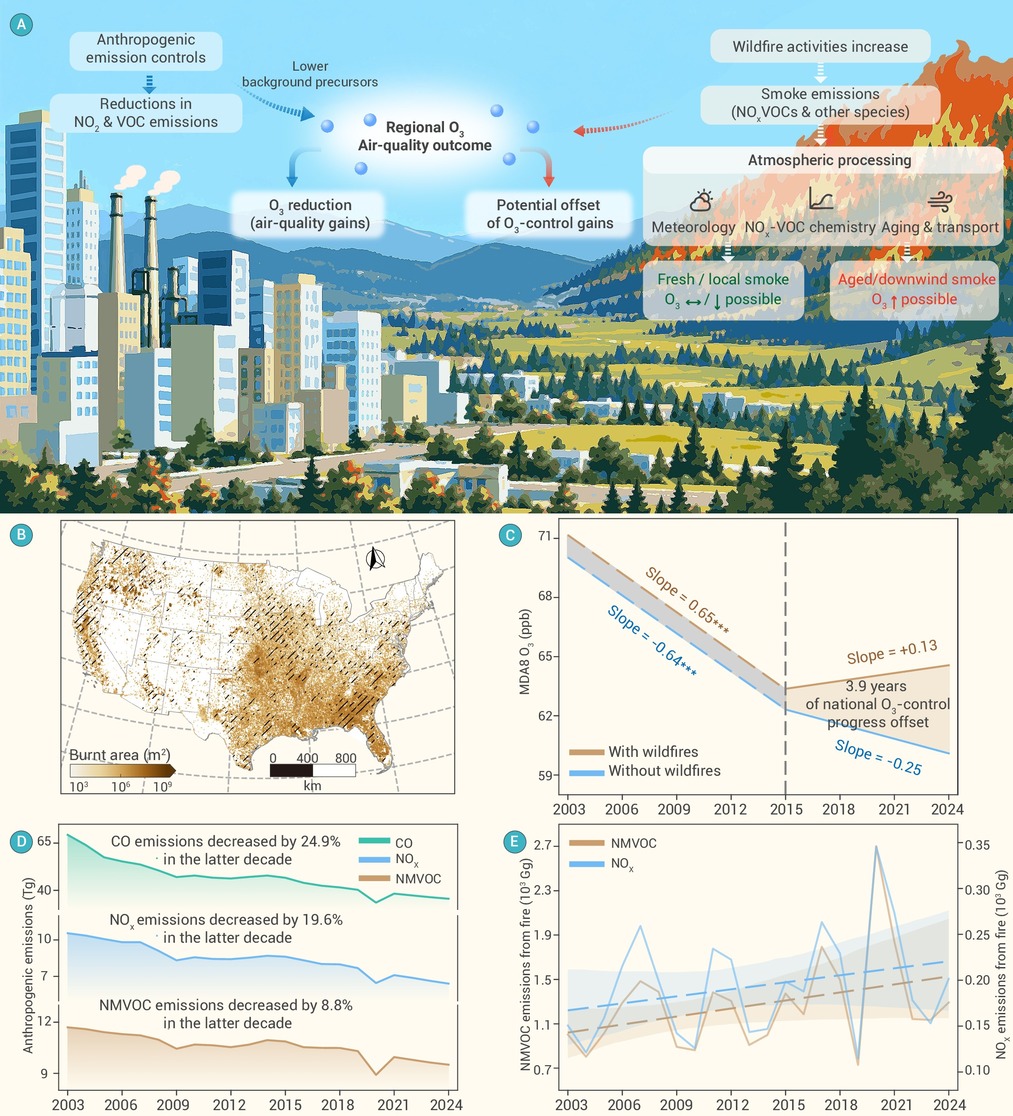
Figure 1.
Wildfire influence can offset ozone improvements achieved through anthropogenic emission controls
