
Decoding spectral representation for Earth’s matter via large language models: A new methodology for planetary cognition
-

-
REFERENCES
[1] Roemer F. E., Buehler S. A., Brath M., et al. (2023). Direct observation of Earth’s spectral long-wave feedback parameter. Nat. Geosci. 16:416−421. DOI:10.1038/s41561-023-01175-6 [2] Li C., Hong D., Zhang B., et al. (2024). Interpretable foundation models as decryptors peering into the Earth system. The Innovation 5:100682. DOI:10.1016/j.xinn.2024.100682 [3] Yuan Q., Shen H., Li T., et al. (2020). Deep learning in environmental remote sensing: Achievements and challenges. Remote Sens. Environ. 241:111716. DOI:10.1016/j.rse.2020.111716 [4] Bodnar C., Bruinsma W. P., Lucic A., et al. (2025). A foundation model for the Earth system. Nature 641:1180−1187. DOI:10.1038/s41586-025-09005-y [5] Thoreau R., Risser L., Achard V., et al. (2024). Toulouse hyperspectral data set: A benchmark data set to assess semi-supervised spectral representation learning and pixel-wise classification techniques. ISPRS J. Photogramm. Remote Sens. 212:323−337. DOI:10.1016/j.isprsjprs.2024.05.003 -
ABOUT THIS ARTICLE
Cite this article:
Zhu T., Wang S., Xu Y., et al. (2027). Decoding spectral representation for Earth’s matter via large language models: A new methodology for planetary cognition. The Innovation Geoscience 5:100266. https://doi.org/10.59717/j.xinn-geo.2026.100266
Welcome!
To request copyright permission to republish or share portions of our works, please visit Copyright Clearance Center's (CCC) Marketplace website at marketplace.copyright.com.
Export File
Citation
Zhu T., Wang S., Xu Y., et al. (2027). Decoding spectral representation for Earth’s matter via large language models: A new methodology for planetary cognition. The Innovation Geoscience 5:100266. https://doi.org/10.59717/j.xinn-geo.2026.100266

Format
Content
 DownLoad:
-
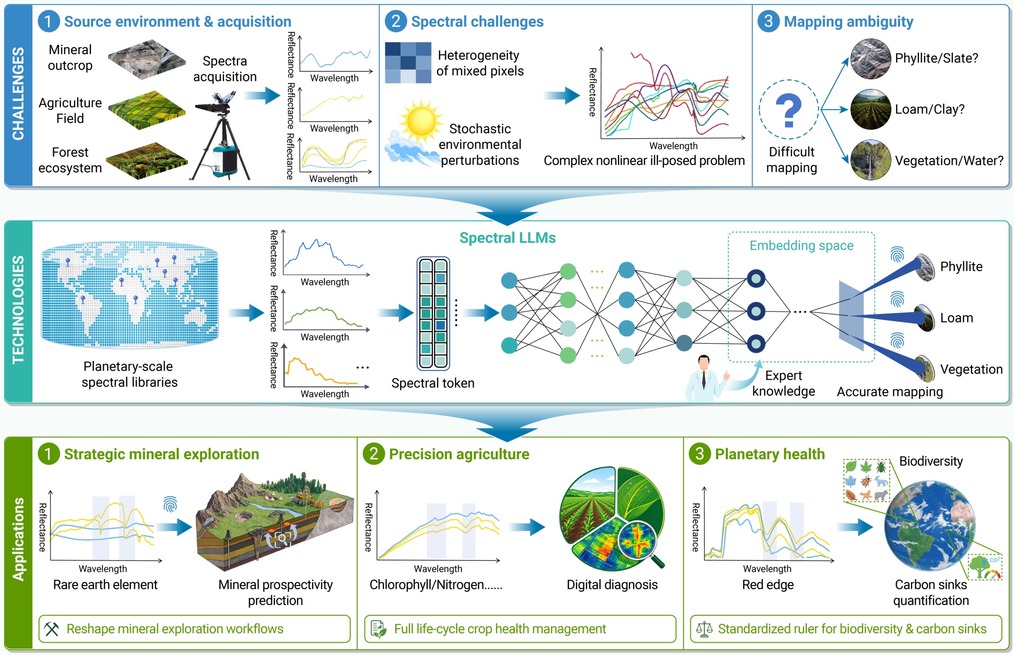
Figure 1.
Intelligent mapping of spectra to surface materials enabled by LLMs for Spectrum Earth cognition.
