
-
GRAPHICAL ABSTRACT

 DownLoad:
Full size image
DownLoad:
Full size image
-
PUBLIC SUMMARY
-
Artificial Intelligence (AI) enhances gas sensors for smarter, efficient chemical detection.
AI improves sensitivity, selectivity, and adaptability in dynamic environments.
Machine learning enables real-time data processing and accurate gas identification.
AI-integrated sensors benefit industry, environment, healthcare, and agriculture applications.
Future convergence with Internet of Things (IoT) and 5G boosts sensing capability.
-
-
ABSTRACT
The integration of Artificial Intelligence (AI) with gas sensor technology has significantly advanced the field of chemical sensing, enabling more intelligent, efficient, and adaptive systems for a wide range of applications. Traditional gas sensors, such as electrochemical, semiconductor, and optical sensors, have limitations in terms of sensitivity, selectivity, and adaptability to dynamic environmental conditions. AI, particularly machine learning and deep learning techniques, offers a promising solution to overcome these challenges by enhancing sensor performance, enabling real-time data processing, and improving gas identification and concentration estimation. This review explores the applications of AI in gas sensing, focusing on AI’s role in sensor data preprocessing, feature extraction, classification, and regression tasks. Additionally, we examine recent advances in near-sensor and in-sensor computing architectures, together with deployment strategies that tightly integrate AI computation into sensor hardware. These approaches are discussed in terms of data processing efficiency, energy consumption, and latency, while also addressing persistent challenges associated with computational scalability and reliable operation in complex gas environments. Overcoming these challenges will require coordinated progress in sensor device engineering as well as the development of more adaptive and robust machine learning and AI algorithms. The review also highlights successful applications of AI-powered gas sensing systems in industrial monitoring, environmental protection, healthcare, and agriculture. Finally, we explore the future development of AI in gas sensing, focusing on the convergence of AI with emerging technologies like the Internet of Things (IoT), edge computing, and 5G, which promise to further enhance the capabilities of intelligent gas detection systems. -

-
REFERENCES
[1] Zong B., Wu S., Yang Y., et al. (2024). Smart gas sensors: Recent developments and future prospective. Nano-Micro Lett. 17:54. DOI:10.1007/s40820-024-01543-w [2] Yan J., Kang Y., Fang W., et al. (2025). Tuning gas sensing properties through metal-nanocluster functionalization of 3D SnO2 nanotube arrays for selective gas detection. ACS Sens. 10:6084−6094. DOI:10.1021/acssensors.5c01699 [3] Zhu B., Fang W., Yan J., et al. (2025). Wearable H2S sensors with enhanced humidity tolerance: Microcrumpled SnO2 quantum-wire films for real-time room-temperature gas monitoring. ACS Appl. Mater. Interfaces 17:50856−50864. DOI:10.1021/acsami.5c10408 [4] Verma G., Gokarna A., Kadiri H., et al. (2023). Multiplexed gas sensor: Fabrication strategies, recent progress, and challenges. ACS Sens. 8:3320−3337. DOI:10.1021/acssensors.3c01244 [5] Chowdhury M.A.Z. and Oehlschlaeger M.A. (2025). Artificial intelligence in gas sensing: A review. ACS Sens. 10:1538−1563. DOI:10.1021/acssensors.4c02272 [6] Yang K.M., Kang Y., Yan J., et al. (2025). Fingertip-chip sensor based on Pd nanocluster sensitized 3D NiO nanotube arrays for real-time, selective methane detection. Lab Chip 25:4986-4993. DOI:10.1039/d5lc00570a [7] Song Z., Tian Y., Kang Y., et al. (2025). Development of a three-dimensional nanostructure SnO2-based gas sensor for room-temperature hydrogen detection. Sensors 25:4784. DOI:10.3390/s25154784 [8] Mei H., Peng J., Wang T., et al. (2024). Overcoming the limits of cross-sensitivity: Pattern recognition methods for chemiresistive gas sensor array. Nano-Micro Lett. 16:269. DOI:10.1007/s40820-024-01489-z [9] Cho Y.H., Kim D.S., Seo J.H., et al. (2025). Artificial olfactory system enabled by ultralow chemical sensing variations of 1D SnO2 nanoarchitectures. Adv. Sci. 12. DOI:10.1002/advs.202501293 [10] Ariyaratne R., Elangasinghe M.A., Zamora M. L., et al. (2023). Understanding the effect of temperature and relative humidity on sensor sensitivities in field environments and improving the calibration models of multiple electrochemical carbon monoxide (CO) sensors in a tropical environment. Sens. Actuators, B 390:133935. DOI:10.1016/j.snb.2023.133935 [11] Liu C., Duan Z., Zhang B., et al. (2023). Local Gaussian process regression with small sample data for temperature and humidity compensation of polyaniline-cerium dioxide NH3 sensor. Sens. Actuators, B 378:133113. DOI:10.1016/j.snb.2022.133113 [12] Sun T., Feng B., Huo J., et al. (2023). Artificial intelligence meets flexible sensors: emerging smart flexible sensing systems driven by machine learning and artificial synapses. Nano-Micro Lett. 16:14. DOI:10.1007/s40820-023-01235-x [13] Ku W., Lee G., Lee J.-Y., et al. (2024). Rational design of hybrid sensor arrays combined synergistically with machine learning for rapid response to a hazardous gas leak environment in chemical plants. J. Hazard. Mater. 466:133649. DOI:10.1016/j.jhazmat.2024.133649 [14] Zhang X., Wang T., Ni W., et al. (2024). Sensor array optimization for the electronic nose via different deep learning methods. Sens. Actuators, B 410:135579. DOI:10.1016/j.snb.2024.135579 [15] Jang M., Bae G., Kwon Y. M., et al. (2024). Artificial Q‐Grader: Machine learning‐enabled intelligent olfactory and gustatory sensing system. Adv. Sci. 11. DOI:10.1002/advs.202308976 [16] Li J., Wang H., Luo Y., et al. (2024). Design of AI-enhanced and hardware-supported multimodal E-skin for environmental object recognition and wireless toxic gas alarm. Nano-Micro Lett. 16. DOI:10.1007/s40820-024-01466-6 [17] Liu M., Ren R., Zhou X., et al. (2025). From gas sensing to AI–gas sensing. Chem. Commun. 61:9996−10010. DOI:10.1039/d5cc01291k [18] Wang T., Wu Y., Zhang Y., et al. (2023). Portable electronic nose system with elastic architecture and fault tolerance based on edge computing, ensemble learning, and sensor swarm. Sens. Actuators, B 375:132925. DOI:10.1016/j.snb.2022.132925 [19] Zhang Z., Liu X., Zhou H., et al. (2024). Advances in machine-learning enhanced nanosensors: From cloud artificial intelligence toward future edge computing at chip level. Small 5:2300325. DOI:10.1002/sstr.202300325 [20] Lee S.-W., Kang M., Han J.-K., et al. (2023). An artificial olfactory sensory neuron for selective gas detection with in-sensor computing. Device 1. DOI:10.1016/j.device.2023.100063 [21] Tan J., Duan S., Wang L., et al. (2023). Multi-gas sensing electronic nose using memristor-based in-memory computing. IEEE Sens. J. 23:28526−28534. DOI:10.1109/JSEN.2023.3323943 [22] Xiao L., Han F., Zhang C., et al. (2025). Co-design of lightweight neural network and low-power edge computing architecture for intelligent electronic nose system. IEEE Sens. J. 25:27288−27300. DOI:10.1109/JSEN.2025.3569844 [23] Acharyya S., Bhowmick P.K. and Guha P.K. (2023). Selective identification and quantification of VOCs using metal nanoparticles decorated SnO2 hollow-spheres based sensor array and machine learning. J. Alloys Compd. 968:171891. DOI:10.1016/j.jallcom.2023.171891 [24] Malhotra J.S., Kubus M., Pedersen K.S., et al. (2023). Room-temperature monitoring of CH4 and CO2 using a metal–prganic framework-based QCM sensor showing inherent analyte discrimination. ACS Sens. 8:3478−3486. DOI:10.1021/acssensors.3c01058 [25] Mo X., Zhu C., Zhang Z., et al. (2024). Nitrogen-doped indium oxide electrochemical sensor for stable and selective NO2 detection. 36:e2409294. DOI:10.1002/adma.202409294 [26] Wang L., Cheng Y., Gopalan S., et al. (2023). Review and perspective: Gas separation and discrimination technologies for current gas sensors in environmental applications. ACS Sens. 8:1373−1390. DOI:10.1021/acssensors.2c02810 [27] Fang W., Yan J., Tian Y., et al. (2025). Enhancing low-temperature H2S sensing performance of SnO2 quantum wires via transition metal doping and oxygen vacancy engineering. Nanoscale 17:21224−21230. DOI:10.1039/d5nr02580j [28] Zhang T., Tan R., Shen W., et al. (2023). Inkjet-printed ZnO-based MEMS sensor array combined with feature selection algorithm for VOCs gas analysis. Sens. Actuators, B 382:133555. DOI:10.1016/j.snb.2023.133555 [29] Yang X., Deng Y., Yang H., et al. (2023). Functionalization of mesoporous semiconductor metal oxides for gas sensing: Recent advances and emerging challenges. Adv. Sci. 10:2204810. DOI:10.1002/advs.202204810 [30] Han X., Li C., Guo M., et al. (2024). Fiber-optic trace gas sensing based on graphite excited photoacoustic wave. Sens. Actuators, B 408:135546. DOI:10.1016/j.snb.2024.135546 [31] Najafi P. and Ghaemi A. (2024). Chemiresistor gas sensors: Design, challenges, and strategies: A comprehensive review. Chem. Eng. J. 498:154999. DOI:10.1016/j.cej.2024.154999 [32] Turlybekuly A., Shynybekov Y., Soltabayev B., et al. (2024). The cross-sensitivity of chemiresistive gas sensors: Nature, methods, and peculiarities: A systematic review. ACS Sens. 9:6358−6371. DOI:10.1021/acssensors.4c02097 [33] Bulemo P.M., Kim D.-H., Shin H., et al. (2025). Selectivity in chemiresistive gas sensors: Strategies and challenges. Chem. Rev. 125:4111−4183. DOI:10.1021/acs.chemrev.4c00592 [34] Sun C., Liu H., Shao J., et al. (2023). Au-loaded Zn2SnO4/SnO2/ZnO nanosheets for fast response and highly sensitive TEA gas sensors. Sens. Actuators, B 376:132951. DOI:10.1016/j.snb.2022.132951 [35] Veríssimo M.I.S. (2024). A critical review of the analytical performance of the most recent MOS-based gas sensors for indoor air quality monitoring of WHO priority pollutants. Trends Anal. Chem. 178:117813. DOI:10.1016/j.trac.2024.117813 [36] Ou Y., Wang B., Xu N., et al. (2024). Tandem electric-fields prolong energetic hot electrons lifetime for ultra-fast and stable NO2 detection. Adv. Mater. 36:2403215. DOI:10.1002/adma.202403215 [37] Zhang Y., Wang M., San X., et al. (2024). Highly selective gas sensors for formaldehyde detection based on ZnO@ZIF-8 core-shell heterostructures. Sens. Actuators, B 398:134689. DOI:10.1016/j.snb.2023.134689 [38] Zhang T., Lin S., Zhou Y., et al. (2023). Several ML algorithms and their feature vector design for gas discrimination and concentration measurement with an ultrasonically catalyzed MOX sensor. ACS Sens. 8:665−672. DOI:10.1021/acssensors.2c02159 [39] Singh S., S S., Varma P., et al. (2024). Metal oxide-based gas sensor array for VOCs determination in complex mixtures using machine learning. 191:196.DOI:10.1007/s00604-024-06258-8 [40] Ma S., Zhao Z., Li H., et al. (2025). Flake-like WO3 decorated by PdRh nanoalloys: Sensing performance, DFT calculation, and machine learning-enhanced selectivity for triethylamine gas detection. Sens. Actuators, B 444:138329. DOI:10.1016/j.snb.2025.138329 [41] Li Z., Yu J., Dong D., et al. (2023). E-nose based on a high-integrated and low-power metal oxide gas sensor array. Sens. Actuators, B 380:133289. DOI:10.1016/j.snb.2023.133289 [42] Yuan Z., Sun H., Ji H., et al. (2025). Single feature to achieve gas recognition: Humidity interference suppression strategy based on temperature modulation and principal component linear discriminant analysis. Sens. Actuators, B 423:136842. DOI:10.1016/j.snb.2024.136842 [43] Marín D., Llano-Viles J., Haddi Z., et al. (2023). Home monitoring for older singles: A gas sensor array system. Sens. Actuators, B 393:134036. DOI:10.1016/j.snb.2023.134036 [44] He X., Zhuang Y., Gao D., et al. (2025). Leveraging convolutional neural networks for enhancing performance of Cs3Cu2I5/TiO2 nanocrystal-based carbon monoxide gas sensor. Sens. Actuators, B 429:137311. DOI:10.1016/j.snb.2025.137311 [45] Mei H., Peng J., Wang T., et al. (2025). Smart VOCs recognition system based on single gas sensor and multi-task deep learning model. Sens. Actuators, B 439:137853. DOI:10.1016/j.snb.2025.137853 [46] Yang J., Hu X., Feng L., et al. (2024). AI-enabled portable E-nose regression predicting harmful molecules in a gas mixture. ACS Sens. 9:2925−2934. DOI:10.1021/acssensors.4c00050 [47] Liang Z., Chen D., Yang L., et al. (2024). A multibranch LSTM-attention ensemble classification network for sensor drift compensation. IEEE Sens. J. 24:25830−25841. DOI:10.1109/JSEN.2024.3418849 [48] Kumar S.P., Garg S., Alabdulkreem E., et al. (2024). Advanced generative adversarial network for optimizing layout of wireless sensor networks. Sci. Rep. 14:32139. DOI:10.1038/s41598-024-83957-5 [49] Sung S.-H., Suh J.M., Hwang Y.J., et al. (2024). Data-centric artificial olfactory system based on the eigengraph. Nat. Commun. 15:1211. DOI:10.1038/s41467-024-45430-9 [50] Lim N., Hong S., Jung J., et al. (2024). Enhancing mixed gas discrimination in e-nose system: Sparse recurrent neural networks using transient current fluctuation of SMO array sensor. J. Ind. Inf. Integr. 42:100715. DOI:10.1016/j.jii.2024.100715 [51] Kang M., Cho I., Park J., et al. (2022). High accuracy real-time multi-gas identification by a batch-uniform gas sensor array and deep learning algorithm. ACS Sens. 7:430−440. DOI:10.1021/acssensors.1c01204 [52] Chae H. Y., Cho J., Purbia R., et al. (2023). Environment-adaptable edge-computing gas-sensor device with analog-assisted continual learning scheme. IEEE Trans. Ind. Electron. 70:10720−10729. DOI:10.1109/tie.2022.3220871 [53] Cho J., Pyeon Y.J., Kwon Y.M., et al. (2024). A mixture-gas edge-computing multisensor device with generative learning framework. IEEE Sens. J. 24:15023−15032. DOI:10.1109/JSEN.2024.3374358 [54] Spandonidis C., Theodoropoulos P., Giannopoulos F., et al. (2022). Evaluation of deep learning approaches for oil & gas pipeline leak detection using wireless sensor networks. Eng. Appl. Artif. Intell. 113:104890. DOI:10.1016/j.engappai.2022.104890 [55] Fu C., Zhang K., Guan H., et al. (2024). Progressive prediction algorithm by multi-interval data sampling in multi-task learning for real-time gas identification. Sens. Actuators, B 418:136271. DOI:10.1016/j.snb.2024.136271 [56] Ren M., Xu H., Dong C., et al. (2022). Toward a gas sensor interface circuit—A review. IEEE Sens. J. 22:18253−18265. DOI:10.1109/JSEN.2022.3199254 [57] Lee Y.C., Cheng S.W., Lin Y.C., et al. (2019). Monolithic integrated CMOS-MEMS MOS type gas sensor and novel heater for sensitivity and power consumption enhancement. 2019 20th International Conference on Solid-State Sensors, Actuators and Microsystems & Eurosensors XXXIII (TRANSDUCERS & EUROSENSORS XXXIII). https://ieeexplore.ieee.org/document/8808434 [58] Sagar M.S.I., Allison N.R., Jalajamony H.M., et al. (2022). Review–Modern data analysis in gas sensors. J. Electrochem. Soc. 169:127512. DOI:10.1149/1945-7111/aca839 [59] Wang J., Yang J., Chen D., et al. (2018). Gas detection microsystem wth MEMS gas sensor and integrated circuit. IEEE Sens. J. 18:6765−6773. DOI:10.1109/JSEN.2018.2829742 [60] Wang C., Chen Z., Chan C.L.J., et al. (2024). Biomimetic olfactory chips based on large-scale monolithically integrated nanotube sensor arrays. Nat. Electron. 7:157−167. DOI:10.1038/s41928-023-01107-7 [61] Su Y., Chen G., Chen C., et al. (2021). Self-powered respiration monitoring enabled by a triboelectric nanogenerator. Adv. Mater. 33:e2101262. DOI:10.1002/adma.202101262 [62] Li Z., Liu Y., Hossain O., et al. (2021). Real-time monitoring of plant stresses via chemiresistive profiling of leaf volatiles by a wearable sensor. Matter 4:2553−2570. DOI:10.1016/j.matt.2021.06.009 [63] Chen M., Zhang M., Yang Z., et al. (2024). AI-driven wearable mask-inspired self-healing sensor array for detection and identification of volatile organic compounds. Adv. Funct. Mater. 34:2309732. DOI:10.1002/adfm.202309732 [64] Sharma M., Tomar A. and Hazra A. (2024). Edge computing for industry 5.0: Fundamental, applications, and research challenges. IEEE Internet Things J. 11:19070-19093. DOI:10.1109/JIOT.2024.3359297 [65] Sathupadi K., Achar S., Bhaskaran S.V., et al. (2024). Edge-cloud synergy for AI-enhanced sensor network data: A real-time predictive maintenance framework. Sensors 24:7918. DOI:10.3390/s24247918 [66] Zhou F. and Chai Y. (2020). Near-sensor and in-sensor computing. Nat. Electron. 3:664−671. DOI:10.1038/s41928-020-00501-9 [67] Wu X., Shi S., Jiang J., et al. (2025). Bionic olfactory neuron with in‐sensor reservoir computing for intelligent gas recognition. Adv. Mater. 37:2419159. DOI:10.1002/adma.202419159 [68] Hsu T.H., Chiu Y.C., Wei W.C., et al. (2019). AI edge devices using computing-in-memory and processing-in-sensor: From system to device. IEDM 2019:2251-2254. DOI:10.1109/IEDM19573.2019.8993452 [69] Kim T., Kim Y., Cho W., et al. (2024). Ultralow-power single-sensor-based E-nose system powered by duty cycling and deep learning for real-time gas identification. ACS Sens. 9:3557−3572. DOI:10.1021/acssensors.4c00471 [70] Baek Y., Bae B., Shin H., et al. (2025). Edge intelligence through in-sensor and near-sensor computing for the artificial intelligence of things. npj Unconventional Computing 2:25. DOI:10.1038/s44335-025-00040-6 [71] Wang T.-Y., Meng J.-L., Rao M.-Y., et al. (2020). Three-dimensional nanoscale flexible memristor networks with ultralow power for information transmission and processing application. Nano Letters 20:4111−4120. DOI:10.1021/acs.nanolett.9b05271 [72] Zampolli S., Elmi I., Bruschi P., et al. (2025). An ASIC-based system-in-package MEMS gas sensor with impedance spectroscopy readout and AI-enabled identification capabilities. Sens. Actuators, B 424:136924. DOI:10.1016/j.snb.2024.136924 [73] Jo S.H., Cho H.W. and Yoo H.J. (2019). A fully reconfigurable universal sensor analog front-end IC for the internet of things era. IEEE Sens. J. 19:2621−2633. DOI:10.1109/JSEN.2018.2890211 [74] Jiang X. and Ge Z. (2023). RAGAN: Regression attention generative adversarial networks. IEEE Trans. Artif. Intell. 4:1549−1563. DOI:10.1109/TAI.2022.3209956 [75] Zhou F., Zhou Z., Chen J., et al. (2019). Optoelectronic resistive random access memory for neuromorphic vision sensors. Nat. Nanotechnol. 14:776−782. DOI:10.1038/s41565-019-0501-3 [76] Jiang Y., Shi S., Wang S., et al. (2025). In-sensor reservoir computing for gas pattern recognition using Pt-AlGaN/GaN HEMTs. Device 3. DOI:10.1016/j.device.2024.100550 [77] Baek Y., Bae B., Yang J., et al. (2024). Network of artificial olfactory receptors for spatiotemporal monitoring of toxic gas. Sci. Adv. 10:eadr2659. DOI. DOI:10.1126/sciadv.adr2659 [78] Chen Z., Chen Z., Song Z., et al. (2019). Smart gas sensor arrays powered by artificial intelligence. J. Semicond. 40:111601. DOI:10.1088/1674-4926/40/11/111601 [79] Mukhopadhyay S.C., Tyagi S.K.S., Suryadevara N.K., et al. (2021). Artificial intelligence-based sensors for next generation IoT applications: A review. IEEE Sens. J. 21:24920−24932. DOI:10.1109/JSEN.2021.3055618 [80] Roth W., Schindler G., Klein B., et al. (2024). Resource-efficient neural networks for embedded systems. J. Mach. Learn. Res. 25:51. DOI:10.48550/arXiv.2001.03048 [81] Balaskas K., Karatzas A., Sad C., et al. (2024). Hardware-aware DNN compression via diverse pruning and mixed-precision quantization. IEEE Trans. Emerging Top. Comput. 12:1079−1092. DOI:10.1109/TETC.2023.3346944 [82] Fan H., Schaffernicht E. and Lilienthal A.J. (2022). Ensemble learning-based approach for gas detection using an electronic nose in robotic applications. Front. Chem. 10 2022. DOI:10.3389/fchem.2022.863838 [83] Sun C., Li J., Sulaiman R., et al. (2023). Air quality prediction and multi-task offloading based on deep learning methods in edge computing. J. Grid Comput. 21:32. DOI:10.1007/s10723-023-09671-0 [84] Larian H. and Safi-Esfahani F. (2024). InTec: Integrated things-edge computing: A framework for distributing machine learning pipelines in edge AI systems. Computing 107:41. DOI:10.1007/s00607-024-01388-6 [85] Ma Y., Qiu X., Duan Z., et al. (2024). A novel calibration scheme of gas sensor array for a more accurate measurement model of mixed gases. ACS Sens. 9:6022−6031. DOI:10.1021/acssensors.4c01867 [86] Wang D., Wang L., Yin H., et al. (2025). Graph-driven models for gas mixture identification and concentration estimation on heterogeneous sensor array signals. IEEE Trans. Instrum. Meas. 74:1−13. DOI:10.1109/TIM.2025.3588932 [87] John A.T., Qian J., Wang Q., et al. (2025). Metal oxide–metal organic framework layers for discrimination of multiple gases employing machine learning algorithms. ACS Appl. Mater. Interfaces 17:27408−27421. DOI:10.1021/acsami.5c02081 [88] Kaushik A., Kumar R., Arya S.K., et al. (2015). Organic–inorganic hybrid nanocomposite-based gas sensors for environmental monitoring. Chem. Rev. 115:4571−4606. DOI:10.1021/cr400659h [89] Jeong S.-Y., Moon Y.K., Wang J., et al. (2023). Exclusive detection of volatile aromatic hydrocarbons using bilayer oxide chemiresistors with catalytic overlayers. Nat. Commun. 14:233. DOI:10.1038/s41467-023-35916-3 [90] Cho I., Lee K., Sim Y.C., et al. (2023). Deep-learning-based gas identification by time-variant illumination of a single micro-LED-embedded gas sensor. Light-sci Appl 12:95. DOI:10.1038/s41377-023-01120-7 [91] Chen Z., Zhou B., Xiao M., et al. (2024). Real-time, noise and drift resilient formaldehyde sensing at room temperature with aerogel filaments. Sci. Adv. 10:eadk6856. DOI. DOI:10.1126/sciadv.adk6856 [92] Wang W., Zhang Y., Xie B., et al. (2024). Deciphering advanced sensors for life and safety monitoring of lithium batteries. Adv. Energy Mater. 14:2304173. DOI:10.1002/aenm.202304173 [93] Du H., Wang Y., Kang Y., et al. (2024). Side reactions/changes in lithium-ion batteries: Mechanisms and strategies for creating safer and better batteries. Adv. Mater. 36:2401482. DOI:10.1002/adma.202401482 [94] Pan J., Chu J., Zhang L., et al. (2024). Bi2O3 nanosheets for early warning thermal runaway of lithium battery. Adv. Funct. Mater. 34:2407408. DOI:10.1002/adfm.202407408 [95] Sun N., Rong Q., Wu J., et al. (2025). Fully printable integrated multifunctional sensor arrays for intelligent lithium-ion batteries. Nat. Commun. 16:7361. DOI:10.1038/s41467-025-62657-2 [96] Martvall V., Klein Moberg H., Theodoridis A., et al. (2025). Accelerating plasmonic hydrogen sensors for inert gas environments by transformer-based deep learning. ACS Sens. 10:376−386. DOI:10.1021/acssensors.4c02616 [97] Mesías-Ruiz G.A., Pérez-Ortiz M., Dorado J., et al. (2023). Boosting precision crop protection towards agriculture 5.0 via machine learning and emerging technologies: A contextual review. Front. Plant Sci. 14:1143326. DOI:10.3389/fpls.2023.1143326 [98] Ibrahim H., Moru S., Schnable P., et al. (2022). Wearable plant sensor for in situ monitoring of volatile organic compound emissions from crops. ACS Sens. 7:2293−2302. DOI:10.1021/acssensors.2c00834 [99] Lee G., Hossain O., Jamalzadegan S., et al. (2023). Abaxial leaf surface-mounted multimodal wearable sensor for continuous plant physiology monitoring. Sci. Adv. 9:eade2232. DOI:10.1126/sciadv.ade2232 [100] Decardi-Nelson B. and You F. (2024). Artificial intelligence can regulate light and climate systems to reduce energy use in plant factories and support sustainable food production. Nat. Food 5:869−881. DOI:10.1038/s43016-024-01045-3 [101] Yan H., Wang J., Shi N., et al. (2024). A flexible and wearable chemiresistive ethylene gas sensor modified with PdNPs-SWCNTs@Cu-MOF-74 nanocomposite: A targeted strategy for the dynamic monitoring of fruit freshness. Chem. Eng. J. 488:151142. DOI:10.1016/j.cej.2024.151142 [102] Hanna G.B., Boshier P.R., Markar S.R., et al. (2019). Accuracy and methodologic challenges of volatile organic compound-based exhaled breath tests for cancer diagnosis: A systematic review and meta-analysis. JAMA Oncol 5:e182815. DOI:10.1001/jamaoncol.2018.2815 [103] Mondal I., Zoabi A. and Haick H. (2025). Biodegradable, gumidity-insensitive mask-integrated E-nose for sustainable and non-invasive continuous breath analysis. Adv. Funct. Mater. 35:2425193. DOI:10.1002/adfm.202425193 [104] Li H., Gong H., Wong T.H., et al. (2023). Wireless, battery-free, multifunctional integrated bioelectronics for respiratory pathogens monitoring and severity evaluation. Nat. Commun. 14: 7539. DOI:10.1038/s41467-023-43189-z [105] Even A., Minderhoud R., Torfs T., et al. (2025). Measurements of redox balance along the gut using a miniaturized ingestible sensor. Nat. Electron. 8:856−870. DOI:10.1038/s41928-025-01411-4 [106] Abdigazy A., Arfan M., Shao J., et al. (2024). 3D gas mapping in the gut with AI-enabled ingestible and wearable electronics. Cell Rep. Phys. Sci. 5:101990. DOI:10.1016/j.xcrp.2024.101990 [107] Kim D., Lee J., Park M.K., et al. (2024). Recent developments in wearable breath sensors for healthcare monitoring. Commun. Mater. 5:41. DOI:10.1038/s43246-024-00480-w [108] Escobedo P., Fernández-Ramos M.D., López-Ruiz N., et al. (2022). Smart facemask for wireless CO2 monitoring. Nat. Commun. 13:72. DOI:10.1038/s41467-021-27733-3 [109] Li J.Y., Wang H., Luo Y.B., et al. (2024). Design of AI-enhanced and hardware-supported multimodal E-skin for environmental object recognition and wireless toxic gas alarm. Nano-Micro Letters 16:256.DOI:10.1007/s40820-024-01466-6 [110] Sun N., Rong Q.L., Wu J., et al. (2025). Fully printable integrated multifunctional sensor arrays for intelligent lithium-ion batteries. Nat. Commun. 16:7361.DOI:10.1038/s41467-025-62657-2 [111] Lee G., Hossain O., Jamalzadegan S., et al. (2023). Abaxial leaf surface-mounted multimodal wearable sensor for continuous plant physiology monitoring. Sci. Adv. 9:eade2232.DOI:10.1126/sciadv.ade2232 -
ABOUT THIS ARTICLE
Cite this article:
Yan J., Kang Y., Wang T., et al. (2025). AI empowers intelligent chemical sensing systems. The Innovation Informatics 1:100014. https://doi.org/10.59717/j.xinn-inform.2025.100014
Welcome!
To request copyright permission to republish or share portions of our works, please visit Copyright Clearance Center's (CCC) Marketplace website at marketplace.copyright.com.
Export File
Citation
Yan J., Kang Y., Wang T., et al. (2025). AI empowers intelligent chemical sensing systems. The Innovation Informatics 1:100014. https://doi.org/10.59717/j.xinn-inform.2025.100014

Format
Content

-
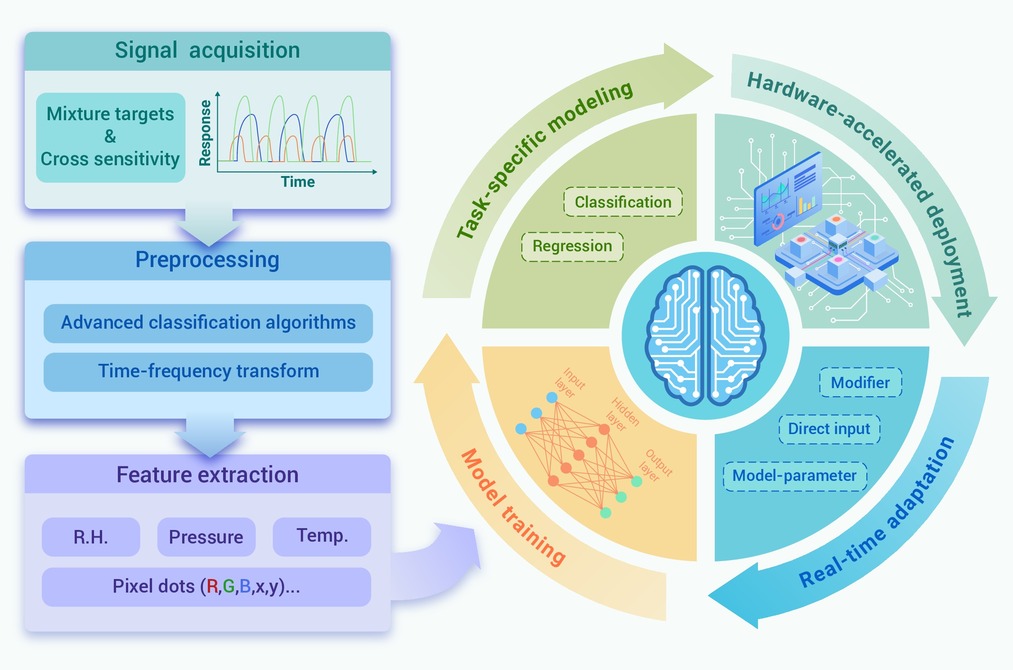
Figure 1.
The AI-enabled gas sensor data processing pipeline, which encompasses signal acquisition, preprocessing, feature extraction, model training, task-specific modeling for classification and regression, hardware-accelerated deployment and real-time adaptation.
-
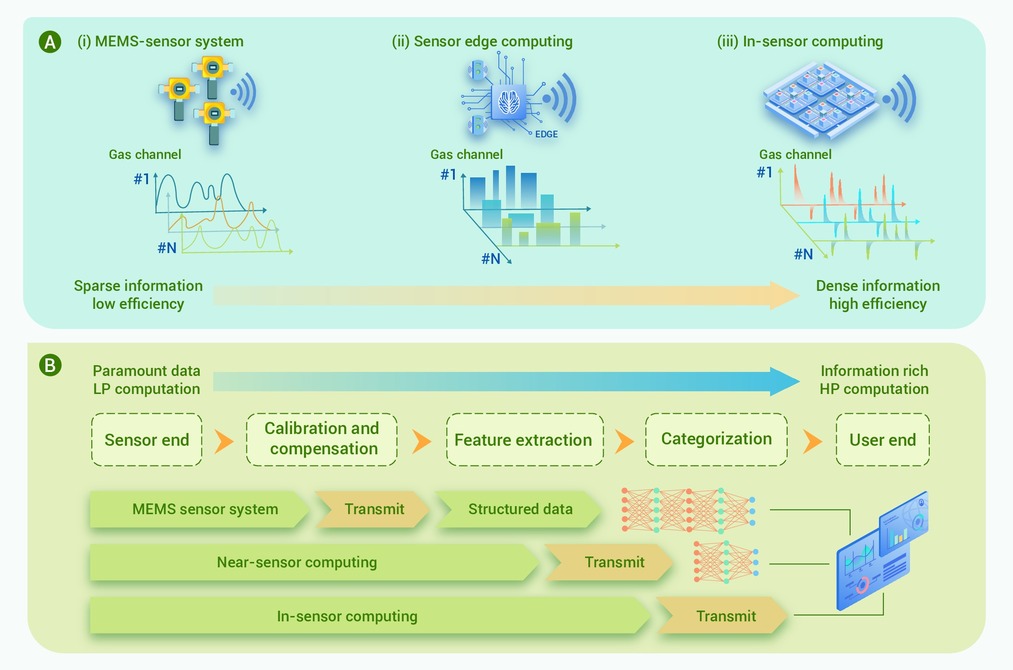
Figure 2.
Mixture-gas sensing systems embedded with AI computing
-
Figure 3.
The conceptual framework of AI-driven intelligent gas sensing applications, illustrating their deployment across environmental monitoring (A),109 energy safety (B),110 agriculture (C),111 and healthcare (D).104
-
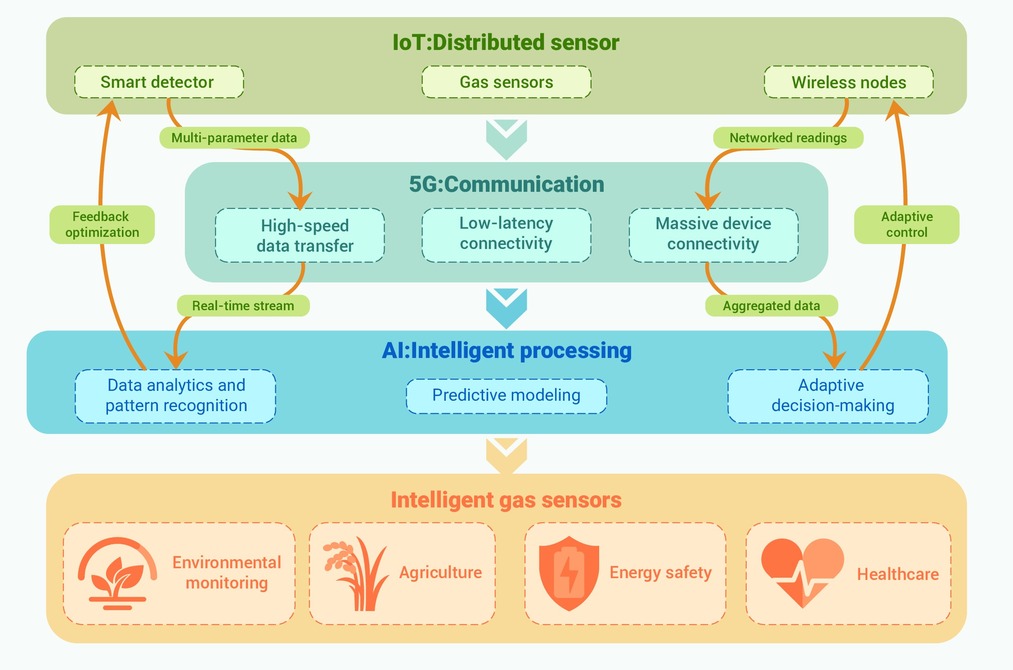
Figure 4.
Development trends of AI-empowered gas sensing systems integrated with IoT, edge computing, and 5G.
