
-
ABSTRACT
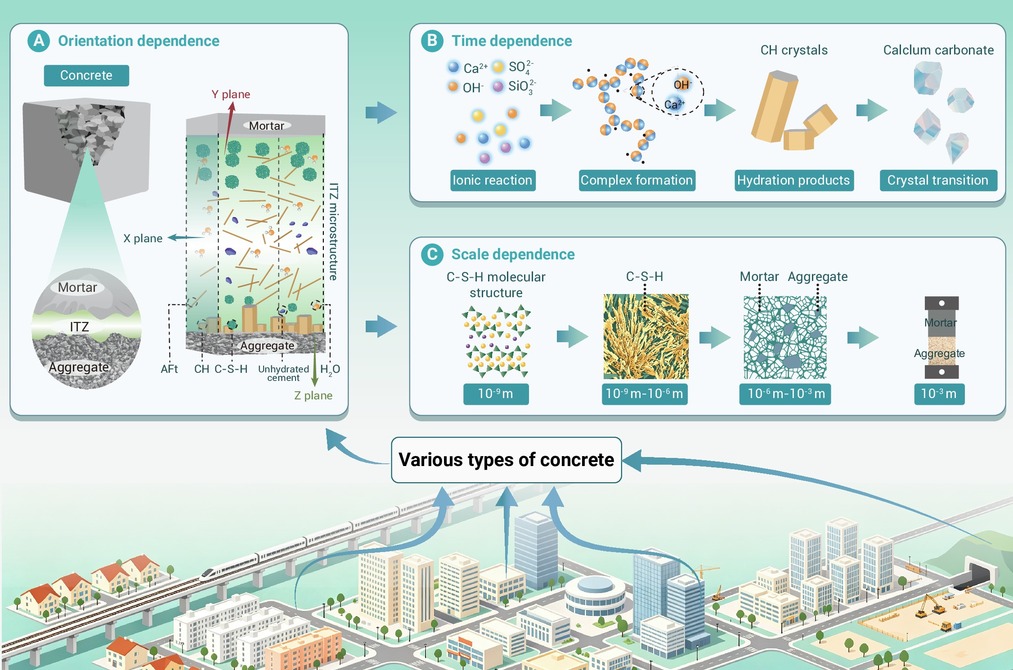
Despite two centuries of engineering success, concrete still lacks a unified scientific theory. The failure of concrete is often traced to the interfacial transition zone (ITZ), a region that governs the mechanical behaviour of concrete yet whose own properties remain incompletely understood. We identify three fundamental dependencies, namely orientation, time, and scale, that should be resolved to establish an interface mechanics in concrete. -

-
REFERENCES
[1] Xiao J., Zhou S., Poon C. S. et al. (2025). How to make concrete sustainable. Nature 638:888–890. DOI: 10.1038/d41586-025-00568-4 [2] Xiao J., Yu C., Wang B. et al. (2026). Recycled aggregate concrete design, application and challenges. Nat. Rev. Clean Technol. 2:67–83. DOI: 10.1038/s44359-025-00125-2 [3] Luo Z., Li W., Wang K., Castel A. et al. (2021). Comparison on the properties of ITZs in fly ash-based geopolymer and Portland cement concretes with equivalent flowability. Cement Concrete Res. 143:106392. DOI: 10.1016/j.cemconres.2021.106392 [4] Karen L. S., Alison K. C. and Peter L. (2004). The interfacial transition zone (ITZ) between cement paste and aggregate in concrete. Interf. Sci. 12:411−421. DOI:10.1023/B:INTS.0000042339.92990.4c [5] Gao X., Liu Q., Cai Y. et al. (2025). A new model for investigating the formation of interfacial transition zone in cement-based materials. Cement Concrete Res. 187:107675. DOI: 10.1016/j.cemconres.2024.107675 [6] Liu F., Wang B., Li X., et al. (2026). Hydration time-dependent evolution of interfacial micromechanical behavior between magnesium potassium phosphate cement and cement concrete. Cement Concrete Comp. 166:106362. DOI: 10.1016/j.cemconcomp.2025.106362 [7] Gan Y., Zhang H., Liang M. et al. (2022). Flexural strength and fatigue properties of interfacial transition zone at the microscale. Cement Concrete Comp. 133:104717. DOI: 10.1016/j.cemconcomp.2022.104717 [8] Fang G. and Zhang M. (2020). The evolution of interfacial transition zone in alkali-activated fly ash-slag concrete. Cement Concrete Res. 129:105963. DOI: 10.1016/j.cemconres.2019.105963 [9] Aranda M. A. G., De la Torre A. G., Bernal S. A. et al. (2026). Insights into the nano- and microstructures of cementitious materials using synchrotron X-rays. Cement Concrete Res. 202:108150. DOI: 10.1016/j.cemconres.2026.108150 [10] Figueiredo R. B., Kawasaki M. and Langdon T. G. (2023). Seventy years of Hall-Petch, ninety years of superplasticity and a generalized approach to the effect of grain size on flow stress. Prog. Mater. Sci. 137:101131. DOI:10.1016/j.pmatsci.2023.101131 -
ABOUT THIS ARTICLE
Cite this article:
Xiao J., Yu C., Sun Z., et al. (2026). Towards a unified interface mechanics of concrete. The Innovation Insights 1:100013. https://doi.org/10.59717/j.tiis.2026.100013
Welcome!
To request copyright permission to republish or share portions of our works, please visit Copyright Clearance Center's (CCC) Marketplace website at marketplace.copyright.com.
Export File
Citation
Xiao J., Yu C., Sun Z., et al. (2026). Towards a unified interface mechanics of concrete. The Innovation Insights 1:100013. https://doi.org/10.59717/j.tiis.2026.100013

Format
Content
 DownLoad:
-
Figure 1.
Theoretical framework of interface mechanics in concrete.
